Banner Naumann 171
Watch:
Starting price: € 160
B.P.: 18.90%
Closing on: 2026-08-02 16:00:00 Roma time
Watch:
Starting price: € 160
Current bid: € 160
B.P.: 18.90%
Closing on: 2026-08-02 16:00:00 Roma time
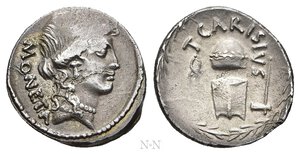
Lot # 368 - T. CARISIUS. Denarius (46 BC). Rome. Obv: MONETA. Head of Juno Moneta right.Rev: T CARISIVS. Implements for coining money: anvil die with punch die above, tongs and hammer; all within laurel wreath.Crawford 464/2; RBW 1614.This type of reverse is one of the rare depictions from the ancient world of the tools used to mint coins. The process of coin minting remained essentially unchanged from antiquity until the dawn of the modern age, when machinery finally appeared. Yet no detailed descriptions have been handed down by classical authors, which makes the images found on frescoes and on coins such as this one particularly valuable. On the reverse are depicted the essential tools typical of ancient mint workshops. At the centre stands a sturdy cylindrical anvil, into the upper surface of which the obverse die was set. The conical object above the anvil, decorated with a garland, may represent the reverse die, also known as the 'hammer die', as it received the direct blow of the hammer to impress the image onto the metal flan. The reverse die, therefore, was a loose element, placed on the anvil each time before striking a new flan. It should be noted, however, that according to some interpretations the object may instead evoke a pileus, the characteristic headgear of Vulcan, the god‑smith. On either side of the anvil are shown a hammer and a pair of tongs, used to place the heated metal flan onto the anvil. This task was entrusted to the 'suppostores', while those in charge of the hammer were called 'malliatores', and with their blow they impressed the images on both faces of the coin. In the Republican period, the Roman mint was located in the sanctuary on the Capitoline Hill dedicated to Juno Moneta, the deity depicted on the obverse and clearly identified by the legend. The epithet Moneta, meaning 'she who warns', appears to have been common for goddesses protecting the city’s acropolis, and her cult, particularly ancient, may date back to the late sixth century BC. Condition: Very fine.Weight: 3.67 g. Diameter: 20 mm.Estimate: € 100
Watch:
Starting price: € 80
B.P.: 18.90%
Closing on: 2026-08-02 16:00:00 Roma time
Watch:
Starting price: € 40
B.P.: 18.90%
Closing on: 2026-08-02 16:00:00 Roma time
Watch:
Starting price: € 80
B.P.: 18.90%
Closing on: 2026-08-02 16:00:00 Roma time
Watch:
Starting price: € 80
B.P.: 18.90%
Closing on: 2026-08-02 16:00:00 Roma time
Watch:
Starting price: € 160
B.P.: 18.90%
Closing on: 2026-08-02 16:00:00 Roma time
Watch:
Starting price: € 80
B.P.: 18.90%
Closing on: 2026-08-02 16:00:00 Roma time
Watch:
Starting price: € 160
B.P.: 18.90%
Closing on: 2026-08-02 16:00:00 Roma time
Watch:
Starting price: € 80
B.P.: 18.90%
Closing on: 2026-08-02 16:00:00 Roma time
Watch:
Starting price: € 80
B.P.: 18.90%
Closing on: 2026-08-02 16:00:00 Roma time
Watch:
Starting price: € 160
B.P.: 18.90%
Closing on: 2026-08-02 16:00:00 Roma time
Watch:
Starting price: € 80
B.P.: 18.90%
Closing on: 2026-08-02 16:00:00 Roma time
Europa Abducted by Zeus
Lot # 379 - L. VALERIUS ACISCULUS. Denarius (45 BC). Rome. Obv: ACISCVLVS. Diademed head of Apollo right; star above, acisculus (double-headed ax) to left.Rev: L VALERIVS. Europa, holding billowing veil, seated on bull trotting right.Crawford 474/1a; CRI 90.In Greek mythology, the bull is generally associated with river deities, who were depicted with horns; with Poseidon (the black bull), with Dionysus, and with divine youths born with horns, such as Zagreus, and above all with Zeus (the white bull). In this form, the lord of the gods seduced Europa, and it was said that he had been raised on the island of Crete. Europa was the only daughter among the otherwise entirely male offspring of Agenor and Telephassa. Zeus fell in love with her and abducted her on the beach, after attracting her attention while disguised as a pure white bull, unusually gentle and willing to be caressed by the ‘broad-faced’ maiden (this is the meaning of the name Europa, probably referring to the full moon). With the terrified girl on his back, he swam to Crete, where he transformed into an eagle and raped her in a grove of willows or plane trees. Her brothers, following the orders of their inconsolable father, searched for her everywhere, encountering various adventures. From the union of Zeus and Europa began the royal dynasty of Crete, as Europa bore him Minos, Rhadamanthus and Sarpedon. In myths and stories connected with Crete, the image of the bull appears repeatedly. Here Minos, the natural son of Zeus, asked the gods to legitimise his succession to the throne by sending him a bull. The animal that rose from the waters off the island, with powerful limbs and a gleaming white coat, was so beautiful that Minos refused to sacrifice it to Poseidon, as he had promised. Instead, he sent it to graze with his own herd and sacrificed another in its place. Condition: Near extremely fine.Weight: 4.06 g. Diameter: 19 mm.Estimate: € 250
Watch:
Starting price: € 200
Current bid: € 200
B.P.: 18.90%
Closing on: 2026-08-02 16:00:00 Roma time
Watch:
Starting price: € 160
Current bid: € 160
B.P.: 18.90%
Closing on: 2026-08-02 16:00:00 Roma time
Watch:
Starting price: € 80
B.P.: 18.90%
Closing on: 2026-08-02 16:00:00 Roma time
Watch:
Starting price: € 160
B.P.: 18.90%
Closing on: 2026-08-02 16:00:00 Roma time
Watch:
Starting price: € 40
B.P.: 18.90%
Closing on: 2026-08-02 16:00:00 Roma time
Watch:
Starting price: € 40
B.P.: 18.90%
Closing on: 2026-08-02 16:00:00 Roma time
Watch:
Starting price: € 80
B.P.: 18.90%
Closing on: 2026-08-02 16:00:00 Roma time
Watch:
Starting price: € 80
B.P.: 18.90%
Closing on: 2026-08-02 16:00:00 Roma time
Watch:
Starting price: € 80
Current bid: € 80
B.P.: 18.90%
Closing on: 2026-08-02 16:00:00 Roma time
Watch:
Starting price: € 40
B.P.: 18.90%
Closing on: 2026-08-02 16:00:00 Roma time
Watch:
Starting price: € 400
B.P.: 18.90%
Closing on: 2026-08-02 16:00:00 Roma time
Watch:
Starting price: € 80
B.P.: 18.90%
Closing on: 2026-08-02 16:00:00 Roma time
Watch:
Starting price: € 80
B.P.: 18.90%
Closing on: 2026-08-02 16:00:00 Roma time
Watch:
Starting price: € 400
Current bid: € 400
B.P.: 18.90%
Closing on: 2026-08-02 16:00:00 Roma time
Watch:
Starting price: € 80
Current bid: € 80
B.P.: 18.90%
Closing on: 2026-08-02 16:00:00 Roma time
Temple of Divus Julius Caesar
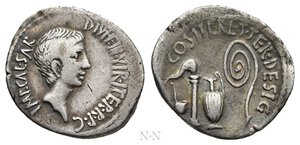
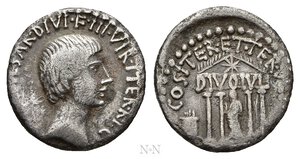
Lot # 394 - OCTAVIAN. Denarius (36 BC). Mint in central or southern Italy. Obv: IMP CAESAR DIVI F III VIR ITER R P C. Bare head right.Rev: COS ITER ET TER DESIG. Tetrastyle temple, containing veiled and togate statue of Julius Caesar holding lituus; in pediment, star; on architrave, inscription DIVO IVL; in left field, lighted altar.Crawford 540/2; CRI 315; RBW 1829.The Temple of Caesar, or Temple of the Divine Julius, commemorating the imperator who died tragically and prematurely in a conspiracy, was built by his successor Octavian in the Forum of Caesar. It closed the eastern side of the Forum Square, framed by Augustus’ triumphal arch celebrating his victory over the Parthians and by the portico of the Arch of Gaius and Lucius Caesar. Today, only the massive central section of the podium remains. The temple stood on a podium with two lateral stairways and a circular altar between them, marking the place where Caesar’s body was cremated. Inside the cella stood a statue of Caesar crowned with a star, recalling the comet that appeared after his death and was interpreted as a divine sign announcing his reception among the gods. Ancient sources recount that, after his assassination in Pompey’s Curia at Largo Argentina, Caesar’s body was taken to the Roman Forum for cremation, and a marble column inscribed Parenti Patriae ('to the father of the fatherland') was erected on the spot. A few weeks later, the consul Dolabella had the column and altar removed and paved over the area. In 42 BC, however, the triumvirs Octavian, Antony and Lepidus, determined to avenge Caesar and honour him for posterity, decreed that a temple should be built on that very site. Civil wars delayed the project, and only twelve years later was the temple finally dedicated by Augustus, now sole ruler and emperor. It was Augustus who introduced the eastern custom of deifying rulers after death. The temple was dedicated to Caesar on 10 August 29 BC. The temple appears on this coin of Octavian, where one can recognise the statue of Caesar holding the augural lituus, the depicted comet, and, in front of the portico, a round altar. The entire structure was framed at the back and along the sides by a portico, the Porticus Iulia, while in front of the pronaos stood one of the Forum’s speaker platforms, the rostra ad Divi Julii, decorated with the ship prows taken from Antony and Cleopatra’s fleet after their defeat at Actium in 31 BC. This tribune was often mentioned in connection with funerary ceremonies for members of the imperial family, and coins of Hadrian recall an address he delivered before the temple. Under Septimius Severus the temple was damaged by fire, possibly together with the Regia and the House of the Vestals; yet it was promptly restored and survived until the decline of the pagan cult. Condition: Good fine.Weight: 3.50 g. Diameter: 18 mm.Estimate: € 100
Watch:
Starting price: € 80
B.P.: 18.90%
Closing on: 2026-08-02 16:00:00 Roma time
Watch:
Starting price: € 80
Current bid: € 80
B.P.: 18.90%
Closing on: 2026-08-02 16:00:00 Roma time
Watch:
Starting price: € 200
B.P.: 18.90%
Closing on: 2026-08-02 16:00:00 Roma time
Watch:
Starting price: € 200
B.P.: 18.90%
Closing on: 2026-08-02 16:00:00 Roma time
Watch:
Starting price: € 80
B.P.: 18.90%
Closing on: 2026-08-02 16:00:00 Roma time
Watch:
Starting price: € 80
B.P.: 18.90%
Closing on: 2026-08-02 16:00:00 Roma time
Watch:
Starting price: € 80
B.P.: 18.90%
Closing on: 2026-08-02 16:00:00 Roma time
Watch:
Starting price: € 80
B.P.: 18.90%
Closing on: 2026-08-02 16:00:00 Roma time
Watch:
Starting price: € 40
B.P.: 18.90%
Closing on: 2026-08-02 16:00:00 Roma time