Banner Naumann 171
Watch:
Starting price: € 80
B.P.: 18.90%
Closing on: 2026-08-02 16:00:00 Roma time
Watch:
Starting price: € 160
B.P.: 18.90%
Closing on: 2026-08-02 16:00:00 Roma time
Watch:
Starting price: € 240
B.P.: 18.90%
Closing on: 2026-08-02 16:00:00 Roma time
Watch:
Starting price: € 280
B.P.: 18.90%
Closing on: 2026-08-02 16:00:00 Roma time
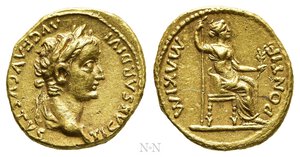
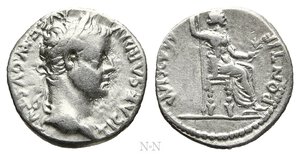
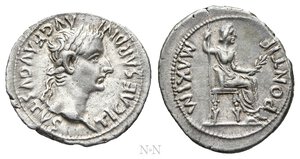
Lot # 425 - TIBERIUS (14-37). GOLD Aureus. "Tribute Penny" type. Lugdunum. Obv: TI CAESAR DIVI AVG F AVGVSTVS. Laureate head right.Rev: PONTIF MAXIM. Livia (as Pax) seated right on throne, holding sceptre and olive branch.RIC² 29; Calicó 305a.Ex Heritage Auctions 3089 (2021), lot 31053. The obverse legend calling Tiberius 'divi filius', son of God (Augustus), is one of the contradictions of what was considered one of the most controversial princes of ancient Rome. In fact, Tiberius was reluctant to accept the succession, more loyal to republican ideals. When he became emperor, he first of all refused the name 'Imperator', which was his by right. He also did not want the prestigious title of 'Father of the State' and apparently despised that of 'Augustus', which he ended up accepting, however, together with the 'imperium maius et infinitum' and the 'tribunicia potestas', which were the foundations of the Republic. He also arranged for the cult of the living emperor to be abolished. All these refusals contributed to the misunderstanding of Tiberius by his contemporaries, who were now attached to the Augustan concept of Empire. Tiberius was the son of Tiberius Claudius Nero, of noble lineage and republican orientation, and Livia Drusilla. His father had sided first with Julius Caesar, then, upon his assassination, with the Caesaricides, to join the revolt against Octavian and fall back south with Sextus Pompey. In 39 B.C. at Misenum, Nero was forced to divorce his wife to give her to Julius Caesar's heir, so Tiberius ended up in Augustus' custody and Livia gained an important political advantage. Tiberius married Vipsania Agrippina, the woman he loved and who bore him a son, Drusus, but was forced by Augustus to divorce and marry his daughter Julia. This was another blow to Tiberius who, disgusted with his new wife and politics, decided to retire to Rhodes, leaving room for Augustus' chosen heirs, Gaius and Lucius Caesar. The two, however, died (AD 2 and 4) and Augustus ended up associating Tiberius himself with the throne, whom he considered to be competent above all in military matters. Condition: Near extremely fine.Weight: 7.78 g. Diameter: 20 mm.Estimate: € 5000
Watch:
Starting price: € 4'000
B.P.: 18.90%
Closing on: 2026-08-02 16:00:00 Roma time
Watch:
Starting price: € 240
Current bid: € 325
B.P.: 18.90%
Closing on: 2026-08-02 16:00:00 Roma time
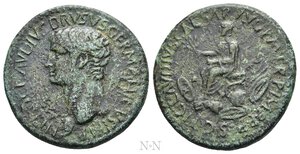
Lot # 427 - NERO CLAUDIUS DRUSUS (Died 9 BC). Sestertius. Rome. Struck under Claudius (41-54). Obv: NERO CLAVDIVS DRVSVS GERMANICVS IMP. Bare head left.Rev: TI CLAVDIVS CAESAR AVG P M TR P IMP P P / S C. Claudius seated left on curule chair, holding branch; spears, shields, cuirass and helmet around.RIC² 93 (Claudius).Nero Claudius Drusus Germanicus was a member of the Julio-Claudian dynasty, son of Augustus' third wife, Livia Drusilla, and younger brother of the future emperor Tiberius. Augustus granted him numerous privileges, allowing him to hold various public offices several years before the age permitted by law. He married Antonia Minor, daughter of Mark Antony and Octavia Minor (sister of Augustus). She bore him several children, including Germanicus and the future emperor Claudius. Drusus is remembered above all as a great Roman general. In 16 BC, he took part in the Rhaetian campaign, defeating the Isarci, Breoni, and Reti tribes and, together with Tiberius, the Vindelici, contributing to the creation of new Roman provinces (Rhaetia and Noricum) in the Alpine region. He was then sent to Transalpine Gaul in 14 BC to build roads and fortified bases along the Rhine. In 13 BC, he successfully commanded military operations against the rebellious tribes of the Rhine. Finally, he took part in campaigns in Germany, where the Romans subjugated Frisi and Batavi. Drusus led the legions in several offensive operations and successfully defended himself against numerous ambushes. Upon his return to Rome in 11 BC, he received triumphal honors and his soldiers conferred on him the title of “imperator.” Back in Germany, his brilliant military career was suddenly interrupted in 9 BC by a fall from his horse. The injury to his femur ultimately led him to death, watched over by Tiberius, who celebrated his funeral. Condition: Very fine; slightly smoothed.Weight: 26.00 g. Diameter: 34 mm.Estimate: € 300
Watch:
Starting price: € 240
B.P.: 18.90%
Closing on: 2026-08-02 16:00:00 Roma time
Watch:
Starting price: € 80
Current bid: € 80
B.P.: 18.90%
Closing on: 2026-08-02 16:00:00 Roma time
Watch:
Starting price: € 3'200
B.P.: 18.90%
Closing on: 2026-08-02 16:00:00 Roma time
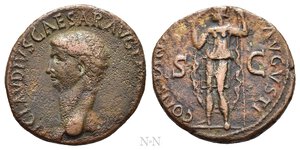
Watch:
Starting price: € 40
B.P.: 18.90%
Closing on: 2026-08-02 16:00:00 Roma time
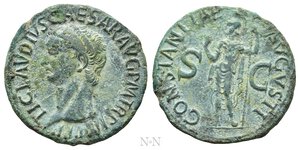
Watch:
Starting price: € 160
B.P.: 18.90%
Closing on: 2026-08-02 16:00:00 Roma time
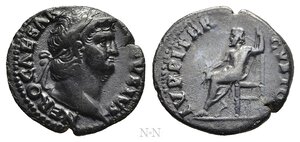
Watch:
Starting price: € 160
Current bid: € 160
B.P.: 18.90%
Closing on: 2026-08-02 16:00:00 Roma time
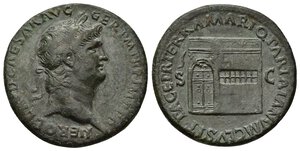
Watch:
Starting price: € 1'600
B.P.: 18.90%
Closing on: 2026-08-02 16:00:00 Roma time
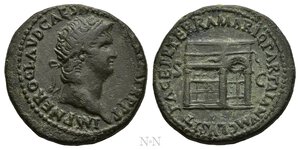
Watch:
Starting price: € 200
Current bid: € 200
B.P.: 18.90%
Closing on: 2026-08-02 16:00:00 Roma time
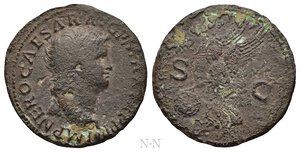
Watch:
Starting price: € 40
B.P.: 18.90%
Closing on: 2026-08-02 16:00:00 Roma time
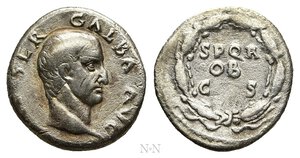
Watch:
Starting price: € 80
Current bid: € 80
B.P.: 18.90%
Closing on: 2026-08-02 16:00:00 Roma time
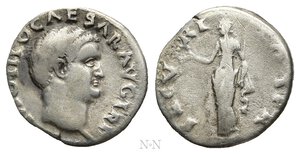
Watch:
Starting price: € 80
Current bid: € 80
B.P.: 18.90%
Closing on: 2026-08-02 16:00:00 Roma time
Watch:
Starting price: € 160
B.P.: 18.90%
Closing on: 2026-08-02 16:00:00 Roma time
Ex Kress 1962
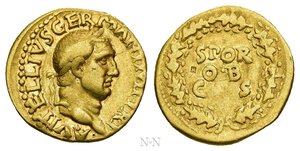
Lot # 439 - VITELLIUS (69). GOLD Aureus. Rome. Obv: A VITELLIVS GERMAN IMP TR P. Laureate head right.Rev: S P Q R/ O•B/ C S. Legend in three lines, all within wreath (corona civica).RIC² 82; Calicó 574.Ex Kress 123 (1962), lot 518a. Vitellius was born in AD 15 and rose to prominence largely thanks to his talent for flattery and for pleasing the emperors. His origins were the subject of conflicting stories, ranging from descent from ancient Italic deities to being the son of a freedman cobbler. After a youth marked by excess, he managed to win favour with Caligula, Claudius and Nero by exploiting their personal passions, and even poisoned his own son out of fear that he was plotting against him. Galba sent him to Lower Germany more to remove him from Rome than out of confidence, yet Vitellius quickly won over the soldiers by granting favours and cancelling punishments. The German legions, encouraged by Valens and Caecina Alienus, proclaimed him emperor and defeated Otho at Bedriacum. Vitellius entered Rome like a triumphator, presented his young son as heir, and declared his intention to found a new dynasty. He replaced the praetorian guard, punished Galba’s killers, and honoured Nero, earning the hostility of senatorial historians. When news arrived that the troops had proclaimed Vespasian, his power collapsed swiftly: the Danubian armies defeated his forces in the second battle of Bedriacum, the Misenum fleet deserted him, and Valens’ attempt to raise new troops failed. In Rome, the Capitoline Hill was set ablaze during the fighting, and Vitellius, after trying to flee, was captured, dragged along the Via Sacra and killed. He suffered damnatio memoriae, and his brother and son died with him. His failure stemmed from the growing strength of provincial armies, the marginal role of the Senate, and his limited military experience, worsened by his choice of collaborators who were openly at odds with one another. Yet Vitellius did show respect for the Senate, allowing his reign to begin only after its ratification and refusing titles he considered too grand for himself. Condition: Near very fine.Weight: 7.22 g. Diameter: 20 mm.Estimate: € 12500
Watch:
Starting price: € 10'000
B.P.: 18.90%
Closing on: 2026-08-02 16:00:00 Roma time
Watch:
Starting price: € 80
Current bid: € 80
B.P.: 18.90%
Closing on: 2026-08-02 16:00:00 Roma time
Bust Variant
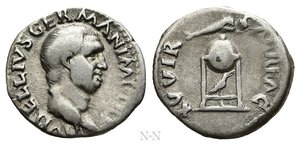
Lot # 441 - VITELLIUS (69). Denarius. Rome. Obv: A VITELLIVS GERMAN IMP TR P. Bare head right.Rev: XV VIR SACR FAC. Tripod, dolphin on top, raven on strut between legs.RIC² 86 var. (head laureate); RSC 112.Very rareVitellius was born in AD 15 and rose to prominence largely thanks to his talent for flattery and for pleasing the emperors. His origins were the subject of conflicting stories, ranging from descent from ancient Italic deities to being the son of a freedman cobbler. After a youth marked by excess, he managed to win favour with Caligula, Claudius and Nero by exploiting their personal passions, and even poisoned his own son out of fear that he was plotting against him. Galba sent him to Lower Germany more to remove him from Rome than out of confidence, yet Vitellius quickly won over the soldiers by granting favours and cancelling punishments. The German legions, encouraged by Valens and Caecina Alienus, proclaimed him emperor and defeated Otho at Bedriacum. Vitellius entered Rome like a triumphator, presented his young son as heir, and declared his intention to found a new dynasty. He replaced the praetorian guard, punished Galba’s killers, and honoured Nero, earning the hostility of senatorial historians. When news arrived that the troops had proclaimed Vespasian, his power collapsed swiftly: the Danubian armies defeated his forces in the second battle of Bedriacum, the Misenum fleet deserted him, and Valens’ attempt to raise new troops failed. In Rome, the Capitoline Hill was set ablaze during the fighting, and Vitellius, after trying to flee, was captured, dragged along the Via Sacra and killed. He suffered damnatio memoriae, and his brother and son died with him. His failure stemmed from the growing strength of provincial armies, the marginal role of the Senate, and his limited military experience, worsened by his choice of collaborators who were openly at odds with one another. Yet Vitellius did show respect for the Senate, allowing his reign to begin only after its ratification and refusing titles he considered too grand for himself. Condition: Near very fine.Weight: 3.20 g. Diameter: 20 mm.Estimate: € 440
Watch:
Starting price: € 352
B.P.: 18.90%
Closing on: 2026-08-02 16:00:00 Roma time
Watch:
Starting price: € 4'000
B.P.: 18.90%
Closing on: 2026-08-02 16:00:00 Roma time
Watch:
Starting price: € 160
B.P.: 18.90%
Closing on: 2026-08-02 16:00:00 Roma time
Watch:
Starting price: € 80
B.P.: 18.90%
Closing on: 2026-08-02 16:00:00 Roma time
Watch:
Starting price: € 160
B.P.: 18.90%
Closing on: 2026-08-02 16:00:00 Roma time
Watch:
Starting price: € 80
Current bid: € 80
B.P.: 18.90%
Closing on: 2026-08-02 16:00:00 Roma time
Watch:
Starting price: € 80
B.P.: 18.90%
Closing on: 2026-08-02 16:00:00 Roma time
Watch:
Starting price: € 400
Current bid: € 400
B.P.: 18.90%
Closing on: 2026-08-02 16:00:00 Roma time
Watch:
Starting price: € 240
B.P.: 18.90%
Closing on: 2026-08-02 16:00:00 Roma time
Watch:
Starting price: € 80
Current bid: € 90
B.P.: 18.90%
Closing on: 2026-08-02 16:00:00 Roma time
Watch:
Starting price: € 80
B.P.: 18.90%
Closing on: 2026-08-02 16:00:00 Roma time
Watch:
Starting price: € 80
Current bid: € 80
B.P.: 18.90%
Closing on: 2026-08-02 16:00:00 Roma time
Watch:
Starting price: € 160
B.P.: 18.90%
Closing on: 2026-08-02 16:00:00 Roma time
Watch:
Starting price: € 160
B.P.: 18.90%
Closing on: 2026-08-02 16:00:00 Roma time
Watch:
Starting price: € 80
Current bid: € 80
B.P.: 18.90%
Closing on: 2026-08-02 16:00:00 Roma time
Watch:
Starting price: € 160
B.P.: 18.90%
Closing on: 2026-08-02 16:00:00 Roma time
Watch:
Starting price: € 40
B.P.: 18.90%
Closing on: 2026-08-02 16:00:00 Roma time
Watch:
Starting price: € 80
B.P.: 18.90%
Closing on: 2026-08-02 16:00:00 Roma time
Watch:
Starting price: € 240
B.P.: 18.90%
Closing on: 2026-08-02 16:00:00 Roma time
Watch:
Starting price: € 160
B.P.: 18.90%
Closing on: 2026-08-02 16:00:00 Roma time
Watch:
Starting price: € 40
Current bid: € 40
B.P.: 18.90%
Closing on: 2026-08-02 16:00:00 Roma time
Watch:
Starting price: € 40
B.P.: 18.90%
Closing on: 2026-08-02 16:00:00 Roma time
Watch:
Starting price: € 40
Current bid: € 80
B.P.: 18.90%
Closing on: 2026-08-02 16:00:00 Roma time
Watch:
Starting price: € 600
B.P.: 18.90%
Closing on: 2026-08-02 16:00:00 Roma time
Watch:
Starting price: € 80
B.P.: 18.90%
Closing on: 2026-08-02 16:00:00 Roma time
Watch:
Starting price: € 200
B.P.: 18.90%
Closing on: 2026-08-02 16:00:00 Roma time
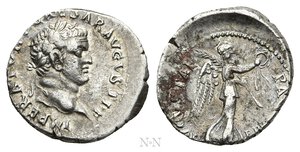
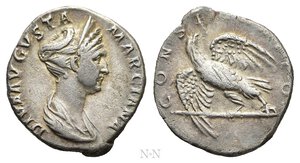
Lot # 467 - DIVA MARCIANA (Died 112/4). Denarius. Rome. Obv: DIVA AVGVSTA MARCIANA. Draped bust right, wearing stephane.Rev: CONSECRATIO. Eagle standing left, head right, wings spread.Woytek 719; RIC 743.The eldest daughter of the senator Marcus Ulpius Trajan and of Marcia, therefore Trajan's elder sister, she inherited her middle name, Marciana, from her mother's paternal ancestors. She married around 63 Gaius Saloninus Matidius Patricius, a very wealthy man, praetor and member of the religious college of the Arvales. From him Ulpia had a daughter Salonina Matidia. After Saloninus' death, Marciana did not remarry, although she had many pretenders due to her prestigious relationship with the emperor and her beauty. However, Trajan respected her wishes and never forced her to remarry. Her daughter Matidia instead married first a Matidius, then Lucius Vibius Sabinus, from a consular family, and from this marriage was born Vibia Sabina, future wife of Hadrian. When Vibius Sabinus died in 84 or 87, Ulpia Marciana with her daughter and granddaughters went to live in the family home of Trajan and his wife Plotina, and later in the palace. After 105 she was elevated to the rank of Augusta by her brother, the first sister of an emperor to receive this title. Although she was initially reticent, she was finally convinced by Plotina and first appeared on coins and depicted by statues. Her portrait is known for its complicated hairstyle with a high diadem. Marciana often travelled with Trajan, who considered her a trusted advisor and often asked her opinion on decisions. He also dedicated two cities to her, Colonia Marciana in Africa, and Marcianopolis in Moesia. She died between 112 and 114, when she was deified at the behest of Trajan, along with their father Marcus Ulpius Trajan. Condition: Very fine.Weight: 3.20 g. Diameter: 20 mm.Estimate: € 1000
Watch:
Starting price: € 800
B.P.: 18.90%
Closing on: 2026-08-02 16:00:00 Roma time
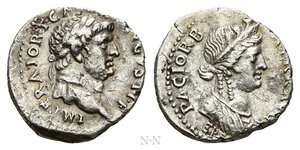
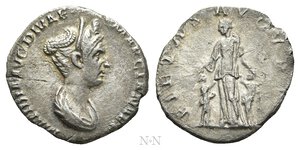
Lot # 468 - MATIDIA (Augusta, 112-119). Denarius. Rome. Obv: MATIDIA AVG DIVAE MARCIANAE F. Diademed and draped bust right.Rev: PIETAS AVGVST. Pietas standing facing, head left, placing hands on heads of two children, Sabina and Matidia, to left and right.Woytek 729; RIC 759 (Trajan).RareSalonia Matidia was born in AD 68 and was the only daughter of praetor Gaius Salonius Matidius Patruinus and Ulpia Marciana (mentioned in the obverse legend of this coin), the sister of the future emperor Trajan. She married at the age of 13-14 to Lucius Vibius Sabinus, from a powerful family of consular rank. In 83 AD a daughter, Vibia Sabina, the future wife of Emperor Hadrian, was born and her husband died. Matidia married twice more and had three more daughters, including the future grandmother of Marcus Aurelius, Rupilia Faustina. But her other two husbands also soon died. She made her home a literary salon, full of cultured people, and loved palace life, advising the emperor Trajan, and often following him to the battlefields to support him. She is also said to have had a good understanding with the emperor's wife, Plotina, with whom she worked to secure a worthy successor to the throne, opting for Hadrian, who married his daughter Vibia. It is unclear what happened when Trajan died, having fallen ill in Cilicia during the campaign against the Parthians. Hadrian's adoption, according to the historian Cassius Dio, was announced to the Roman Senate with a false letter from Trajan, actually written by Plotina. Hadrian however kept both women close and allowed Matidia to assist him until she died in 119 AD. At her death the emperor granted her a touching eulogy and organised spectacular gladiatorial games, and finally deified her by having a temple built in Rome. Condition: Near very fine.Weight: 2.73 g. Diameter: 20 mm.Estimate: € 1000
Watch:
Starting price: € 800
B.P.: 18.90%
Closing on: 2026-08-02 16:00:00 Roma time
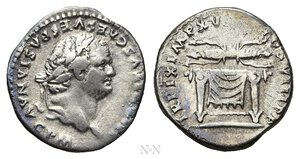
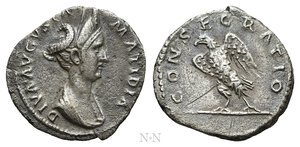
Lot # 469 - DIVA MATIDIA (Died 119). Denarius. Rome. Obv: DIVA AVGVSTA MATIDIA. Diademed and draped bust right.Rev: CONSECRATIO. Eagle standing left on sceptre, with wings displayed.RIC² 2462 (Hadrian).RareSalonia Matidia was born in AD 68 and was the only daughter of praetor Gaius Salonius Matidius Patruinus and Ulpia Marciana (mentioned in the obverse legend of this coin), the sister of the future emperor Trajan. She married at the age of 13-14 to Lucius Vibius Sabinus, from a powerful family of consular rank. In 83 AD a daughter, Vibia Sabina, the future wife of Emperor Hadrian, was born and her husband died. Matidia married twice more and had three more daughters, including the future grandmother of Marcus Aurelius, Rupilia Faustina. But her other two husbands also soon died. She made her home a literary salon, full of cultured people, and loved palace life, advising the emperor Trajan, and often following him to the battlefields to support him. She is also said to have had a good understanding with the emperor's wife, Plotina, with whom she worked to secure a worthy successor to the throne, opting for Hadrian, who married his daughter Vibia. It is unclear what happened when Trajan died, having fallen ill in Cilicia during the campaign against the Parthians. Hadrian's adoption, according to the historian Cassius Dio, was announced to the Roman Senate with a false letter from Trajan, actually written by Plotina. Hadrian however kept both women close and allowed Matidia to assist him until she died in 119 AD. At her death the emperor granted her a touching eulogy and organised spectacular gladiatorial games, and finally deified her by having a temple built in Rome. Condition: Near very fine.Weight: 3.00 g. Diameter: 19 mm.Estimate: € 1000
Watch:
Starting price: € 800
B.P.: 18.90%
Closing on: 2026-08-02 16:00:00 Roma time
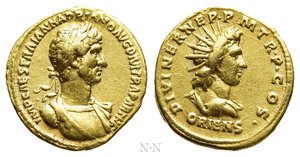
Lot # 470 - HADRIAN (117-183). GOLD Aureus. Rome. Obv: IMP CAES TRAIAN HADRIANO AVG DIVI TRA PARTH F. Laureate and cuirassed bust right, with balteus strap.Rev: DIVI NER NEP P M TR P COS / ORIENS. Radiate and draped bust of Sol right.RIC² 50; Calicó 1293.Ex Stack's Bowers The January 2020 NYINC (2020), lot 20108. Hadrian was born in Italica or Rome in 76 AD to an influential family; his grandfather had been a member of the senate. Having soon been orphaned, Hadrian was entrusted to his cousin Trajan, who acted as his tutor and granted him in marriage one of his great-granddaughters, Sabina, in 100 AD. It was therefore quite natural that on Trajan's death Hadrian should succeed him, although he had never adopted him. In fact at the prince's death the senate received letters from Trajan mentioning Hadrian's adoption, but according to Cassius Dio they were signed by his widow Plotina. Probably Lucius Licinius Sura, his future and greatest general, also made great efforts for Trajan to consider Hadrian's candidacy. Hadrian is remembered as a literate monarch, a lover of Greek letters and neosophistic philosophy. The new emperor had a very different political conception from that of his predecessor, beginning with the renouncing of the expansionism so much desired by Trajan in order to focus more on the defense of imperial borders, as evidenced by the construction of Hadrian's Wall. His reign was also marked by the travels he embarked on between 121 and 132, a way of learning about and expressing respect for every corner of the empire. Indeed, he visited numerous regions and garrisons, reserving special interest for the armies and the discipline of the soldiers. Despite his efforts to avoid any armed conflict, Hadrian had to deal with a Jewish revolt that erupted because he had renamed Jerusalem as the Colonia Aelia Capitolina, after his family name, for having a temple dedicated to Jupiter Capitolinus erected there and for forbidding circumcision, a custom he perceived as barbaric, despite not being hostile to Judaism. The revolt was very bloody and led by Simon bar Kochba, who lost his life in the last battle. In internal politics Hadrian gave his best, eliminating unnecessary expenses and undertaking magnificent public works, not only in Rome. He also asked his jurists to collect all edicts that would ensure greater justice for the weaker, but went to the disadvantage of the Senate, which responded with conspiracies. Hadrian managed to escape these attempts and sent all the conspirators to death, earning himself a very bad reputation. For this he publicly apologized and engaged in a series of food concessions to the people, forgave a huge amount of debt, and promised not to use any more violence against the senators. Promise that he did not keep, however, as a result of further conspiracy attempts. In 136 he designated Lucius Aelius Caesar as his successor, but he died two years later. Hadrian, having failed to have children by Sabina, was thus forced to adopt Antoninus Pius, asking him to adopt in turn two other young men, Marcus Aurelius and Lucius Verus, son of the late Aelius. He died in 138 after a long and painful illness. Condition: Very fine.Weight: 7.18 g. Diameter: 20 mm.Estimate: € 3000
Watch:
Starting price: € 2'400
Current bid: € 2'600
B.P.: 18.90%
Closing on: 2026-08-02 16:00:00 Roma time
Watch:
Starting price: € 40
B.P.: 18.90%
Closing on: 2026-08-02 16:00:00 Roma time
Watch:
Starting price: € 160
B.P.: 18.90%
Closing on: 2026-08-02 16:00:00 Roma time
Watch:
Starting price: € 80
B.P.: 18.90%
Closing on: 2026-08-02 16:00:00 Roma time
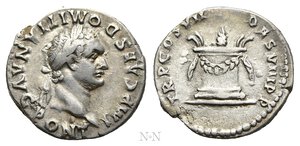
Watch:
Starting price: € 200
Current bid: € 451
B.P.: 18.90%
Closing on: 2026-08-02 16:00:00 Roma time
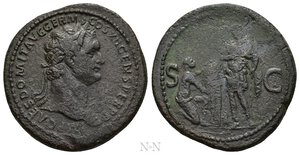
Watch:
Starting price: € 40
B.P.: 18.90%
Closing on: 2026-08-02 16:00:00 Roma time
Watch:
Starting price: € 40
B.P.: 18.90%
Closing on: 2026-08-02 16:00:00 Roma time
Watch:
Starting price: € 640
B.P.: 18.90%
Closing on: 2026-08-02 16:00:00 Roma time
Watch:
Starting price: € 400
B.P.: 18.90%
Closing on: 2026-08-02 16:00:00 Roma time
Watch:
Starting price: € 80
B.P.: 18.90%
Closing on: 2026-08-02 16:00:00 Roma time
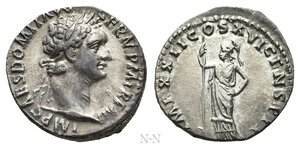
Watch:
Starting price: € 80
Current bid: € 80
B.P.: 18.90%
Closing on: 2026-08-02 16:00:00 Roma time