Banner Astarte XXIII
Risultati: 42
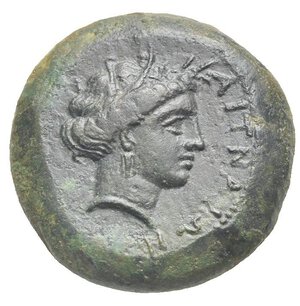
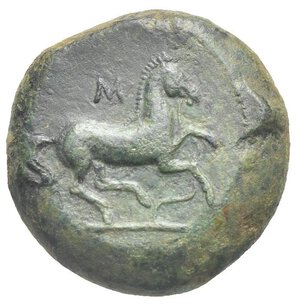
Sicily. Aitna. Circa 355-339 BC. Tetras (Bronze, 18.85 mm, 7.67 g). ΑΙΤΝΑΙΩΝ Wreathed head of Kore to right, wearing triple-pendant earring. Rev. Horse prancing to right with loose bridles; above, M. Calciati, CNS III, 145, 3. Campana, CNAI II, 55, 5a. SNG Morcom 507. SNG ANS 1158. HGC 2, 74. Green patina. Sharp details. Extremely Fine. - Sicily. Aitna. Circa 355-339 BC. Tetras (Bronze, 18.85 mm, 7.67 g). ΑΙΤΝΑΙΩΝ Wreathed head of Kore to right, wearing triple-pendant earring. Rev. Horse prancing to right with loose bridles; above, M. Calciati, CNS III, 145, 3. Campana, CNAI II, 55, 5a. SNG Morcom 507. SNG ANS 1158. HGC 2, 74. Green patina. Sharp details. Extremely Fine.
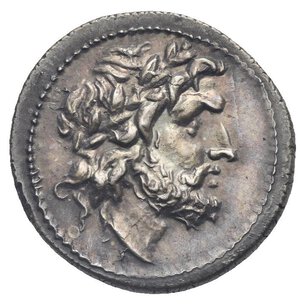
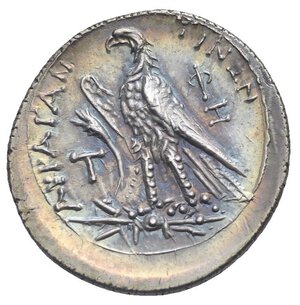
Sicily. Akragas. Punic occupation. Circa 231-210 BC. Punic Half-Shekel (Silver, 19.59 mm, 3.46 g) Laureate head of Zeus right. Rev. ΑΚΡΑΓΑΝ ΤΙΝΩΝ Eagle standing left on thunderbolt; on the left, ear of grain and T; on the right, Φ above I. Burnett, SNR 62, p. 6. AMB 272 (these dies). SNG ANS 1136. Manganaro, JNG 1982, pl. 12, n. 40 (this coin). An impressive coin, boldly struck in high relief and and with beautiful iridescent toning. Extremely Fine. Very rare. Ex F. Sternberg XIII, 17 November 1983, lot 76. - Sicily. Akragas. Punic occupation. Circa 231-210 BC. Punic Half-Shekel (Silver, 19.59 mm, 3.46 g) Laureate head of Zeus right. Rev. ΑΚΡΑΓΑΝ ΤΙΝΩΝ Eagle standing left on thunderbolt; on the left, ear of grain and T; on the right, Φ above I. Burnett, SNR 62, p. 6. AMB 272 (these dies). SNG ANS 1136. Manganaro, JNG 1982, pl. 12, n. 40 (this coin). An impressive coin, boldly struck in high relief and and with beautiful iridescent toning. Extremely Fine. Very rare. Ex F. Sternberg XIII, 17 November 1983, lot 76.
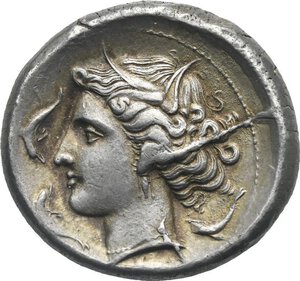
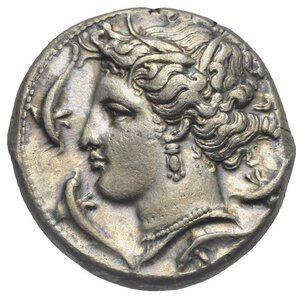
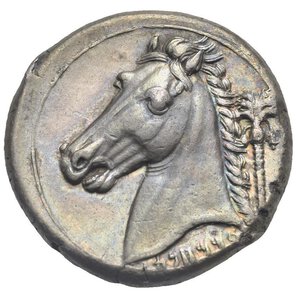
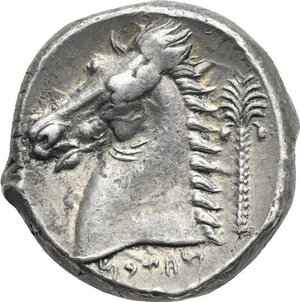
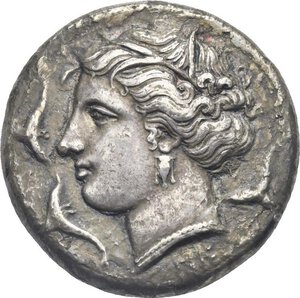
Sicily. Entella, Punic occupation. Circa 320-300 BC. Tetradrachm (Silver, 26.05 mm, 16.87 g). Head of Nymph left, wearing reed wreath; four dolphins swimming around. Rev. MMHNT ("People of the Camp" in Punic), horse head left; on the right, palm tree. Jenkins, Coins of Punic Sicily, Part IV, 145-152 var. CNP 267. Bar Issue 4. SNG Lloyd 1631 (same obv. die). De Luynes 1458 (same obv. die). HGC 2, 284. Lightly toned. Good Very Fine. Ex Classical Numismatic Group 72, 14 June 2006, lot 179. - Sicily. Entella, Punic occupation. Circa 320-300 BC. Tetradrachm (Silver, 26.05 mm, 16.87 g). Head of Nymph left, wearing reed wreath; four dolphins swimming around. Rev. MMHNT ("People of the Camp" in Punic), horse head left; on the right, palm tree. Jenkins, Coins of Punic Sicily, Part IV, 145-152 var. CNP 267. Bar Issue 4. SNG Lloyd 1631 (same obv. die). De Luynes 1458 (same obv. die). HGC 2, 284. Lightly toned. Good Very Fine. Ex Classical Numismatic Group 72, 14 June 2006, lot 179.
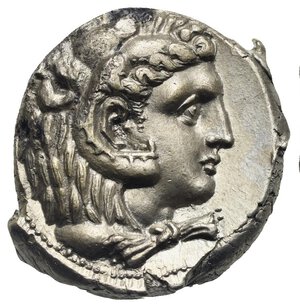
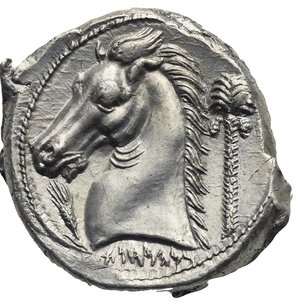
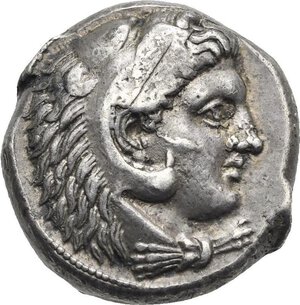
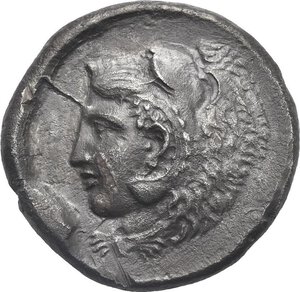
Sicily. Entella, Punic occupation. Circa 300-289 BC. Tetradrachm (Silver, 24.38 mm, 16.44 g). Head of Herakles right, wearing lion skin headdress. Rev. MHMHNT ("People of the Camp" in Punic), horse head left; on the right, palm tree; before, ear of grain. Jenkins, Coins of Punic Sicily, Part IV, 289 (O92/R237). Hunter 13. SNG Lloyd 1654. HGC 2, 293. Nicely toned, with oxides on obverse. Interesting flan. Good Extremely Fine. From a Swiss collection in Ticino, formed before 2005. - Sicily. Entella, Punic occupation. Circa 300-289 BC. Tetradrachm (Silver, 24.38 mm, 16.44 g). Head of Herakles right, wearing lion skin headdress. Rev. MHMHNT ("People of the Camp" in Punic), horse head left; on the right, palm tree; before, ear of grain. Jenkins, Coins of Punic Sicily, Part IV, 289 (O92/R237). Hunter 13. SNG Lloyd 1654. HGC 2, 293. Nicely toned, with oxides on obverse. Interesting flan. Good Extremely Fine. From a Swiss collection in Ticino, formed before 2005.
Sicily. Entella, Punic occupation. Circa 300-289 BC. Tetradrachm (Silver, 22.88 mm, 17.01 g). Head of Herakles right, wearing lion skin headdress. Rev. MHSBM ("Paymasters" in Punic) Horse head left; on the right, palm tree. Jenkins, Coins of Punic Sicily, Part IV, 375 (0116/R305), see pp. 7-8 for interpretation of legend; de Luynes 1457; CNP 272; HGC 2, 295. Extremely Fine; Cabinet tone. Die break at nose on obverse and a scratch. Good Very Fine/About Extremely Fine. From the Arethusa Collection, Roma Numismatics 27, 22 March 2023, lot 77 and from Amilcare Collection, Roma Numismatics Ltd., E-Sale 67, 6 February 2020, lot 88. - Sicily. Entella, Punic occupation. Circa 300-289 BC. Tetradrachm (Silver, 22.88 mm, 17.01 g). Head of Herakles right, wearing lion skin headdress. Rev. MHSBM ("Paymasters" in Punic) Horse head left; on the right, palm tree. Jenkins, Coins of Punic Sicily, Part IV, 375 (0116/R305), see pp. 7-8 for interpretation of legend; de Luynes 1457; CNP 272; HGC 2, 295. Extremely Fine; Cabinet tone. Die break at nose on obverse and a scratch. Good Very Fine/About Extremely Fine. From the Arethusa Collection, Roma Numismatics 27, 22 March 2023, lot 77 and from Amilcare Collection, Roma Numismatics Ltd., E-Sale 67, 6 February 2020, lot 88.
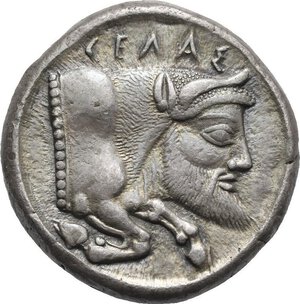
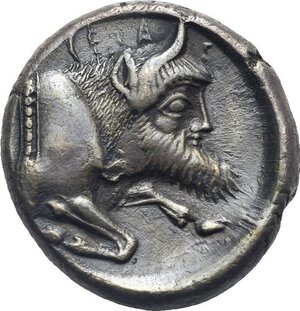
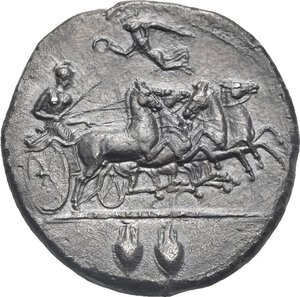
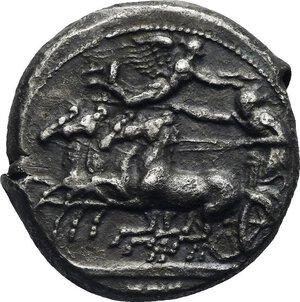
Sicily. Gela. Circa 490-475 BC. Tetradrachm (Silver, 25.07 mm, 17.19 g). Charioteer driving slow biga right, holding kentron and reins; Nike flying above crowning horses. Rev. CEΛΑΣ, forepart of the river-god Gelas right, in the form of a man-headed bull. HGC 2, 338. Jenkins 161.4 (this coin). Delightful cabinet tone. Good Very Fine - About Extremely Fine. Ex Naville Ars Classica XII, 18 October 1926, lot 716; from G. de Ciccio Collection, Sambon & Canessa 19 December 1907, lot 145. - Sicily. Gela. Circa 490-475 BC. Tetradrachm (Silver, 25.07 mm, 17.19 g). Charioteer driving slow biga right, holding kentron and reins; Nike flying above crowning horses. Rev. CEΛΑΣ, forepart of the river-god Gelas right, in the form of a man-headed bull. HGC 2, 338. Jenkins 161.4 (this coin). Delightful cabinet tone. Good Very Fine - About Extremely Fine. Ex Naville Ars Classica XII, 18 October 1926, lot 716; from G. de Ciccio Collection, Sambon & Canessa 19 December 1907, lot 145.
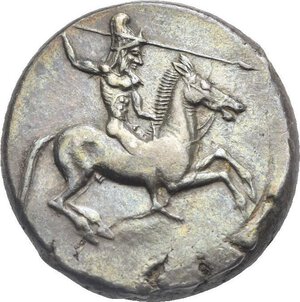
Sicily. Gela. Circa 490-475 BC. Didrachm (Silver, 19.44 mm, 8.61 g). Helmeted rider on prancing horse r., wielding spear. Rev. CE - Λ - Α, forepart of the river-god Gelas right, in the form of a man-headed bull. HGC 2, 363. Jenkins 29. Iridescent tone. Extremely Fine / Good Very Fine. Rare couple of dies. - Sicily. Gela. Circa 490-475 BC. Didrachm (Silver, 19.44 mm, 8.61 g). Helmeted rider on prancing horse r., wielding spear. Rev. CE - Λ - Α, forepart of the river-god Gelas right, in the form of a man-headed bull. HGC 2, 363. Jenkins 29. Iridescent tone. Extremely Fine / Good Very Fine. Rare couple of dies.
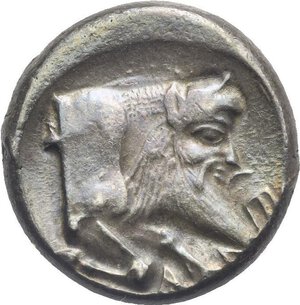
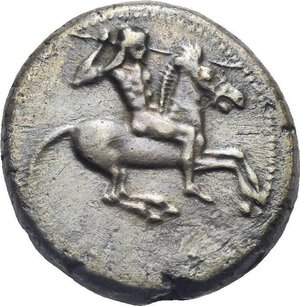
Sicily. Gela. Circa 490-475 BC. Didrachm (Silver, 19.92 mm, 8.38 g) Nude bearded warrior riding horse galloping to right, wearing headdress with long lappet on back, hurling spear with the right hand behind his head and holding reins in the left hand. Rev. CEΛΑ Σ of the river-god Gelas right, in the form of a man-headed bull. Jenkins, Gela, 91.3 (this coin). SNG ANS 20. HGC 2, 363. Old cabinet tone. About Extremely Fine. Ex Collections D(oe) et G(ai), Feuardent 18 June 1924, lot 33. - Sicily. Gela. Circa 490-475 BC. Didrachm (Silver, 19.92 mm, 8.38 g) Nude bearded warrior riding horse galloping to right, wearing headdress with long lappet on back, hurling spear with the right hand behind his head and holding reins in the left hand. Rev. CEΛΑ Σ of the river-god Gelas right, in the form of a man-headed bull. Jenkins, Gela, 91.3 (this coin). SNG ANS 20. HGC 2, 363. Old cabinet tone. About Extremely Fine. Ex Collections D(oe) et G(ai), Feuardent 18 June 1924, lot 33.
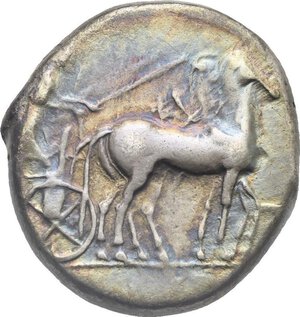
Sicily. Kamarina. Circa 425-405 BC. Tetradrachm signed by the master engraver Exakestidas (Silver, 29.06 mm, 16.71 g). Athena driving fast quadriga right, holding kentron and reins; Nike flying above crowning her; exergual line inscribed EΞAKEΣTIΔAΣ; in exergue, two amphorae. Rev. Head of Herakles left, wearing lion skin headdress. HGC 2, 524 var. (KAMAPINAION on reverse). Westermark & Jenkins -, but cfr. 146 for the obverse O8 and 147 for the reverse R14 (this die combination apparently unrecorded). Cfr. Nomos 22, lot 43 for the same type of die break on the reverse, there in its early stage. Dark patina, partially crystallized with oxides. Several die breaks on reverse. Good Very Fine. Very Rare. Ex Hess-Divo 341, 13 December 2023, lot 8. - Sicily. Kamarina. Circa 425-405 BC. Tetradrachm signed by the master engraver Exakestidas (Silver, 29.06 mm, 16.71 g). Athena driving fast quadriga right, holding kentron and reins; Nike flying above crowning her; exergual line inscribed EΞAKEΣTIΔAΣ; in exergue, two amphorae. Rev. Head of Herakles left, wearing lion skin headdress. HGC 2, 524 var. (KAMAPINAION on reverse). Westermark & Jenkins -, but cfr. 146 for the obverse O8 and 147 for the reverse R14 (this die combination apparently unrecorded). Cfr. Nomos 22, lot 43 for the same type of die break on the reverse, there in its early stage. Dark patina, partially crystallized with oxides. Several die breaks on reverse. Good Very Fine. Very Rare. Ex Hess-Divo 341, 13 December 2023, lot 8.
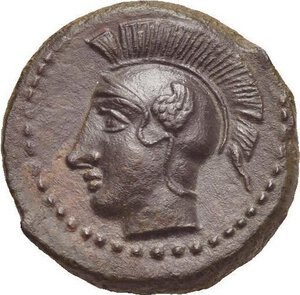
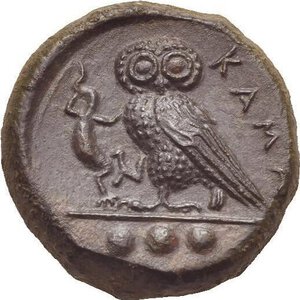
Sicily. Kamarina. Circa 420-405 BC. Tetras (Bronze, 14.81 mm, 3.46 g). Head of Athena to left, wearing crested Attic helmet decorated with a wing. Rev. KAMA Owl to left standing on one leg, head facing, grasping lizard; in exergue, three pellets (mark of value). Westermark & Jenkins, 221, 200. Calciati, CNS III, 63, 33. SNG ANS 1229. SNG Lloyd 881. SNG München 415-8. Buceti 41. HGC 2, 548. Professionally cleaned, with no retouching. Well centered specimen, with sharp details. Choice Extremely Fine. - Sicily. Kamarina. Circa 420-405 BC. Tetras (Bronze, 14.81 mm, 3.46 g). Head of Athena to left, wearing crested Attic helmet decorated with a wing. Rev. KAMA Owl to left standing on one leg, head facing, grasping lizard; in exergue, three pellets (mark of value). Westermark & Jenkins, 221, 200. Calciati, CNS III, 63, 33. SNG ANS 1229. SNG Lloyd 881. SNG München 415-8. Buceti 41. HGC 2, 548. Professionally cleaned, with no retouching. Well centered specimen, with sharp details. Choice Extremely Fine.
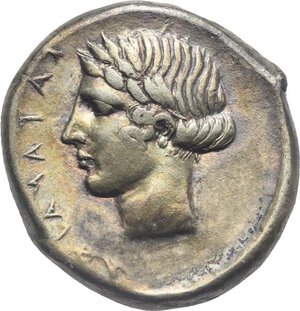
Sicily. Katane. Circa 435-412 BC. Tetradrachm (Silver, 25.91 mm, 16.79 g) Charioteer driving slow biga right, holding kentron in the left hand and reins in the right hand. Rev. KATANAIΩΝ (retrograde) Laureate head of Apollo left. Mirone, "Le monete dell' antica Catana", RIN 1917, p. 207, n. 41. Rizzo pl. X, n. 16. HGC 2, 570 var. (no leaf on reverse). Iridescent cabinet tone. Good Very Fine. Very rare. - Sicily. Katane. Circa 435-412 BC. Tetradrachm (Silver, 25.91 mm, 16.79 g) Charioteer driving slow biga right, holding kentron in the left hand and reins in the right hand. Rev. KATANAIΩΝ (retrograde) Laureate head of Apollo left. Mirone, "Le monete dell' antica Catana", RIN 1917, p. 207, n. 41. Rizzo pl. X, n. 16. HGC 2, 570 var. (no leaf on reverse). Iridescent cabinet tone. Good Very Fine. Very rare.
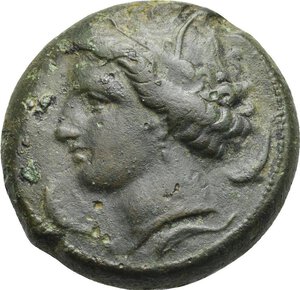
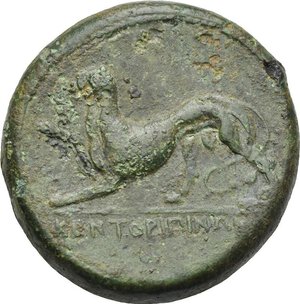
Sicily. Kentoripai. Circa 339-330 BC. Drachm (Bronze, 32.00 mm, 33.72 g). Head of Nymph left, wearing reed wreath; four dolphins swimming around. Rev. KENTOPIΠINΩΝ (retrograde), panther standing left. HGC 2, 638. Castrizio, Series I, 1,4 (DI/R3). H.A. Cahn et all., ""Antikenmuseum Basel und Sammlung Ludwig: Griechische Münzen aus Grossgriechenland und Sizilien"", 344 (this coin). Green patina. Minor areas of roughness. Very Fine. Rare. Ex Roma Numismatics E-Sale 107, 16 March 2023, lot 109; Classical Numismatic Group 90, 23 May 2012, lot 348 (property of Princeton Economics acquired by Martin Armstrong); from the Athos Moretti Collection, Numismatica Ars Classica 13, 8 October 1998, lot 344." Ex Roma Numismatics E-Sale 107, 16 March 2023, lot 109; Classical Numismatic Group 90, 23 May 2012, lot 348 (property of Princeton Economics acquired by Martin Armstrong); from the Athos Moretti Collection, Numismatica Ars Classica 13, 8 October 1998, lot 344. - Sicily. Kentoripai. Circa 339-330 BC. Drachm (Bronze, 32.00 mm, 33.72 g). Head of Nymph left, wearing reed wreath; four dolphins swimming around. Rev. KENTOPIΠINΩΝ (retrograde), panther standing left. HGC 2, 638. Castrizio, Series I, 1,4 (DI/R3). H.A. Cahn et all., ""Antikenmuseum Basel und Sammlung Ludwig: Griechische Münzen aus Grossgriechenland und Sizilien"", 344 (this coin). Green patina. Minor areas of roughness. Very Fine. Rare. Ex Roma Numismatics E-Sale 107, 16 March 2023, lot 109; Classical Numismatic Group 90, 23 May 2012, lot 348 (property of Princeton Economics acquired by Martin Armstrong); from the Athos Moretti Collection, Numismatica Ars Classica 13, 8 October 1998, lot 344." Ex Roma Numismatics E-Sale 107, 16 March 2023, lot 109; Classical Numismatic Group 90, 23 May 2012, lot 348 (property of Princeton Economics acquired by Martin Armstrong); from the Athos Moretti Collection, Numismatica Ars Classica 13, 8 October 1998, lot 344.
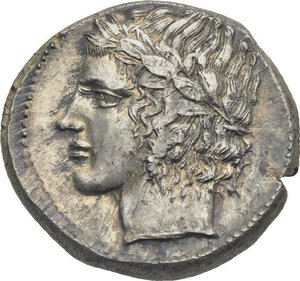
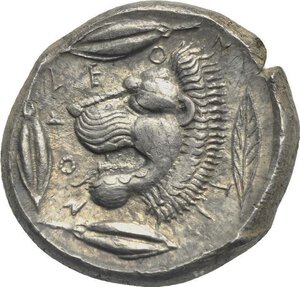
Sicily. Leontinoi. Circa 455-430 BC. Tetradrachm (Silver, 26.15 mm, 17.34 g) struck circa 425 BC. Laureate head of Apollo left, wearing curly flowing hair. Rev. LEO N TI NON Head of roaring lion left, protruding tongue; behind, laurel leaf; around, three barley grains. SNG ANS 257 (same dies). Basel 357. Boehringer Leontini 55 (same dies). Rizzo pl. XXIV, 4 (same dies). HGC 2, 671. Sharp and clear reliefs. Cabinet tone with iridescent highlights. Good Extremely Fine. - Sicily. Leontinoi. Circa 455-430 BC. Tetradrachm (Silver, 26.15 mm, 17.34 g) struck circa 425 BC. Laureate head of Apollo left, wearing curly flowing hair. Rev. LEO N TI NON Head of roaring lion left, protruding tongue; behind, laurel leaf; around, three barley grains. SNG ANS 257 (same dies). Basel 357. Boehringer Leontini 55 (same dies). Rizzo pl. XXIV, 4 (same dies). HGC 2, 671. Sharp and clear reliefs. Cabinet tone with iridescent highlights. Good Extremely Fine.
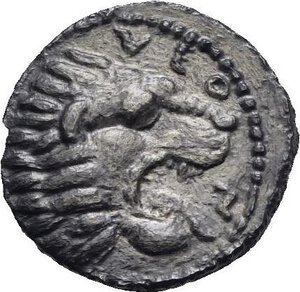
Sicily. Leontinoi. Circa 455-430 BC. Litra (Silver, 12.48 mm, 0.64 g). ΛEO-N Head of a lion with open jaws to right. Rev. Apollo standing left, holding laurel branch and sacrificing from patera over altar; on the right, barley grain. Boehringer, Leontini, 50. SNG ANS 264-6. HGC 2, 692. Deeply toned. Near Extremely Fine. - Sicily. Leontinoi. Circa 455-430 BC. Litra (Silver, 12.48 mm, 0.64 g). ΛEO-N Head of a lion with open jaws to right. Rev. Apollo standing left, holding laurel branch and sacrificing from patera over altar; on the right, barley grain. Boehringer, Leontini, 50. SNG ANS 264-6. HGC 2, 692. Deeply toned. Near Extremely Fine.
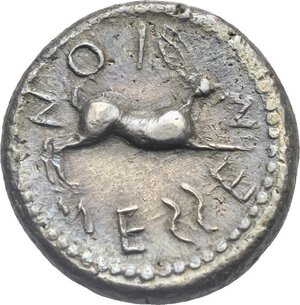
Sicily. Messana. Circa 480-461 BC. Tetradrachm (Silver, 26.24 mm, 17.43 g) Charioteer driving mule biga right, holding kentrum and reins; in exergue, laurel leaf. Rev. MESSE - N - ION, hare leaping right. M. Caccamo Caltabiano 182 (this coin). Rizzo pl. XXV, 8. SNG ANS 314-320. G. Giacosa, "Uomo e cavallo sulla Moneta Greca", pl. 10 obv. (this coin). HGC 2, 779. Cabinet toned. Some roughness on reverse, otherwise, Extremely Fine/Near Extremely Fine. From the Collection of Athos Moretti, Numismatica Ars Classica 13, 8 October 1998, lot 361. - Sicily. Messana. Circa 480-461 BC. Tetradrachm (Silver, 26.24 mm, 17.43 g) Charioteer driving mule biga right, holding kentrum and reins; in exergue, laurel leaf. Rev. MESSE - N - ION, hare leaping right. M. Caccamo Caltabiano 182 (this coin). Rizzo pl. XXV, 8. SNG ANS 314-320. G. Giacosa, "Uomo e cavallo sulla Moneta Greca", pl. 10 obv. (this coin). HGC 2, 779. Cabinet toned. Some roughness on reverse, otherwise, Extremely Fine/Near Extremely Fine. From the Collection of Athos Moretti, Numismatica Ars Classica 13, 8 October 1998, lot 361.
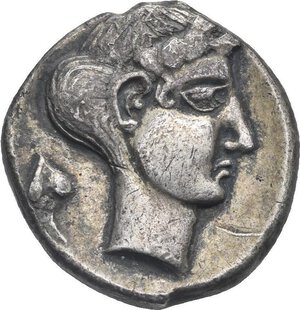
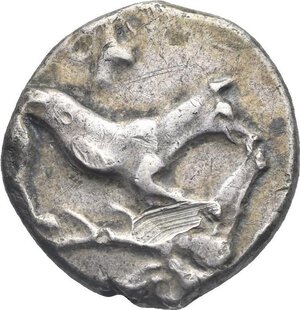
Sicily. Motya or Panormos. Circa 415-405 BC. Punic Didrachm featuring Segestan types (Silver, 20.81 mm, 8.14 g). Hound right standing on stag’s head and seizing it by the nose; above, small female head right. Rev. Head of Nymph right; on the left, ivy-leaf. Jenkins, Coins of Punic Sicily, Part I (Swiss Numismatic Review Vol. 50, 1971), Motya II series, pl. 4.35 (O18/R22 - this coin). Cfr. Gabrici, La monetazione del bronzo nella Sicilia antica, p. 46 (argumenting for Panormos). Old cabinet tone. Scratch on obverse and scattered marks. Very Fine. Extremely Rare. Ex G. de Ciccio Collection, Sambon & Canessa, 19 December 1907, lot 258. The Punic didrachm series was minted during a turbulent period in Sicilian history. After the Syracusans defeated the Athenians in 413 BC, Selinos resumed its conflict with Segesta in 410 BC. Facing renewed threats, the Elimian Segesta sought Carthaginian support, which led to Carthage subjugating Segesta and destroying both Selinos and Himera. This aggressive expansion alarmed the rest of Greek Sicily, but having just expelled the Athenians, they hesitated to intervene. The situation escalated when Hermocrates, a Syracusan exile, raided Punic territories in 407 BC, triggering a prolonged war that culminated in the destruction of cities like Akragas and Motya. In this context, the didrachm series, produced by the Siculo-Punic cities of Motya and Panormos, was likely used to fund Carthage's massive military efforts in Sicily. Segesta, newly under Carthaginian control and experienced in minting didrachms, probably played a key role in this production, as evidenced by die-sharing with Motya and Panormos. The presence of hybrid coins combining dies from these cities suggests a central mint, though its location is debated. While Jenkins and Hurter propose Panormos, Rutter argues convincingly for Segesta, which, considering the historical circumstances, seems the most plausible location." - Sicily. Motya or Panormos. Circa 415-405 BC. Punic Didrachm featuring Segestan types (Silver, 20.81 mm, 8.14 g). Hound right standing on stag’s head and seizing it by the nose; above, small female head right. Rev. Head of Nymph right; on the left, ivy-leaf. Jenkins, Coins of Punic Sicily, Part I (Swiss Numismatic Review Vol. 50, 1971), Motya II series, pl. 4.35 (O18/R22 - this coin). Cfr. Gabrici, La monetazione del bronzo nella Sicilia antica, p. 46 (argumenting for Panormos). Old cabinet tone. Scratch on obverse and scattered marks. Very Fine. Extremely Rare. Ex G. de Ciccio Collection, Sambon & Canessa, 19 December 1907, lot 258. The Punic didrachm series was minted during a turbulent period in Sicilian history. After the Syracusans defeated the Athenians in 413 BC, Selinos resumed its conflict with Segesta in 410 BC. Facing renewed threats, the Elimian Segesta sought Carthaginian support, which led to Carthage subjugating Segesta and destroying both Selinos and Himera. This aggressive expansion alarmed the rest of Greek Sicily, but having just expelled the Athenians, they hesitated to intervene. The situation escalated when Hermocrates, a Syracusan exile, raided Punic territories in 407 BC, triggering a prolonged war that culminated in the destruction of cities like Akragas and Motya. In this context, the didrachm series, produced by the Siculo-Punic cities of Motya and Panormos, was likely used to fund Carthage's massive military efforts in Sicily. Segesta, newly under Carthaginian control and experienced in minting didrachms, probably played a key role in this production, as evidenced by die-sharing with Motya and Panormos. The presence of hybrid coins combining dies from these cities suggests a central mint, though its location is debated. While Jenkins and Hurter propose Panormos, Rutter argues convincingly for Segesta, which, considering the historical circumstances, seems the most plausible location."
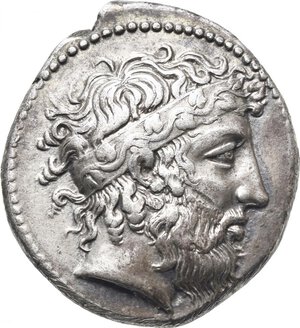
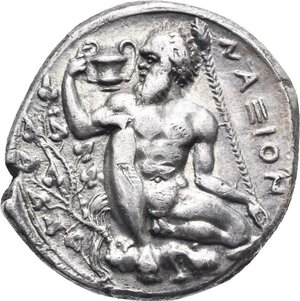
Sicily. Naxos. Circa 415 BC. Tetradrachm (Silver, 25.25 mm, 16.89 g). Head of Dionysos right, wearing stephane decorated with ivy wreath. Rev. ΝΑΞΙΟΝ, Silenos squatting nude on rock facing slightly right, head turned to left, holding long transversal thyrsus and kantharos; on the left, ivy plant growing upwards. HGC 2, 984. Cahn, Naxos 102 (V66/R84). Lightly toned. Minor scratch on obverse and some contact marks on reverse; minor die break on reverse, typical of the Cahn R84; edge intermittently smoothed with a file, believed to be done to fit the coin into a pendant, probably from the early 20th century or just before. However, of the most refined classical style, a masterpiece of Dionysian exuberance. Good Very Fine. Rare. From a Swiss Collection, formed in Ticino before 2005. This short-lived coinage, likely issued to fund Athens' ill-fated expedition against Syracuse, represents a notable departure from earlier designs. Unlike the archaic tetradrachms minted after Naxos' independence in 461 BC, these coins exhibit a refined classical style. The obverse portrays Dionysos with a cool, Olympian presence, his gaze and tousled hair reflecting contemporary Athenian monumental sculpture. The reverse shows Silenos in a more relaxed, humanized form, seated in a simplified landscape and anticipating his wine. This transition from rigid archaic forms to dynamic, lifelike depictions highlights the coin's artistic excellence and alignment with high classical aesthetics." - Sicily. Naxos. Circa 415 BC. Tetradrachm (Silver, 25.25 mm, 16.89 g). Head of Dionysos right, wearing stephane decorated with ivy wreath. Rev. ΝΑΞΙΟΝ, Silenos squatting nude on rock facing slightly right, head turned to left, holding long transversal thyrsus and kantharos; on the left, ivy plant growing upwards. HGC 2, 984. Cahn, Naxos 102 (V66/R84). Lightly toned. Minor scratch on obverse and some contact marks on reverse; minor die break on reverse, typical of the Cahn R84; edge intermittently smoothed with a file, believed to be done to fit the coin into a pendant, probably from the early 20th century or just before. However, of the most refined classical style, a masterpiece of Dionysian exuberance. Good Very Fine. Rare. From a Swiss Collection, formed in Ticino before 2005. This short-lived coinage, likely issued to fund Athens' ill-fated expedition against Syracuse, represents a notable departure from earlier designs. Unlike the archaic tetradrachms minted after Naxos' independence in 461 BC, these coins exhibit a refined classical style. The obverse portrays Dionysos with a cool, Olympian presence, his gaze and tousled hair reflecting contemporary Athenian monumental sculpture. The reverse shows Silenos in a more relaxed, humanized form, seated in a simplified landscape and anticipating his wine. This transition from rigid archaic forms to dynamic, lifelike depictions highlights the coin's artistic excellence and alignment with high classical aesthetics."
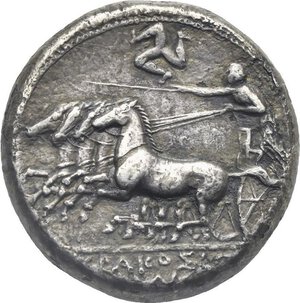
Sicily. Panormos (as Ziz), Punic occupation. Circa 340-320 BC. Tetradrachm (Silver, 25.58 mm, 17.11 g). Charioteer driving fast quadriga left, holding kentron and reins; Nike flying above crowning him; in exergue, SYS (in Punic). Rev. Head of Nymph left, wearing reed wreath; two dolphins swimming before, and flower behind. HGC 2, 1022 var. (symbol on reverse). Jenkins, Coins of Punic Sicily, Part I (Swiss Numismatic Review Vol. 50, 1971), Panormos series, pl. 13.65 (O17/R52). Deeply toned. Die break on reverse. Good Very Fine/About Extremely Fine. Rare. Ex Gorny & Mosch 249, 11 October 2017, lot 129 (G.S. Collection, Nuremberg); Gerhard Hirsch 267, 5 May 2010, lot 103. - Sicily. Panormos (as Ziz), Punic occupation. Circa 340-320 BC. Tetradrachm (Silver, 25.58 mm, 17.11 g). Charioteer driving fast quadriga left, holding kentron and reins; Nike flying above crowning him; in exergue, SYS (in Punic). Rev. Head of Nymph left, wearing reed wreath; two dolphins swimming before, and flower behind. HGC 2, 1022 var. (symbol on reverse). Jenkins, Coins of Punic Sicily, Part I (Swiss Numismatic Review Vol. 50, 1971), Panormos series, pl. 13.65 (O17/R52). Deeply toned. Die break on reverse. Good Very Fine/About Extremely Fine. Rare. Ex Gorny & Mosch 249, 11 October 2017, lot 129 (G.S. Collection, Nuremberg); Gerhard Hirsch 267, 5 May 2010, lot 103.
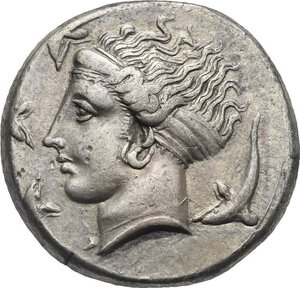
Sicily. Panormos (as Ziz), Punic occupation. Circa 340-320 BC. Tetradrachm (Silver, 26.85 mm, 16.67 g). Charioteer driving fast quadriga left, holding kentron and reins; Nike flying above crowning him; in exergue, SYS (in Punic) between two confronted dolphins. Rev. Head of Nymph left, wearing reed wreath; four dolphins swimming around. Jenkins, Punic 80 (O21/R67). SNG ANS 542 var. HGC 2, 1022. Cabinet tone. Die break on reverse, otherwise, Extremely Fine. - Sicily. Panormos (as Ziz), Punic occupation. Circa 340-320 BC. Tetradrachm (Silver, 26.85 mm, 16.67 g). Charioteer driving fast quadriga left, holding kentron and reins; Nike flying above crowning him; in exergue, SYS (in Punic) between two confronted dolphins. Rev. Head of Nymph left, wearing reed wreath; four dolphins swimming around. Jenkins, Punic 80 (O21/R67). SNG ANS 542 var. HGC 2, 1022. Cabinet tone. Die break on reverse, otherwise, Extremely Fine.
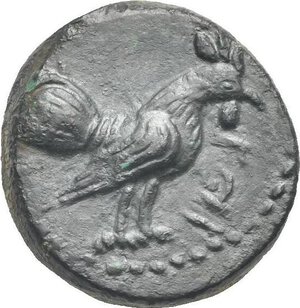
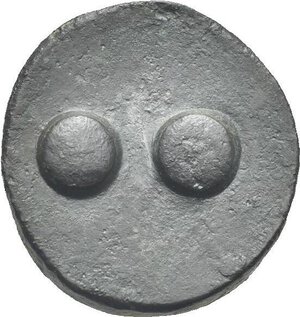
Sicily. Panormos (as Ziz), Punic occupation. Circa 415-405 BC. Hexas (Bronze, 16.04 mm, 3.65 g). SYS (in Punic), cock standing right. Rev. Two pellets (mark of value). Viola, CNP 783. Calciati, CNS I, 270, 3. Jenkins SNR 50, --. Buceti, 333, 7. HGC 2, 1055. Dark green patina. A particularly nice example of this very rare issue. Extremely Fine. Rare. - Sicily. Panormos (as Ziz), Punic occupation. Circa 415-405 BC. Hexas (Bronze, 16.04 mm, 3.65 g). SYS (in Punic), cock standing right. Rev. Two pellets (mark of value). Viola, CNP 783. Calciati, CNS I, 270, 3. Jenkins SNR 50, --. Buceti, 333, 7. HGC 2, 1055. Dark green patina. A particularly nice example of this very rare issue. Extremely Fine. Rare.
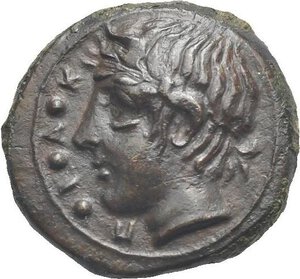
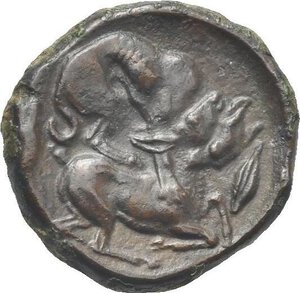
Sicily. Piakos. Circa 425-420 BC. Tetras (Bronze, 15.35 mm, 2.76 g). Unsigned work by the 'Maestro della foglia'. Π-Ι-Α-Κ Wreathed head of youthful river god to left, with a horn above his forehead; in field to left, three pellets (mark of value). Rev. Hound attacking a deer around the neck; to right, and left (partially visible), wheat grain. G. K. Jenkins, "The Coinages of Enna, Galaria, Piakos, Imachara, Kephaloidion and Longane", AIIN suppl. 20 (1975), p. 92, group I, pl. 7, 2. Calciati, CNS III, 198, 2. Campana, CNAI I, 100, 2. Rizzo pl. LX, 14. AMB 397. Buceti, 372, 3. HGC 2, 1101. Green-dark brown patina. Professionally cleaned, with no retouching. Well centered specimen, with sharp details. About Extremely Fine. Rare. - Sicily. Piakos. Circa 425-420 BC. Tetras (Bronze, 15.35 mm, 2.76 g). Unsigned work by the 'Maestro della foglia'. Π-Ι-Α-Κ Wreathed head of youthful river god to left, with a horn above his forehead; in field to left, three pellets (mark of value). Rev. Hound attacking a deer around the neck; to right, and left (partially visible), wheat grain. G. K. Jenkins, "The Coinages of Enna, Galaria, Piakos, Imachara, Kephaloidion and Longane", AIIN suppl. 20 (1975), p. 92, group I, pl. 7, 2. Calciati, CNS III, 198, 2. Campana, CNAI I, 100, 2. Rizzo pl. LX, 14. AMB 397. Buceti, 372, 3. HGC 2, 1101. Green-dark brown patina. Professionally cleaned, with no retouching. Well centered specimen, with sharp details. About Extremely Fine. Rare.
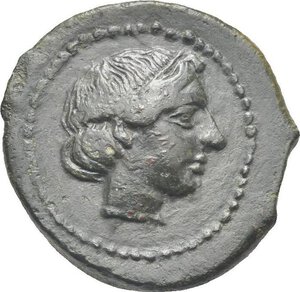
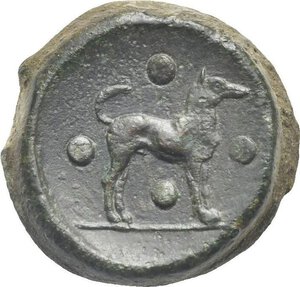
Sicily. Segesta. Circa 420 BC. Trias (Bronze, 19.89 mm, 8.14 g). Head of nymph to right, wearing hair-band. Rev. Hound standing to right on the exergue line; around, four pellets (mark of value). Hurter pl. 29, 2. Berend, group A, pl. VII, 2-4. Calciati, CNS I, 293, 2. Virzì 1346. SNG ANS 657. SNG Cop. 586. SNG Lloyd 1201=Weber 1522. HGC 2, 1180. Green patina. Gently smoothed. Good Very Fine. Rare. - Sicily. Segesta. Circa 420 BC. Trias (Bronze, 19.89 mm, 8.14 g). Head of nymph to right, wearing hair-band. Rev. Hound standing to right on the exergue line; around, four pellets (mark of value). Hurter pl. 29, 2. Berend, group A, pl. VII, 2-4. Calciati, CNS I, 293, 2. Virzì 1346. SNG ANS 657. SNG Cop. 586. SNG Lloyd 1201=Weber 1522. HGC 2, 1180. Green patina. Gently smoothed. Good Very Fine. Rare.
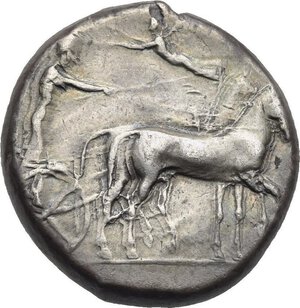
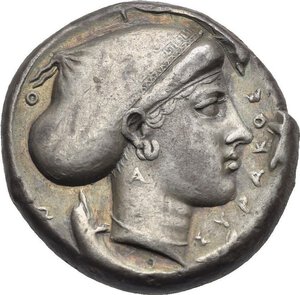
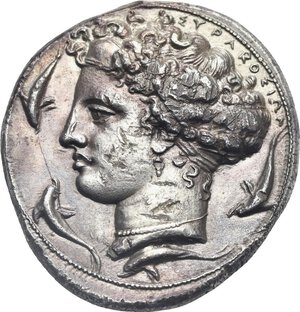
Sicily. Syracuse, Second Democracy. Circa 420-415 BC. Tetradrachm (Silver, 24.36 mm, 17.25 g). Charioteer driving slow biga right, holding kentron and reins; Nike flying above crowning him. Rev. ΣΥΡΑΚΟΣ - Ι - Ο - Ν, Head of Arethusa right, hair bound in sakkos decorated with meander pattern; on neck below ear, A (master’s mark); four dolphins swimming around. Boehringer 700 (V345/R478). SNG ANS 235 (same dies). HGC 2, 1322. Nicely toned, with iridescent highlights. A magnificent coin, rare to find in this condition and centering, featuring a highly refined portrait of Arethusa; it’s no coincidence that an excellent engraver chose to sign it. Good Very Fine. - Sicily. Syracuse, Second Democracy. Circa 420-415 BC. Tetradrachm (Silver, 24.36 mm, 17.25 g). Charioteer driving slow biga right, holding kentron and reins; Nike flying above crowning him. Rev. ΣΥΡΑΚΟΣ - Ι - Ο - Ν, Head of Arethusa right, hair bound in sakkos decorated with meander pattern; on neck below ear, A (master’s mark); four dolphins swimming around. Boehringer 700 (V345/R478). SNG ANS 235 (same dies). HGC 2, 1322. Nicely toned, with iridescent highlights. A magnificent coin, rare to find in this condition and centering, featuring a highly refined portrait of Arethusa; it’s no coincidence that an excellent engraver chose to sign it. Good Very Fine.
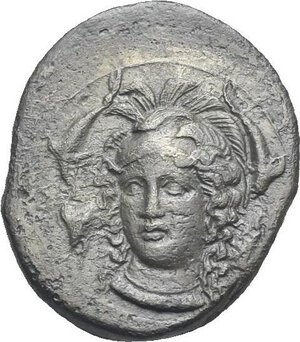
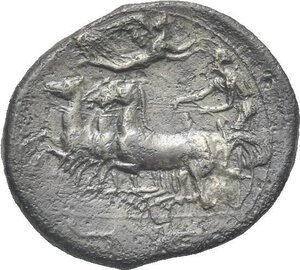
Sicily. Syracuse, Second Democracy. Circa 410-405 BC. Hemidrachm (Silver, 15.84 mm, 1.98 g). Σ - Y, helmeted head of Athena facing slightly left; four dolphins around. Rev. Charioteer driving fast quadriga left, holding kentron and reins; Nike flying above crowning him; in exergue, two confronted dolphins. SNG ANS 312-13; HGC 2, 1369. Dark patina. Very Fine. Rare. - Sicily. Syracuse, Second Democracy. Circa 410-405 BC. Hemidrachm (Silver, 15.84 mm, 1.98 g). Σ - Y, helmeted head of Athena facing slightly left; four dolphins around. Rev. Charioteer driving fast quadriga left, holding kentron and reins; Nike flying above crowning him; in exergue, two confronted dolphins. SNG ANS 312-13; HGC 2, 1369. Dark patina. Very Fine. Rare.
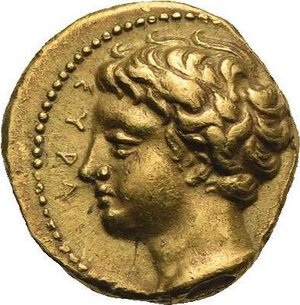
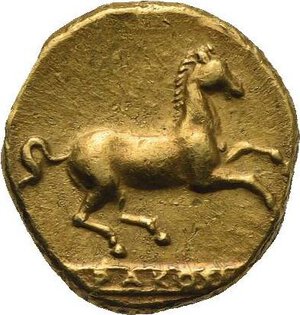
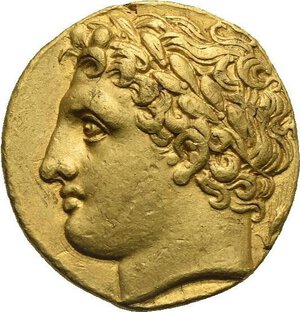
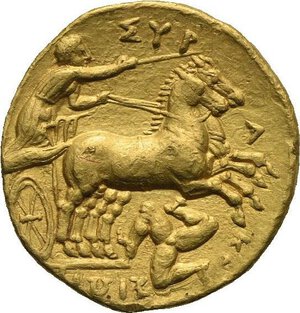
Sicily. Syracuse, Dionysios I. Circa 405-400 BC. 50 Litrai or Dekadrachm (Gold, 11.32 mm, 2.87 g). ΣΥΡA, male head left; behind, ear of grain. Rev. ΣΥΡΑΚΟΣΙΩΝ, horse prancing right. HGC 2, 1281. SNG ANS 347. D. Berend, Le Monnayage d’or de Syracuse sous Denys I, 7.2 (this coin). Boston MFA 436 = Warren 354. De Luynes 1239. Jameson 1918. Weber 1610 (same dies). Extremely Fine. Ex Hamburger 98, 3 April 1933, lot 391; Cahn 84, 29 November 1933, lot 149; Hamburger 96, 25 October 1932, lot 62. - Sicily. Syracuse, Dionysios I. Circa 405-400 BC. 50 Litrai or Dekadrachm (Gold, 11.32 mm, 2.87 g). ΣΥΡA, male head left; behind, ear of grain. Rev. ΣΥΡΑΚΟΣΙΩΝ, horse prancing right. HGC 2, 1281. SNG ANS 347. D. Berend, Le Monnayage d’or de Syracuse sous Denys I, 7.2 (this coin). Boston MFA 436 = Warren 354. De Luynes 1239. Jameson 1918. Weber 1610 (same dies). Extremely Fine. Ex Hamburger 98, 3 April 1933, lot 391; Cahn 84, 29 November 1933, lot 149; Hamburger 96, 25 October 1932, lot 62.
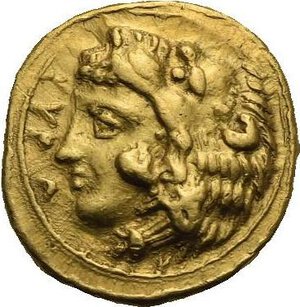
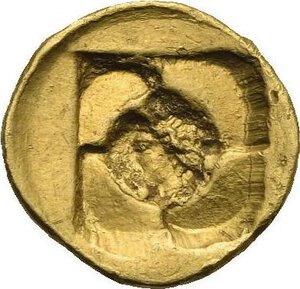
Sicily. Syracuse, Dionysios I. Circa 405-400 BC. 20 Litrai or Tetradrachm (Gold, 10.60 mm, 1.13 g). ΣΥΡA Head of Herakles left, wearing lion skin headdress. Rev. Quadripartite incuse square; in deeper incuse circle in center, small female head left. Boehringer, pl. I, 6. SNG ANS 350-6. Rizzo pl. XLVIII n. 9. HGC 2, 1289 var. (legend also on the reverse). Cfr. CNG E-415, lot 5 (same dies without reverse legend). Rusty reverse die. Extremely Fine/Good Very Fine. Ex Gorny & Mosch 249, 11 October 2017, lot 110. - Sicily. Syracuse, Dionysios I. Circa 405-400 BC. 20 Litrai or Tetradrachm (Gold, 10.60 mm, 1.13 g). ΣΥΡA Head of Herakles left, wearing lion skin headdress. Rev. Quadripartite incuse square; in deeper incuse circle in center, small female head left. Boehringer, pl. I, 6. SNG ANS 350-6. Rizzo pl. XLVIII n. 9. HGC 2, 1289 var. (legend also on the reverse). Cfr. CNG E-415, lot 5 (same dies without reverse legend). Rusty reverse die. Extremely Fine/Good Very Fine. Ex Gorny & Mosch 249, 11 October 2017, lot 110.
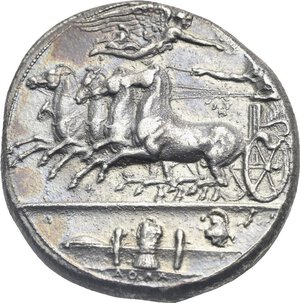
Sicily. Syracuse, Dionysios I. Circa 407-400 BC. Dekadrachm (Silver, 35.21 mm, 42.74 g). Charioteer driving fast quadriga left, holding kentron and reins; Nike flying above crowning him; in exergue, panoply of arms arranged on two steps, the lower inscribed ΑΘΛΑ ("prizes"). Rev. ΣΥΡΑΚΟΣΙΩN, Head of Arethusa left, hair bound in front with ampyx and caught up behind by net; four dolphins swimming around. Jongkees 13 (dies C/μ). SNG Spencer-Churchill 57 (these dies). HGC 2, 1298. Cfr. Numismatica Ars Classica 78, lot 218 (these dies). Scavino, RIN 2008, 13 (D3/R12). Lightly toned. The obverse die shows slight rust, with scratches, marks, and two small die breaks on the reverse. Nonetheless, an attractive specimen of this desirable issue, struck from a very rare pair of dies, an unsigned work of Kimon. About Extremely Fine. Very rare. From a Swiss collection, formed before 2005. This decadrachm of Syracuse, crafted by the legendary Kimon under Dionysius I, stands as the pinnacle of ancient Greek numismatic art—an absolute masterpiece of engraving. Struck during Syracuse's golden age, it showcases Kimon's unmatched skill: the lifelike beauty of Arethusa and the tragic quadriga transform this coin into a work of unparalleled brilliance. Coveted by collectors and connoisseurs, this is far more than currency; it is a timeless testament to artistic genius, an enduring symbol of Syracuse's grandeur and cultural triumph. - Sicily. Syracuse, Dionysios I. Circa 407-400 BC. Dekadrachm (Silver, 35.21 mm, 42.74 g). Charioteer driving fast quadriga left, holding kentron and reins; Nike flying above crowning him; in exergue, panoply of arms arranged on two steps, the lower inscribed ΑΘΛΑ ("prizes"). Rev. ΣΥΡΑΚΟΣΙΩN, Head of Arethusa left, hair bound in front with ampyx and caught up behind by net; four dolphins swimming around. Jongkees 13 (dies C/μ). SNG Spencer-Churchill 57 (these dies). HGC 2, 1298. Cfr. Numismatica Ars Classica 78, lot 218 (these dies). Scavino, RIN 2008, 13 (D3/R12). Lightly toned. The obverse die shows slight rust, with scratches, marks, and two small die breaks on the reverse. Nonetheless, an attractive specimen of this desirable issue, struck from a very rare pair of dies, an unsigned work of Kimon. About Extremely Fine. Very rare. From a Swiss collection, formed before 2005. This decadrachm of Syracuse, crafted by the legendary Kimon under Dionysius I, stands as the pinnacle of ancient Greek numismatic art—an absolute masterpiece of engraving. Struck during Syracuse's golden age, it showcases Kimon's unmatched skill: the lifelike beauty of Arethusa and the tragic quadriga transform this coin into a work of unparalleled brilliance. Coveted by collectors and connoisseurs, this is far more than currency; it is a timeless testament to artistic genius, an enduring symbol of Syracuse's grandeur and cultural triumph.
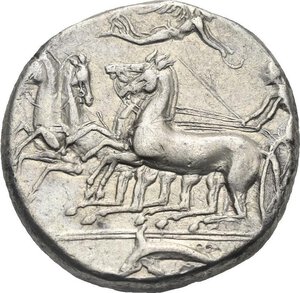
Sicily. Syracuse, Dionysios I. Circa 405-395 BC. Tetradrachm (Silver, 24.40 mm, 16.27 g). Charioteer driving fast quadriga prancing left, holding kentron and reins; Nike flying above crowning him; in exergue, dolphin swimming left. Rev. ΣΥΡΑΚΟΣΙΩΝ, Head of Arethusa left, underwater, wearing sphendone; four dolphins swimming around. SNG ANS 299. Tudeer 101 (V43/R70). SNG Lloyd 1406 (same dies). HGC 2, 1345. Nicely toned. Refined style, yet also fresh and joyful, unsigned but in the style of Eukleidas. Good Very Fine. Rare. - Sicily. Syracuse, Dionysios I. Circa 405-395 BC. Tetradrachm (Silver, 24.40 mm, 16.27 g). Charioteer driving fast quadriga prancing left, holding kentron and reins; Nike flying above crowning him; in exergue, dolphin swimming left. Rev. ΣΥΡΑΚΟΣΙΩΝ, Head of Arethusa left, underwater, wearing sphendone; four dolphins swimming around. SNG ANS 299. Tudeer 101 (V43/R70). SNG Lloyd 1406 (same dies). HGC 2, 1345. Nicely toned. Refined style, yet also fresh and joyful, unsigned but in the style of Eukleidas. Good Very Fine. Rare.
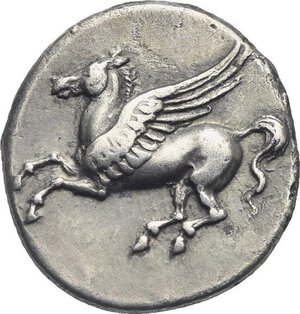
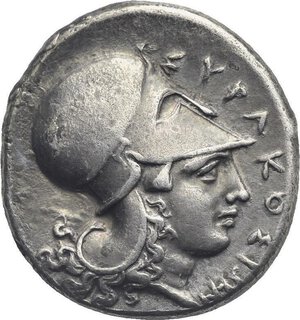
Sicily. Syracuse. Timoleon and the Third Democracy. Circa 343-317 BC. Stater (Silver, 20.85 mm, 8.38 g) Pegasus flying left. Rev. ΣΥΡΑΚΟΣΙΩΝ Head of Athena right, wearing Corinthian helmet and flowing curly hair. Calciati Pegasi 2, p. 607, 1. SNG ANS 494-507. SNG Lloyd 1442-3. Dewing 930-1. HGC 2, 1400. Nicely toned. Near Extremely Fine/Extremely Fine. - Sicily. Syracuse. Timoleon and the Third Democracy. Circa 343-317 BC. Stater (Silver, 20.85 mm, 8.38 g) Pegasus flying left. Rev. ΣΥΡΑΚΟΣΙΩΝ Head of Athena right, wearing Corinthian helmet and flowing curly hair. Calciati Pegasi 2, p. 607, 1. SNG ANS 494-507. SNG Lloyd 1442-3. Dewing 930-1. HGC 2, 1400. Nicely toned. Near Extremely Fine/Extremely Fine.
Sicily. Syracuse, Timoleon and the Third Democracy. Circa 343-317 BC. Hemidrachm (Silver, 12.71 mm, 1.34 g). Σ ΥΡΑΚΟΣ Ι ΩΝ Head of Arethusa left, wearing top tied hair, pendant earring and necklace; three dolphins swimming around. Rev. Forepart of Pegasus left, above, star (?). SNG ANS 512. Dewing 932. BMC 277. SNG München 1130. HGC 2, 1405. Old cabinet tone. Refined style. Near Extremely Fine. - Sicily. Syracuse, Timoleon and the Third Democracy. Circa 343-317 BC. Hemidrachm (Silver, 12.71 mm, 1.34 g). Σ ΥΡΑΚΟΣ Ι ΩΝ Head of Arethusa left, wearing top tied hair, pendant earring and necklace; three dolphins swimming around. Rev. Forepart of Pegasus left, above, star (?). SNG ANS 512. Dewing 932. BMC 277. SNG München 1130. HGC 2, 1405. Old cabinet tone. Refined style. Near Extremely Fine.
Sicily. Syracuse, Agathokles. Circa 317-310 BC. 50 Litrae or Dekadrachm (Gold, 15.39 mm, 4.28 g). Laureate head of Apollo left, behind, ear of grain. Rev. ΣΥΡ Α ΚΟ ΣΙΩΝ Charioteer wearing long chiton, driving fast biga right, holding kentron and reins, below, triskeles. SNG ANS 552. SNG Lloyd 1472. BMC 338. Boston MFA 457. HGC 2, 1276. Scattered contact marks. Fine style. About Extremely Fine. Ex Roma Numismatic 12, 29 September 2016, lot 106; Numismatic Fine Arts MBS, 12 October 1988, lot 112; Numismatic Fine Arts 16, 2 December 1985, lot 82. - Sicily. Syracuse, Agathokles. Circa 317-310 BC. 50 Litrae or Dekadrachm (Gold, 15.39 mm, 4.28 g). Laureate head of Apollo left, behind, ear of grain. Rev. ΣΥΡ Α ΚΟ ΣΙΩΝ Charioteer wearing long chiton, driving fast biga right, holding kentron and reins, below, triskeles. SNG ANS 552. SNG Lloyd 1472. BMC 338. Boston MFA 457. HGC 2, 1276. Scattered contact marks. Fine style. About Extremely Fine. Ex Roma Numismatic 12, 29 September 2016, lot 106; Numismatic Fine Arts MBS, 12 October 1988, lot 112; Numismatic Fine Arts 16, 2 December 1985, lot 82.
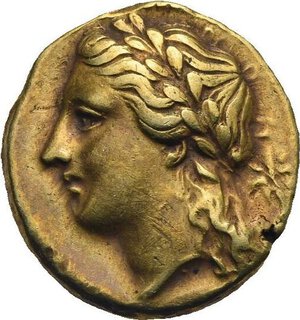
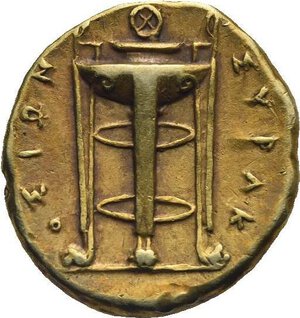
Sicily. Syracuse, Agathokles. Circa 310-305 BC. 25 Litrai or Hemistater (Electrum, 14.63 mm, 3.60 g). Laureate head of Apollo left; behind, star. Rev. ΣΥΡΑΚ - ΟΣΙΩΝ, tripod-lebes, legs terminating in lion's paws, high ring handles. Jenkins 156. . SNG ANS 623-625. HGC 2, 1294. Scattered contact marks. Fine style. Good Very Fine. Reddish tone. Good Very Fine/About Extremely Fine. - Sicily. Syracuse, Agathokles. Circa 310-305 BC. 25 Litrai or Hemistater (Electrum, 14.63 mm, 3.60 g). Laureate head of Apollo left; behind, star. Rev. ΣΥΡΑΚ - ΟΣΙΩΝ, tripod-lebes, legs terminating in lion's paws, high ring handles. Jenkins 156. . SNG ANS 623-625. HGC 2, 1294. Scattered contact marks. Fine style. Good Very Fine. Reddish tone. Good Very Fine/About Extremely Fine.
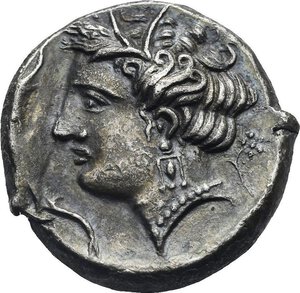
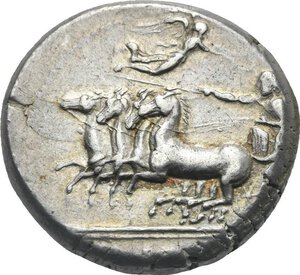
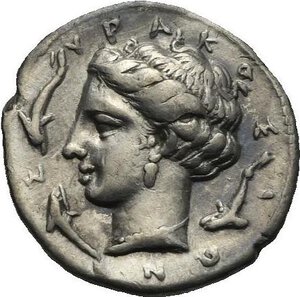
Sicily. Syracuse. Agathokles. 317-289 BC. Tetradrachm (Silver, 24.82 mm, 16.22 g) circa 310-305 BC. Head of Arethusa left, wearing reed wreath, triple-pendant earring and necklace, three dolphins swimming around; below neck, NK. Rev. Charioteer driving fast quadriga left, holding kentron and reins; above, triskeles; in exergue, ΣΥΡΑΚΟΣΙΩΝ / AN monogram. Ierardi 41e (O8/R22) this coin. Bar issue 2. SNG Fitzwilliam 1329. . SNG Lockett 1002 (same dies). SNG ANS 637. Weber 1668 (same dies). Dark thick patina, with some oxides. Good Very Fine. Ex Duca di Cajaniello collection, Sambon-Canessa, 27 June 1927, lot 1025. - Sicily. Syracuse. Agathokles. 317-289 BC. Tetradrachm (Silver, 24.82 mm, 16.22 g) circa 310-305 BC. Head of Arethusa left, wearing reed wreath, triple-pendant earring and necklace, three dolphins swimming around; below neck, NK. Rev. Charioteer driving fast quadriga left, holding kentron and reins; above, triskeles; in exergue, ΣΥΡΑΚΟΣΙΩΝ / AN monogram. Ierardi 41e (O8/R22) this coin. Bar issue 2. SNG Fitzwilliam 1329. . SNG Lockett 1002 (same dies). SNG ANS 637. Weber 1668 (same dies). Dark thick patina, with some oxides. Good Very Fine. Ex Duca di Cajaniello collection, Sambon-Canessa, 27 June 1927, lot 1025.
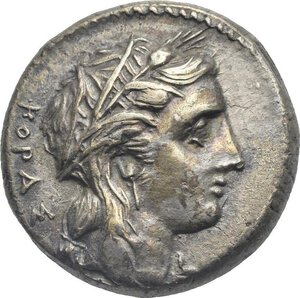
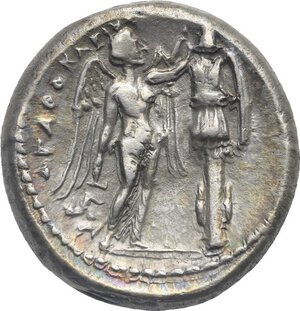
Sicily. Syracuse, Agathokles. Circa 310-305 BC. Tetradrachm (Silver, 24.92 mm, 16.79 g). KOPAΣ, head of Kore/Persephone right, wearing wreath of ears of grain. Rev. ΑΓΑΘΟΚΛΕIOΣ, Nike standing facing, head turned to right, holding hammer and erecting trophy of arms; on the lower left, triskeles. HGC 2, 1536. Ierardi 221a (O63/R47 - this coin). Old cabinet tone. About Extremely Fine. From the Richard J. Graham Collection (pseudonym of the renowned collector Paul Tinchant), J. Schulman 243, 8 June 1966, lot 1107; from the Dr. Albert Hugh Lloyd Collection (1864-1936), from the Cefalù hoard, 1925 (IGCH 2154; coin plate VII n. 2). - Sicily. Syracuse, Agathokles. Circa 310-305 BC. Tetradrachm (Silver, 24.92 mm, 16.79 g). KOPAΣ, head of Kore/Persephone right, wearing wreath of ears of grain. Rev. ΑΓΑΘΟΚΛΕIOΣ, Nike standing facing, head turned to right, holding hammer and erecting trophy of arms; on the lower left, triskeles. HGC 2, 1536. Ierardi 221a (O63/R47 - this coin). Old cabinet tone. About Extremely Fine. From the Richard J. Graham Collection (pseudonym of the renowned collector Paul Tinchant), J. Schulman 243, 8 June 1966, lot 1107; from the Dr. Albert Hugh Lloyd Collection (1864-1936), from the Cefalù hoard, 1925 (IGCH 2154; coin plate VII n. 2).
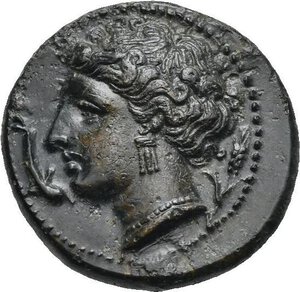
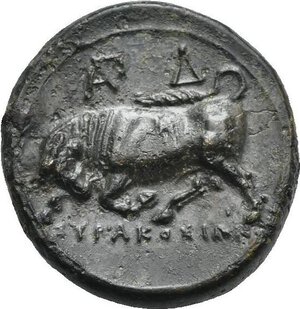
Sicily. Syracuse, Agathokles. Circa 317-305 BC. Bronze (Bronze, 15.94 mm, 3.35 g). Head of Arethusa left; behind, ear of grain; before, dolphin. Rev. ΣΥΡΑΚΟΣΙΩΝ, bull butting left; above, monogram AΓ and Δ. HGC 2, 1490. Calciati Ds95. Coll De Luynes 1322. Glossy untouched brownish patina. Good Extremely Fine. Rare. - Sicily. Syracuse, Agathokles. Circa 317-305 BC. Bronze (Bronze, 15.94 mm, 3.35 g). Head of Arethusa left; behind, ear of grain; before, dolphin. Rev. ΣΥΡΑΚΟΣΙΩΝ, bull butting left; above, monogram AΓ and Δ. HGC 2, 1490. Calciati Ds95. Coll De Luynes 1322. Glossy untouched brownish patina. Good Extremely Fine. Rare.
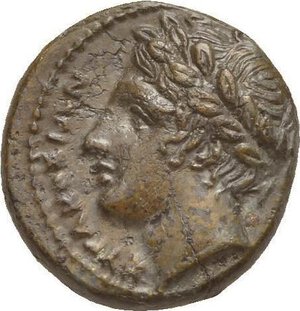
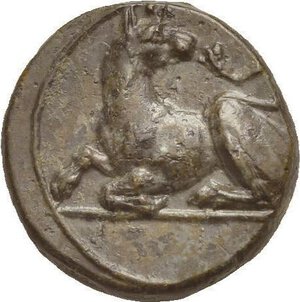
Sicily. Syracuse. Agathokles, Circa 317-289 BC. AE (Bronze, 13.09 mm, 2.36 g). ΣΥΡΑΚΟΣΙΩΝ Laureate head of Apollo left, wearing short hair. Rev. Hound seated left, head turned to right, tail turned to left. Calciati 149. SNG ANS 744. HGC 2, 1525. Glossy untouched brownish patina. Good Extremely Fine. Rare. - Sicily. Syracuse. Agathokles, Circa 317-289 BC. AE (Bronze, 13.09 mm, 2.36 g). ΣΥΡΑΚΟΣΙΩΝ Laureate head of Apollo left, wearing short hair. Rev. Hound seated left, head turned to right, tail turned to left. Calciati 149. SNG ANS 744. HGC 2, 1525. Glossy untouched brownish patina. Good Extremely Fine. Rare.
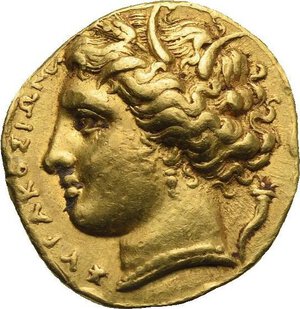
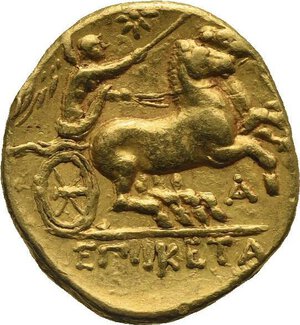
Sicily. Syracuse, Hiketas II. Circa 288-278 BC. Hemistater (Gold, 15.56 mm, 4.26 g). ΣYPAKOΣIΩN, wreathed head of Persephone left; behind, cornucopia. Rev. Nike driving fast biga right, holding kentron and reins; above, star; before, [Φ]; below, A; in exergue, EPI IKETA. Buttrey, "The Morgantina Gold Hoard and the Coinage of Hicetas", NC 1973, dies 4/K. SNG ANS 780. HGC 2, 1277. Lovely style. Good Very Fine. Accompanied with old collection tag. - Sicily. Syracuse, Hiketas II. Circa 288-278 BC. Hemistater (Gold, 15.56 mm, 4.26 g). ΣYPAKOΣIΩN, wreathed head of Persephone left; behind, cornucopia. Rev. Nike driving fast biga right, holding kentron and reins; above, star; before, [Φ]; below, A; in exergue, EPI IKETA. Buttrey, "The Morgantina Gold Hoard and the Coinage of Hicetas", NC 1973, dies 4/K. SNG ANS 780. HGC 2, 1277. Lovely style. Good Very Fine. Accompanied with old collection tag.
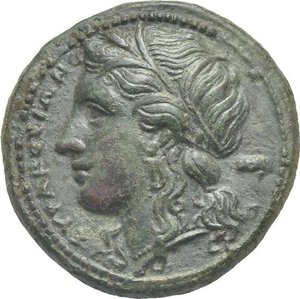
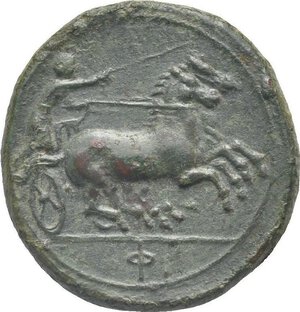
Sicily. Syracuse. Hiketas II. Circa 287-278 BC. (Bronze, 21.92 mm, 7.34 g). ΣΥΡΑΚΟΣΙΩΝ Wreathed head of Persephone to left; wearing pendant earring and pearl necklace; behind the neck, astragalus. Rev. Charioteer driving fast biga right, holding kentron and reins; in exergue, Φ. Calciati, CNS II, group II, class 1, 261, 123. SNG ANS 757. HGC 2, 1466. Green patina with red spots of cuprite. About Extremely Fine. - Sicily. Syracuse. Hiketas II. Circa 287-278 BC. (Bronze, 21.92 mm, 7.34 g). ΣΥΡΑΚΟΣΙΩΝ Wreathed head of Persephone to left; wearing pendant earring and pearl necklace; behind the neck, astragalus. Rev. Charioteer driving fast biga right, holding kentron and reins; in exergue, Φ. Calciati, CNS II, group II, class 1, 261, 123. SNG ANS 757. HGC 2, 1466. Green patina with red spots of cuprite. About Extremely Fine.
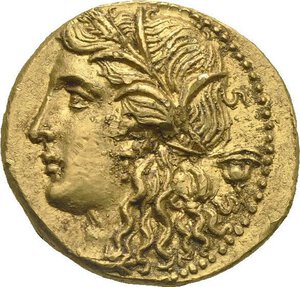
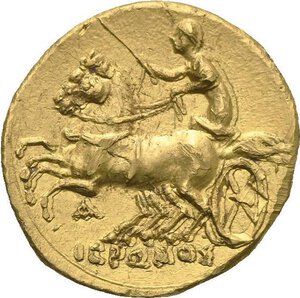
Sicily. Syracuse, Hieron II. Circa 220-217 BC. 60 Litrai or Dekadrachm (Gold, 17.06 mm, 4.26 g). Wreathed head of Persephone left; behind, rose. Rev. Charioteer driving fast biga left, holding kentron and reins; below, A and ΙΕΡΩΝΟΣ. HGC 2, 1539. Carroccio 34 (D15/R25). SNG ANS 867. Buceti, 361, 1136. Obverse die slightly rusted, scratches and scattered marks, minor die shift on the reverse. Otherwise Extremely Fine. - Sicily. Syracuse, Hieron II. Circa 220-217 BC. 60 Litrai or Dekadrachm (Gold, 17.06 mm, 4.26 g). Wreathed head of Persephone left; behind, rose. Rev. Charioteer driving fast biga left, holding kentron and reins; below, A and ΙΕΡΩΝΟΣ. HGC 2, 1539. Carroccio 34 (D15/R25). SNG ANS 867. Buceti, 361, 1136. Obverse die slightly rusted, scratches and scattered marks, minor die shift on the reverse. Otherwise Extremely Fine.
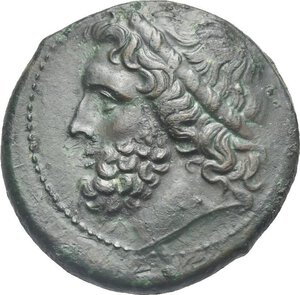
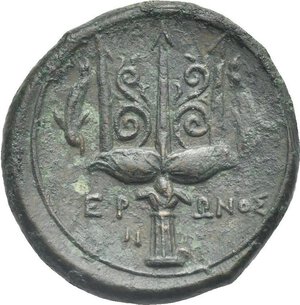
Sicily. Syracuse, Hieron II. Circa 263-218 BC. Tetras (Bronze, 23.30 mm, 9.23 g). Diademed head of Poseidon left wearing tainia. Rev. EP - ΩΝΟΣ Ornamented trident head flanked by two dolphins; IEP ONOS, to lower left, N. BMC 218, 602; SNG Cop 854; SNG München 1406; Calciati p. 371 n. 194. HGC 2, 1550. Untouched green-brownish patina. A well-struck piece. Extremely Fine. Ex Sternberg XX, April 1988, lot 454. - Sicily. Syracuse, Hieron II. Circa 263-218 BC. Tetras (Bronze, 23.30 mm, 9.23 g). Diademed head of Poseidon left wearing tainia. Rev. EP - ΩΝΟΣ Ornamented trident head flanked by two dolphins; IEP ONOS, to lower left, N. BMC 218, 602; SNG Cop 854; SNG München 1406; Calciati p. 371 n. 194. HGC 2, 1550. Untouched green-brownish patina. A well-struck piece. Extremely Fine. Ex Sternberg XX, April 1988, lot 454.
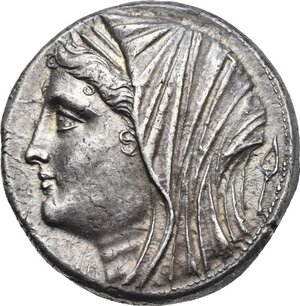
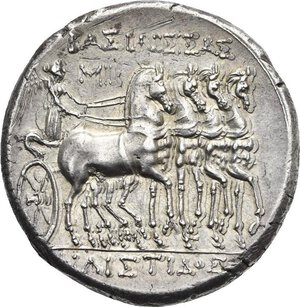
Sicily. Syracuse, Philistis, wife of Hieron II. Circa 240-216 BC. 16 Litrae (Silver, 26.81 mm, 13.59 g). Diademed and veiled head of Philistis left; behind, arrow head. Rev. ΒΑΣΙΛΙΣΣΑΣ/ ΦΙΛΙΣΤΙΔΟΣ, Nike driving slow quadriga right, holding reins; above, MI. HGC 2, 1556. Burnett, Enna Hoard –. Nicely toned. Minor die shift on the reverse and almost invisible contact mark. Extremely Fine. A very rare variety with a lovely portrait. Ex Roma Numismatics 27, 22 March 2023, lot 104; Numismatica Ars Classica 64, 17 May 2012, lot 748, Jean Elsen 59, 18 September 1999, lot 52. - Sicily. Syracuse, Philistis, wife of Hieron II. Circa 240-216 BC. 16 Litrae (Silver, 26.81 mm, 13.59 g). Diademed and veiled head of Philistis left; behind, arrow head. Rev. ΒΑΣΙΛΙΣΣΑΣ/ ΦΙΛΙΣΤΙΔΟΣ, Nike driving slow quadriga right, holding reins; above, MI. HGC 2, 1556. Burnett, Enna Hoard –. Nicely toned. Minor die shift on the reverse and almost invisible contact mark. Extremely Fine. A very rare variety with a lovely portrait. Ex Roma Numismatics 27, 22 March 2023, lot 104; Numismatica Ars Classica 64, 17 May 2012, lot 748, Jean Elsen 59, 18 September 1999, lot 52.
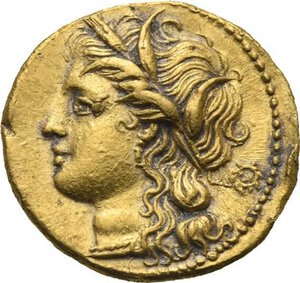
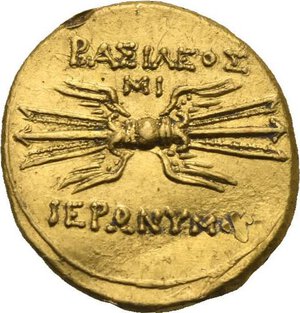
Sicily. Syracuse, Hieronymos. Circa 215-214. Hemistater (Gold, 16.31 mm, 4.25 g). Wreathed head of Persephone left; behind, wreath. Rev. BAΣIΛEΩΣ / IEPΩNYMOY Winged thunderbolt; above, MI. HGC 2, 1564. Holloway, “The Thirteen-months coinage of Hieronymos of Syracuse”, 1 (O1/R1 - only three specimens recorded). Coll. De Luynes 1383. Buceti, 442, 1557. HGC 2, 1564. Slightly bent flan with some scratches, otherwise, Good Very Fine. Of the highest rarity, apparently only the fourth known specimen of this variety. - Sicily. Syracuse, Hieronymos. Circa 215-214. Hemistater (Gold, 16.31 mm, 4.25 g). Wreathed head of Persephone left; behind, wreath. Rev. BAΣIΛEΩΣ / IEPΩNYMOY Winged thunderbolt; above, MI. HGC 2, 1564. Holloway, “The Thirteen-months coinage of Hieronymos of Syracuse”, 1 (O1/R1 - only three specimens recorded). Coll. De Luynes 1383. Buceti, 442, 1557. HGC 2, 1564. Slightly bent flan with some scratches, otherwise, Good Very Fine. Of the highest rarity, apparently only the fourth known specimen of this variety.