Greek Coins
Results from 10801 to 10850 of 10851
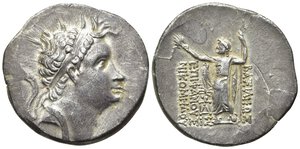
Lot # 223
-
KINGS OF BITHYNIA. Nikomedes III Philopator (127-94 BC). Tetradrachm. Dated CY 210 (88/7 BC). Obv: Diademed head of Nikomedes right.Rev: ΒΑΣΙΛΕΩΣ / ΕΠΙΦΑΝΟΥΣ ΝΙΚΟΜΗΔΟΥ. Zeus standing left, holding wreath and sceptre. Controls: To inner left, eagle standing left on thunderbolt, monogram and IΣ (date).De Callataÿ p.64; HGC 7, 645. Condition: Very fine.Weight: 11.27 g. Diameter: 32 mm.
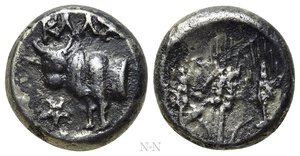
Lot # 222
-
BITHYNIA. Kalchedon. Hemidrachm (Circa 367/6-340 BC). Obv: KAΛX. Forepart of bull left on grain ear; pentagram to left.Rev: Three grain ears.SNG BM Black Sea 109-10 var. (symbol); SNG Copenhagen 355; HGC 7, 514 var. (unlisted symbol). Condition: Very fine.Weight: 1.80 g. Diameter: 10 mm.
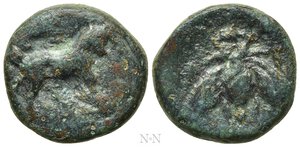
Lot # 221
-
ASIA MINOR. Uncertain mint. Ae (4th-3rd centuries). Obv: Ram(?) standing right.Rev: Bee.Unpublished in the standard references. Condition: Near very fine.Weight: 1.94 g. Diameter: 13 mm.
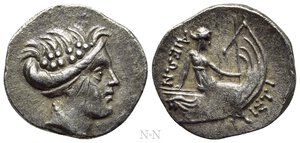
Lot # 220
-
EUBOIA. Histiaia. Tetrobol (3rd-2nd centuries BC). Obv: Wreathed head of the nymph Histiaia right.Rev: IΣTIAIEΩN. Nymph seated right on stern of galley; wing on prow.BCD Euboia 387ff.; HGC 4, 1524. Condition: Very fine.Weight: 1.25 g. Diameter: 15 mm.
Lot # 219
-
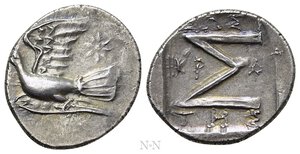
SIKYONIA. Sikyon. Triobol - Hemidrachm (Circa 100-60 BC). Sosikrates, magistrate. Obv: Dove flying left; star above tail.Rev: ΣΩΣI/K-PA/THΣ. Large Σ within incuse square.BCD Peloponnesos 351.3; HGC 5, 215. Condition: Good very fine.Weight: 2.33 g. Diameter: 17 mm.
Lot # 218
-
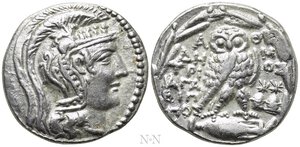
ATTICA. Athens. Tetradrachm (74/3 BC). New Style Coinage. Demetrios, Agatippos, magistrates. Obv: Head of Athena Parthenos right, wearing triple crested Attic helmet decorated with Pegasos and floral pattern.Rev: A - ΘE / ΔH - MH / TPI - OΣ / AΓA / ΘIΠ / ΠOΣ. Owl, with head facing, standing right on amphora. Controls: uncertain letter on amphora and below; to right, caps of Dioscuri; all within wreath.Thompson 884c-d; HGC 4, 1602.Among the Greek poleis, Athens is undoubtedly the city that denotes the greatest monetary development. The earliest coinage followed the reforms attributed to Solon on the introduction of Attic weights to replace the Eginetic ones. These early coins, called "Wappenmünzen," were replaced by the "owls" at the end of the 6th century: tetradrachms marked with the head of Athena and the owl, next to which is now the ethnic of the Athenians. These types will last, with variations in style, until the end of silver production (c. mid-1st century). The most noticeable change occurs with the so-called "new style," established from the beginning of the 2nd century BC. In these issues the owl is surrounded by an olive wreath, which is why the tetradrachms are referred to in the inscriptions as "stephanephoroi" (= wreath bearers). Coins of new style also bear inscriptions with the names of magistrates. Condition: Good very fine.Weight: 16.59 g. Diameter: 29 mm.
Lot # 217
-
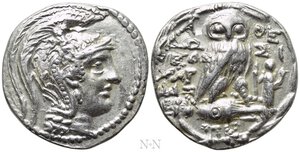
ATTICA. Athens. Tetradrachm (99/8 BC). New Style Coinage. Dositheos, Charias and Sol-, magistrates. Obv: Head of Athena Parthenos right, wearing triple crested Attic helmet decorated with Pegasos and floral pattern.Rev: A - ΘE / ΔΩ - ΣΙ / ΘΕΟΣ / ΧΑΡ / IΑΣ / ΣOΛ. Owl standing right on amphora, head facing. Controls: Θ on amphora, ΠE below; to right, Tyche standing left, holding sceptre and cornucopia; all within wreath.Thompson 867f; HGC 4, 1602.Among the Greek poleis, Athens is undoubtedly the city that denotes the greatest monetary development. The earliest coinage followed the reforms attributed to Solon on the introduction of Attic weights to replace the Eginetic ones. These early coins, called "Wappenmünzen," were replaced by the "owls" at the end of the 6th century: tetradrachms marked with the head of Athena and the owl, next to which is now the ethnic of the Athenians. These types will last, with variations in style, until the end of silver production (c. mid-1st century). The most noticeable change occurs with the so-called "new style," established from the beginning of the 2nd century BC. In these issues the owl is surrounded by an olive wreath, which is why the tetradrachms are referred to in the inscriptions as "stephanephoroi" (= wreath bearers). Coins of new style also bear inscriptions with the names of magistrates. Condition: Good very fine.Weight: 16.66 g. Diameter: 30 mm.
Lot # 216
-
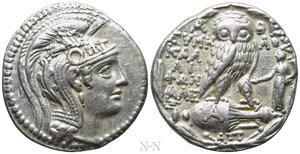
ATTICA. Athens. Tetradrachm (108/7 BC). New Style Coinage. Eumelos, Kalliphon and Alex-, magistrates. Obv: Head of Athena Parthenos right, wearing triple crested Attic helmet decorated with Pegasos and floral pattern.Rev: A - ΘE / EYMH - ΛOΣ / KAΛ / ΛI / ΦΩN / AΛE / Ξ. Owl, with head facing, standing right on overturned amphora; in right field, Tyche standing left, extending right hand and holding cornucopia; A on amphora, AΠ below; all within wreath.Thompson 730; HGC 4, 1602.Among the Greek poleis, Athens is undoubtedly the city that denotes the greatest monetary development. The earliest coinage followed the reforms attributed to Solon on the introduction of Attic weights to replace the Eginetic ones. These early coins, called "Wappenmünzen," were replaced by the "owls" at the end of the 6th century: tetradrachms marked with the head of Athena and the owl, next to which is now the ethnic of the Athenians. These types will last, with variations in style, until the end of silver production (c. mid-1st century). The most noticeable change occurs with the so-called "new style," established from the beginning of the 2nd century BC. In these issues the owl is surrounded by an olive wreath, which is why the tetradrachms are referred to in the inscriptions as "stephanephoroi" (= wreath bearers). Coins of new style also bear inscriptions with the names of magistrates. Condition: Good very fine.Weight: 16.67 g. Diameter: 29 mm.
Lot # 215
-
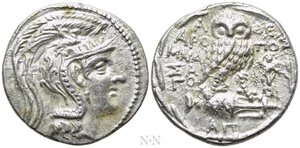
ATTICA. Athens. Tetradrachm (128/7 BC). New Style Coinage. Aropos and Mnasago-, magistrates. Obv: Head of Athena Parthenos right, wearing triple crested Attic helmet decorated with Pegasos and floral pattern.Rev: A - ΘE / APO - ΠOΣ / MNA / ΣA / ΓO. Owl standing right on amphora, head facing. Controls: To right, winged Agon standing facing, crowning himself and holding palm branch; A on amphora, AΠ below; all within wreath.Thompson 990a; HGC 4, 1602.Among the Greek poleis, Athens is undoubtedly the city that denotes the greatest monetary development. The earliest coinage followed the reforms attributed to Solon on the introduction of Attic weights to replace the Eginetic ones. These early coins, called "Wappenmünzen," were replaced by the "owls" at the end of the 6th century: tetradrachms marked with the head of Athena and the owl, next to which is now the ethnic of the Athenians. These types will last, with variations in style, until the end of silver production (c. mid-1st century). The most noticeable change occurs with the so-called "new style," established from the beginning of the 2nd century BC. In these issues the owl is surrounded by an olive wreath, which is why the tetradrachms are referred to in the inscriptions as "stephanephoroi" (= wreath bearers). Coins of new style also bear inscriptions with the names of magistrates. Condition: Good very fine.Weight: 16.48 g. Diameter: 29 mm.
Lot # 214
-
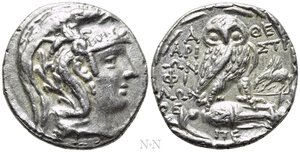
ATTICA. Athens. Tetradrachm (Circa 129/8 BC). Aristion, Philon and Theo-, magistrates. Obv: Head of Athena Parthenos right, wearing triple crested Attic helmet decorated with Pegasos and floral pattern.Rev: A - ΘE / API - ΣTI / ΩN / ΦI / ΛΩN / ΘEO. Owl, with head facing, standing right on amphora. Controls: Z on amphora, ΠE below; to right, Pegasos grazing left; all within wreath.Thompson 969a; HGC 4, 1602.Among the Greek poleis, Athens is undoubtedly the city that denotes the greatest monetary development. The earliest coinage followed the reforms attributed to Solon on the introduction of Attic weights to replace the Eginetic ones. These early coins, called "Wappenmünzen," were replaced by the "owls" at the end of the 6th century: tetradrachms marked with the head of Athena and the owl, next to which is now the ethnic of the Athenians. These types will last, with variations in style, until the end of silver production (c. mid-1st century). The most noticeable change occurs with the so-called "new style," established from the beginning of the 2nd century BC. In these issues the owl is surrounded by an olive wreath, which is why the tetradrachms are referred to in the inscriptions as "stephanephoroi" (= wreath bearers). Coins of new style also bear inscriptions with the names of magistrates. Condition: Good very fine.Weight: 16.70 g. Diameter: 28 mm.
Lot # 213
-
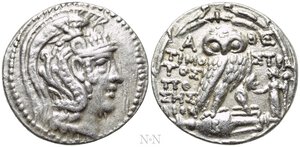
ATTICA. Athens. Tetradrachm (134/3 BC). New Style Coinage. Timostratos, Poses and Dion-, magistrates. Obv: Head of Athena Parthenos right, wearing triple crested Attic helmet decorated with Pegasos and floral pattern.Rev: A - ΘE / TIMO - ΣTPA / TOΣ / ΠO / ΣHΣ / ΔION. Owl standing right on amphora, head facing. Controls: B on amphora, uncertain control below; to right, Dionysos standing left, holding mask and sceptre; all within wreath.Cf. Thompson 823a; HGC 4, 1602.Among the Greek poleis, Athens is undoubtedly the city that denotes the greatest monetary development. The earliest coinage followed the reforms attributed to Solon on the introduction of Attic weights to replace the Eginetic ones. These early coins, called "Wappenmünzen," were replaced by the "owls" at the end of the 6th century: tetradrachms marked with the head of Athena and the owl, next to which is now the ethnic of the Athenians. These types will last, with variations in style, until the end of silver production (c. mid-1st century). The most noticeable change occurs with the so-called "new style," established from the beginning of the 2nd century BC. In these issues the owl is surrounded by an olive wreath, which is why the tetradrachms are referred to in the inscriptions as "stephanephoroi" (= wreath bearers). Coins of new style also bear inscriptions with the names of magistrates. Condition: Good very fine.Weight: 16.65 g. Diameter: 30 mm.
Lot # 212
-
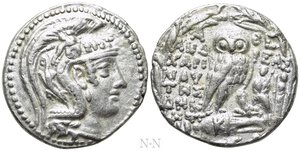
ATTICA. Athens. Tetradrachm (136/5 BC). New Style Coinage. Andreas, Charinautes and Demetr-, magistrates. Obv: Head of Athena Parthenos right, wearing triple crested Attic helmet decorated with Pegasos and floral pattern.Rev: A - ΘE / ANΔ - PEAΣ / XAPI / NAY / THΣ / ΔHM / HTP. Owl standing right on amphora, head facing. Controls: K on amphora, ΠE below; to right, Dionysos and Demeter standing facing; all within wreath.Thompson 805d-e; HGC 4, 1602.Among the Greek poleis, Athens is undoubtedly the city that denotes the greatest monetary development. The earliest coinage followed the reforms attributed to Solon on the introduction of Attic weights to replace the Eginetic ones. These early coins, called "Wappenmünzen," were replaced by the "owls" at the end of the 6th century: tetradrachms marked with the head of Athena and the owl, next to which is now the ethnic of the Athenians. These types will last, with variations in style, until the end of silver production (c. mid-1st century). The most noticeable change occurs with the so-called "new style," established from the beginning of the 2nd century BC. In these issues the owl is surrounded by an olive wreath, which is why the tetradrachms are referred to in the inscriptions as "stephanephoroi" (= wreath bearers). Coins of new style also bear inscriptions with the names of magistrates. Condition: Good very fine.Weight: 16.17 g. Diameter: 30 mm.
Lot # 211
-
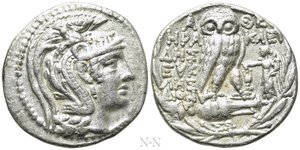
ATTICA. Athens. Tetradrachm (Circa 137/6 BC). Herakleides, Eukles and Dionysog-, magistrates. Obv: Head of Athena Parthenos right, wearing triple crested Attic helmet decorated with Pegasos and floral pattern.Rev: A - ΘE / HPA - KΛEI / ΔHΣ / EYK / ΛHΣ / ΔION / YΣOΓ. Owl, with head facing, standing right on amphora. Controls: B on amphora, ΣΩ below; to right, winged Tyche standing left, holding amphora; all within wreath.Thompson 779c-e; HGC 4, 1602.Among the Greek poleis, Athens is undoubtedly the city that denotes the greatest monetary development. The earliest coinage followed the reforms attributed to Solon on the introduction of Attic weights to replace the Eginetic ones. These early coins, called "Wappenmünzen," were replaced by the "owls" at the end of the 6th century: tetradrachms marked with the head of Athena and the owl, next to which is now the ethnic of the Athenians. These types will last, with variations in style, until the end of silver production (c. mid-1st century). The most noticeable change occurs with the so-called "new style," established from the beginning of the 2nd century BC. In these issues the owl is surrounded by an olive wreath, which is why the tetradrachms are referred to in the inscriptions as "stephanephoroi" (= wreath bearers). Coins of new style also bear inscriptions with the names of magistrates. Condition: Good very fine.Weight: 16.69 g. Diameter: 30 mm.
Lot # 210
-
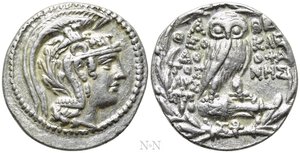
ATTICA. Athens. Tetradrachm (138/7 BC). New Style Coinage. Theodotos, Kleophanes and Lysipp-, magistrates. Obv: Head of Athena Parthenos right, wearing triple crested Attic helmet decorated with Pegasos and floral pattern.Rev: A - ΘE / ΘEO / ΔO / TOΣ - KΛE / OΦA / NHΣ / ΛYΣ / IΠΠ. Owl standing right on amphora, head facing. Controls: Z on amphora, ΣΩ control below; all within wreath.Thompson 773b; HGC 4, 1602.Among the Greek poleis, Athens is undoubtedly the city that denotes the greatest monetary development. The earliest coinage followed the reforms attributed to Solon on the introduction of Attic weights to replace the Eginetic ones. These early coins, called "Wappenmünzen," were replaced by the "owls" at the end of the 6th century: tetradrachms marked with the head of Athena and the owl, next to which is now the ethnic of the Athenians. These types will last, with variations in style, until the end of silver production (c. mid-1st century). The most noticeable change occurs with the so-called "new style," established from the beginning of the 2nd century BC. In these issues the owl is surrounded by an olive wreath, which is why the tetradrachms are referred to in the inscriptions as "stephanephoroi" (= wreath bearers). Coins of new style also bear inscriptions with the names of magistrates. Condition: Good very fine.Weight: 16.72 g. Diameter: 30 mm.
Lot # 209
-
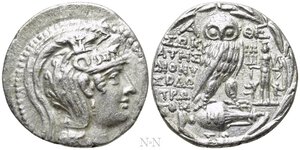
ATTICA. Athens. Tetradrachm (148/7 BC). New Style Coinage. Sokrates, Dionisodo- and Protom-, magistrates. Obv: Head of Athena Parthenos right, wearing triple crested Attic helmet decorated with Pegasos and floral pattern.Rev: Α - ΘΕ / ΣΩKΡ / ATHΣ / ΔIONY / ΣOΔΩ / ΠPΩ / TOM. Owl standing right on amphora, head facing. Controls: To right, Apollo Delios standing left, holding Three Graces and bow; H on amphora, ΣΦ below; all within wreath.Cf. Thompson 622a; HGC 4, 1602.Among the Greek poleis, Athens is undoubtedly the city that denotes the greatest monetary development. The earliest coinage followed the reforms attributed to Solon on the introduction of Attic weights to replace the Eginetic ones. These early coins, called "Wappenmünzen," were replaced by the "owls" at the end of the 6th century: tetradrachms marked with the head of Athena and the owl, next to which is now the ethnic of the Athenians. These types will last, with variations in style, until the end of silver production (c. mid-1st century). The most noticeable change occurs with the so-called "new style," established from the beginning of the 2nd century BC. In these issues the owl is surrounded by an olive wreath, which is why the tetradrachms are referred to in the inscriptions as "stephanephoroi" (= wreath bearers). Coins of new style also bear inscriptions with the names of magistrates. Condition: Good very fine.Weight: 16.80 g. Diameter: 29 mm.
Lot # 208
-
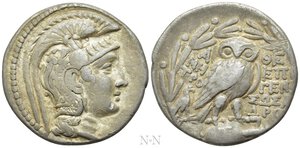
ATTICA. Athens. Tetradrachm (158/7 BC). New Style Coinage. Epigen-, Sosandros, Metro- , magistrates. Obv: Helmeted head of Athena right.Rev: A - ΘE / MH - TPO / EΠΙ - ΓΕΝH / ΣOΣAN - ΔΡΟC. Owl standing right on amphora, head facing. Controls: to left, eagle standing right on thunderbolt; uncertain control on amphora and below.Cf. Thompson 452a; HGC 4, 1602. Condition: Good fine.Weight: 16.13 g. Diameter: mm.
Lot # 207
-
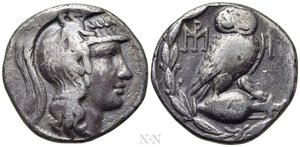
ATTICA. Athens. Tetradrachm (Circa 165-42 BC). New Style Coinage. Roman rule under Sulla. Obv: Head of Athena right wearing crested Attic helmet, decorated with griffin.Rev: Owl standing right on amphora, head facing Control: monogram to left and right; all within wreath.Thompson 1273-1329; HGC 4, 1777. Condition: Fine.Weight: 15.89 g. Diameter: 27 mm.
Lot # 206
-
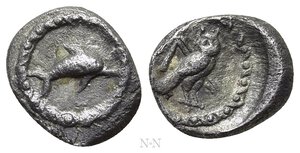
ATTICA. Athens. Tetradrachm (Circa 454-404 BC). Obv: Helmeted head of Athena right, with frontal eye.Rev: AΘE. Owl standing right, head facing; olive sprig and crescent to left; all within incuse square.Kroll 8; HGC 4, 1597. Condition: Very fine.Weight: 16.86 g. Diameter: 24 mm.
Lot # 205
-
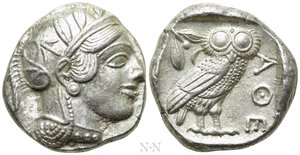
ATTICA. Athens. Tetradrachm (Circa 454-404 BC). Obv: Helmeted head of Athena right, with frontal eye.Rev: AΘE. Owl standing right, head facing; olive sprig and crescent to left; all within incuse square.Kroll 8; HGC 4, 1597. Condition: Good very fine.Weight: 17.22 g. Diameter: 24 mm.
Lot # 204
-
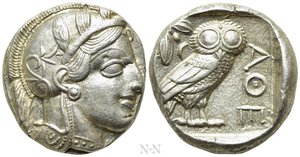
ATTICA. Athens. Tetradrachm (Circa 454-404 BC). Obv: Helmeted head of Athena right, with frontal eye.Rev: AΘE. Owl standing right, head facing; olive sprig and crescent to left; all within incuse square.Kroll 8; HGC 4, 1597. Condition: Good very fine.Weight: 17.24 g. Diameter: 23 mm.
Lot # 203
-
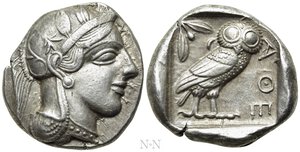
ATTICA. Athens. Tetradrachm (Circa 454-404 BC). Obv: Helmeted head of Athena right, with frontal eye.Rev: AΘE. Owl standing right, head facing; olive sprig and crescent to left; all within incuse square.Kroll 8; HGC 4, 1597. Condition: Good very fine.Weight: 17.26 g. Diameter: 26 mm.
Lot # 202
-
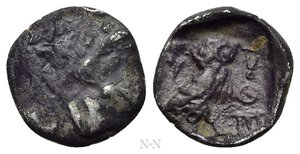
ATTICA. Athens. Obol (Circa 454-404 BC). Obv: Helmeted head of Athena right.Rev: AΘE. Owl standing right, head facing; olive sprig and crescent to left; all within incuse square.Kroll 13; HGC 4, 1665. Condition: Fine.Weight: 0.64 g. Diameter: 9 mm.
Lot # 201
-
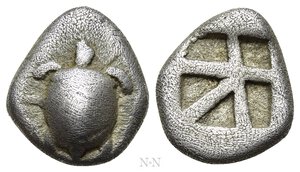
ATTICA. Aegina. Obol (Circa 480-457 BC). Obv: Sea turtle.Rev: Square incuse with skew pattern.Meadows Group IIIa; HGC 6, 450.Ex Dr. Busso Peus Nachfolger 423 (2018), lot 39 Condition: Very fine.Weight: 0.98 g. Diameter: 10 mm.
Lot # 200
-
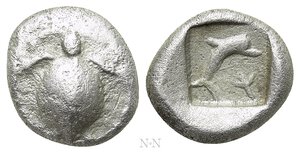
ATTICA. Aegina. Obol (Circa 480 BC). Obv: Sea turtle.Rev: Dolphin swimming right; floral ornament to lower right; all within incuse square.Traité 1046; BMC 145; Milbank pl. I, 10.Extremely rare Condition: Very fine.Weight: 1.07 g. Diameter: 10 mm.
Lot # 199
-
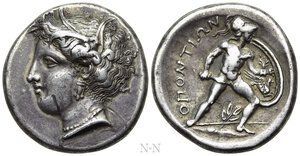
LOKRIS. Lokri Opuntii. Tetradrachm (Circa 360-350 BC). Obv: Wreathed head of Persephone left, wearing triple-pendant earring and necklace.Rev: OΠONTIΩN. Ajax advancing right on rocks, holding shield decorated with palmette and griffin; laurel branch below.BCD Lokris 57 (same dies); Weber 3143 (this coin); de Luynes 1956 (same dies); Jameson 1146 (same dies); HGC 4, 992.Very rareEx Sir H. Weber Collection, London 1924, n. 3134; ex Ars Classica 12 (1926), lot 1350; ex Dr. Busso Peus Nachfolger 277 (2000), lot 99 Condition: Very fine.Weight: 12.20 g. Diameter: 24 mm.
Lot # 198
-
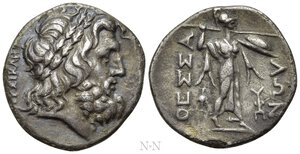
THESSALY. Thessalian League. Stater (Late 2nd-mid 1st centuries BC). Lysikles and Poly-, magistrates. Obv: ΛΥΣΙΚΛΗΟΥ. Head of Zeus right, wearing oak wreath.Rev: ΘEΣΣA / ΛΩN. Athena Itonia striding right, hurling spear and holding shield; grape bunch in inner left, ΠΟΛΥ monogram in right.BCD Thessaly II 821; HGC 4, 208. Condition: Very fine.Weight: 5.93 g. Diameter: 21 mm.
Lot # 197
-
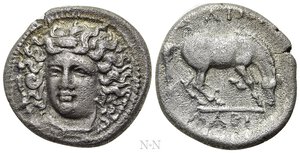
THESSALY. Larissa. Drachm (Circa 365-356 BC). Obv: Head of the nymph Larissa facing slightly left, with hair in ampyx.Rev: ΣΑΙΩΝ / ΛΑΡΙ. Horse standing right, preparing to lie down.Lorber, Hoard Phase L-I, 24-5; BCD Thessaly II 312; HGC 4, 454. Condition: Very fine.Weight: 5.88 g. Diameter: 18 mm.
Lot # 196
-
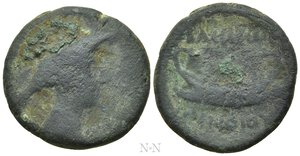
KINGS OF ILLYRIA. Genthios (181-168 BC). Ae. Skodra. Obv: Draped bust of Redon right, wearing petasos.Rev: BAΣIΛEOΣ / ΓENΘIOY. Prow of galley.HGC 3.1, 77.Very rareThe bust on obverse sometimes identified as Genthios portrait, could instead be interpreted as Redon, an Illyrian god of the sea after which the Cape of Rodon is named. A similar iconography can be found on a civic coin of Lissos (HGC 3.1 56), bearing the legend PEΔΩN. Redon, patron of sailors, is usually portrayed as a bearded figure with trident, like Poseidon. He is also patron of travelers, like Hermes, as suggested by the broad hat kausia they wore. Condition: Fine.Weight: 4.36 g. Diameter: 19 mm.
Lot # 195
-
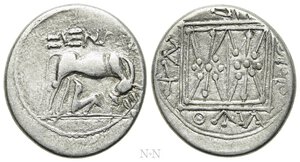
ILLYRIA. Dyrrhachion. Drachm (Circa 229-100 BC). Xenon, magistrate. Contemporary imitation. Obv: ΞENΩN. Cow standing right suckling calf.Rev: Blundered legend. Double stellate pattern within linear borders.Cf. HGC 3.1, 40 (for prototype). Condition: Very fine.Weight: 2.98 g. Diameter: 18 mm.
Lot # 194
-
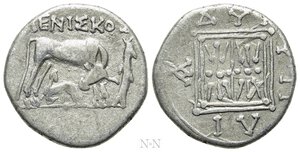
ILLYRIA. Dyrrhachion. Drachm (Circa 229-100 BC). Phillia and Meniskos, magistrates. Obv: MENIΣΚΟΣ. Cow standing right suckling calf; to right, fish upward.Rev: ΔYP / ΦIΛ / ΛI / A. Double stellate pattern within linear borders.Maier -; HGC 3.1, 40. Condition: Near very fine.Weight: 3.01 g. Diameter: 17 mm.
Lot # 193
-
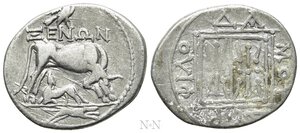
ILLYRIA. Dyrrhachion. Drachm (Circa 229-100 BC). Xenon and Philodamos, magistrates. Obv: ΞENΩN. Cow standing right suckling calf; above, eagle standing right, with wings spread; in exergue, hound running right.Rev: ΔYP / ΦIΛO / ΔA / MOY. Double stellate pattern within linear borders.Maier 388; HGC 3.1, 40. Condition: Near very fine.Weight: 3.18 g. Diameter: 20 mm.
Lot # 192
-
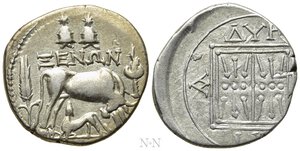
ILLYRIA. Dyrrhachion. Drachm (Circa 229-100 BC). Xenon and Phillia-, magistrates. Obv: ΞΕΝΩΝ. Cow standing right suckling calf; pilei of the Dioscuri above, grain-ear to left, torch to right.Rev: ΔYP / ΦIΛ ΛI A. Double stellate pattern within linear borders.Maier 376; HGC 3.1, 40. Condition: Very fine.Weight: 3.23 g. Diameter: 19 mm.
Lot # 191
-
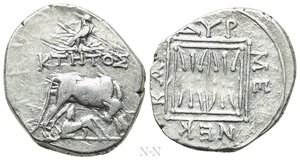
ILLYRIA. Dyrrhachion. Drachm (Circa 229-100 BC). Ktetos and Menakka, magistrates. Obv: KTHTOΣ. Cow standing right suckling calf; above, eagle standing right on thunderbolt.Rev: ΔYP / ME / NEK / KA. Double stellate pattern within linear borders.Maier 298; HGC 3.1, 40. Condition: Very fine.Weight: 3.49 g. Diameter: 19 mm.
Lot # 190
-
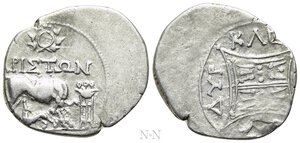
ILLYRIA. Dyrrhachion. Drachm (Circa 229-100 BC). Ariston and Kleitorios, magistrates. Obv: APIΣTΩN. Cow standing right suckling calf; wreath above, tripod to right.Rev: ΔYP KΛEI / TOPI / OY. Double stellate pattern.Maier 259; HGC 3.1, 40. Condition: Very fine.Weight: 3.18 g. Diameter: 21 mm.
Lot # 189
-
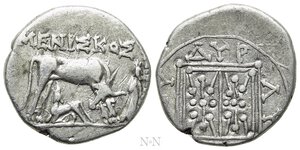
ILLYRIA. Dyrrhachion. Drachm (Circa 250-200 BC). Meniskos and Lykiskos, magistrates. Obv: ΜΕΝΙΣΚΟΣ. Cow standing right, suckling calf; to right, female figure standing facing.Rev: ΔYP / ΛY / KIΣ / KOY. Double stellate pattern within linear borders.Maier 278; HGC 3.1, 40. Condition: Very fine.Weight: 3.22 g. Diameter: 17 mm.
Lot # 188
-
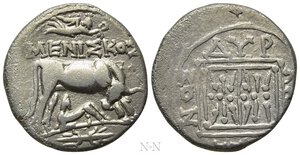
ILLYRIA. Dyrrhachion. Drachm (Circa 250-200 BC). Meniskos and Kallonos, magistrates. Obv: ΜΕΝΙΣΚΟΣ. Cow standing right, suckling calf; above, Nike flying right, holding wreath; thunderbolt below.Rev: ΔYP / KAΛ-ΛΩ-NOΣ. Double stellate pattern within linear borders.Maier 256; HGC 3.1, 40. Condition: Near very fine.Weight: 2.61 g. Diameter: 17 mm.
Lot # 187
-
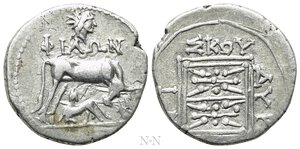
ILLYRIA. Dyrrhachion. Drachm (Circa 275/10-48 BC). Philon and Meniskos, magistrates. Obv: ΦΙΛΩΝ. Cow standing right, suckling calf; above, head of Helios right.Rev: ΔYP / ME / NI / ΣΚΟY. Double stellate pattern within linear borders.Maier 306; HGC 3.1, 40. Condition: Very fine.Weight: 3.35 g. Diameter: 17 mm.
Lot # 186
-
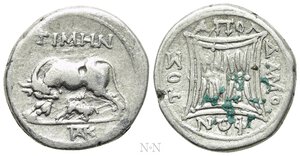
ILLYRIA. Apollonia. Drachm (Circa 80/70-48 BC). Timen- and Damophontos, magistrates. Obv: TIMHN. Cow standing left, head lowered right, suckling calf; monogram in exergue.Rev: ΑΠΟΛ / ΔAMO / ΦΩN / TOΣ. Double stellate pattern within dual linear border.Maier 36; HGC 3.1, 4. Condition: Near very fine.Weight: 3.38 g. Diameter: 17 mm.
Lot # 185
-
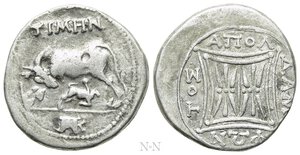
ILLYRIA. Apollonia. Drachm (Circa 80/70-48 BC). Timen- and Damophontos, magistrates. Obv: TIMHN. Cow standing left, head lowered right, suckling calf; monogram in exergue.Rev: ΑΠΟΛ / ΔAMO / ΦΩN / TOΣ. Double stellate pattern within dual linear border.Maier 36; HGC 3.1, 4. Condition: Near very fine.Weight: 2.81 g. Diameter: 17 mm.
Lot # 184
-
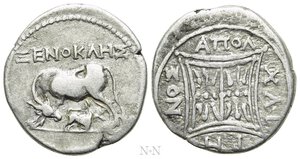
ILLYRIA. Apollonia. Drachm (Circa 229-100 BC). Xenokles and Chairenos, magistrates. Obv: ΞENOKΛHΣ. Cow standing left, head lowered right, suckling calf.Rev: ΑΠΟΛ / XAI / PH / NOΣ. Double stellate pattern.Maier 99; HGC 3.1, 4. Condition: Near very fine.Weight: 3.34 g. Diameter: 18 mm.
Lot # 183
-
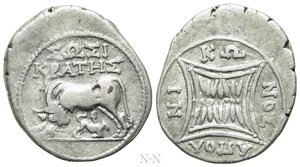
ILLYRIA. Apollonia. Drachm (Circa 229-100 BC). Sosikrates und Nikon, magistrates. Obv: ΣΩΣIKPATHΣ. Cow standing left, head lowered right, suckling calf.Rev: ΑΠΟΛ / NI / KΩ / NOΣ. Double stellate pattern within dual linear border.Maier 78; HGC 3.1, 4. Condition: Very fine.Weight: 3.03 g. Diameter: 20 mm.
Lot # 182
-
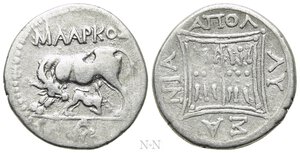
ILLYRIA. Apollonia. Drachm (Circa 229-100 BC). Maarkos and Lysanias, magistrates. Obv: MAAPKOΣ. Cow standing left, suckling calf, monogram in exergue.Rev: AΠΟΛ / ΛΥ / ΣΑ / ΝΙΑ. Double stellate pattern within linear borders.Maier 59; HGC 3.1, 4. Condition: Near very fine.Weight: 3.33 g. Diameter: 19 mm.
Lot # 181
-
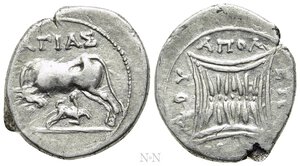
ILLYRIA. Apollonia. Drachm (Circa 229-100 BC). Agias and Epikados, magistrate. Obv: AΓΙAΣ. Cow standing left, head lowered right, suckling calf.Rev: ΑΠΟΛ / ΕΠI / KA / ΔOY. Double stellate pattern.Maier 38; HGC 3.1, 4. Condition: Very fine.Weight: 3.30 g. Diameter: 18 mm.
Lot # 180
-
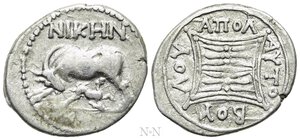
ILLYRIA. Apollonia. Drachm (Circa 229-100 BC). Niken and Autoboulos, magistrate. Obv: NIKHN. Cow standing left, head lowered right, suckling calf.Rev: ΑΠΟΛ / AYTO / BOY / ΛOY. Double stellate pattern within dual linear border.Maier 31; HGC 3.1, 4. Condition: Very fine.Weight: 3.15 g. Diameter: 19 mm.
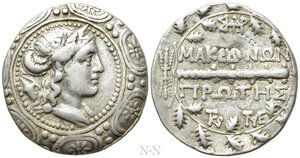
Lot # 179
-
MACEDON UNDER ROMAN PROTECTORATE. First Meris. Tetradrachm (Circa 167-148 BC). Amphipolis. Obv: Diademed and draped bust of Artemis right, with bow and quiver over shoulder; all in centre of Macedonian shield.Rev: MAKEΔONΩN / ΠPΩTHΣ. Club; monogram above, two monograms below; all within oak wreath; thunderbolt to left.SNG Copenhagen 1314; HGC 3.1, 1103. Condition: Near very fine.Weight: 16.75 g. Diameter: mm.
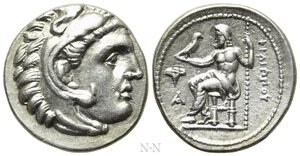
Lot # 178
-
KINGS OF MACEDON. Philip III Arrhidaios (323-317 BC). Drachm. Sardes. Obv: Head of Herakles right, wearing lion skin.Rev: ΦIΛIΠΠOY. Zeus seated left on throne, holding eagle and sceptre. Controls: In left field, rose above A.Price P107. Condition: Extremely fine.Weight: 4.30 g. Diameter: 18 mm.
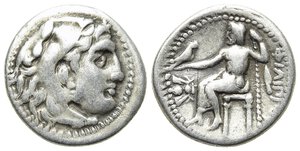
Lot # 177
-
KINGS OF MACEDON. Philip III Arrhidaios (323-317 BC). Drachm. Magnesia ad Maeandrum. Obv: Head of Herakles right, wearing lion's skin.Rev: ΦΙΛΙΠΠΟY. Zeus Aetophoros seated left with sceptre. Controls: in left field, bee right; spearhead to inner right.Price P50. Condition: Good fine.Weight: 3.92 g. Diameter: 17 mm.
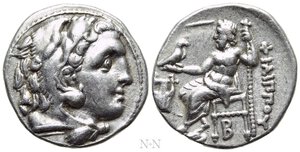
Lot # 176
-
KINGS OF MACEDON. Philip III Arrhidaios (323-317 BC). Drachm. Kolophon. Obv: Head of Herakles right, wearing lion skin.Rev: ΦΙΛΙΠΠΟΥ. Zeus seated left on throne, holding eagle and sceptre. Controls: Lyre in left field, B below throne.Price P45. Condition: Good very fine.Weight: 4.31 g. Diameter: 17 mm.
Lot # 175
-
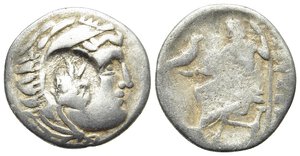
KINGS OF MACEDON. Alexander III 'the Great' (336-323 BC). Countermarked Drachm. Obv: Head of Herakles right, wearing lion skin; c/m: head of Apollo right and K in incuse circle.Rev: AΛEΞANΔPOY. Zeus seated left on throne, holding eagle and sceptre.Numismatik Naumann 148, lot 105. Condition: C/m Very fine.Weight: 4.71 g. Diameter: 19 mm.
Lot # 174
-
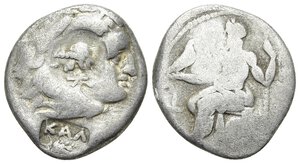
KINGS OF MACEDON. Alexander III 'the Great' (336-323 BC). Countermarked Drachm. Obv: Head of Herakles right, wearing lion skin; c/m: KAΛ and corn ears within incuse rectangle and head of Apollo right and K in incuse circle.Rev: AΛEΞANΔPOY. Zeus seated left on throne, holding eagle and sceptre.Numismatik Naumann 148, lot 104. Condition: C/ms Near very fine.Weight: 4.01 g. Diameter: 18 mm.
Results from 10801 to 10850 of 10851