Live Bidding Wednesday 11th June 2025 02:00:00 PM CET
Antiquities & Ancient Jewelry (1-221)

Risultati: 219
Pagina 2
Lot # 62
-
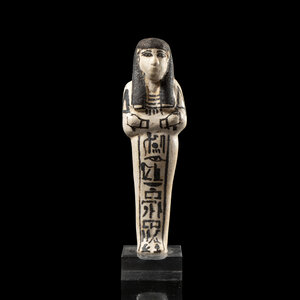
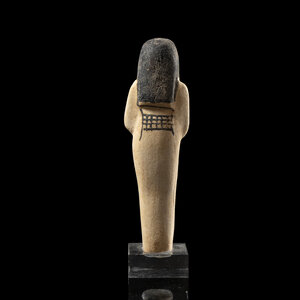
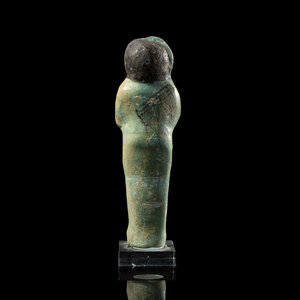
AN EGYPTIAN WHITE FAIENCE GLAZED SHABTI FOR THE LADY OF THE HOUSE INHAY.
New-Kingdom, Dynasty 19, ca. 1292-1185 BCE
H. 14 cm
Provenance
Formerly with, M.E. Gern, , Zurich 8.3.1984
Exhibition
Antikenmuseum und Basel, Ramses Göttlicher Herrscher Am Nil, 17/12/2016-18/06/2017
Depicted mummiform, wearing a long black wig, a broad collar. The arms folded over the chest, are holding hoes. The body inscribed with a single column of hieroglyphic text with the name of "Lady of the House, Inhay". The term "Lady of the House" (ancient Egyptian: nb.t-pr) was a widely used designation for married women in ancient Egypt, reflecting their position as the overseers of the household. This title, which first appeared during the Old Kingdom, was frequently paired with other titles to indicate a woman's social standing and her range of responsibilities. Beautiful state of conservation.
Lot # 63
-
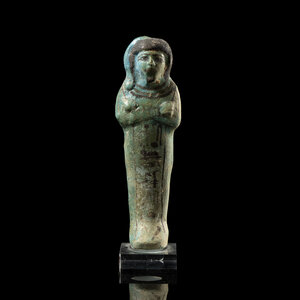
AN EGYPTIAN BLUE FAIENCE GLAZED SHABTI OF PRINCE KHAEMWASET.
New-Kingdom, Reign of Ramesses II, ca. 1279-1213 BCE
H. 15 cm
Provenance
Formerly with, Meier Jacob. 26.5.1986
Exhibition
Antikenmuseum und Basel, Ramses Göttlicher Herrscher Am Nil, 17/12/2016-18/06/2017
Depicted mummiform, wearing a short black wig with sidelock and a broad collar. The arms folded over the chest and holding hoes. The center of the body with a single column of hieroglyphic text with the name of Khaemwaset. The shabtis associated with Prince Khaemwaset, the son of Pharaoh Ramesses II and Queen Isetnofret, are among the most remarkable funerary artifacts from Egypt's 19th Dynasty. Renowned as one of the earliest known Egyptologists, Prince Khaemwaset is celebrated for his efforts in restoring and recording ancient monuments. His shabtis not only served a traditional funerary role but also symbolized his commitment to preserving Egypt's cultural legacy. The inscriptions and symbols engraved on these artifacts offer profound insights into his life, beliefs, and lasting contributions to Egyptian history.
Lot # 64
-
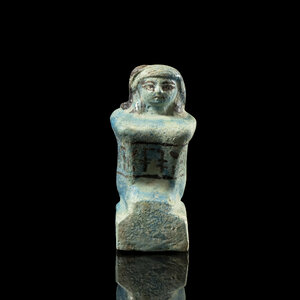
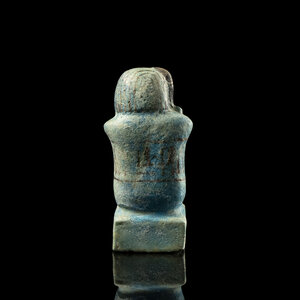
AN EGYPTIAN BLUE FAIENCE GLAZED CUBE-SHAPED FIGURE OF PRINCE KHAEMWASET.
New-Kingdom, Reign of Ramesses II, ca. 1279-1213 BCE
H. 10 cm
Provenance
Formerly with, Mikazuki, Tokyo, 10.10,1991
Exhibition
Antikenmuseum und Basel, Ramses Göttlicher Herrscher Am Nil, 17/12/2016-18/06/2017
The small cube-shaped sculpture bears an inscription on the front that extends in two directions, reading: “The King’s Son and General Ramses.” The depiction shows Prince Ramses crouched on the ground, his legs drawn up with his arms crossed over his knees.
His body is shrouded, leaving only his head and the wig with the characteristic side lock of a prince visible, both meticulously painted.
The entire figurine is mounted on a rectangular base. Ramses was the eldest son of Pharaoh Ramses II and his wife Isetnofret. He held the rank of General and later emerged as Crown Prince alongside his younger brother Merenptah during the 33rd and 34th years of Ramses II’s reign.
However, historical records suggest that he passed away sometime after the 52nd year of his father’s reign. Beautiful conservation.
Lot # 65
-
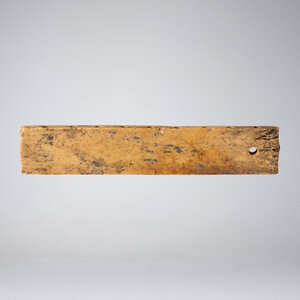
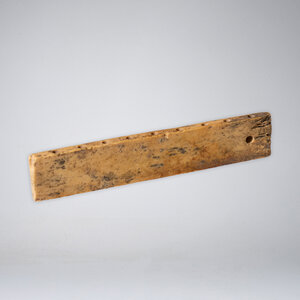
AN EGYPTIAN IVORY STOPPER FOR OUSEKH NECKLACE.
New-Kingdom, Dynasty 19, ca. 1292–1189 BC
L. 12 x H. 2,2 cm
Of rectangular shape, and pierced on the thiner edge with 9 holes (to fix the necklace rows). One hole on the longer edge.
Lot # 66
-
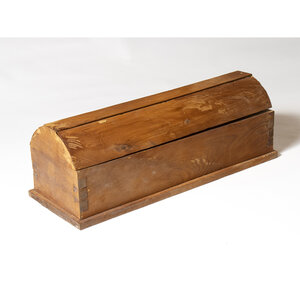
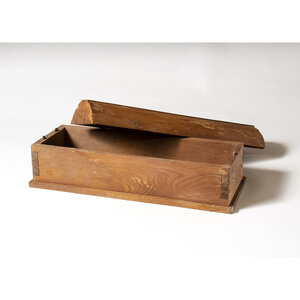
A RARE EGYPTIAN SYCOMORE SIMULACRUM SARCOPHAGUS.
Ptolemaic period, 332-30 BCE
L.47 x W.17 x H. 16 cm
Provenance
Swiss collection since 2002
Of fine quality, composed of several wooden panels secured with square-section pegs. This is the outer shell of a simulacrum sarcophagus of the god Osiris.
Lot # 67
-
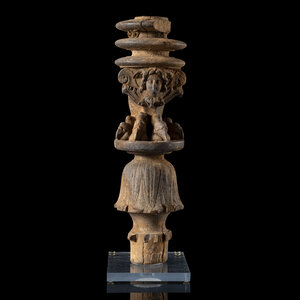
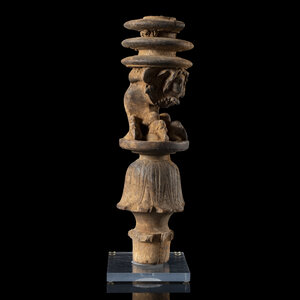
A RARE PTOLEMAIC WOODEN LEG FURNITURE.
4th-3rd century BCE.
H. 31 cm
Provenance
Acquired in 21 12.1977 (invoice)
Exhibition
Antikenmuseum und Basel
Turned and sculpted with a corinthian capital adorned with a protome depicting the head of Alexander the Great (winged). The capital stands on a powerfully carved hawk's claw over a reversed lotus. Carved out of one piece of wood. Exceptional conservation.
Lot # 68
-
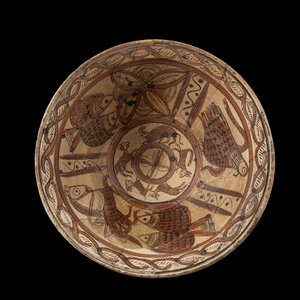
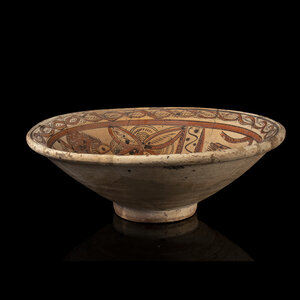
A RARE EGYPTIAN PAINTED POTTERY BOWL.
Coptic art, 6th-8th century
H. 12,5 cm / Diam. 38 cm
Provenance
Ex Beaux Arts, 21.8.1991
The border of the recessed field is adorned with an ondulated frieze with black strokes. In the large central field, animals and vegetal motifs are distribued in sections divided by red lines with black strokes, waves and dots. In the "ombo" a 4 petal flower in a circles outsided by running animals.
This swiftly painted ceramic was an everyday object; neither the material, form, size, nor decoration provide any indication that the plate, as recently speculated, was intended for ecclesiastical purposes. Assembled from large fragments and restored.
For such painted plate see, Das Museum für Spätantike und Byzantinische Kunst Berlin, p.192, 104.
Lot # 69
-
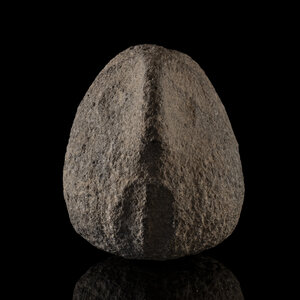
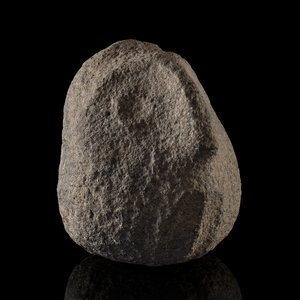
A RARE HITTITE STONE STYLIZED HEAD.
Ca. 1800 BCE
H. 15 cm
Provenance
Formerly with, Jean Sigrist, Basel, 8.4.2002
With stylized features, circular eyes and proeminent nose.
Lot # 70
-
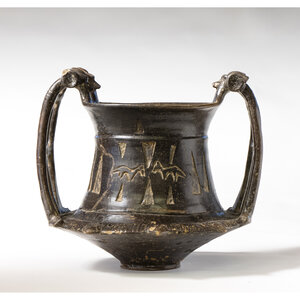
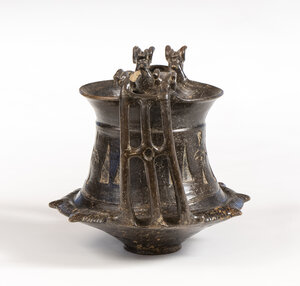
A LARGE FALISCAN IMPASTO KANTHAROS
7th century BCE
H. 24 cm
Provenance
Catalogue Nefer 9, 1991, p.11, n°4
With "plastic", incised and applied decoration. Large open-work handles terminating in a double ram's head. Restored from large fragments. Beautiful glaze 'impasto'.
Lot # 71
-
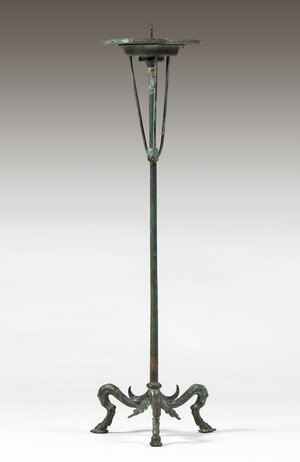
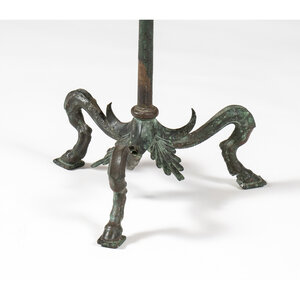
A ROMAN BRONZE THYMIATERION. Circa 2nd century A.D. H. 57,5 cm. Provenance Formerly with, Mr. M.B., 09.7.2003. With zoomorphic legs. The upper part is a modern addition.
Lot # 72
-
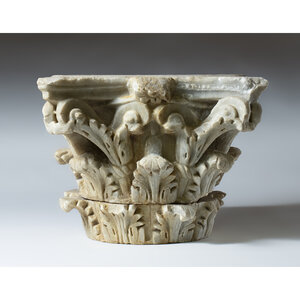
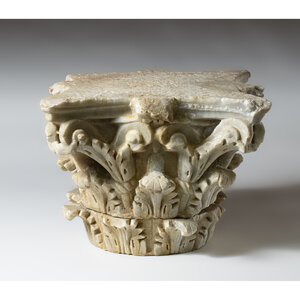
A ROMAN MARBLE COMPOSITE CORINTHIAN STYLE CAPITAL. 1st-2nd century A.D. H. 32 x L.42 x W.42 cm. Provenance Formerly with, Prescott Trading 11.7.1999. Carved with tiers of acanthus leaves, deeply cut helices at the sides, with floral ornaments on the abacus above. Beautiful conservation.
Lot # 73
-
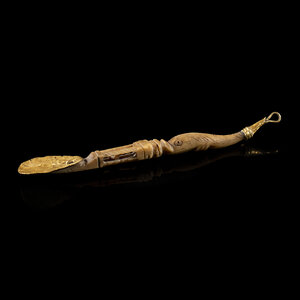
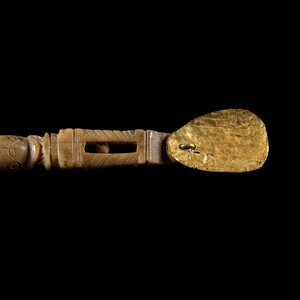
A LATE ROMAN BONE AND GOLD COSMETIC SPOON.
3rd-4th Century A.D.
L. 12 cm
Provenance
Formerly with, G. Rihani, 11.8.1990
Crafted from bone, intricately carved into the elegant form of a dolphin, with circular eyes and incised details on the fins and tail—a powerful symbol in Roman culture. Dolphins were revered as protectors of sailors and guides across the seas, often associated with the god Neptune and seen as harbingers of good fortune. The handle is masterfully sculpted, featuring a rectangular openwork section that encloses a small spherical bead, adding a touch of refined ornamentation typical of luxury items from this period.
The fiddle-shaped bowl of the spoon is adorned with a finely hammered sheet of gold, perfectly contoured to its oval shape. This application of gold leaf not only enhances its aesthetic value but also indicates the social status of its owner. Additionally, the dolphin's tail is enveloped in a gold plate, terminating in a suspension ring. This suggests it may have been worn or displayed, further highlighting its status as a luxury object rather than a mere functional utensil.
Lot # 75
-
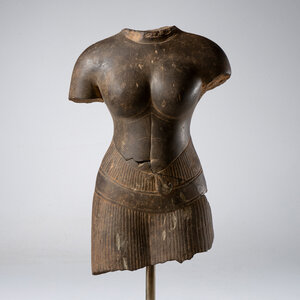
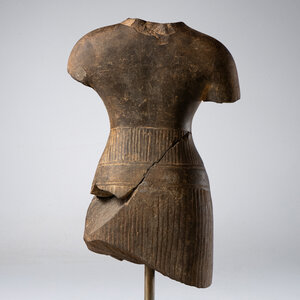
A KHMER GREY SANDSTONE FIGURE FIGURE OF A FEMALE DEITY.
Baphuon style, 11th century
H. 32 cm
Provenance
Formerly with, Mr. Visuth Prathumhong Bangkok (import document)
Swiss private collection, acquired on May 23, 1988
The goddess is adorned with a sampot featuring vertical pleats and a belt with a flange. Her bare torso, delicately modelled, is sculpted with well-defined breasts.
During the Baphuon period, the robust, muscular torsos seen in earlier centuries evolved into more refined forms, characterized by rounded shoulders, a slender waist, and curvaceous hips. Prajnaparamita, symbolizing the essence of dharma in tenth-century Khmer Mahayana Buddhism, is distinguished by the effigy of the Buddha atop her chignon.
For comparison, see a similar eleventh-century Baphuon-style female deity from the Florence and Herbert Irving Collection, auctioned at Christie's New York on March 21, 2019 (Lot 1108).
Lot # 76
-
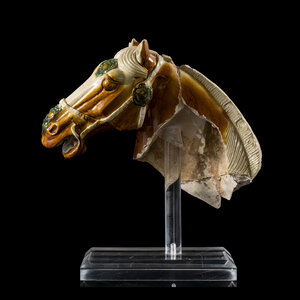
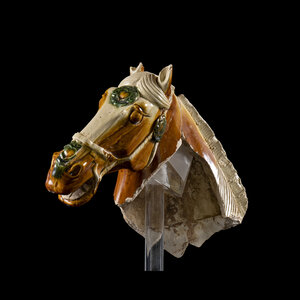
A LARGE TANG SANCAI GLAZED-POTTERY HORSE HEAD. 618-907 A.D. H. 28 x L. 33,5 cm. Provenance Formerly with, Suzanne Chen, Hong Kong, Swiss private collection since 2007 (importation document). Re-assembled from large fragments. Its head turned slightly to the left and mouth open. Its mane, tail, and central forelock between pricked ears are covered with a cream glaze. The bridle and harness are decorated with large scrolling foliate appliques.
Lot # 77
-
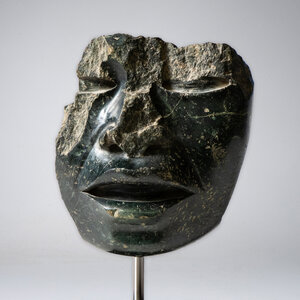
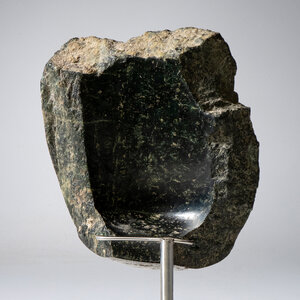
A CHONTAL SERPENTINE FUNERARY MASK OF A DIGNITARY.
100-500 A.D.
H. 16 x L. 13,5 cm
Provenance
Formerly in the private collection of Mr. Leydier
Swiss private collection since the 1980's
Published in Collonges, Suisse, 2001, p. 63, fig. 82
Representing the face of a dignitary with a hieratic and timeless expression. Cavities carved into the eyes and mouth, with traces of mineral and plant-based resins, suggest that in pre-Columbian times, these features were inlaid with hard stones to accentuate the gaze and highlight the mouth. The balanced-shaped eyebrows are slightly raised in relief, the mouth is carefully sculpted, and the lip contours are harmonious, giving this piece an expressive movement of great interest.
Although realistic in appearance, these masks were probably not portraits but rather representations of an idealized face.
Recent archaeological discoveries in the Guerrero region and the Guatemalan border have revealed that this civilization is, in fact, more recent than previously believed. It seems that this people (the Chontals) maintained commercial contacts with their neighbors in Teotihuacan, and the influence of the latter is evident in some of their works, as is the case here.
Lot # 78
-
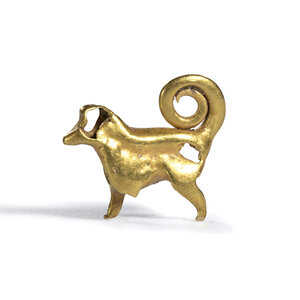
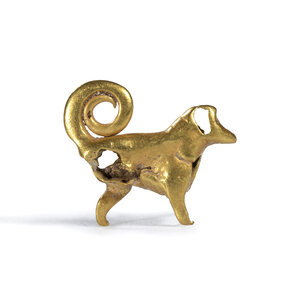
*AN ELAMITE GOLD DOG AMULET.
Ca. 3100-2900 BCE
L. 1,6 cm
Provenance
Old private collection, Switzerland, between 1980s-1990s
Shaped like a small dog, witha tick tail curled over its back.
Missing left front leg, with losses to the head and hindquarters. The dog was a holy animal in Elam and was associated with Gula, the goddess of healing.
* For Swiss buyers, VAT applies to the hammer price and buyer's premium (only for the lot with the "*" mention)
Lot # 79
-
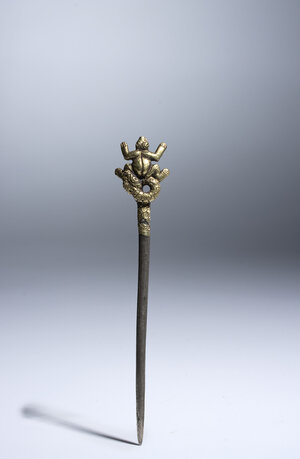
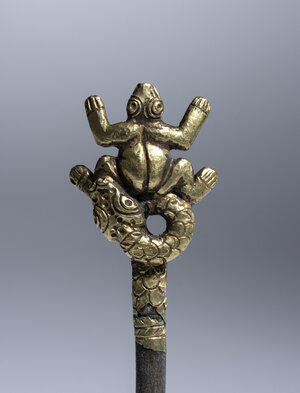
*A WESTERN ASIAN GILTED SILVER PIN.
Bactria, Late 2nd-1st Millennium BCE
L. 14,5 cm
Provenance
Old private collection, Switzerland, between 1980s-1990s
This rare silver pin, partially gilded at the terminal, is finely crafted in the form of a serpent attacking a frog. Both the reptile and the amphibian are rendered in a stylized manner, with prominently bulging eyes. The serpent’s scales and the anatomical features of the frog are carefully engraved, reflecting a high level of craftsmanship.
The "exceptional" scene that it depicts represents an important origin myth—which references the creation of the world. For Swiss buyers, VAT applies to the hammer price and buyer's premium (only for the lots with the * mention)
Lot # 80
-
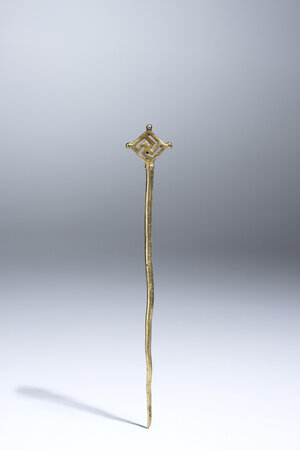
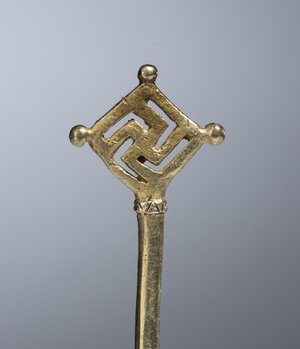
*A RARE WESTERN ASIAN GOLD/ELECTRUM PIN WITH SWASTIKA.
Bactria, 3rd-2nd Millennium BCE
L: 13.2 cm ; 14 gr.
Provenance
Swiss collection, acquired on the Parisian market, Binoche et Giquello, 30 May 2012, lot 96
In a very fine state of preservation, the shaft is topped with an openwork diamond-shaped section decorated with a swastika motif and spheres at the points.
The swastika is an ancient symbol that appears across many cultures, including in Bactria, a historical region in Central Asia (covering parts of modern-day Afghanistan, Uzbekistan, and Tajikistan). In Bactrian art and artifacts, particularly from the Bronze Age and early Iron Age, the swastika often appears as a geometric or solar motif, associated with good fortune, cosmic order, or eternity—long before its later appropriation in the 20th century. (see British Museum, a seal with the swastika, 1947,0416.8)
For Swiss buyers, VAT applies to the hammer price and buyer's premium (only for the lots with the * mention)
Lot # 81
-
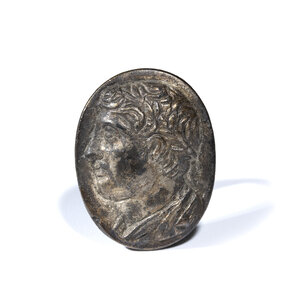
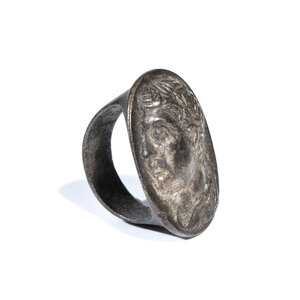
*A GREEK SILVER FINGER RING.
Hellenistic period, circa 3rd century BCE
L. 3 cm (1 3/16 in)
Provenance
European Private Collection, acquired in the late 19th-early 20th century.
Christie's NY, sale 1914, 06/12/2007, lot 309
With a wide hoop, flat on the interior, slightly rounded on the exterior, expanding to the large oval bezel, with a draped profile portrait bust of a Hellenistic ruler in relief, the fleshy face with short wavy hair bound in a fillet. Great state of conservation.
For Swiss buyers, VAT applies to the hammer price and buyer's premium (only for the lots with the * mention)
Lot # 82
-
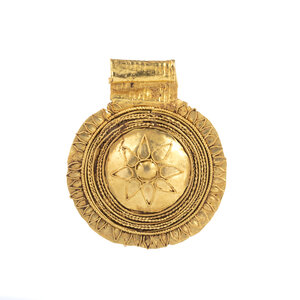
*A LARGE GREEK HELLENISTIC GOLD PENDANT.
3rd-2nd century BCE
L. 3,7 cm
Provenance
Old private collection, Switzerland, between 1980s-1990s
Composed of two round gold plates soldered together. On the main face, the raised center is decorated with an eight-petal rosette made of gold wires. Surrounding it are concentric bands featuring an alternating pattern of plain, twisted, and braided cables. The edge is adorned with a radiating motif. The suspension loop is formed from a gold sheet folded over itself. In excellent condition. This element was likely the central pendant of a necklace.
For Swiss buyers, VAT applies to the hammer price and buyer's premium (only for the lots with the * mention)
Lot # 83
-
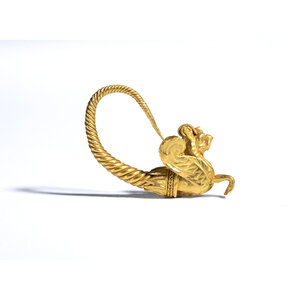
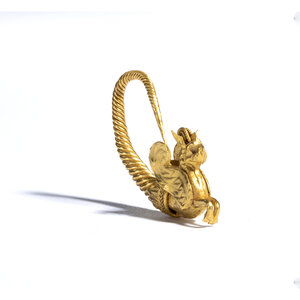
*A GREEK HELLENISTIC GOLD EARRNG WITH A WINGED LION.
3rd century BCE
L. 3 cm
Provenance
Old private collection, Switzerland, between 1980s-1990s
The front part is shaped as a winged lion, with the curved wing tips finely detailed through cold incisions. The ears are adorned along the edges with an incised gold cable. The junction between the body and the attachment is formed by a tubular section composed of a round cable and braided wires, from which emerges a thick twisted cable intended for ear attachment. Excellent preservation and impressive dimensions.
For Swiss buyers, VAT applies to the hammer price and buyer's premium (only for the lots with the * mention)
Lot # 84
-
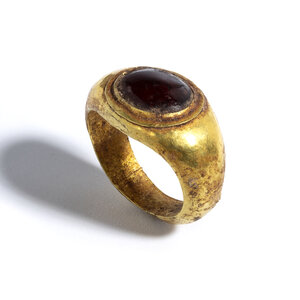
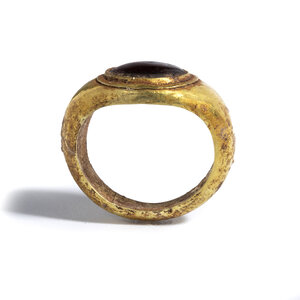
* A ROMAN GOLD RING SET WITH A GARNET.
1st century A.D.
Diam. 2,2 cm
Provenance
Old private collection, Switzerland, between 1980s-1990s
With a single hoop, flatten within and rounded without, broadering at the shoulders with an oval box-setting containing an oval garnet stone. Patina and deposit on the surface.
For Swiss buyers, VAT applies to the hammer price and buyer's premium (only for the lots with the * mention)
Lot # 85
-
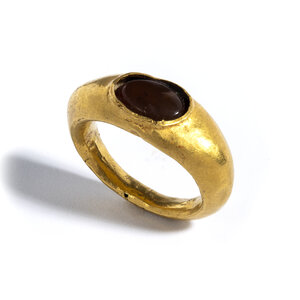
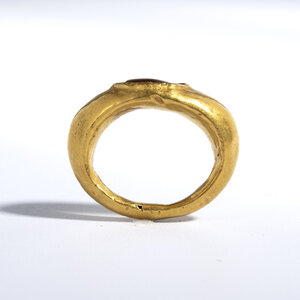
*A ROMAN GOLD RING SET WITH A GARNET.
1st century A.D.
Diam. 2,4 cm
Provenance
Old private collection, Switzerland, between 1980s-1990s
With a single hoop, flatten within and rounded without, broadering at the shoulders with an oval box-setting containing an oval garnet stone. Patina and deposit on the surface.
For Swiss buyers, VAT applies to the hammer price and buyer's premium (only for the lots with the * mention)
Lot # 86
-
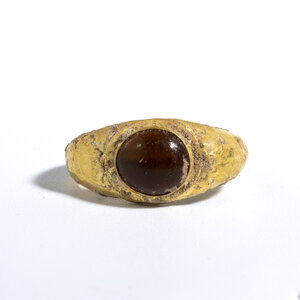
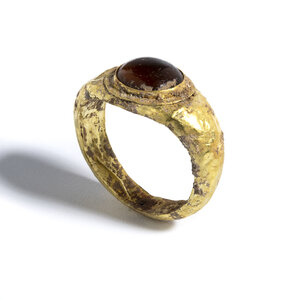
*A ROMAN GOLD RING SET WITH AN ORANGE GARNET.
1st century A.D.
Diam. 2,2 cm
Provenance
Old private collection, Switzerland, between 1980s-1990s
With a single hoop, flatten within and rounded without, broadering at the shoulders with an oval box-setting containing an oval orange garnet stone. Patina and deposit on the surface.
For Swiss buyers, VAT applies to the hammer price and buyer's premium (only for the lots with the * mention)
Lot # 87
-
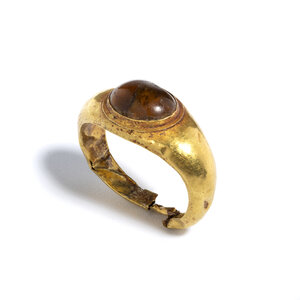
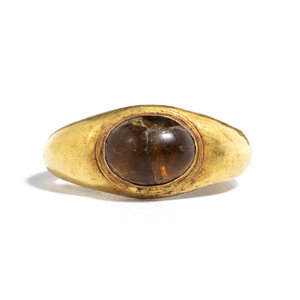
*A ROMAN GOLD RING SET WITH A ORANGE CABOCHON GARNET. Ca. 1st Century A.D. Diam. 2,4 cm. Provenance Old private collection, Switzerland, between 1980s-1990s With a single hoop, flatten within and rounded without, broadering at the shoulders with an oval box-setting containing an oval orange garnet stone (accident). Patina and deposit on the surface.
For Swiss buyers, VAT applies to the hammer price and buyer's premium (only for the lots with the * mention)
Lot # 88
-
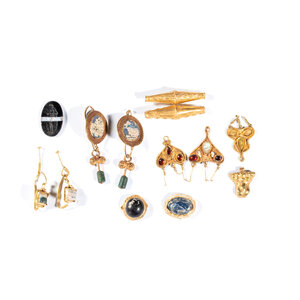
*A GROUP OF ROMAN GOLD JEWELRY.
2nd-3rd century A.D.
Max. L. 2 cm
Provenance
Old private collection, Switzerland, between 1980s-1990s
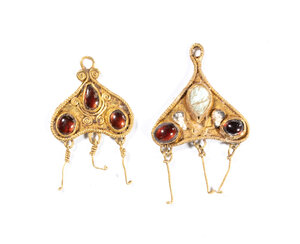
Comprising: a glass intaglio with a Venus; a pair of gold and glass earrinfs with pendeloques; two losange-shaped tubular gold elements (from a necklace); a pair of gold earrings with single hoop and square box setting with glass; two triangle shape gold elements set with glass and garnets; a gold pendeloque with three oval box settings (missing stones); a gold pendant in the shape of a phallus; two gold elements with glass settings.
For Swiss buyers, VAT applies to the hammer price and buyer's premium (only for the lots with the * mention)
Lot # 89
-
*A ROMAN GOLD RING SET WITH A GLASS INTAGLIO.
1st century A.D.
Diam. 1,8 cm
Provenance
Old private collection, Switzerland, between 1980s-1990s
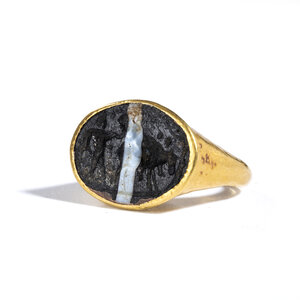
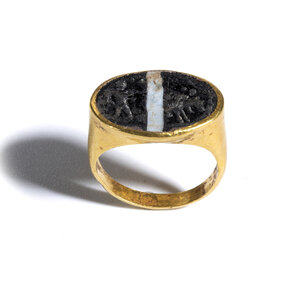
With a single hoop, broadering at the shoulders ending with an oval setting with a large oval glass intaglio imitating a banded agate. Bucolic scene. Patina and deposit onthe surface. Very good state of conservation.
For Swiss buyers, VAT applies to the hammer price and buyer's premium (only for the lots with the * mention)
Lot # 90
-
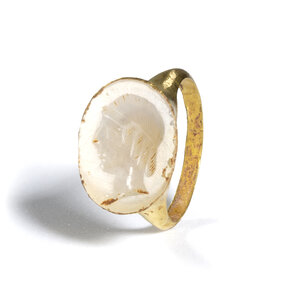
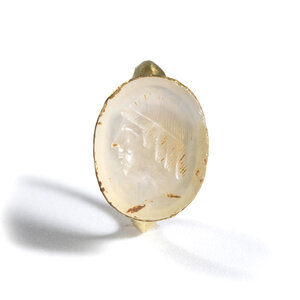
*AN EASTERN MEDITERRANEAN GOLD RING SET WITH AN AGATE INTAGLIO. HEAD OF APOLLO.
1st century A.D.
Diam. 2,1 cm
Provenance
Old private collection, Switzerland, between 1980s-1990s
With a single hoop, flatten within and rounded without and surmounted by a high raised box setting containing an oval agate intaglio. Head of Apollo facing left. Deposit and patina. Intact.
For Swiss buyers, VAT applies to the hammer price and buyer's premium (only for the lots with the * mention)
Lot # 91
-
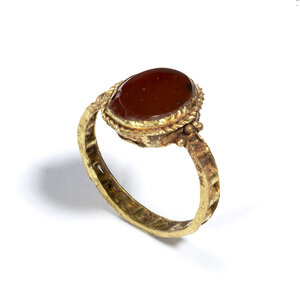
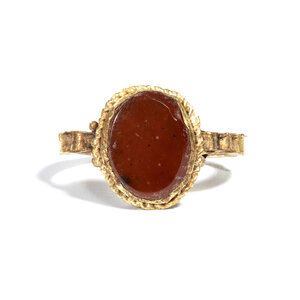
*A ROMAN GOLD RING WITH A CARNELIAN STONE.
3rd-4th century A.D.
Diam. 2,5 cm
Provenance
Old private collection, Switzerland, between 1980s-1990s
With a rounded hoop formed by a platted wavy gold band in the center and surmounted by an oval box-setting with a carnelian agate stone (accident). Deposit and patina.
For Swiss buyers, VAT applies to the hammer price and buyer's premium (only for the lots with the * mention)
Lot # 92
-
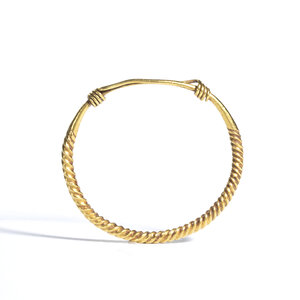
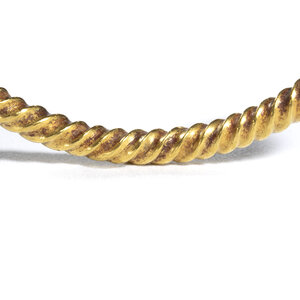
*A ROMAN GOLD CHILD BRACELET.
1s-2nd century A.D.
Diam. 4,2 cm
Provenance
Old private collection, Switzerland, between 1980s-1990s
In exceptionally well-preserved condition, made from a thick twisted gold wire that tapers near the clasp. The ends are coiled upon themselves. Traces of deposit.
For Swiss buyers, VAT applies to the hammer price and buyer's premium (only for the lots with the * mention)
Lot # 93
-
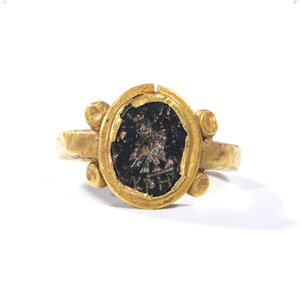
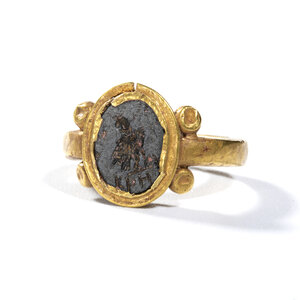
*A ROMAN GOLD RING SET WITH A JASPER INTAGLIO.
2nd-3rd century A.D.
Diam. 1,8 cm
Provenance
Old private collection, Switzerland, between 1980s-1990s
With a single hoop adorned at the shoulders of spherical beads and joined with an oval box setting containing a jasper intaglio. Owl with three greek letters. Patina and deposit.
For Swiss buyers, VAT applies to the hammer price and buyer's premium (only for the lots with the * mention)
Lot # 94
-
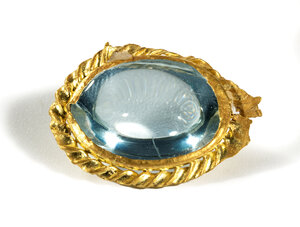
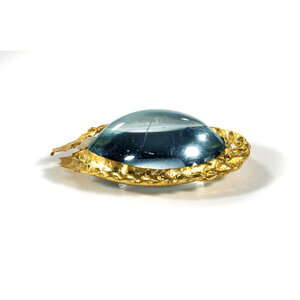
*A ROMAN GOLD PENDANT WITH A CABOCHON AQUAMARINE.
2nd-3rd century A.D.
L. 2,6 cm
Provenance
Old private collection, Switzerland, between 1980s-1990s
The large oval cabochon acquamarine is set in a gold frame adorne with a large twiste gold band.
For Swiss buyers, VAT applies to the hammer price and buyer's premium (only for the lots with the * mention)
Lot # 95
-
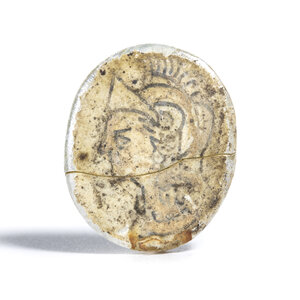
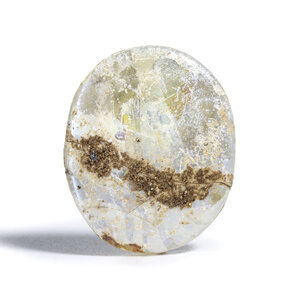
*A RARE ROMAN GLASS WITH PAINTED DESIGN. HEAD OF ATHENA. 1st-3rd century A.D. Dim. 2,5 x 2,1 cm Provenance Old private collection, Switzerland, between 1980s-1990s Of oval shape, with iridescencen and a painted design on the surface depicting a portrait of the goddess Athena facing left. Helmeted. Crack. Deposit. Rare.
For Swiss buyers, VAT applies to the hammer price and buyer's premium (only for the lots with the * mention)
Lot # 96
-
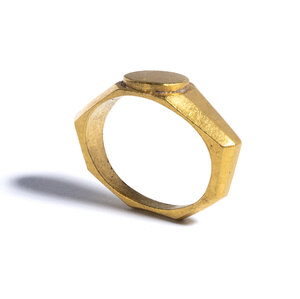
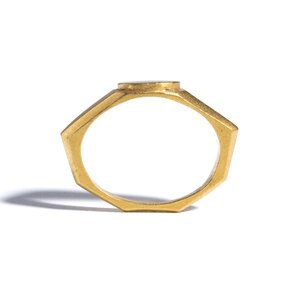
*A ROMAN GOLD RING WITH PLAIN BEZEL.
2nd-3rd century A.D.
Diam. 2,2 cm
Provenance
Old private collection, Switzerland, between 1980s-1990s
Of octogonal form, with a low raused oval bezel (ungrave). Beautiful conservation.
For Swiss buyers, VAT applies to the hammer price and buyer's premium (only for the lots with the * mention)
Lot # 97
-
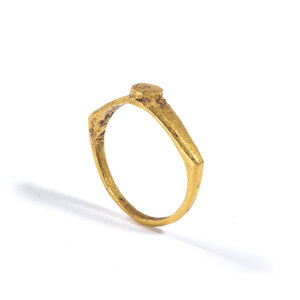
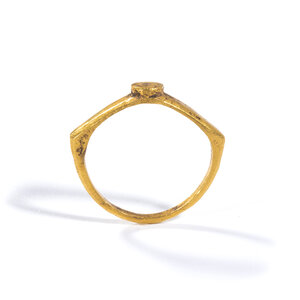
*A ROMAN GOLD RING WITH PLAIN BEZEL.
2nd-3rd century A.D.
Diam. 2,2 cm
Provenance
Old private collection, Switzerland, between 1980s-1990s
The single hoop with angular section at shoulders surmounted by a raised oval plain bezel (ungraved). Patina and deposit on the surface. Very good state of conservation.
For Swiss buyers, VAT applies to the hammer price and buyer's premium (only for the lots with the * mention)
Lot # 98
-
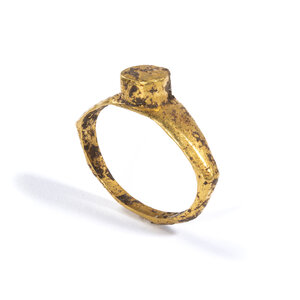
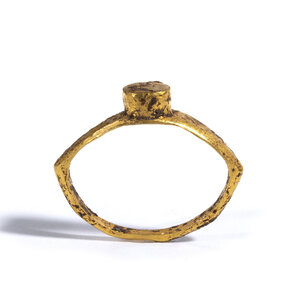
*A ROMAN GOLD RING WITH HIGH BEZEL.
2nd-3rd century A.D.
Diam. 2,1 cm
Provenance
Old private collection, Switzerland, between 1980s-1990s
The single hoop with angular section at shoulders surmounted by a high raised oval plain bezel (ungraved). Patina and deposit on the surface. Very good state of conservation.
For Swiss buyers, VAT applies to the hammer price and buyer's premium (only for the lots with the * mention)
Lot # 99
-
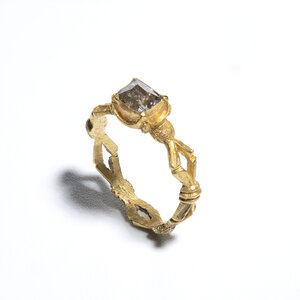
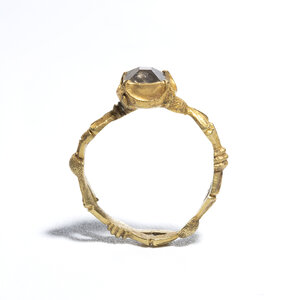
* A RENAISSANCE GOLD RING SET WITH A FACETED ROCK CRYSTAL.
Mid 16th century
H. 1,5 cm
Provenance
Old private collection, Switzerland, between 1980s-1990s
A splendid example of a European Renaissance ring dating to 1550–1600. A table-cut rock crystal is set in a closed setting. The quatrefoil-shaped bezel is enclosed by an inset crescent on each side and flanked by stippled shoulders, extending into a hoop with an alternating lozenge-shaped cross-section and carved balusters.
For similar examples of 16th-century rings, see items 334 and 430 in Rings: Jewellery of Power, Love and Loyalty (2007) by Diana Scarisbrick; item AF.1743 in the British Museum collection; and items 279 and 281 in Victoria and Albert Museum Catalogue of Rings (1930) by C. Oman.
For Swiss buyers, VAT applies to the hammer price and buyer's premium (only for the lots with the * mention)
Lot # 100
-
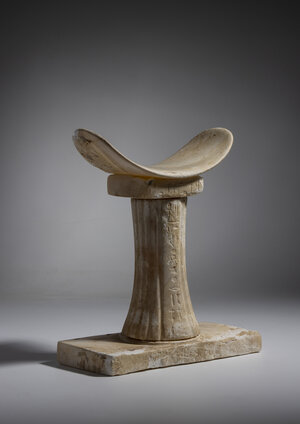
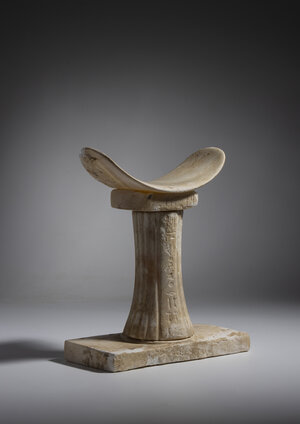
*AN EGYPTIAN ALABASTER HEAD REST OF NEFER-NEFEROU.
Old Kingdom, Dynasty 6, 2400-2250 BCE
H. 20 cm x W. 17 cm
Provenance
Formerly, old private European collection, collected in the late 1970's
Ex Bonhams, London, 14 May 2003, lot 13
Accompanied with an Art Loss Register from 2004
This headrest is composed of four distinct elements: an arched upper section designed to support the head; a square abacus; a column featuring a smooth band reserved for the inscription; and a flat, rectangular base sculpted with a circular platform on which the column pedestal rests. Its form, clearly inspired by funerary architectural models, emerged during the Old Kingdom and reached a fully developed classical style in Dynasty 6. This example is characteristic of that period, with a flaring column featuring evenly spaced fluting and a subtle entasis. Damage—such as the break on the right side of the gracefully curved arch—is common on objects of this type.
Although headrests of this general shape are widespread, such forms were typically reserved for high-ranking officials. Four-part headrests made of calcite, however, are extremely rare. All known examples date to Dynasty 6 and served exclusively as funerary or votive objects. The construction method—assembling four separate components—and the slightly exaggerated height of the column suggest that these headrests were not intended for everyday use.
The dedicatory inscription runs from right to left on the abacus and continues vertically down the column. It is identical to the text engraved on the horizontal band and follows a conventional formula identifying the deceased. The abacus reads: “the sole of Nefer-Neferti,” while the column inscription states: “the sole friend, venerable before the great god, Nefer-Neferti.”
For a similar uninscribed headrest see W.C. Hayes, The Scepter of Egypt, vol I, (New York 1990), p.121, fig.75. For the form of the headrest cf. C. Ziegler, D. Arnolds, K Grzymski (contributors), Egyptian Art in the Age of the Pyramids, (York 1999), p.452, no.183.
For Swiss buyers, VAT applies to the hammer price and buyer's premium (only for the lots with the * mention)
Lot # 101
-
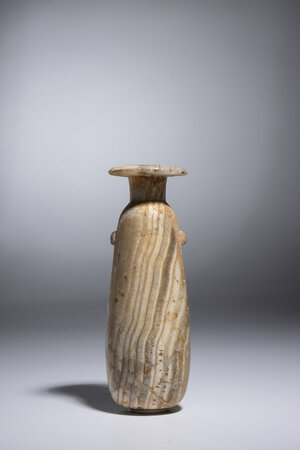
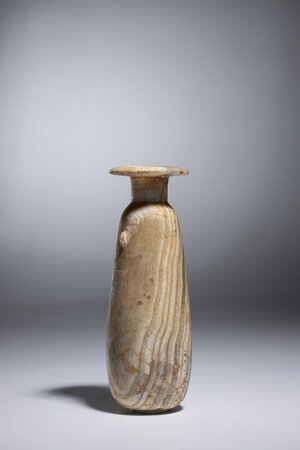
*AN EGYPTIAN ALABASTER ALABASTRON.
Late Period, ca. 7th-6th century BCE
H. 15,8 cm
Provenance
Formerly, private collection, Switzerland, between 1980-1990
Acquired prior 1992
With piriform body, disc rim, and twin vestigial handles . Resored at the base.
For Swiss buyers, VAT applies to the hammer price and buyer's premium (only for the lots with the * mention)
Lot # 102
-
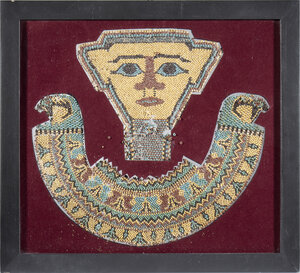
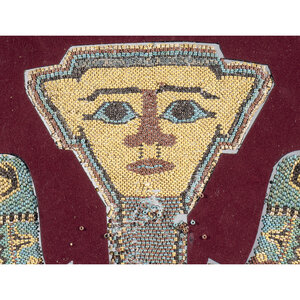
*AN EGYPTIAN GLAZED COMPOSITION MUMMY BEAD MASK WITH COLLAR NECKLACE.
Late Period, 664-332 BCE
H. (mask) 16 cm / L. (necklace) 29 cm
Provenance
Formerly, private collection Mr. & Mrs. François and Marion Reber, Burki, Rue des Beaux-Arts 10, Neuchâtel, Switzerland.
Collected in the Early 20th century by Mr F. Burki, father of Mrs Marion Reber.
The mask composed of disc-shaped spacer beads glued together, the yellow face with the edges banded in black, turquoise, coral pink and yellow, the eyes and eyebrows outlined in black, with a coral pink mouth and nose, and a horizontal striped beard.
A beautiful 4 rows ousekh necklace, with Horus falcon head clasp.
For Swiss buyers, VAT applies to the hammer price and buyer's premium (only for the lots with the * mention)
Lot # 103
-
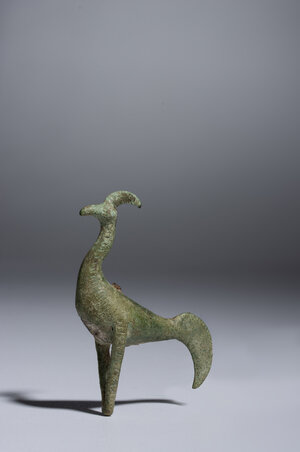
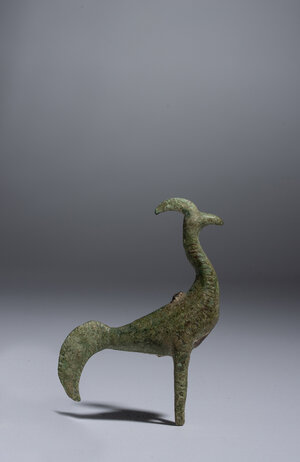
*A GREEK GEOMETRIC BRONZE BIRD.
Ca. 9th century BCE
H. 7,3 cm
Provenance
Old private collection, Switzerland, between 1980s-1990s
With its crest and full tail, this bird, perhaps a peacock, is particularly magnificent. It could have stood on its base or been hung through the loop on the back (missing). The fullness of its body is enhanced by the elegant verticality of the posture. Great state of conservation.
In Geometric art, animal representations vastly outnumber those of humans, with horses, birds, sheep, bulls, and other quadrupeds appearing most frequently. Thousands of cast bronze figurines have been uncovered in sanctuaries across ancient Greece, where they were left as personal votive offerings to the gods. Bronze birds such as this example—shown standing on a base—are most commonly found in sanctuaries located in northern Greece.
For Swiss buyers, VAT applies to the hammer price and buyer's premium (only for the lots with the * mention)
Lot # 104
-
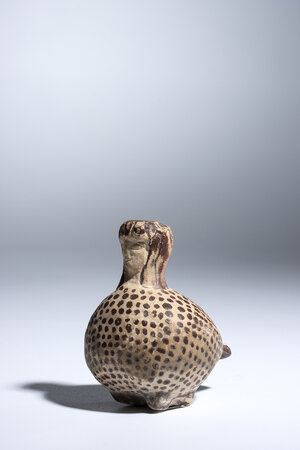
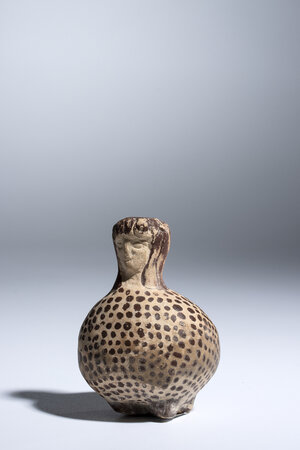
*A CORINTHIAN 'PLASTIC' SIREN VASE.
Late 7th- Early 6th century BCE
H. 9 x L. 9 cm
Provenance
Old private collection, Switzerland, between 1980s-1990s
With a bird-shape body and woman's head. The vessel is decorated with ochre-red dots on the body, and ochre-red paint on the hair and legs. This plastic vase belongs to the rare group of “plainest vases,” representative of the refined technique of Corinthian coroplasts during the Archaic period. Beautiful conservation.
For a similar typology see a Siren vase, Würzburg, Martin von Wagner Museum K 1781 (see: MASS PRODUCTION, STANDARDIZED PARTS, AND THE CORINTHIAN "PLASTIC" VASE, American School of Classical Studies at Athens, plates 121-122)
For Swiss buyers, VAT applies to the hammer price and buyer's premium (only for the lots with the * mention)
Lot # 105
-
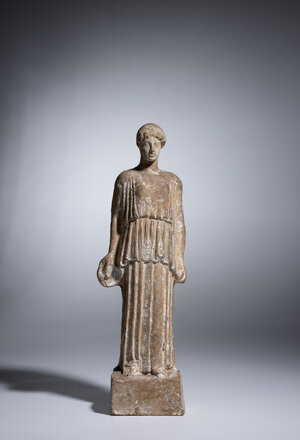
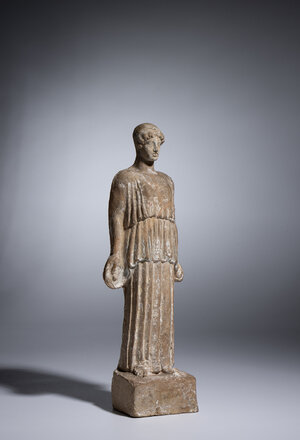
*A GREEK TERRACOTTA KORE.
Boeotian, 5th century BCE
H. 33,5 cm
Provenance
Formerly, collection Mutiaux, Hôtel Drouot, Paris, Succession du Colonel W. (6e vente), expert Charles Ratton, 9 mai 1952 : n°46 (Planche V )
Collection, M. W. Paris, 1950s-1970s
Artcurial Auction, Paris, Arts Oriental, collection Francoise and Claude BOURELIER, Sale 2671, 12/05/2015, Lot 91
Export Certificate for cultural property Nr.167194
Female terracotta figurine standing on a cubic base, arms at her sides, wearing a long pleated chiton, holding a patera in one hand and an apple in the other.
Traces of blue, red, and white pigments.
Fractures and restorations.
For Swiss buyers, VAT applies to the hammer price and buyer's premium (only for the lots with the * mention)
Lot # 106
-
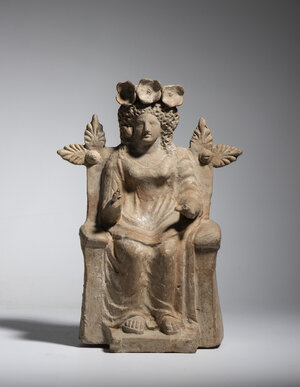
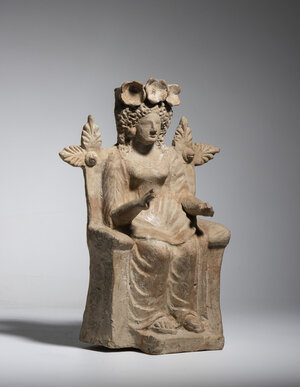
*A GREEK TERRACOTTA STATUETTE OF A GODDESS. 4th century BCE H. 23 cm. Provenance Formerly, private collection, Mr. J.C. (1936-2016), Geneva, Switzerland, collected 1970's-2005. Seated on elaborate throne with footstool, The back corners decorated with two finely incised leaves and a lion head mascaron. The goddess is characterized by an elaborate hairstyle adorned with a floral crown. She wears peplos and himation on top. The drapery is finely modeled.
For Swiss buyers, VAT applies to the hammer price and buyer's premium (only for the lots with the * mention)
Lot # 107
-
*AN EXCEPTIONAL ETRUSCAN TERRACOTTA HEAD OF A YOUNG WOMAN.
6th-5th century BCE
H. 19,5 cm
Provenance
Formerly, private collection, M.P., France, acquired before 1970
Swiss private collection acquired in 2008
With T.L test from ARCHEOLAB TL, in 2008
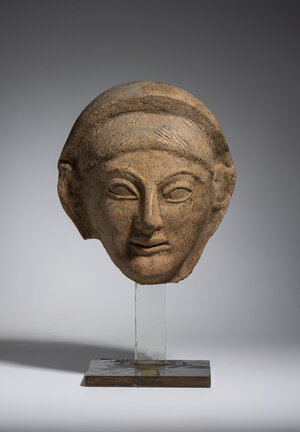
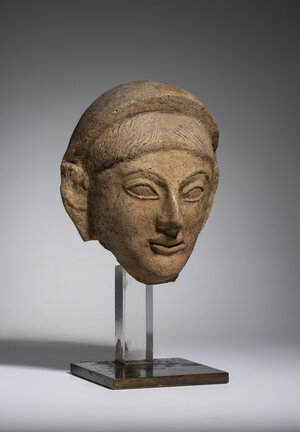
The head presented front face is characterized by a elongated oval face with archaic features modeled with great finesse; large almond-shape eyes framed by thick lids, eyebrows in relief, proeminent straightnose and beautiful semi opened lips. The short front is framed by a large band of hair depicted by wavy incisions and surmounted by a veil that goes behind the head letting the pointed ears visible. Restoration on the back. Beautiful conservation.
The archaic imprint of the physiognomy, along with the hieratic aspect, is characteristic of Etruscan productions from the 8th to the 6th century BCE, where Greek influence is notably present (cf. Greek protome of a woman, Louvre Museum, inv.A 407).
For Swiss buyers, VAT applies to the hammer price and buyer's premium (only for the lots with the * mention)
Lot # 108
-
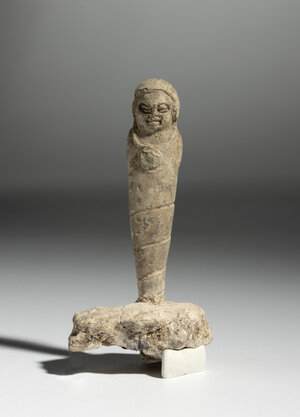
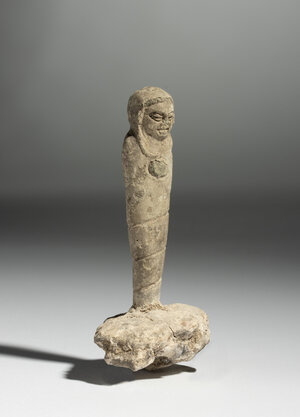
*AN ETRUSCAN LEAD VOTIVE FIGURE.
Ca. 5th-4th century BCE
H. 10,5 cm
Provenance
Old private collection, Switzerland, between 1980s-1990s
This votive miniature figure depicts a newborn baby in a swaddling. The chest adorned with a neckace and a bulla (?). Standing on its base. Recent studies associate these ex-votos with the cult of the mother goddess Matuta, whose oldest known temple was located in the Forum Boarium in Rome and was destroyed in 506 BCE. (see: MATER MATUTA, ‘FERTILITY CULTS’ AND THE INTEGRATION OF WOMEN IN RELIGIOUS LIFE IN ITALY IN THE FOURTH TO FIRST CENTURIES BC, Papers of the British School at Rome , Volume 87 , October 2019 , pp. 1 - 45)
For Swiss buyers, VAT applies to the hammer price and buyer's premium (only for the lots with the * mention)
Lot # 109
-
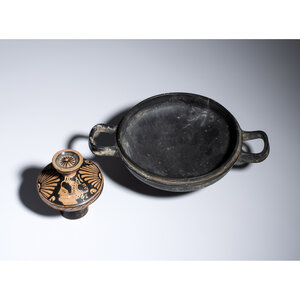
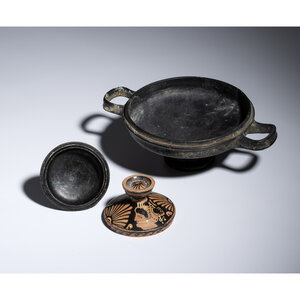
*A LOT OF MAGNA GRAECIA TERRACOTTA PYXIS
Circa 4th century BCE
H. max 23,3 cm
Provenance
Old private collection, Switzerland, between 1980s-1990s
With high discoidal foot. The lid, decorated in reserved red, features the head of a woman framed by large palmettes. The other one, with lateral handles, is covered in black ware. (Lid missing.)
For Swiss buyers, VAT applies to the hammer price and buyer's premium (only for the lots with the * mention)
Lot # 110
-
*AN APULIAN RED-FIGURE PLATE.
Ca. 340 BCE
Diam. 23,2 cm. (9 1/8 in.)
Provenance
Formerly, collection Pierre & Claude Vérité, acquired between 1930-1960, Paris
Ex Christie's France, sale 1063, 20/12/2011, Collection Pierre et Claude Vérité, lot 59
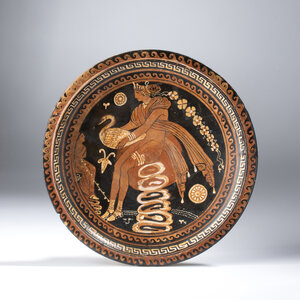
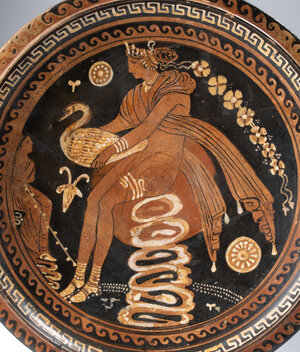
Reassembled from large fragments. Depicting a young woman seated on a rock, holding a swan in her hands (likely Leda and the Swan), her wavy hair pulled back into a bun and held in place by a sakkos. She is adorned with jewelry on her wrist, thigh, and ankles, and wears a long drapery over her shoulders. In front of her stands a young man wrapped in a long himation, holding a staff. The background is decorated with floral motifs. The scene is framed by a frieze of waves and meanders, with another wave frieze along the rim. Traces of white and orange pigment highlights remain.
For Swiss buyers, VAT applies to the hammer price and buyer's premium (only for the lots with the * mention)
Lot # 111
-
*AN ATTIC RED-FIGURE ASKOS.
5th-4th century BCE
Diam. 10,5 cm
Provenance
Swiss collection, acquired at Tajan, Paris, 09/04/2010
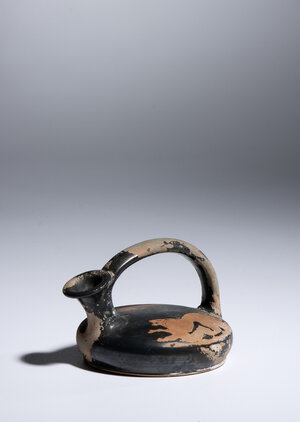
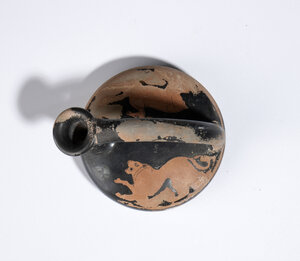
Askos with a lenticular body, decorated in reserved red with a lion chasing a doe. Surface wear. Intact.
For Swiss buyers, VAT applies to the hammer price and buyer's premium (only for the lots with the * mention)
Lot # 112
-
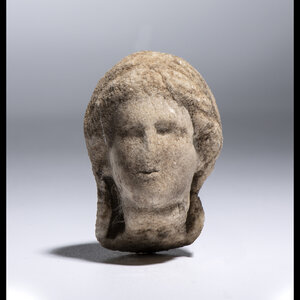
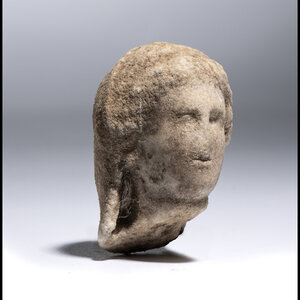
*AN HELLENISTIC MARBLE HEAD OF A VEILED WOMAN.
Ca. 4th-3rd century BCE
H. 8 cm x L. 5 cm x W. 6 cm
Provenance
Old private collection, Switzerland, between 1980s-1990s
The head, presented frontally, is characterized by a rounded oval shape. Although partially worn by time, the features still reveal almond-shaped, carved eyes, a prominent, ridged brow, and a small, slightly open mouth with somewhat full lips. The short forehead is surmounted by a hairstyle composed of long strands of hair drawn back beneath a veil. The physiognomy and overall appearance are directly reminiscent of Hellenistic Greek portraiture.
For Swiss buyers, VAT applies to the hammer price and buyer's premium (only for the lots with the * mention)
Lot # 113
-
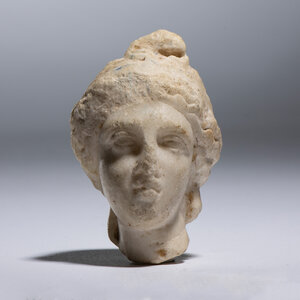
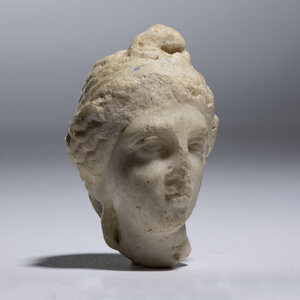
*A ROMAN MARBLE HEAD OF A GODDESS.
2nd-3rd century A.D.
H. 8 cm x L. 5 cm x W. 6 cm
Provenance
Old private collection, Switzerland, between 1980s-1990s
The head, slightly tilted upward, is marked by a beautiful rounded oval. The languid facial features include elongated eyes with full upper eyelids, a pronounced brow ridge, a straight nose, and full lips. The short forehead is topped with a hairstyle composed of long, wavy strands gathered into a knot at the crown of the head and a low chignon at the back. The entire coiffure is adorned with a diadem. This figure is characteristic of portraits of Aphrodite or Apollo. Some losses and chipping are visible in the hair (top knot and frontal strands), as well as on the nose.
For Swiss buyers, VAT applies to the hammer price and buyer's premium (only for the lots with the * mention)
Lot # 114
-
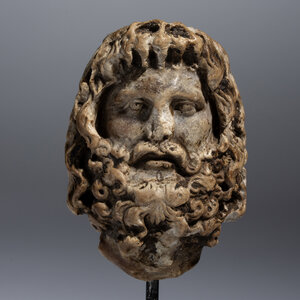
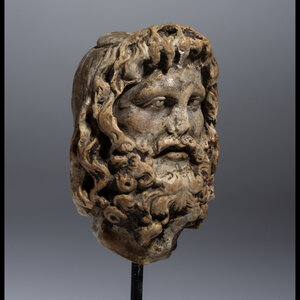
*AN EGYPTO-ROMAN MARBLE HEAD OF SERAPIS.
1st-2nd century A.D.
H. 6 cm
Provenance
Collection Maurice Nahman, Paris, Hôtel Drouot, 26-27 février 1953, lot 198
Succession Pierre Lévi (1907-2002)
Swiss collection, acquired 03/02/2007, Paris, Hôtel Drouot
Accompanied with the Art Loss Register, 10/03/2008
The original cult statue of Serapis was created by Bryaxis in Alexandria around 286–287 B.C., portraying the god with luxuriant curls, notably marked by three distinct locks falling vertically over the forehead (see A. Stewart, Greek Sculpture, p. 203). However, as B.S. Ridgway notes (Hellenistic Sculpture I, p. 95), the widespread diffusion of the Serapis cult throughout the Graeco-Roman world renders it "impossible, in the present state of our knowledge, to determine which cult image served as the prototype for the extant replicas." Although this particular rendering of Serapis is otherwise unattested, Ridgway observes (op. cit., p. 96) that representations featuring a fringe—such as in the present example—were “greatly preferred in Roman times.” The deity is chiefly recognized by his attributes, especially the modius (grain measure), which once likely surmounted the head; the flat surface at the top suggests the original presence of this emblem.
For Swiss buyers, VAT applies to the hammer price and buyer's premium (only for the lots with the * mention)
Lot # 115
-
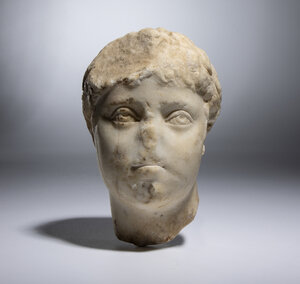
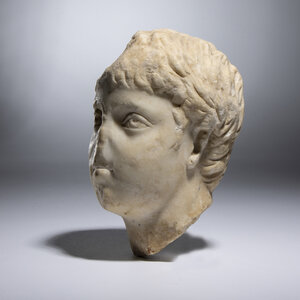
*A ROMAN MARBLE HEAD OF YOUNG CARACALLA. Early 3rd century A.D. H. 19 cm x L. 12 cm x W. 12 cm. Provenance Old private collection, Switzerland, between 1980s-1990s. The head and gaze are gently turned to the left. The hair, combed forward over the forehead, remains thick despite some material loss at the front, and partially covers the ears. The brow ridge, although somewhat worn, is long and delicately modeled, while the upper eyelid is prominently rendered. The iris is finely incised, with the pupil marked by a double cup-shaped engraving, in keeping with artistic conventions of the late 2nd and throughout the 3rd century, at the height of the Antonine period. The mouth features subtly upturned corners. Despite the youthful appearance, the expression is strikingly serious, austere, and authoritative—a quality reminiscent of an unpublished portrait of the young Caracalla in the Fondazione Sorgente Group collection.
For Swiss buyers, VAT applies to the hammer price and buyer's premium (only for the lots with the * mention)
Lot # 116
-
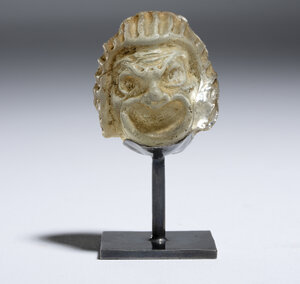
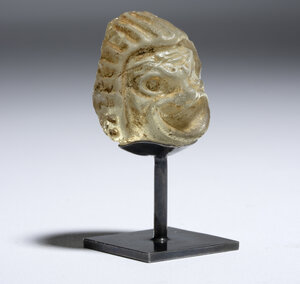
* A ROMAN FRAGMENTARY GLASS APPLIQUE OF A THEATRICAL MASK.
1st-2nd century A.D.
H. 2,5 cm
Provenance
Ex Estate Marie Claire (1929-2015) and John Stow Cuniberti (1928-2009), Geneva, Switzerland
This blue green pale glass applique depicts a comic theatrical mask with exaggerated, grimacing features and a gaping mouth. It was likely intended as an element of a piece of jewellery. Excellent state of conservation.
For Swiss buyers, VAT applies to the hammer price and buyer's premium (only for the lots with the * mention)
Lot # 117
-
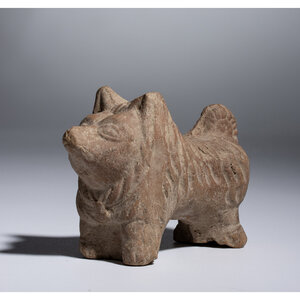
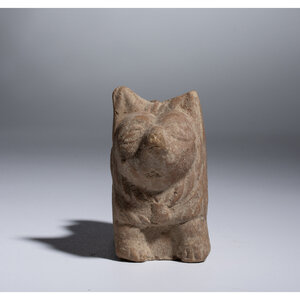
*A ROMAN 'PLASTIC" VASE ANIMAL.
1st century BCE-1st century A.D.
H. 9 x L. 12,9 cm
Provenance
Old private collection, Switzerland, between 1980s-1990s
This mold-made vessel depicts a long-haired dog, its fur rendered through fine incised lines. The almond-shaped eyes, slightly raised head, and curled tail contribute to its lifelike appearance. The animal wears a collar with a pendant. A hole on its back indicates the opening of the container.
For Swiss buyers, VAT applies to the hammer price and buyer's premium (only for the lots with the * mention)
Lot # 118
-
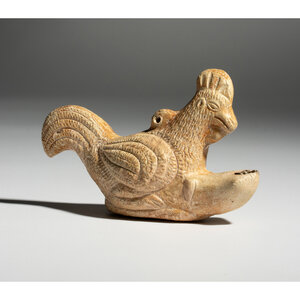
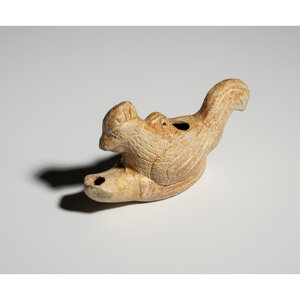
*A ROMAN TERRACOTTA OIL LAMP OF A ROOSTER.
1st-2nd century A.D.
L. 13,3 cm
Provenance
Formerly,private collection, Germany, collected in the 1970's
This two-part mold-made lamp, featuring a volute nozzle, is topped by a reclining cockerel with its wings folded close to its body. A perforation is present on the back, and a suspension loop is located at the neck. Very good state of conservation.
For Swiss buyers, VAT applies to the hammer price and buyer's premium (only for the lots with the * mention)
Lot # 119
-
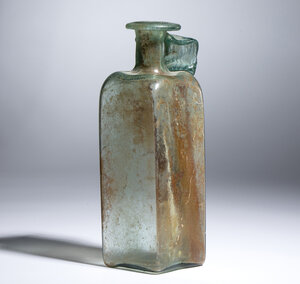
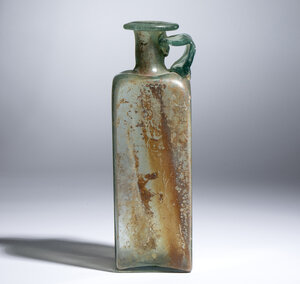
*A ROMAN GLASS JUG.
2nd century A.D.
H. 24 cm
Provenance
Old private collection, Switzerland, between 1980s-1990s
Flask, mould-blown.Translucent light blue, square-sided, with short cylindrical neck and wide everted rim, with applied vertically ribbed handle, the base moulded with concentric circles. Exceptional conservation. Deposits.
For Swiss buyers, VAT applies to the hammer price and buyer's premium (only for the lots with the * mention)
Lot # 120
-
*AN EXCEPTIONAL ROMAN BRONZE DISTAFF.
2nd-3rd century A.D.
L. 27,5 cm
Provenance
Swiss collection since 2003, acquired on the Swiss market in 2003.
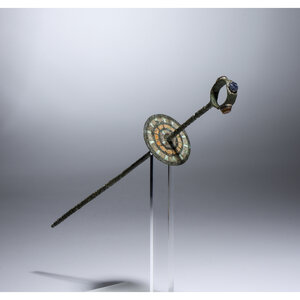
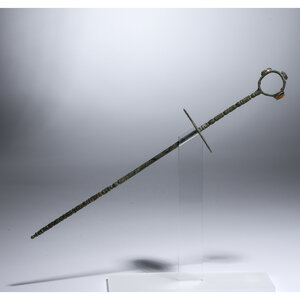
Used as a wool-wrapping tool prior to spinning thread. Composed of a long, finely worked shaft with segmented grooves, surmounted by a disc inlaid with tesserae of stone and terracotta. The spinning ring is adorned with two carnelian intaglios and a blue glass inlay. This ring enabled one to spin tight woolen threads around a separate instrument without creating an unruly mess of hair or spun thread. Beautiful conservation and rare typology.
For Swiss buyers, VAT applies to the hammer price and buyer's premium (only for the lots with the * mention)
Lot # 121
-
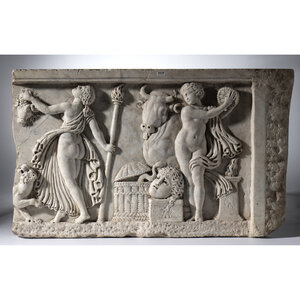
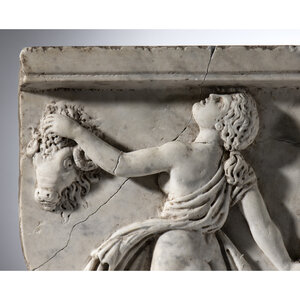
*A POST CLASSICAL MARBLE RELIEF WITH DIONYSIAC SCENE.
After the antique
H. 41 x L. 67 cm
Provenance
Old private collection, Switzerland, between 1980s-1990s
For Swiss buyers, VAT applies to the hammer price and buyer's premium (only for the lots with the * mention)
Caricamento altri risultati...