Live Bidding Wednesday 11th June 2025 02:00:00 PM CET
Antiquities & Ancient Jewelry (1-221)

Risultati: 219
Pagina 3
Lot # 122
-
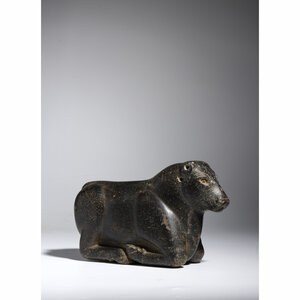
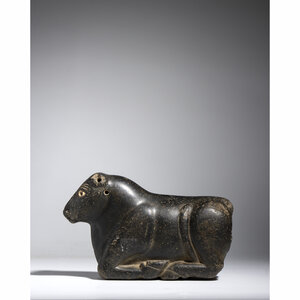
*A SUMERIAN BLACK STONE FIGURE OF A BULL WITH INLAID EYES.
Circa 3rd Millennium BCE
H. 13,4 x L.20,5 cm
Provenance
Formerly, private collection A.K., Switzerland, collected prior 1971
Then by descent
Estate of a European Ancient Dealer,, acquired in Dece
Lot # 123
-
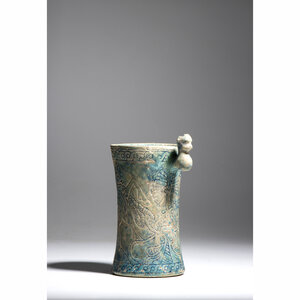
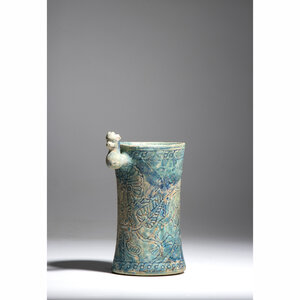
*A RARE ELAMITE BLUE FAIENCE VASE WITH AN HANDLE IN A FORM OF A RAM HEAD PROTOME.
Neo-Elamite, 8th-7th century BCE
Dim. 16 x 12 x 9 cm
Provenance
Estate of a European Ancient Dealer, acquired prior 1992, on the French market.
Then by descent
Accompanied by 2 TL test:
- Oxford Lab., 18/11/1992
- ASA Lab., 8/04/1994
Published in Antique Trade Gazette, 28/09/1996
The slightly flaring cylindrical body rests on a flat disc-shaped foot. A protome, possibly a handle, emerges from the rim of the vessel in the form of a kneeling bull/ram creature (horns missing). The decoration includes a guilloche band at the top and bottom. The main scene on the body depicts two rearing bulls on each side of two Trees of Life. Restorations.
For comparison see Metropolitan Museum, 43.102.45a–c and for a close comparison with identical scene see Louvre Museum, SB 411 BIS.
For Swiss buyers, VAT applies to the hammer price and buyer's premium (only for the lots with the * mention)
Lot # 124
-
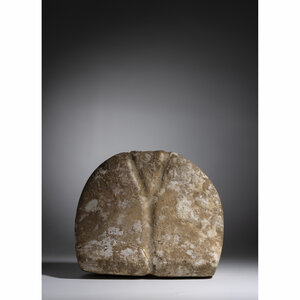
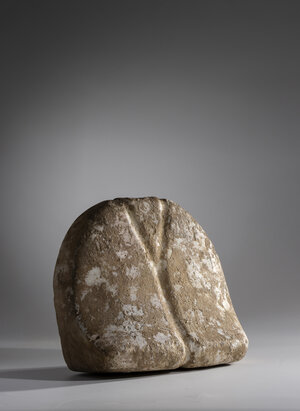
*A LARGE WESTERN ASIAN MARBLE SCULPTOR MODEL IDOL.
Bactria, 2nd Millennium BCE
Dim. H. 30 x L. 24 x prof. 13 cm
Provenance
Estate of a European Ancient Dealer, acquired prior 2001 on the French market
Then by descent
French cultural passport 041149, 10/08/2001
Inspired by the form of Bactrian composite idols made of chlorite and calcite, the body features a minimalist design. A hollow "Y"-shaped groove runs from the top of the neck down to the base, evoking a schematic representation of the neck and legs.The back with with a shallow slot/groove carved which divided the side in two equal parts.
For Swiss buyers, VAT applies to the hammer price and buyer's premium (only for the lots with the * mention)
Lot # 125
-
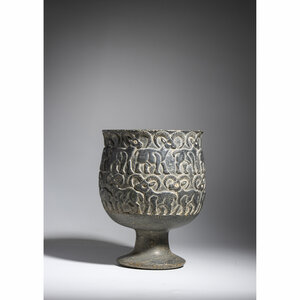
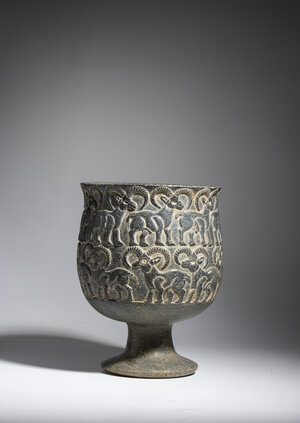
*A WESTERN ASIAN CHLORITE CHALICE.
Circa 2nd Millennium BCE
H. 24,3 cm x Diam. 18 cm
Provenance
Formerly, private collection A.K., Switzerland, collected prior 1971
Then by descent
Estate of a European Ancient Dealer,, acquired in December 2011
Then by descent by succession
With a raised disc-shaped foot, a flaring body, and a thin rim. The body is decorated in relief with two registers of walking ibexes. Their horns, tails, and hooves are incised, and the eyes were inlaid with shell (some now missing). For Swiss buyers, VAT applies to the hammer price and buyer's premium (only for the lots with the * mention)
Lot # 126
-
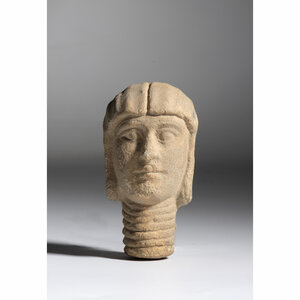
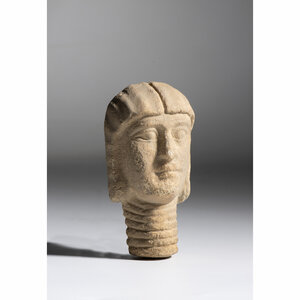
*A WESTERN ASIAN TERRACOTTA HEAD OF A WOMAN.
Circa 2nd Millennium BCE.
H. 9 cm
Provenance
Formerly, private collection A.K., Switzerland, collected prior 1971
Then by descent
Estate of a European Ancient Dealer, acquired in December 2011
Then by descent by succession
With an elongated oval face, elongated eyes with marked upper-lid, triangular nose and thin lips. One eye with a black painted pupil. The hairstyle is composed of long hair parted in the center, on each side. The neck grooved with multiples concentric lines (a necklace ? ). Flat on the back.
For Swiss buyers, VAT applies to the hammer price and buyer's premium (only for the lots with the * mention)
Lot # 127
-
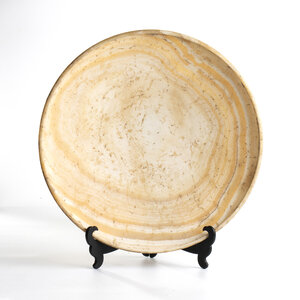
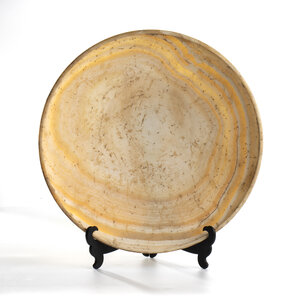
*AN EGYPTIAN ALABASTER DISH.
Old Kingdom, Dynasty 4, circa 2558-2532 BCE
Dim.5 x 46 x 46 cm
Provenance
Estate of a European Ancient Dealer, acquired prior 2004, on the French market.
Then by descent
French cultural passport 063083, 26/02/2004
The shallow dish with gently concave rim, depressed centre and domed base. Intact. Slight superficial crack.
For Swiss buyers, VAT applies to the hammer price and buyer's premium (only for the lots with the * mention)
Lot # 128
-
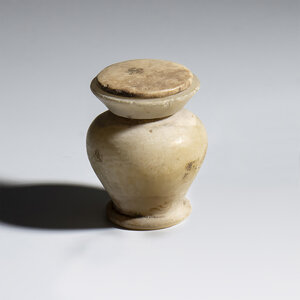
*AN EGYPTIAN ALABASTER KOHL POT WITH LID.
New-Kingdom, Dynasty 18-19, 1550-1189 BCE
H. 5,7 cm
Provenance
Estate of a European Ancient Dealer, acquired prior 2003, on the French market.
Then by descent
French cultural passport 058870, 28/04/2003.
The tapering body with wide horizontal rim and disc lid, broad base.
For Swiss buyers, VAT applies to the hammer price and buyer's premium (only for the lots with the * mention)
Lot # 129
-
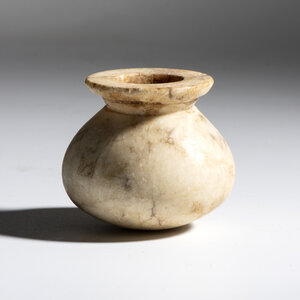
*AN EGYPTIAN ALABASTER KOHL.
New-Kingdom, Dynasty 19, ca. 1189 BCE
H. 5 cm
Provenance
Estate of a European Ancient Dealer, acquired prior 2003, on the French market.
Then by descent
French cultural passport 058870, 28/04/2003.
The globular body, with wide rim. For Swiss buyers, VAT applies to the hammer price and buyer's premium (only for the lots with the * mention)
For Swiss buyers, VAT applies to the hammer price and buyer's premium (only for the lots with the * mention)
Lot # 130
-
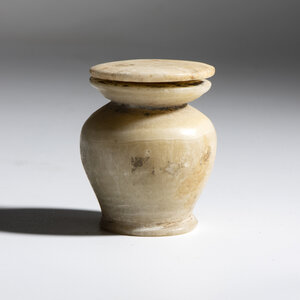
*AN EGYPTIAN ALABASTER KOHL POT.
New-Kingdom, Dynasty 18-19, 1550-1189 BCE
H. 5 cm ; Diam. 4 cm
Provenance
Estate of a European Ancient Dealer, acquired prior 2003, on the French market.
Then by descent
French cultural passport 058870, 28/04/2003.
The tapering body with wide horizontal rim and broad base. For Swiss buyers, VAT applies to the hammer price and buyer's premium (only for the lots with the * mention)
For Swiss buyers, VAT applies to the hammer price and buyer's premium (only for the lots with the * mention)
Lot # 131
-
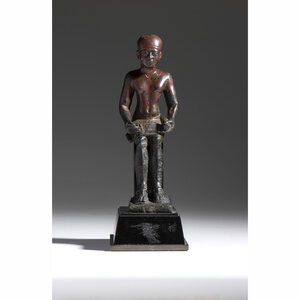
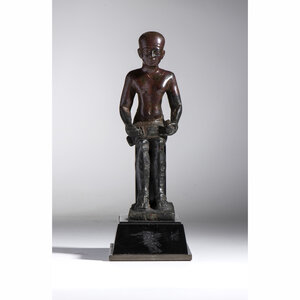
*AN EGYPTIAN BRONZE STATUE OF IMHOTEP.
Late Period, Dynasty 26-30, 664-343 BCE
H. 14,5 x L. 7 x W. 5 cm
Provenance
Estate of a European Ancient Dealer acquired 5/06/2004, on the French market.
Then by descent
French cultural passport 107328, 26/02/2009.
Depicted seated with his feet parallel on a trapezoidal integral plinth, wearing a short pleated kilt, a cap crown, a papyrus scroll unfolded on his lap. Beautiful red and green patina. For Swiss buyers, VAT applies to the hammer price and buyer's premium (only for the lots with the * mention)
For Swiss buyers, VAT applies to the hammer price and buyer's premium (only for the lots with the * mention)
Lot # 132
-
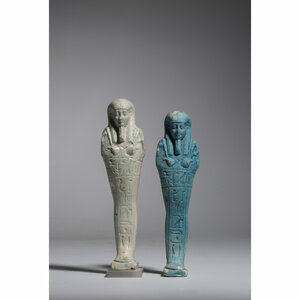
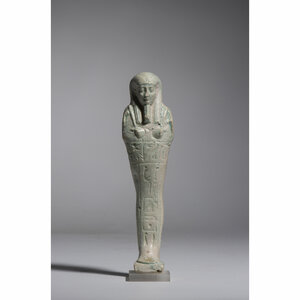
*A LOT OF 2 EGYPTIAN FAIENCE GLAZED SHABTI.
Late Period, Dynasty 26-30, 664-343 BCE
H. 13; 14,5 cm
Provenance
Estate of a European Ancient Dealer, acquired prior 2003, on the French market.
Then by descent
French cultural passport 058893, 28/04/2003.
For Swiss buyers, VAT applies to the hammer price and buyer's premium (only for the lots with the * mention)
Lot # 133
-
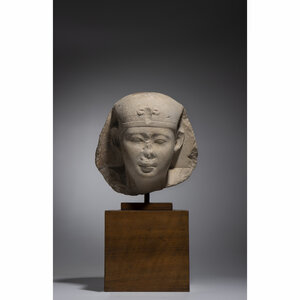
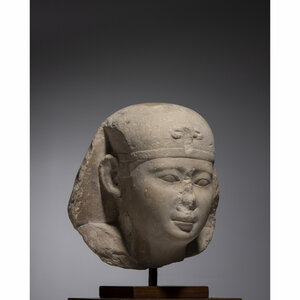
*AN EGYPTIAN LIMESTONE PORTRAIT HEAD OF PTOLEMY II.
Reign of PtolemyII, 286-246 BCE
H. 19,7 cm
Provenance
Rustafjael Collection (1876-1943).
Sotheby's, London, 20 January 1913, lot 242.
Sir Jacob Epstein (1880-1959).
Signor Carlo Monzino; Sotheby's, London, 10 July 1979, lot 100.
Ex Christie's NY, 4/06/2008, lot 51
Estate of a European Ancient Dealer, acquired from above
Then by descent
Published in
The Epstein Collection of Tribal and Exotic Sculpture, Arts Council of Great Britain Hondon 1960 no 297
The oval face with youthful idealizing features including fleshy lips drawn into a smile, a pointed chin and softly-modelled brows, the narrow almond-shaped eyes convex, with sharply-outlined lids, wearing an unstriated nemes-headcloth fronted by a uraeus, preserving traces of grid-lines at the back.
The facial features—such as the almond-shaped eyes with slightly downturned tear ducts, the straight brows that curve downward at the ends, and the shape of the ears—closely resemble several known portraits of Ptolemy II. Comparable examples include: an alabaster portrait in the British Museum (no. 5 in Walker and Higgs, Cleopatra of Egypt: From History to Myth); a life-sized granodiorite statue in the Vatican Museums (fig. 20 in Bianchi et al., Cleopatra’s Egypt: Age of the Ptolemies); a bronze bust in Cairo (no. 7, p. 159 in Stanwick, Portraits of the Ptolemies: Greek Kings as Egyptian Pharaohs); and a limestone head in Paris (no. 126 in Grimes et al., La Gloire d’Alexandrie). Noteworthy also is the positioning of the uraeus, which partially overlaps the browband, along with the symmetrical rendering of the uraeus coils.
Incised grid marks on the left rear side of the nemes headdress suggest that this head may have functioned as a sculptor’s model. However, it is unusual for such models to be finished in the round.
For Swiss buyers, VAT applies to the hammer price and buyer's premium (only for the lots with the * mention)
Lot # 134
-
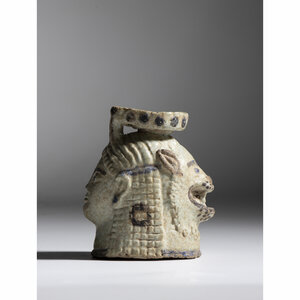
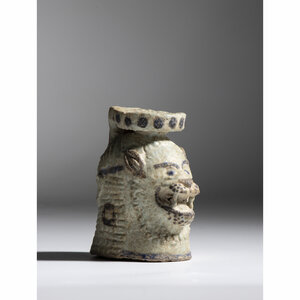
*AN ESATERN GREEK FAIENCE 'PLASTIC' ARYBALLOS.
ca. 6th century BCE
H. 7 cm
Provenance
Estate of a European Ancient Dealer, acquired prior 2003, on the French market.
Then by descent
French cultural passport 055498, 17/03/2003.
Double-headed glazed composition (faience) aryballos or perfume bottle depicting a roaring lion head and a woman head back to back; oval body with a wide handle and lip; flat base; light blue-green glaze, with details painted in black and deep blue with fine detailing, especially on the hair. The handle decorated with a black palmette, the rim with a dotted frieze. Intact. The center of production of these perfumes vases has traditionally been identified as Naucratis, a Greek trading colony on the Nile Delta, in Egypt.
For Swiss buyers, VAT applies to the hammer price and buyer's premium (only for the lots with the * mention)
Lot # 135
-
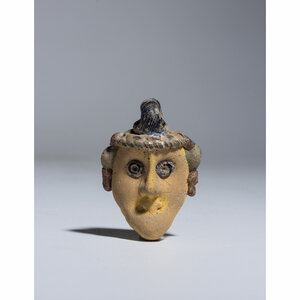
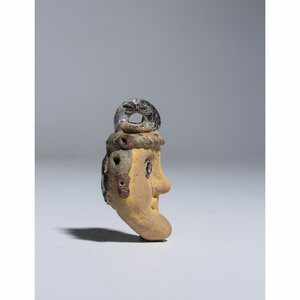
*A LARGE PHOENICIAN CORE-FORMED GLASS HEAD PENDANT.
6th-3rd century BCE
H. 4 cm
Provenance
Formerly, private collection A.K., Switzerland, collected prior 1971
Then by descent
Estate of a European Ancient Dealer,, acquired in December 2011
Then by descent by succession
with opaque yellow face, applied blue eyes, turban with opaque blue, white, red diagonal marvered threads, blue suspension loop. For a similar type see GOLDSTEIN? S.M. Pre-Roman and Early Roman Glass in The Corning Museum of Glass, n°228, p. 112.
For Swiss buyers, VAT applies to the hammer price and buyer's premium (only for the lots with the * mention)
Lot # 136
-
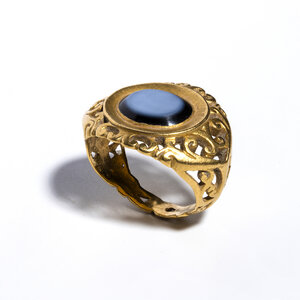
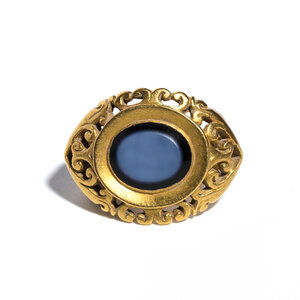
*A ROMAN GOLD KINDRED TYPE RING WITH A NICOLO.
Circa 3rd century A.D.
Int. Diam 23 x 20 mm / TDD 61 (French size)
Stone 11x14 mm
Total weight: 21,48 gr
Provenance
Formerly, private collection A.K., Switzerland, collected prior 1971
Then by descent
Estate of a European Ancient Dealer,, acquired in December 2011
Then by descent by succession
The gold ring with heavy opus interrasile hoop with stylized openwork scrolling foliate design with broad shoulders, reset with an oval raised nicolo.
For Swiss buyers, VAT applies to the hammer price and buyer's premium (only for the lots with the * mention)
Lot # 137
-
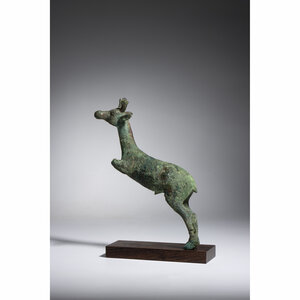
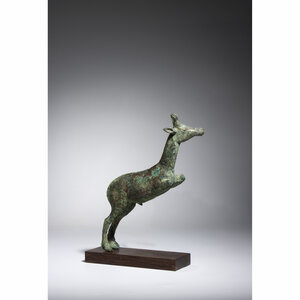
*A RARE ROMAN BRONZE FIGURE OF A GIRAFFE.
Circa 2nd century A.D.
L. circa 26,5 cm
Provenance
Formerly, private collection A.K., Switzerland, collected prior 1971
Then by descent
Estate of a European Ancient Dealer,, acquired in December 2011
Then by descent by succession
Recognizable by its distinctive anatomy, the slender body, and the presence of small ossicones atop the head. The animal is raised on its hind legs. The eyes are finely incised. Losses to the forelegs; one hind leg is broken and restored.
For Swiss buyers, VAT applies to the hammer price and buyer's premium (only for the lots with the * mention)
Lot # 138
-
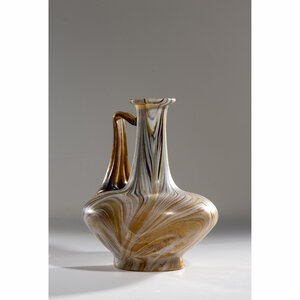
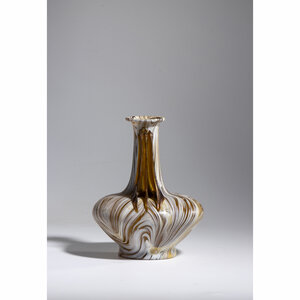
*AN IMPORTANT ROMAN AMBER MARBLED GLASS JUG.
1st-2nd century A.D.
H. 18 cm
Provenance
Formerly, private collection Mrs. B.F., in the family since the 1970s
Estate of a European Ancient Dealer, acquired 29/06/2007, France
Then by descent
Marbled one handled jug, blown, transluscent amber, with white marvered undulating bands. The tapered body, with cylindrical narrow neck with everted rim and curved trailed handle applied to the neck and the shoulder. Intact. Beautiful conservation.
For Swiss buyers, VAT applies to the hammer price and buyer's premium (only for the lots with the * mention)
Lot # 140
-
*A LOT OF 2 ROMAN MARBLE MOSAIC PANELS.
Circa 4th-5th century A.D.
Dim. 107 x 193 cm
With frame 114 x 200 cm
Provenance
Formerly, private collection A.K., Switzerland, collected prior 1971
Then by descent
Collection of a European Ancient Dealer,, acquired in December 2011
Then by descent by succession
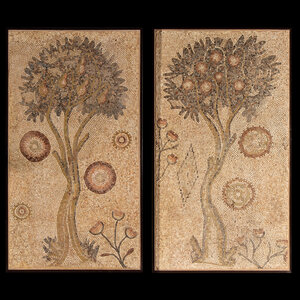
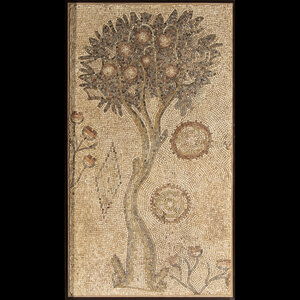
Each panel with multicolored tesserae on a cream ground depicts a pomegranate tree with concentric motif and flowers.
For Swiss buyers, VAT applies to the hammer price and buyer's premium (only for the lots with the * mention)
Lot # 141
-
*A LATE ROMAN MARBLE MOSAIC FLOOR.
Circa 4th-5th century A.D.
Dim. 204 x 239 cm
With frame 217 x 248 cm
Provenance
Formerly, private collection A.K., Switzerland, collected prior 1971
Then by descent
Collection of a European Ancient Dealer, acquired in December 2011
Then by descent by succession
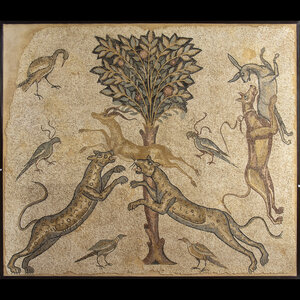
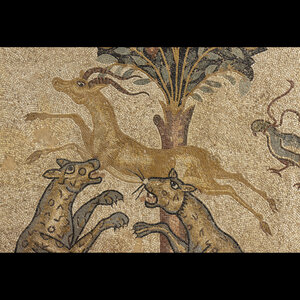
The mosaic is preserved one single panel with multicolored tesserae on a cream ground, depicting animals around a pomegranate tree— Leopards are shown hunting a gazelle, and a dog pursues a hare. Birds are depicted throughout the background. By the 5th century A.D., a new style was adopted for the compositions of animal mosaics, differing drastically from those of the previous centuries. According to K.M.D. Dunbabin (Mosaics of the Greek and Roman World, p. 179), "Instead of being framed in distinct compartments, rows of animals are now spread freely over the surface to be decorated, forming a figured carpet.
For Swiss buyers, VAT applies to the hammer price and buyer's premium (only for the lots with the * mention)
Lot # 142
-
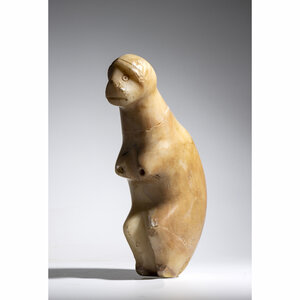
*A SOUTH ARABIAN ALABASTER MEERKAT FIGURE.
Circa 2nd Millennium BCE
H. 30 cm
Provenance
Formerly, private collection A.K., Switzerland, collected prior 1971
Then by descent
Estate of a European Ancient Dealer,, acquired in December 2011
Then by descent by succession
Carved in the round in a stylized manner, this figure of a monkey or meerkat in a standing posture is quite rare. The eyes, snout, and paws are indicated by small circular indentations, while the legs are carved.
A comparable statuette was sold at Christie’s New York, 6 December 2007, lot 64, estimated at $4,000–6,000 and realized $7,500.
For Swiss buyers, VAT applies to the hammer price and buyer's premium (only for the lots with the * mention)
Lot # 143
-
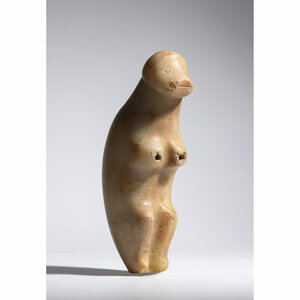
*A SOUTH ARABIAN ALABASTER MEERKAT FIGURE.
Circa 2nd Millennium BCE
H. 21,5 cm
Provenance
Formerly, private collection A.K., Switzerland, collected prior 1971
Then by descent
Estate of a European Ancient Dealer,, acquired in December 2011
Then by descent by succession
Carved in the round in a stylized manner, this figure of a monkey or meerkat in a standing posture is quite rare. The eyes, snout, and paws are indicated by small circular indentations, while the legs are carved.
For Swiss buyers, VAT applies to the hammer price and buyer's premium (only for the lots with the * mention))
Lot # 144
-
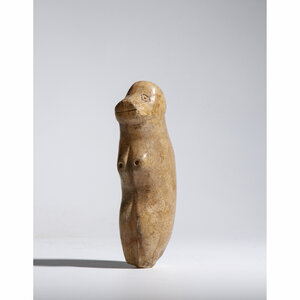
*A SOUTH ARABIAN ALABASTER MEERKAT FIGURE.
Circa 2nd Millennium BCE
H. 13 cm
Provenance
Formerly, private collection A.K., Switzerland, collected prior 1971
Then by descent
Estate of a European Ancient Dealer,, acquired in December 2011
Then by descent by succession
Carved in the round in a stylized manner, this figure of a monkey or meerkat in a standing posture is quite rare. The eyes, snout, and paws are indicated by small circular indentations, while the legs are carved.
For Swiss buyers, VAT applies to the hammer price and buyer's premium (only for the lots with the * mention)
Lot # 145
-
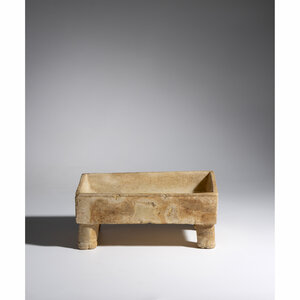
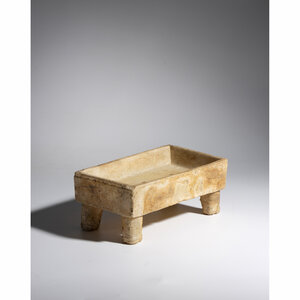
*A SOUTH ARABIAN CALCITE ALABASTER LIBATION TABLE.
Circa 3rd century BCE
Dim. 12,5 x 21 x 9,5 cm
Provenance
Formerly, private collection A.K., Switzerland, collected prior 1971
Then by descent
Estate of a European Ancient Dealer,, acquired in December 2011
Then by descent by succession
Quadrangular in form, resting on four notched cylindrical legs.
For Swiss buyers, VAT applies to the hammer price and buyer's premium (only for the lots with the * mention)
Lot # 146
-
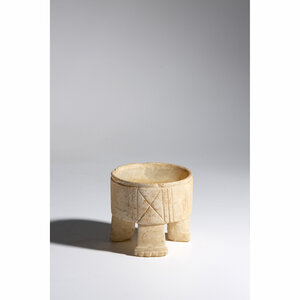
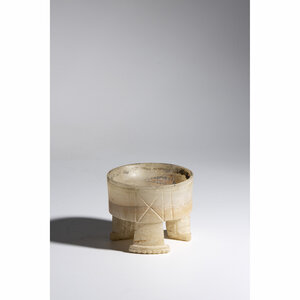
*A GROUP OF 5 SOUTH ARABIAN CALCITE ALABASTER BOWLS.
Ca. 3rd century BCE
H. min. 6,5 cm / max. 8 cm
Provenance
Formerly, private collection A.K., Switzerland, collected prior 1971
Then by descent
Estate of a European Ancient Dealer,, acquired in December 2011
Then by descent by succession
Each of circular in form, resting on three notched legs. The body is decorated with incised geometric lines.
For Swiss buyers, VAT applies to the hammer price and buyer's premium (only for the lots with the * mention)
Lot # 147
-
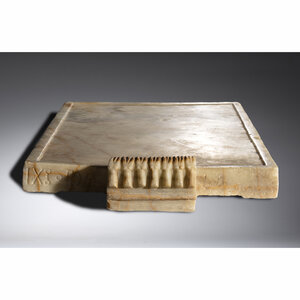
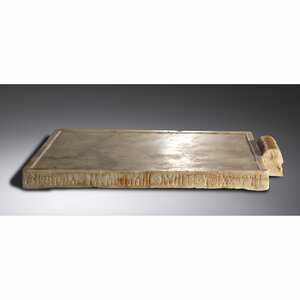
*A SOUTH ARABIAN ALABASTER OFFERING TABLE.
Early 1st century A.D.
Dim. 60,5 x 99 x 8 cm
Provenance
Formerly, private collection A.K., Switzerland, collected prior 1971
Then by descent
Collection of a European Ancient Dealer,, acquired in December 2011
Then by descent by succession
Rectangular in shape, it rests on four short legs. The upper surface is adorned with a raised border. A row of seven reclining conjoined ibexes is depicted, each with an elongated snout, bulging eyes, and large spiraled horns. An inscription runs along all four sides of the table.
Transcription
Face A Krbʿṯt/
Face B w-Lḥyʿṯt/w-Hʿll/bhnw/ḏ-Kyln/s¹qnyw/ʾrnydʿ/S²y
Face C mn/mṣrbn/w-b/ʾḏn/ʾrnydʿ/s¹m/
Face D w-ʾwld-s¹m/w-ʾqny-s¹m
« Karibʿarhat, Laḥayʿathat et Haʿlil, banū dhu-Kaylān {famille connue}, ont offert à Aranyadaʿ {nom d’un dieu} le Patron (cette) table d’offrande et — avec l’accord de Aranyadaʿ — eux-mêmes, leurs enfants et leurs biens ».
For a comparison, see no. 294, p. 203 in Simpson, Queen of Sheba: Treasures from Ancient Yemen (publication referenced, though currently misplaced).
See also Christie’s New York, 9 December 2008, lot 54, sold for $54,000.
For Swiss buyers, VAT applies to the hammer price and buyer's premium (only for the lots with the * mention)
Lot # 148
-
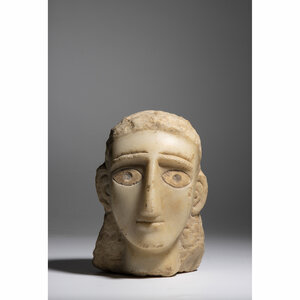
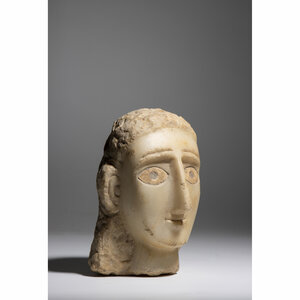
*A SOUTH ARABIAN CALCITE ALABASTER HEAD WITH INLAID EYES.
1st century BCE - 1st century A.D.
H. 18 cm
Provenance
Formerly, private collection A.K., Switzerland, collected prior 1971
Then by descent
Estate of a European Ancient Dealer,, acquired in December 2011
Then by descent by succession
The eyes are inlaid with a carved limestone/calcite material. The face is characterized by a elongated oval shape, large almond shape eyes, with a carved browline.Proeminent nose and large fine lips. The hairstyle is characteristic of these women portraitures, with short hair on top broadening on either side under the ears. For a similar portrait see Queen of Sheba, 2002, p. 194-195. For Swiss buyers, VAT applies to the hammer price and buyer's premium (only for the lots with the * mention).
Lot # 149
-
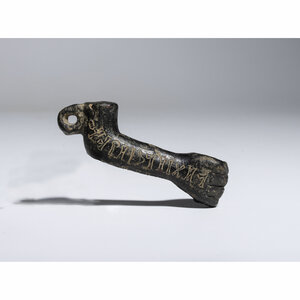
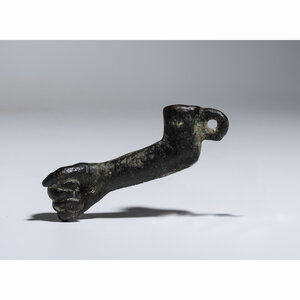
*A SOUTH ARABIAN BRONZE ARM AMULET WITH INSCRIPTIONS.
Circa 2nd-3rd century A.D.
L. 7 cm
Provenance
Formerly, private collection A.K., Switzerland, collected prior 1971
Then by descent
Estate of a European Ancient Dealer,, acquired in December 2011
Then by descent by succession
Showing a right bent arm with closed hand. South arabian inscription. Suspension hoop. The right hand is traditionally regarded as a powerful s ymbol of good fortune and an apotropaic motif, emphasizing a gesture of worshippers. For Swiss buyers, VAT applies to the hammer price and buyer's premium (only for the lots with the * mention)
Lot # 150
-
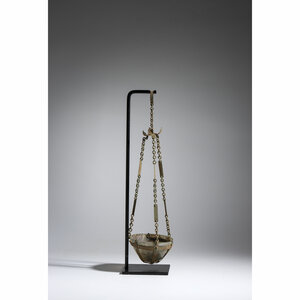
A BYZANTINE BRONZE AND GLASS HANGING CENSER.
Circa 5th-6th century A.D.
H. 40 cm
Provenance
Formerly, private collection A.K., Switzerland, collected prior 1971
Then by descent
Estate of a European Ancient Dealer,, acquired in December 2011
Then by descent by succession
Censer composed of a conical bowl suspended by three small chains attached at the top. Colorless glass and bronze. Christian faith was central to Byzantine life and united the many people who made up the Empire. Incense burners, such as this, would have been swung at different parts of the liturgy to symbolize the prayers of the church-goers rising up to heaven like the smoke of the incense. For Swiss buyers, VAT applies to the hammer price and buyer's premium (only for the lots with the * mention).
Lot # 151
-
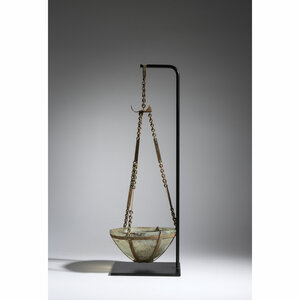
*A BYZANTINE BRONZE AND GLASS HANGING CENSER.
Circa 5th-6th century A.D.
H. 48 cm
Provenance
Formerly, private collection A.K., Switzerland, collected prior 1971
Then by descent
Estate of a European Ancient Dealer,, acquired in December 2011
Then by descent by succession
Censer composed of a conical bowl suspended by three small chains attached at the top. Colorless glass and bronze. Christian faith was central to Byzantine life and united the many people who made up the Empire. Incense burners, such as this, would have been swung at different parts of the liturgy to symbolize the prayers of the church-goers rising up to heaven like the smoke of the incense. For Swiss buyers, VAT applies to the hammer price and buyer's premium (only for the lots with the * mention)
Lot # 152
-
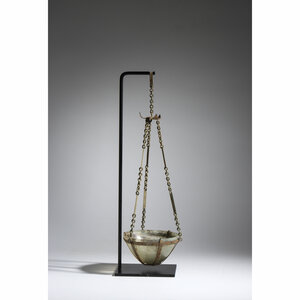
*A BYZANTINE BRONZE AND GLASS HANGING CENSER.
Circa 5th-6th century A.D.
H. 45 cm
Provenance
Formerly, private collection A.K., Switzerland, collected prior 1971
Then by descent
Estate of a European Ancient Dealer, acquired in December 2011
Then by descent by succession
Censer composed of a conical bowl suspended by three small chains attached at the top. Colorless glass and bronze. Christian faith was central to Byzantine life and united the many people who made up the Empire. Incense burners, such as this, would have been swung at different parts of the liturgy to symbolize the prayers of the church-goers rising up to heaven like the smoke of the incense. For Swiss buyers, VAT applies to the hammer price and buyer's premium (only for the lots with the * mention)
Lot # 153
-
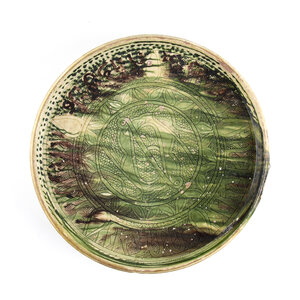
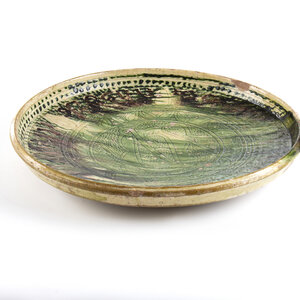
*A EASTERN ASIAN SGRAFFITO GREEN GLAZED FAIENCE DISH.
Late Byzanitne, ca. 12th-13th century A.D.
Diam. 44 cm
Provenance
Estate of a European Ancient Dealer, acquired prior 2006 on the French market
Then by descent
Accompanied by 2 TL tests:
- ASA Lab., 15/09/2006
- ASA Lab. Duplicata, 11/02/2008
French cultural passport 26/01/2009.
For Swiss buyers, VAT applies to the hammer price and buyer's premium (only for the lots with the * mention)
Sgraffito is the technique of decorating redware pottery by scratching through a thin layer of white slip prior to firing. Further decoration was then added by applying casual brush strokes of green pigment using copper oxide, as with this example. These chromatic elements enliven the design and contrast with the incised decoration.
The ceramic ware from the mid 12th century through to the early 13th centuries represent typical objects of Byzantine everyday life. They served as tableware and the most frequent designs on these types of dishes are geometric and decorative motifs, as well as creatures such as birds, fish, octopuses, starfish and even humans, framed by vegetable designs. They are in contrast to most other products of Byzantine everyday culture, displaying hardly any Christian motifs or symbols. This could be due to the fact that the vessels were also intended for the Islamic market.
The main production centres for Sgraffito ware were Paphos and Lapithos in Cyprus. Lapithos, located at the northern coast of the island, produced superior quality glazed and decorated ceramics. This exceptional example shares a close similarity with a dish that is probably the product of a workshop in Paphos in The Fitzwilliam Museum, acc. no. B/2003/070. For Swiss buyers, VAT applies to the hammer price and buyer's premium (only for the lots with the * mention)
Lot # 154
-
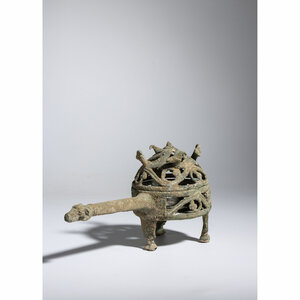
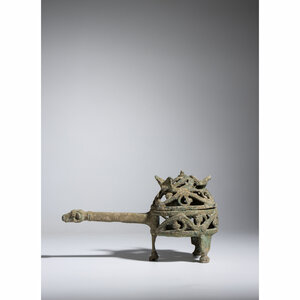
*AN ISLAMIC BRONZE INCENSE BURNER.
Ca. 9th century
H.14,5 cm x L. 25 cm ; Diam. 10 cm
Provenance
Formerly, private collection A.K., Switzerland, collected prior 1971
Then by descent
Estate of a European Ancient Dealer,, acquired in December 2011
Then by descent by succession
With Domed Cover. Incense burners like this one were popularly used in the late antique and Byzantine eastern Mediterranean, and their production continued into the Islamic period. In Christian contexts, incense was used in church services, while in the Islamic world it seems to have been used by caliphs in their palaces and by elites in their homes. This three-legged incense burner with a low cylindrical body and a hinged, relatively high domed cover was a common type. The cover, pierced to emit smoke, is decorated with birds and vegetal designs; the handle with a ram head protome. For Swiss buyers, VAT applies to the hammer price and buyer's premium (only for the lots with the * mention)
Lot # 155
-
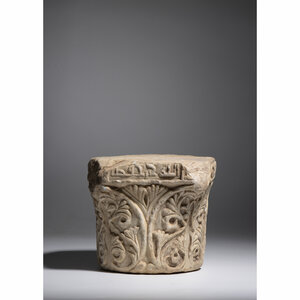
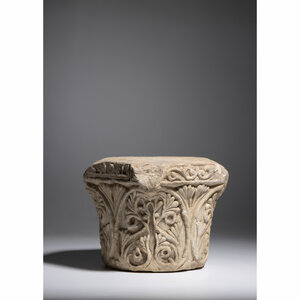
*AN ISLAMIC MARBLE CAPITAL WITH INSCRIPTIONS.
Ca. 12th century A.D.
H. 15 cm
Provenance
Formerly, private collection A.K., Switzerland, collected prior 1971
Then by descent
Estate of a European Ancient Dealer,, acquired in December 2011
Then by descent by succession
The decoration on the acanthus capital clearly demonstrates that the capital is based on examples from Antiquity. The surface decoration of each leaf is based on various finely carved motifs.
An inscription, on one side of the abacus.
For Swiss buyers, VAT applies to the hammer price and buyer's premium (only for the lots with the * mention)
Lot # 156
-
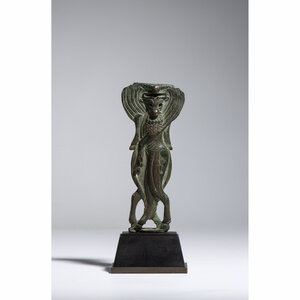
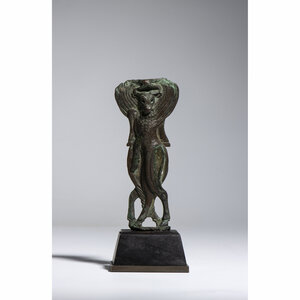
*AFTER THE ANTIQUE. A BRONZE WINGED BULLS FINAL.
Achaeminid style
Dim. 11 x 5 x 2 cm
Provenance
Estate of a European Ancient Dealer, acquired 2000s
Then by descent
For Swiss buyers, VAT applies to the hammer price and buyer's premium (only for the lots with the * mention)
Lot # 157
-
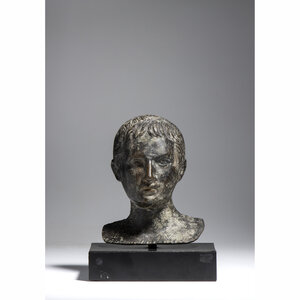
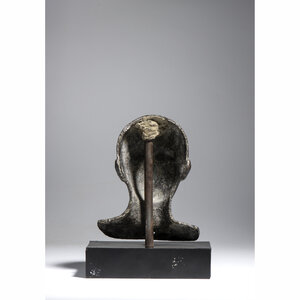
*AFTER THE ANTIQUE. A BRONZE BUST APPLIQUE OF A MAN.
H. 15 x L. 12 cm
Provenance
Estate of a European Ancient Dealer, acquired 2000s
Then by descent
For Swiss buyers, VAT applies to the hammer price and buyer's premium (only for the lots with the * mention)
Lot # 158
-
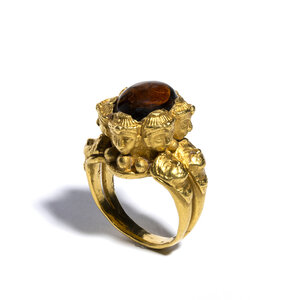
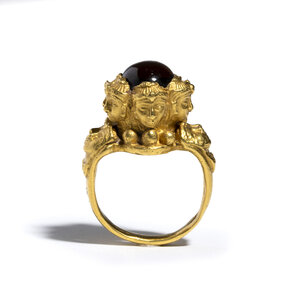
*AN EASTERN ASIAN MASSIVE GOLD RING SET WITH A CITRINE INTAGLIO. HARE.
Int. Diam 23x18 mm; TDD 60 (french size)
Total weight: 51,51 gr
Provenance
Estate of a European Ancient Dealer, acquired prior 2004, on the French market.
Then by descent
French cultural passport 063396, 16/03/2004.
For Swiss buyers, VAT applies to the hammer price and buyer's premium (only for the lots with the * mention)
With doubled hoop joined and broadering at the shoulders adorned with male heads and surmounted by a magnificient high raised box-setting forme dof 6 deity heads containing a cabochon citrine engraved with a rabbit/hare. Under the box setting, embossed, a standing deity. Beautiful conservation.
Lot # 159
-
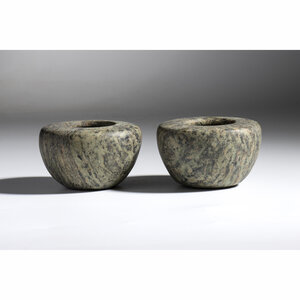
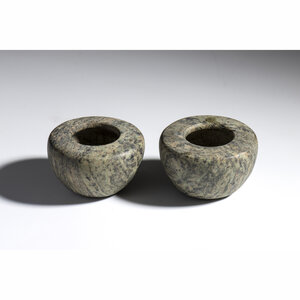
*AFTER THE ANTIQUE 2 SERPENTINE BOWLS.
Dim. 7 x 4 cm
Provenance
Estate of a European Ancient Dealer, acquired prior 2003, on the French market.
Then by descent
French cultural passport 058096, 07/04/2003. For Swiss buyers, VAT applies to the hammer price and buyer's premium (only for the lots with the * mention)
Lot # 160
-
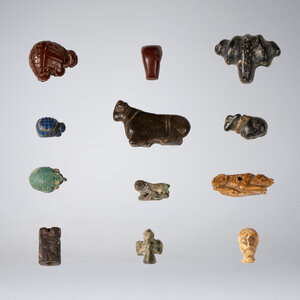
A GROUP OF 12 EGYPTIAN AND MESOPOTAMIAN STONES AND BONE AMULETS.
Late 4th Millennium BCE to Byzantine period.
Min. H. 9 mm / Max. dim. 27 x 38 mm (bull)
Provenance
Swiss private collection of Baron O.C.V.L (1937-2022)
From left top to right bottom: a red jasper turtle amulet, a red jasper bull head, a serpentine ram's head, a lapis lazuli turtle, a steatite crouched bull, a serpentine crouched animal, a faience hedgehog, a bronze lion, a bone crouched dog, a cylinder seal, a nephrite stylized bird pendant, a indurated limestone small male head.
Lot # 161
-
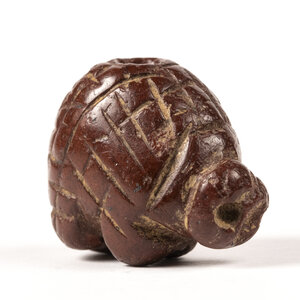
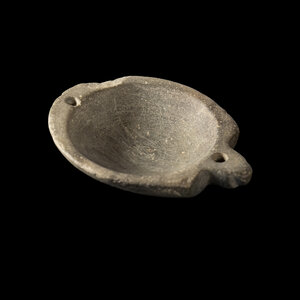
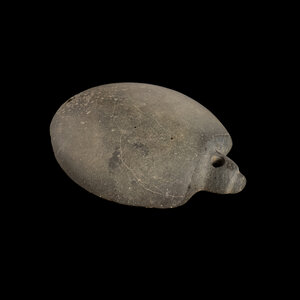
AN EGYPTIAN SCHIST COSMETIC CUP LID. Thinite period, circa Early 3rd Millennium BCE. L 6.4 cm. Provenance Swiss private collection of Baron O.C.V.L (1937-2022). Of a turtle stylized shape including the holes fore and aft. For a similar model see Royal Scottish Museum, Edinburgh, 1955.86
Lot # 162
-
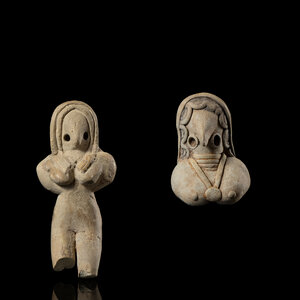
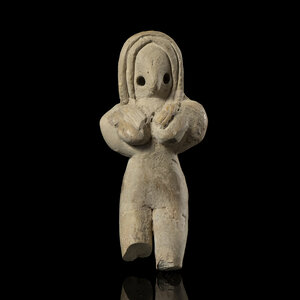
A LOT OF 2 INDUS VALLEY CLAY GODDESSES.
Mehrgarh, c. 3000–2500 BCE
H. 5 and 10 cm
Provenance
Swiss private collection of Baron O.C.V.L (1937-2022)
From left to right: Hand-modeled as a voluptuous woman, the deity’s hands positioned under her prominent breasts, as she looks straight ahead. With long hairs and the facial features marked by wide, hollow eyes above a pointed nose. She is modeled with a slender waist, wide hips, and small rounded shoulders, accentuating her deified position in society as the creator of life. The other one, although fragmentary, is even more detailed, with a complex hairstyle partially covered by a veil. Around the neck a collar and an large necklace with a pendant. The breasts are proeminents.
Anthropomorphic male and female figures have been uncovered at various sites linked to the Indus Valley Civilization. The female figurines from Mehrgarh are characterized by prominent breasts and intricate headdresses. Their curvaceous forms were intended not to sexualize the female body, but to honor its significance in the creation of life.
Lot # 163
-
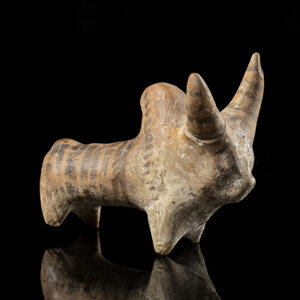
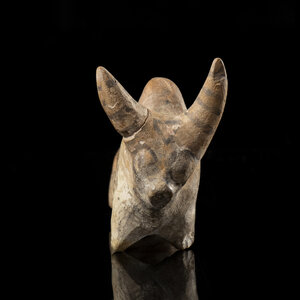
AN INDUS VALLEY TERRACOTTA PAINTED ZEBU.
Mohenjo-Daro, ca. 2600-1900 BCE
Dim. 6,2 x 8 cm
Provenance
Ex Jean David Cahn Auktion
Swiss private collection of Baron O.C.V.L (1937-2022)
The humped bull standing foursquare, its head with rounded protruding eyes, a short muzzle, and long curved horns. The eyes, horns, neck, and back encircled by brown-painted stripes. (Right horn reassembled).
Lot # 164
-
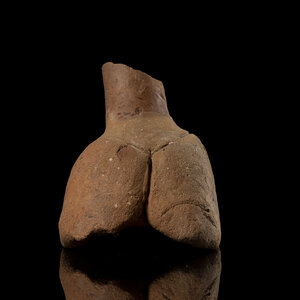
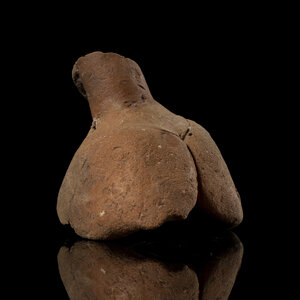
A NEOLITHIC EASTERN EUROPEAN TERRACOTTA FRAGMENTARY SEATED GODDESS FIGURE.
CA. 6500-5300 BCE
H. 5 cm
Provenance
Swiss private collection of Baron O.C.V.L (1937-2022)
The upper part broken, the lower part intact shows proeminent hips and legs, with some incised lines evoking the pubis.
Lot # 165
-
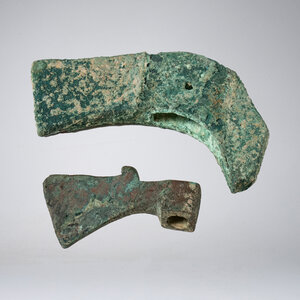
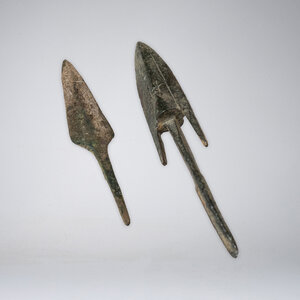
A LOT OF BRONZE AGE COPPER ALLOYED ARROW AND AX HEADS.
Bactrian, Late 3rd-Early 2nd Millennium BCE
H. 6,5 cm ; H. 8,5 cm / L. 12,8 cm ; L. 7,2 cm
Provenance
Swiss private collection of Baron O.C.V.L (1937-2022)
Lot # 166
-
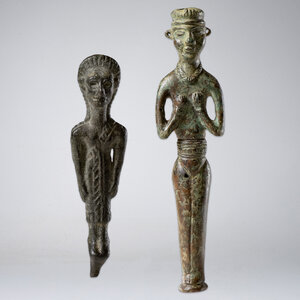
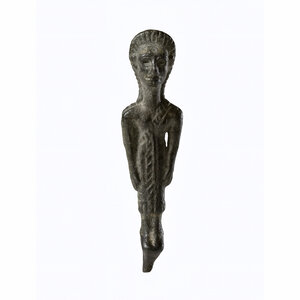
A LOT OF 2 NEAR EASTERN BRONZE FIGURES.
Ca. Late 2nd Millennium BCE
H. 16 cm / 7 cm
Provenance
Swiss private collection of Baron O.C.V.L (1937-2022)
Lot # 167
-
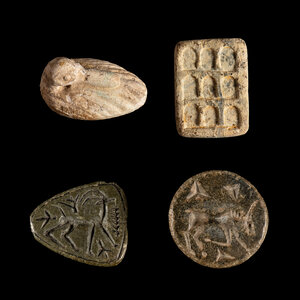
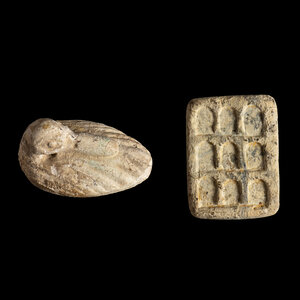
A GROUP OF 4 NEAR EASTERN AND ANATOLIAN LIMESTONE AND STEATITE STAMP SEALS.
5th-Early 4th millenium BCE
Dim.25 x 50 mm; 35 x 47 x 18 mm
Provenance
Swiss private collection of Baron O.C.V.L (1937-2022)
Top left to bottom right:
With an engraved knot handle, the base engraved with an ibex and a zebu advancing right.
Lot # 168
-
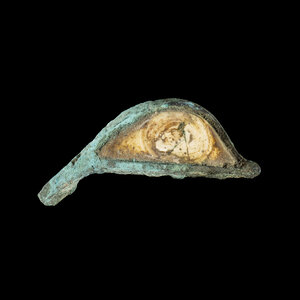
AN EGYPTIAN BRONZE AND CALCITE EYE.
Late Period, 664-332 BCE
L. 75 mm
Provenance
Swiss private collection of Baron O.C.V.L (1937-2022)
This eye was probably inlaid on a sarcophagus mask or a composite statue.
Lot # 169
-
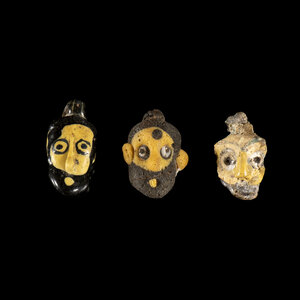
A LOT OF 3 PHOENICIAN GLASS HEADS PENDANTS.
6th-4st century BCE
H. 38 mm
Provenance
Swiss private collection of Baron O.C.V.L (1937-2022)
Rod-formed with an opaque yellow face, the large eyes and hair in black, a suspension loop above,
This belongs to a group of head pendants with oriental features that appears to have been made in Phoenicia and Cyprus, as well as at Carthage in North Africa.
Lot # 170
-
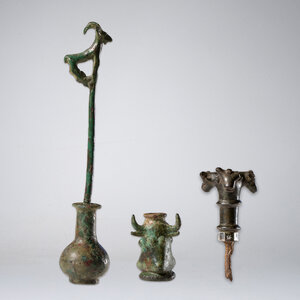
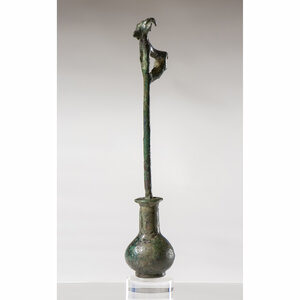
A GROUP OF ANATOLIAN AND LURISTAN BRONZES.
Ca. 1st Millennium BCE
H. min 7 cm / Max. 16 cm
Provenance
Swiss private collection of Baron O.C.V.L (1937-2022)
A bronze bottle with stick pin and ibex final, a mace head in the form of triple bulls heads; a mace head with three bull's heads.
Lot # 171
-
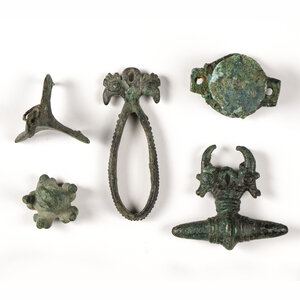
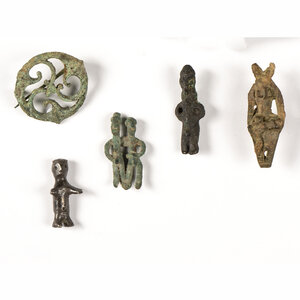
A LOT OF ANATOLIAN AND WESTERN ASIAN BRONZE ELEMENTS.
Circa 2nd Millennium BCE to roman period
Min. H. 30 mm / Max. 65 mm
Provenance
Swiss private collection of Baron O.C.V.L (1937-2022)
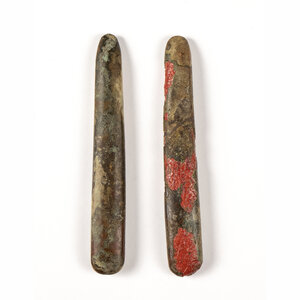
With a germano-roman bronze fibula (2nd/3rd century A.D.); a Bactrian (?) silver anthropomorphic figure (ca. 2nd Mill. BCE); a Amlash bronze embraced figure (ca. 1500-1000 BCE); a Syro-Hittite bronze figure; a copper alloyed figured 'lactans'; 5 bronze harness elements (Luristan to Roman culture, 7th BCE - 2nd century A.D.)
Lot # 173
-
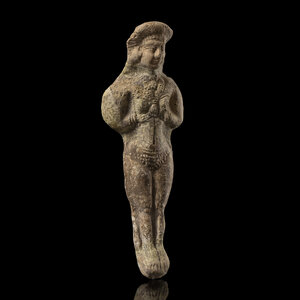
A SYRO HITTITE TERRACOTTA OF A GODDESS.
Ca. 2000-1700 B.C.
H. 7,5 cm
Provenance
Swiss private collection of Baron O.C.V.L (1937-2022)
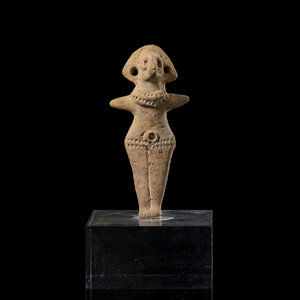
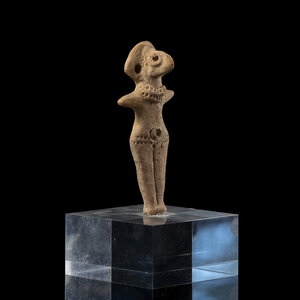
Hand-modeled statuette representing the goddess Astarte, featuring laterally protruding pointed stump-like arms and a bird-shaped face. The large, circular eyes are prominently applied and deeply pierced. Behind the face, trapezoidal towering hair includes two holes, possibly intended for jewelry. The flat plank-shaped idol displays a prominently extended pelvis, symbolizing fertility. A necklace is represented by a smooth indentation around the neck, while the navel is also marked with a circular application and deep piercing. The idol's hips are decorated with a double-row chain, highlighted with incised details. The legs taper downward, separated by a central indentation.
Lot # 174
-
AN ELAMITE TERRACOTTA GODDESS FIGURE.
Ca. 1500-1000 BCE
H. 16,5 cm
Provenance
Swiss private collection of Baron O.C.V.L (1937-2022)
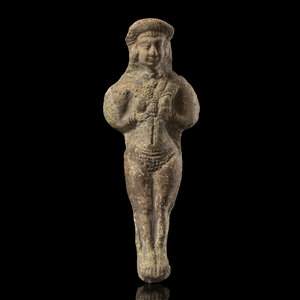
Moulded figure, depicting naked and stading with joined feet. She hold her breasts, between which falls an elaborate pendant. The woman represented may be a goddess, perhaps associated with fertility since her sexual features are raised by pointed details.
Lot # 175
-
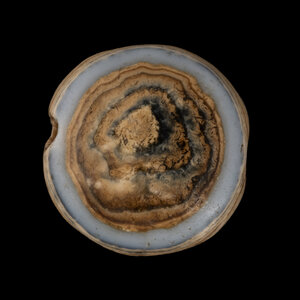
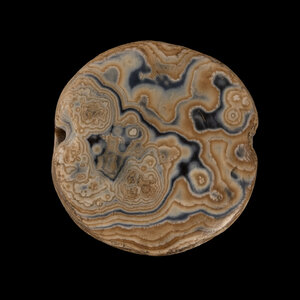
A BACTRIAN AGATE BEAD
1st Millennium BCE
Dim. 16 x 17 x 6 mm
Provenance
Swiss private collection of Baron O.C.V.L (1937-2022)
Of rounded shaped and pierced lengthwise.
Lot # 176
-
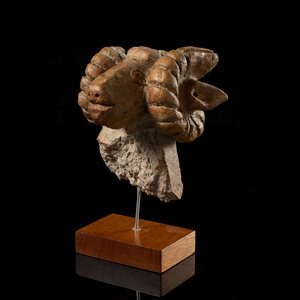
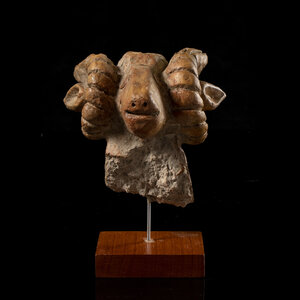
A NEAR EASTERN TERRACOTTA HEAD OF A RAM.
Circa 2nd Millennium BCE
H. 11,5 cm
Provenance
Swiss private collection of Baron O.C.V.L (1937-2022)
Hand modeled with large horns
Lot # 177
-
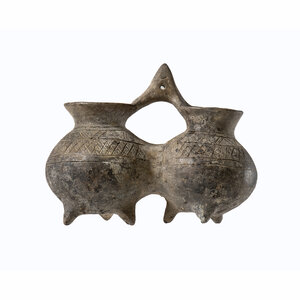
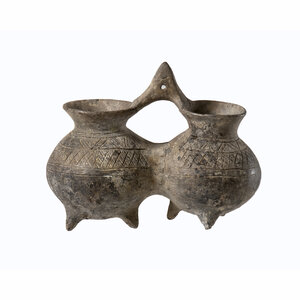
AN URARTU GREY WARE POTTERY
Early Bronze Age, ca. 2800-2500 BCE
H. 13 x L. 16 cm
Provenance
Swiss private collection of Baron O.C.V.L (1937-2022)
Lot # 178
-
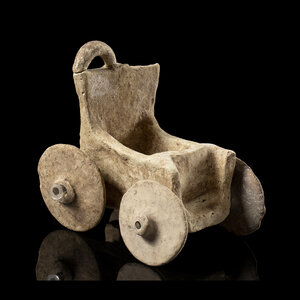
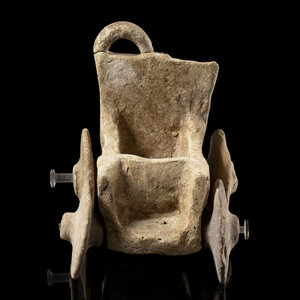
A NEAR EASTERN TERRACOTTA VOTIVE CHARIOT.
Syro-Hittite, ca. 1500-1000 BCE
H. 14 cm
Provenance
Swiss private collection of Baron O.C.V.L (1937-2022)
A hand-modeled pottery votive chariot with both high and low sides, this piece is part of a long-standing tradition in the ancient Near East of pottery figures that depict religious and daily life themes. It was likely offered by a worshipper as part of a ritual, and would have originally been accompanied by figures such as oxen, humans, and possibly small offerings like food placed inside. The chariot symbolized the gods' warlike nature.
Lot # 179
-
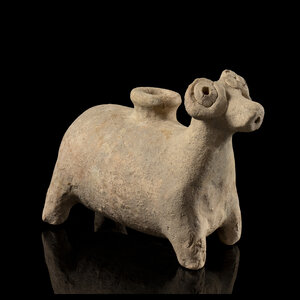
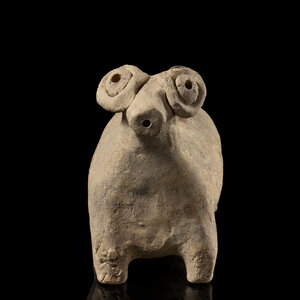
A NEAR EASTERN POTTERY RHYTON
Ca. 2nd Millennium BCE
Dim. 13,5 x 7 cm
Provenance
Swiss private collection of Baron O.C.V.L (1937-2022)
Hand-modeled of a ram shape. With short neck on the back of the animal.
Lot # 180
-
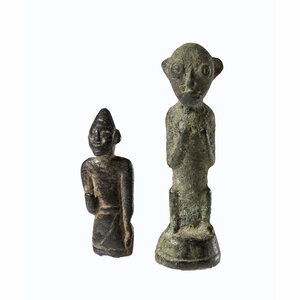
A GROUP OF NEAR WORSHIPPERS FIGURES.
Ca. 2nd Millennium BCE
H. 5,5 cm / H. H. 8 cm
Provenance
Swiss private collection of Baron O.C.V.L (1937-2022)
Lot # 181
-
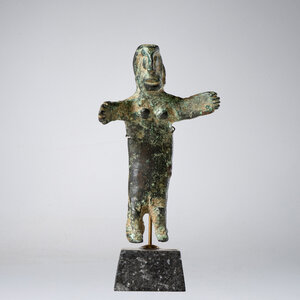
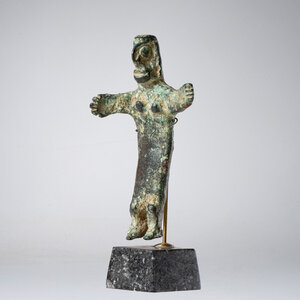
A PIRAVEND BRONZE FIGURE OF A WOMAN.
Early 1st Millennium BCE
H. 9,2 cm
Provenance
Swiss private collection of Baron O.C.V.L (1937-2022), purchased with NEFER, Zurich, 1973
Published in
Catalogue NEFER 6, 1973, n°73
Depicting naked and standing frontal. With a plated body, arms wide-opened, the elongated head is marked by stronf features; proturding eyes and nose. The breasts are also represented with two proturding humps.
Lot # 182
-
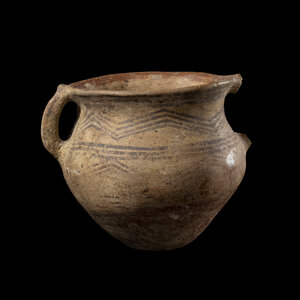
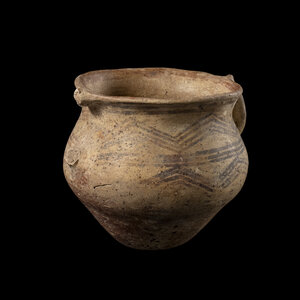
A NEAR EASTERN TERRACOTTA JAR.
Ca. 3rd Millennium BCE
H. 13 cm
Provenance
Swiss private collection of Baron O.C.V.L (1937-2022)
Oblong in shape, with a swollen belly and a flared neck. Black painted decoration structured in registers of zigzag lines separated by three bands. Missing a handle.
Caricamento altri risultati...