Greek And Roman Art
Results from 351 to 400 of 524
Lot # 1171
-
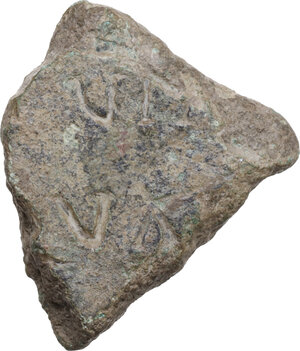
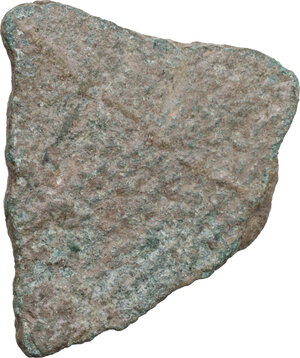
INSCRIBED FRAGMENT Ancient world, c. 3rd century BC - 10th century AD. Fragment of a bronze document bearing an inscription engraved in two lines on one side, while the other is flat. VI (?) VA Dimensions: 35 x 30.5 mm. Interesting study item.
Lot # 1170
-
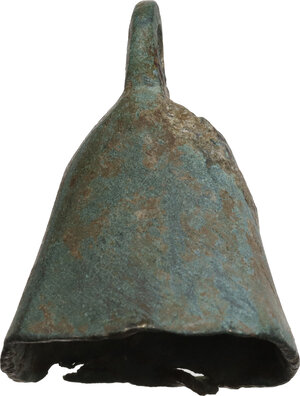
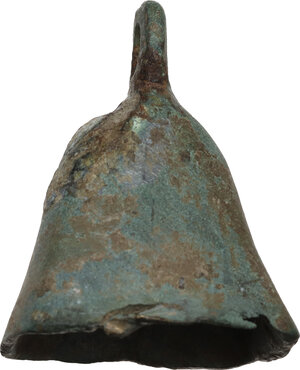
ROMAN BRONZE BELL Roman period, c. 1st - 3rd century AD. Rectangular cross-section bell, with suspension ring. Height: 40 mm. Base: 31 x 27 mm. Weight: 25.50 g. The iron clapper is missing, remaining traces inside.
Lot # 1169
-
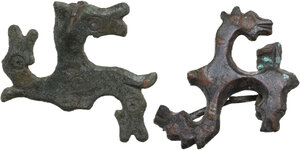
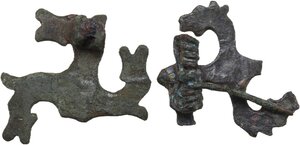
TWO ROMAN BRONZE SWASTIKA FIBULAE Roman period, Balkan area, c. 3rd-4th century AD. Lot of two roman bronze swastika fibulae with the depiction of a stylised horse's head on each arm of the hooked cross. Dimensions: both 36 mm. Both fibulae are missing the swastika arm opposite the spring from which the pin starts (one is missing the pin as well). A deliberate defunctionalisation cannot be excluded. The ends of the garment clips, shaped like horse heads, may be due to the influence of the inhabitants of Thrace or Dacia.
Lot # 1168
-
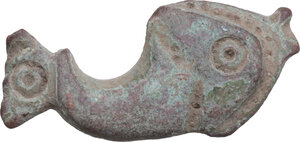
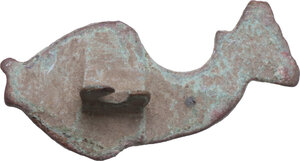
FISH SHAPED FIBULA Roman period, c. 2nd century AD. Bronze fish-shaped fibula, with well rendered details and fancy style. Dimensions: 28 x 13 mm. Missing pin.
Lot # 1167
-
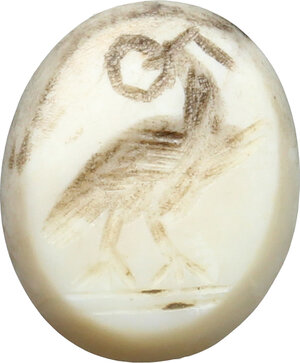
ROMAN JASPER INTAGLIO Jasper intaglio, engraved with eagle holding wreath in the beak. Roman period, 1st century BC-1st century AD. 13 x 11 mm.
Lot # 1166
-
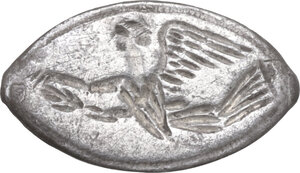
RING BEZEL WITH VICTORY Roman period, after II-IV century AD. Silver ring bezel with engraving of Victory flying left, holding wreath. Dimensions: 16 mm Weight: 1,14 g. AR. 1.14 g. 16 mm.
Lot # 1165
-
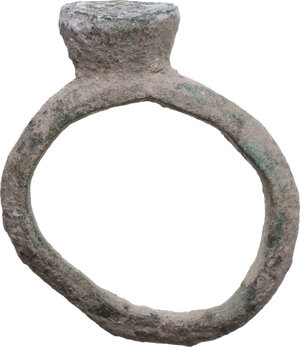
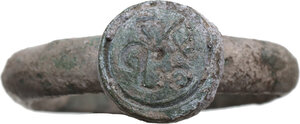
LATE ROMAN RING Roman World, c. 4th - 3rd century Bronze ring with small round engraved bezel Bezel dimensions: 10 mm Size: 14,82 g. AE. 14.82 g. 37.5 mm.
Lot # 1164
-
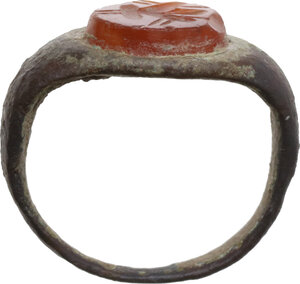
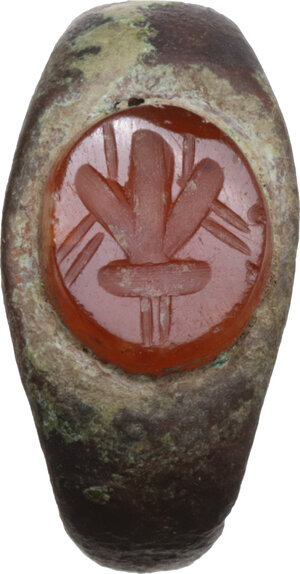
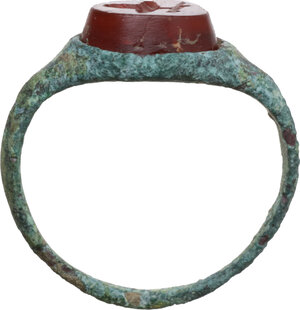
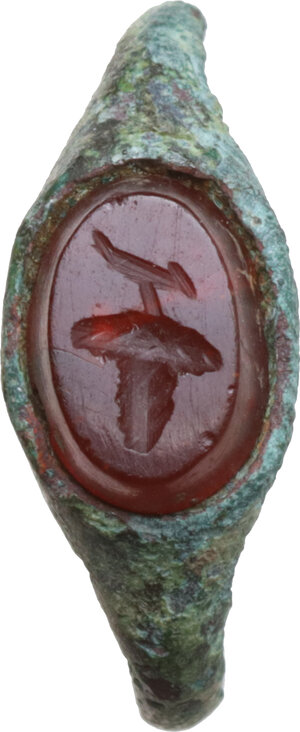
ROMAN RING WITH GEM Roman period, c. 1st - 4th century AD. Roman bronze ring with a carnelian gem depicting a stylized flower. Inner size: 16 mm. Complete, gem slightly chipped on the edge.
Lot # 1163
-
ROMAN 'GRAPE' RING Roman period, c. 1st - 4th century AD. Roman bronze ring with a carnelian gem depicting a grape. Inner size: 16.5 mm. Intact and complete. Good style engraving.
Lot # 1162
-
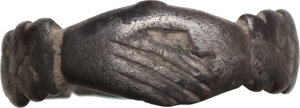
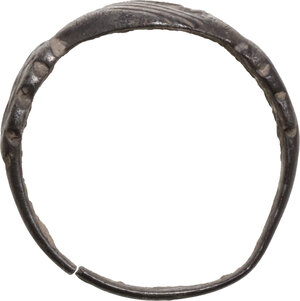
ROMAN SILVER ENGAGEMENT RING 'ANULUS PRONUBUS' Roman period, c. 1st - 4th century AD. Silver engagement ring, composed of a plain circular band, joined by a plate depicting two clasped hands. Inner size: 16 mm. Delicate and nice item, lightly toned. Complete, small break on the rim.
Lot # 1161
-
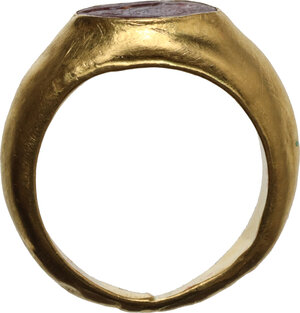
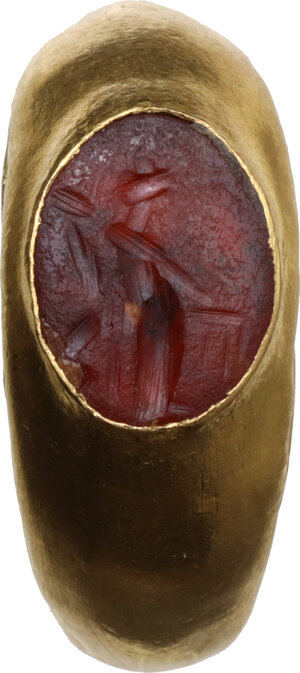
ROMAN GOLD RING Roman period, c. 1st - 2nd century AD. Important Roman gold ring, consisting of two convex plates with an engraved and set carnelian gem, representing a stylized deity with cornucopia sacrificing on altar. Inner size: 18 mm. 5.41 g. 23 mm. Intact and complete, profesionally restored.
Lot # 1160
-
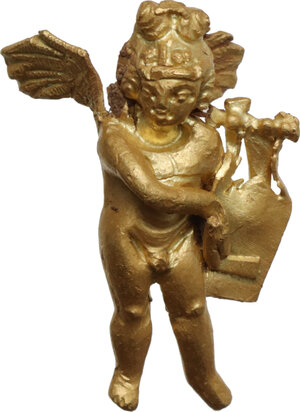
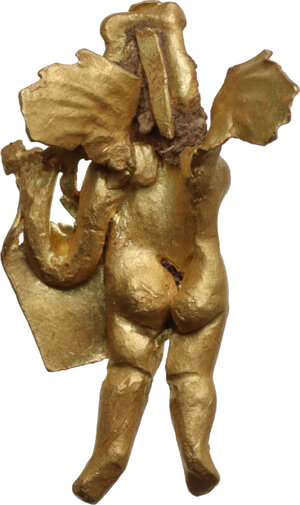
GOLD ROMAN EROS Small figure of Eros or Cupid playing a kithara or lyre in solid gold. Embellishment or part of jewellery. Dimensions: 23x18x8 mm Weight: 2.57 g.
Lot # 1159
-
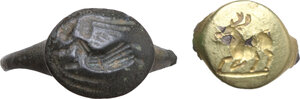
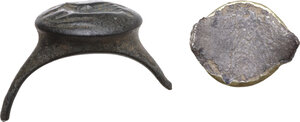
TWO ANCIENT BEZELS Greek world to Roman period, c. 3rd century BC to 1st century AD. Lot of two ancient bezels; one made of a placque of gold mounted on a silver base with the depiction of a stag; one in bronze with the representation of a flying Nike. Dimensions: 14 x 11 and 22 x 11 mm.
Lot # 1158
-
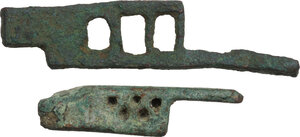
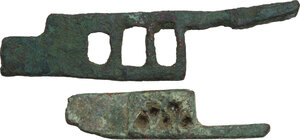
TWO ROMAN PADLOCKS Roman period, c. 1st to 3rd century AD. Lot of two roman bronze lock patches. Lenghts: 70 and 47 mm. Intact and complete.
Lot # 1157
-
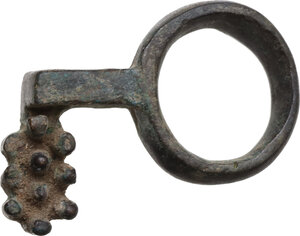
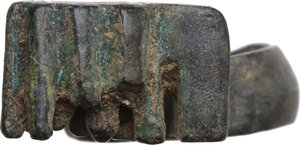
ROMAN BRONZE KEY-RING Roman Period, c. 1st - 4th century AD. Bronze key-ring. Dimensions: 34 X 21 mm. Inner size: 15 mm. AE. Nice green patina.
Lot # 1156
-
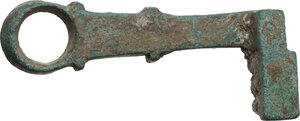
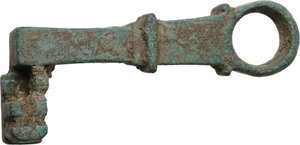
HUGE ROMAN KEY Roman period, c. 1st - 4th century AD. Large Roman bronze key, with a thick quadrangular section body, with reinforcements in the middle part and at the attachment of the ring. Lenght: 85 mm. 126 g. Intact and complete, of unusual dimensions.
Lot # 1155
-
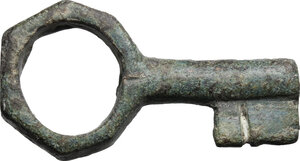
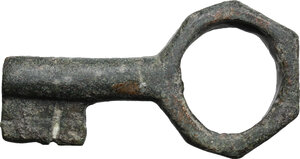
Bronze key-ring. Roman period, 1st-2nd century AD. Size 16.25 mm, length 49x25 mm., 23.11 g.
Lot # 1154
-
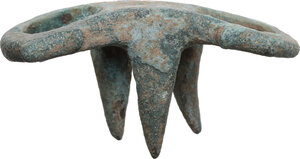
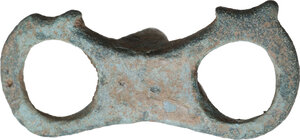
ROMAN BRONZE BOW RING Roman Republican period, c. 5th century BC - 1st century BC. Tricuspid geminous ring in bronze, formed by two cylindrical annular elements, connected by a median body surmounted by three cusps: a wider one, with a triangular base, and two thinner ones placed side by side, with a pyramidal shape. The rings have faint thickenings on the front. Dimensions: 65 x 30 x 34 mm. 69.7 g. In the past these objects have been interpreted in various ways: as female ornaments, tools for horse taming or bridle clips, as thrusters and bow turnbuckles. Among them, the most reliable hypothesis, based on experiences of experimental practice, is that they are bow turnbuckles, having as their main function the protection of the fingers during the release of the arrow. The tricuspid gemini rings are very widespread especially in the Emilian area, in particular in the Parma, Reggio Emilia and Modena areas, but they are also known in northern Italy in the Lombard and Piedmont areas. Their chronological classification is difficult in the absence of stratigraphic associations, given that they appear both in contexts of the second Iron Age and in the late Republican age, above all due to a tendency towards formal conservatism inherent in the instrument.
Lot # 1153
-
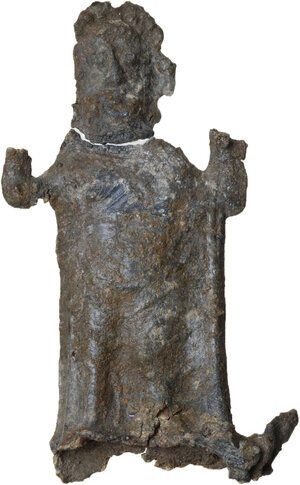
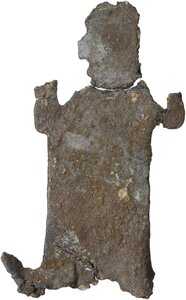
VOTIVE LEAD PLATE Probably Roman republican period, c. 3rd-1st century BC. Lead plaque depicting a bearded figure in a long robe, probably leaning on a stick. Dimensions: 59x32 mm. Fascinating item. Damages and missings. The function of this plaque is unclear; it was probably a votive offering or part of the decoration of a larger object.
Lot # 1152
-
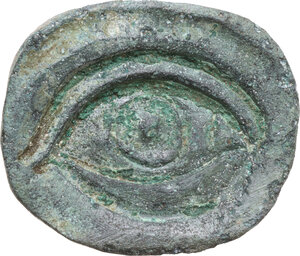
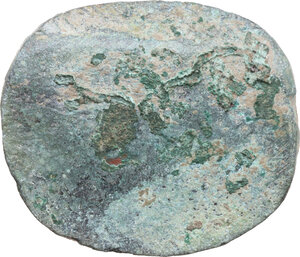
VOTIVE BRONZE EYE Roman Republic, c. 4th - 2nd century BC. Oval plaque in the shape of a left eye, opened, with well rendered details. Dimensions: 37.5 x 31 mm. Weight: 18.98. Rare and fascinating. This example is made from bronze, the use of which may indicate a wealthy owner as most votives were made from terracotta. Votive offerings were given to the gods either in the hope of a cure or as thanks for one, and were made in the shape of the afflicted body part, in this case a left eye. The original owner may have been experiencing blindness or infection.
Lot # 1151
-
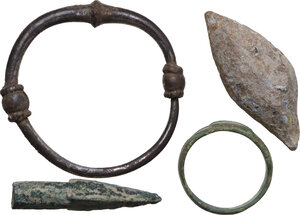
LOT OF FOUR ITEMS Celtic to Roman period, c. 3rd century BC - 4th century AD. Lot composed by a probably celtic silver premoney ring with knobs, a lead slingshot, a bronze arrowhead and a bronze ring.
Lot # 1150
-
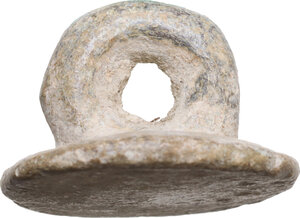
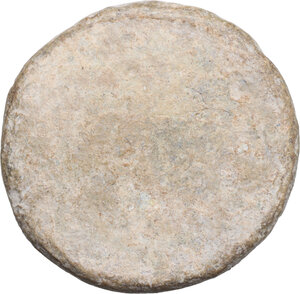
LEAD MOLD WITH A HANDLE Greek World or Roman. Lead mold with no engravements. Width : 34,5 mm Weight: 71 g. PB. 71 g. 34.5 mm.
Lot # 1149
-
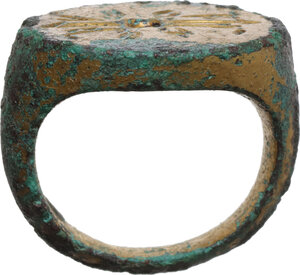
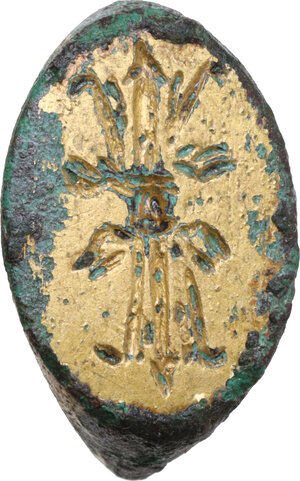
HELLENISTIC RING Greek World, c. 4th - 3rd century BC. Gilded bronze ring with large oval bezel engraved with a winged thunderbolt. Bezel dimensions: 22 x 15 mm. Inner size: 18.5 x 15 mm. Rare and fascinating item. Gilt partially preserved. The particular representation on the bezel of this ring is strongly reminiscent of the reverse of the Syracusan coins minted under Agathokles.
Lot # 1148
-
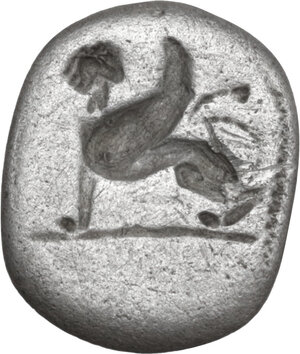
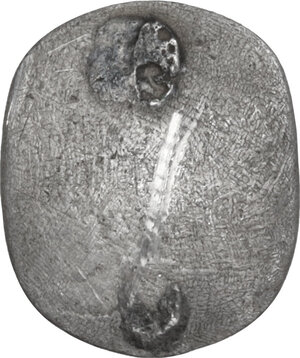
SILVER RING-BEZEL WITH SPHINX Greek World, c. 6th - 2nd century BC. Silver ring bezel with an engraved depiction of a sphinx above a horizontal plane. Dimensions: 15 x 12 mm. Weight: 1.93 g. 1.92 g. 14.5 mm. The representation of the Sphinx, a winged monster with a lion's body and a human head, is one of the longest-lived of the ancient world. Already present in the Middle East, it found its place in Greek mythology with the myth of Oedipus. According to the story, a Sphinx was stationed at the entrance to the city of Thebes, asking all passers-by the same riddle; if they did not know how to answer they were strangled. Oedipus managed to solve the riddle, causing the monster's suicide.
Lot # 1147
-
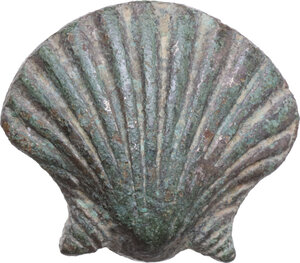
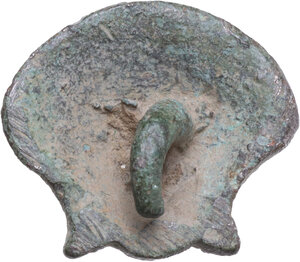
COCKLE SHELL BRONZE APPLIQUE Greek World, c. 4th - 2nd century BC. Bronze applique in the shape of a cockle shell with very well rendered details and a hook on back. Dimensions: 21 x 18.5 mm. Weight: 5.82 g. Intact and complete.
Lot # 1146
-
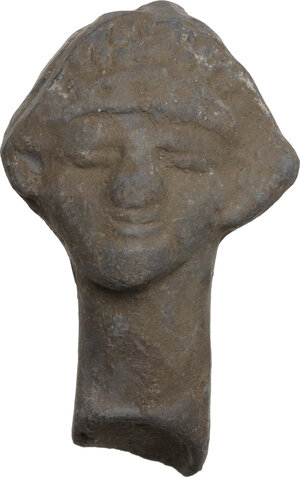
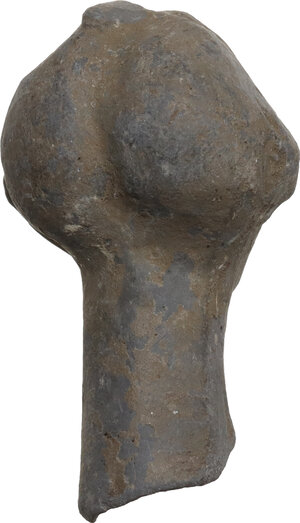
MAGNA GRECIAN TERRACOTTA APPLIQUE Magna Graecia, c. 4th-2nd century BC. Terracotta applique made from matrix, depicting a female head with a long neck and complex hair. Dimensions: 33.5 x 21 mm.
Lot # 1145
-
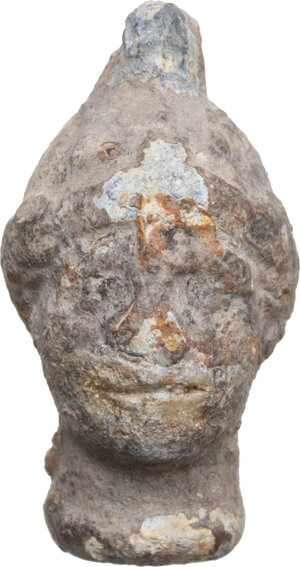
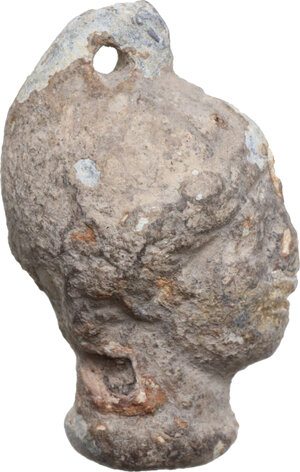
LEAD HEAD WITH HUMAN SHAPE AND PHRYGIAN HELMET Greek world, c. 3rd - 2nd century BC. Head in lead Dimensions: 29.5 mm Weight: 32.59 g. 32.59 g. 29.5 mm.
Lot # 1144
-
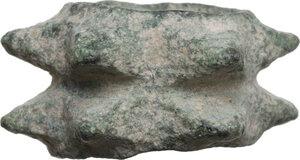
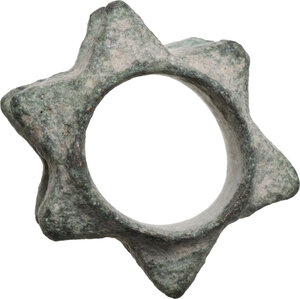
BRONZE 'PASSAREDINI' OR MACE HEAD Italic culture, c. 6th to 4th century BC. Masculine ring forged from leaded bronze. The circular accessory features a relatively smooth interior surface as well as columns of two spikes surrounding the exterior. Diameter: 25.5 mm. Height: 13 mm. Height: 16 mm. AE. 12.1 g. Intact and complete. Generally referred to as 'passaredini' and thus related to the equestrian sphere, this type of bronze object apparently has no certain function. Another hypothesis of use sees these objects as belonging to the military or domestic sphere.
Lot # 1143
-
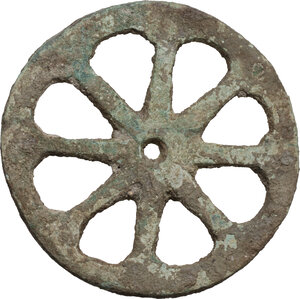
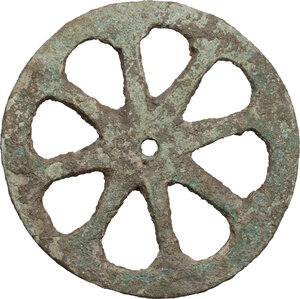
ANCIENT BRONZE WHEEL Greek world or Roman period, c. 1st millennium BC - 1st millennium AD. Medium-sized bronze wheel, composed of eight spokes, probably part of a toy. Diameter: 71 mm. Weight: 80 g. Rare and interesting item.
Lot # 1038
-
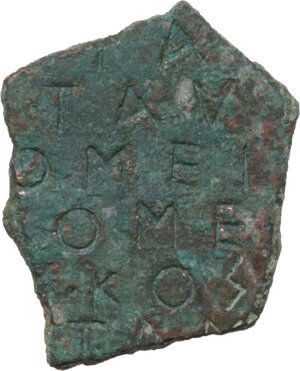
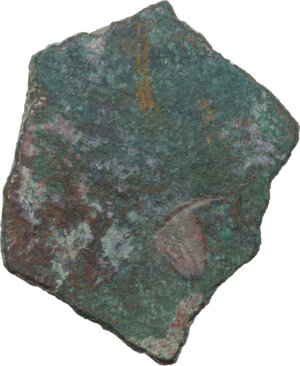
INSCRIBED FRAGMENT Byzantine (?), c. 6th - 10th century AD. Fragment of a bronze document bearing an inscription engraved in six lines on one side, while the other is flat. [-] A . TAV OMEI OME M . KOS T [-] M Dimensions: 44 x 34 mm. Interesting study item. Broken in antiquity. Very interesting object, not easy to identify. The inscription apparently does not contain complete words, although the alphabet used is probably late Greek, perhaps Byzantine.
Lot # 1037
-
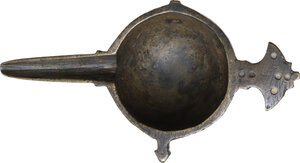
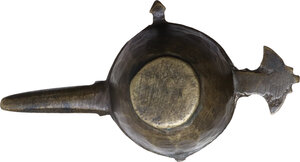
BRONZE ARAB-BYZANTINE ITEM Byzantine, c. 5th - 10th century AD. Arab-Byzantine oil lamp filler or cosmetic mortar with hemispherical body, deep rounded bowl with flat bottom, from which extends a long channelled spout, a flat decorated handle and smaller lateral lugs. Dimensions: 91 x 49.5 mm. One lateral lug missing.
Lot # 1036
-
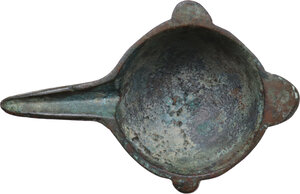
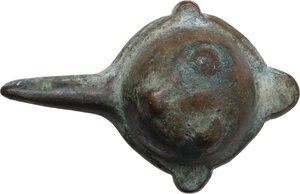
BRONZE ARAB-BYZANTINE ITEM Byzantine, c. 5th - 10th century AD. Arab-Byzantine oil lamp filler or cosmetic mortar with hemispherical body, deep rounded bowl with three feet, from which extends a long channelled spout, a flat short handle and smaller lateral lugs. Dimensions: 82 x 52 mm. Intact and complete, minor deposits. Objects like this, with a small rounded bowl, flanged handles and a long channelled spout, have been speculated to be many different things, from oil lamps to baby feeders. It seems most likely, however, that the hemispherical body was used for as a mortar for crushing cosmetic materials, which would then have been poured down the spout into small flasks, or as a oil lamp filler, the terracotta lamp would be filled with oil through the pouring hole.
Lot # 1035
-
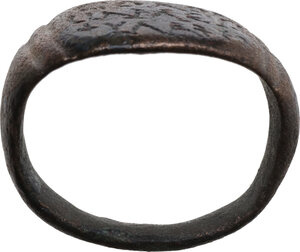
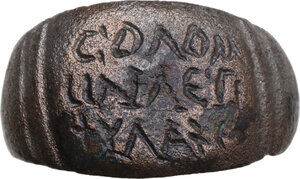
BYZANTINE INSCRIBED RING Byzantine, c. 7th - 8th century AD. Byzantine bronze ring with Greek inscription on three lines, framed by two pairs of vertical engraved lines. Inner size: 20 x 17 mm. Interesting study item. Intact and complete. Patina removed on the bezel.
Lot # 1034
-
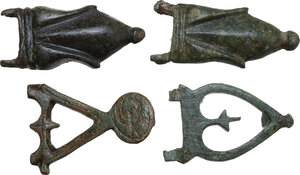
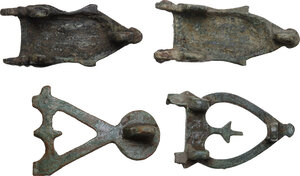
FOUR BYZANTINE BUCKLES PARTS Byzantine, c. 7th - 8th century AD. Lot of four bronze parts of buckles. All byzantine. Lenght: 41 to 36 mm.
Lot # 1030
-
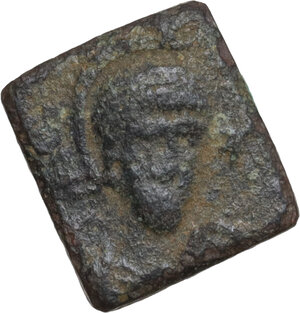
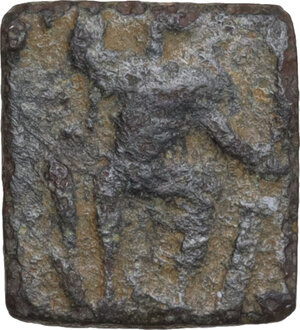
LATE ANTIQUE BRONZE TESSERA Roman period, 5th century AD. Game tessera obtained by cutting a bronze coin minted by Arcadius Dimensions: 11x10 mm. Weight: 1.11 g. Intriguing and rare rework.
In Hoc Signo Vinces
Lot # 1029
-
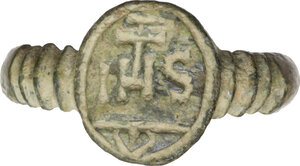
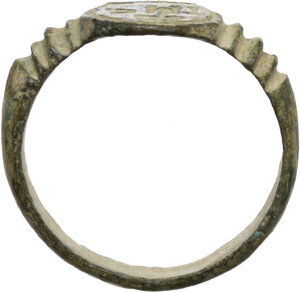
EARLY CHRISTIAN RING Roman period, c. 4th - 5th century AD Bronze ring with oval engraved beazel with the abbreviated christian inscription 'In Hoc Signo Vinces' (IHS), under a cross and above a linear frame with a heart. Cleat decoration on the sides of the bezel. Dimensions: 21 x 11.5 mm. Inner size: 18 mm. Fascinating item, intact and complete. According to the account of Eusebius of Caesarea, Constantine turned towards monotheism when he was still preparing to come to Rome to fight against Maxentius. Turning in prayer to the divinity, shortly after midday he and his army witnessed a prodigious celestial event, the appearance of a crossing of lights above the sun and the writing ἐν τούτῳ νίκα (in Latin, literally 'In Hoc, Vinces').On the following night Christ appeared to him, ordering him to adopt as his banner the sign he had seen in the heaven.
Lot # 1028
-
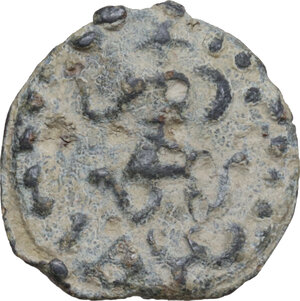
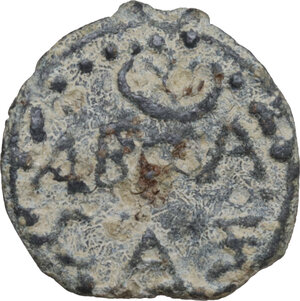
GNOSTIC ROMAN PLAQUE Roman period, c. 3rd - 4th century AD. Lead plaque with on one side: IAⲰ. Abrasax facing, with the head of a rooster and snakes for legs, holding a whip in his right hand and a shield in his left. On the other: ABPA-CAX. Star-in-crescent. Diameter: 18.5 mm. PB. VF. So-called Gnostic amulets not only survive in the form of hardstone gems: they were also produced in the form of lead pendants, rings, beads and tesserae to meet the needs of less wealthy clients. The worship of the ancient demon Abrasax (or Abraxas) rose to great prominence in Roman times through the teachings of the Christian Gnostic Basilides of Alexandria (circa 85-145 AD), who called Abrasax the 'great archon' and the first of the 365 Gnostic Aeons. The etymology of his name is still unclear: it may go back to the Egyptian words 'abrak' and 'sax', translating as 'the honorable and hallowed word', but it is noteworthy that the letters of his name, in Greek isopsephy, add up to 365, the amount of days in a solar year: Α = 1, Β = 2, Ρ = 100, Α = 1, Σ = 200, Α = 1, Ξ = 60, thus: 1+2+100+1+200+1+60 = 365. Basilides' followers believed, among other things, that Abrasax sent Christ as a ghost to the world, which lead to sharp refutations by Early Church Fathers such as Hippolytus of Rome, Clement of Alexandria and Eusebius of Caesarea. The popularity of Basilidianism was mostly restrained to Egypt, where a vivid Gnostic sect is attested in the 2nd-4th centuries, but its legacy still lives on today, as one compelling theory proclaims, in the famous magic word 'abracadabra!'.
Lot # 1027
-
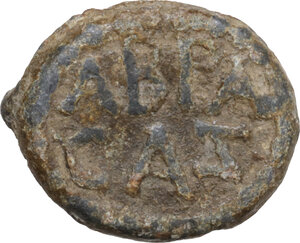
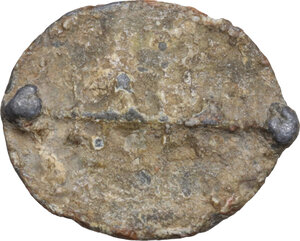
GNOSTIC ROMAN PLAQUE Roman period, c. 3rd - 4th century AD. Lead plaque with the name of the demon Abraxas inscribed: ABPA / CAS. Dimensions: 21 x 17 mm. 5.26 g.
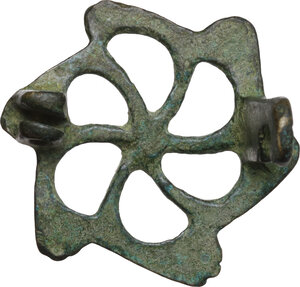
Lot # 1026
-
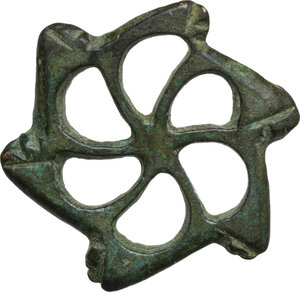
BRONZE OPENWORK FIBULA Roman period, c. 2nd - 4th century AD. Roman bronze fibula configured in a openwork hexahedron. Diameter: 29 mm. Rare and fascinating. Missing pin.
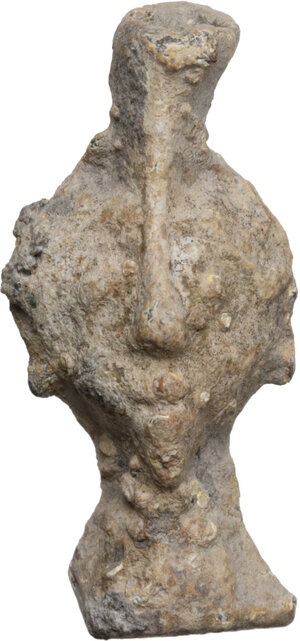
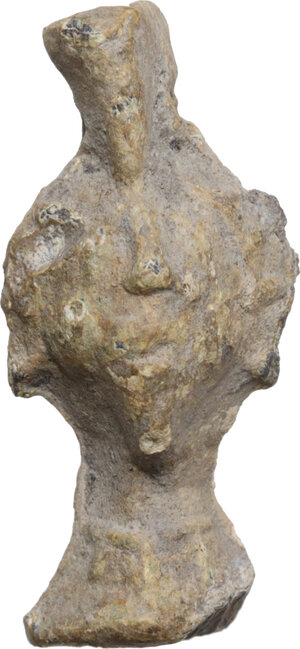
Lot # 1025
-
'GROMA' HEAD WEIGHT Roman period, 1st - 4th century AD. Weight in the shape of a janiform head with suspension loop. Dimensions: 33 x 14 mm. Weight: 22.45 g. Intact and complete.
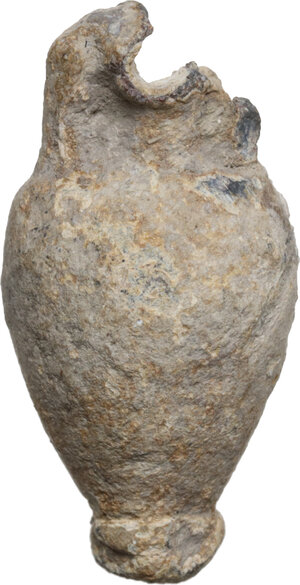
Lot # 1024
-
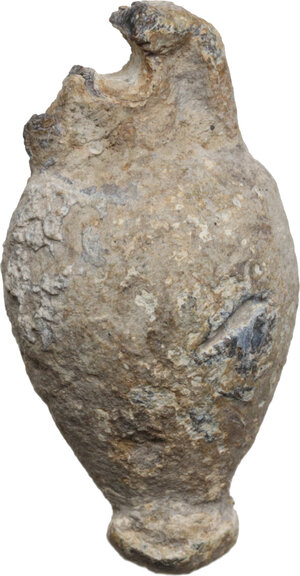
'GROMA' AMPHORA WEIGHT Roman period, 1st - 4th century AD. Weight in the shape of amphora with suspension loop. Dimensions: 35 x 18 mm. Weight: 34.57 g. Minor damage at the hole. In the building of a Castra, after having flattened the ground and before starting the ditch and wall construction, an agrimensor (land surveyor) drew the locations of the streets and of the wall, beginning from the center of the field, using the groma. It follows the description of this topographical tool and its use. (https://legioneromana.altervista.org/content/how-use-roman-groma?language=en).

Lot # 1023
-
BRONZE NEEDLE Roman period, c. 1st - 4th century AD. Bronze needle with large head. Lenght: 124 mm. Intact and complete, slightly bent.


Lot # 1022
-
SMALL BRONZE ROD Roman period, c. 1st - 4th century AD. (?) Bronze rod with a round section stem, with a bird on the top (perhaps a dove) and a flat point towards the top, probably suitable for the handle of the instrument. Lenght: 112 mm. Lack at the bottom.
Lot # 1021
-
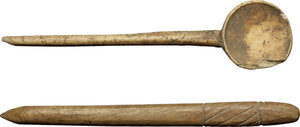
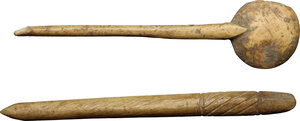
ROMAN BONE UTENSILS Roman period, 1st - 4th century AD. Lot of 2 bone utensils: spoon and spindle. Dimensions: 32 and 17 mm. Minor missings.
Lot # 1020
-
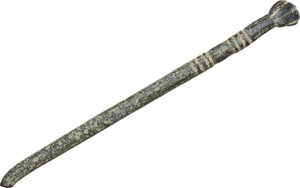
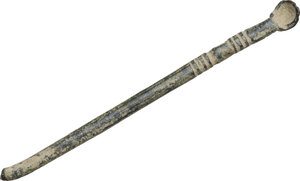
ROMAN SURGICAL SPATULA Roman period, c. 1st - 4th century AD. Bronze surgical spatula with long handle and small concave head. Decorated with engraved lines. Lenght: 69 mm. Lovely deep green patina with sandy deposits.
Lot # 1019
-
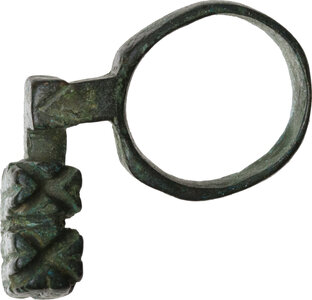
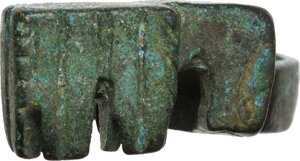
ROMAN BRONZE KEY-RING Roman Period, c. 1st - 4th century AD. Bronze key-ring. Dimensions: 31 x 28 mm. Inner size: 17 mm. AE. Intact and complete, in great conditions.
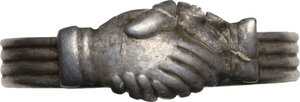
Anulus Pronubus
Lot # 1018
-
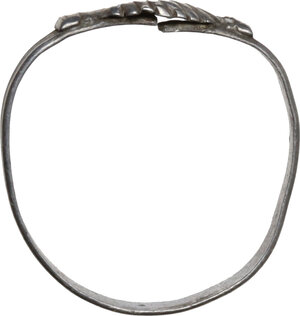
ROMAN SILVER ENGAGEMENT RING Roman period, c. 1st - 4th century AD. Silver engagement ring, composed of a quadripartite circular band, joined by a plate depicting two clasped hands. Inner size: 18 mm. Delicate and choice item. Intact and complete, minor flaws.
Lot # 1017
-
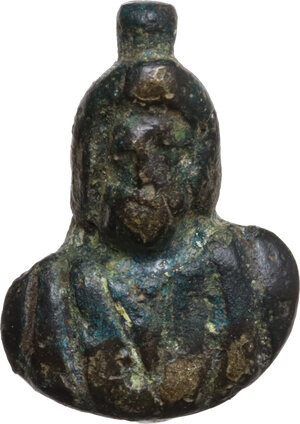
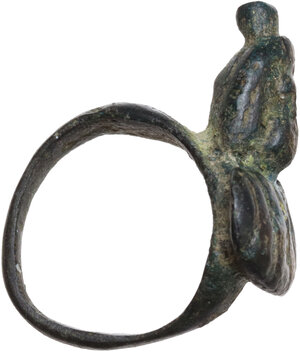
BRONZE RING WITH ZEUS SERAPIS Roman period, c. 1st - 4th century AD. Roman bronze finger ring in the shape of a bust of Zeus Serapis. Dimensions: 28 x 23 mm. Inner-size: 16 mm. Rare and fascinating item. Intact and complete. For many, the cult of Serapis, with songs, lights, bells, processions, represented a final transformation of the savior Osiris into a monotheistic figure, virtually identical to the Christian God. As Christ was a sacrificial lamb, so Serapis was a sacrificial bull and also a God in human form. « The worshipers of Serapis are Christians and those who are devoted to the god Serapis call themselves Vicars of Christ » Historia Augusta, Hadrian.
Lot # 1016
-
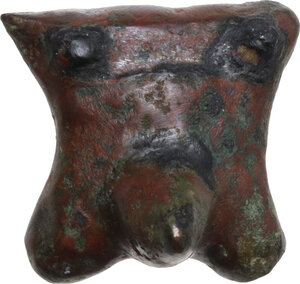
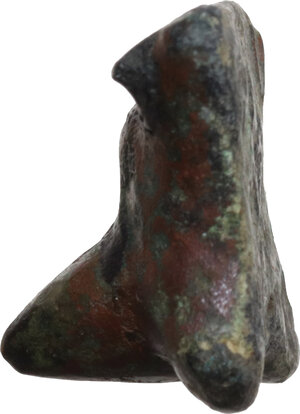
ROMAN PHALLIC APPLIQUE Roman period, c. 1st - 4th century AD. Bronze square shaped phallic applique. Dimensions: 20 x 19 mm. Intact and complete, with enchanting red and green patina.
Lot # 1015
-
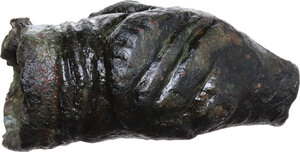
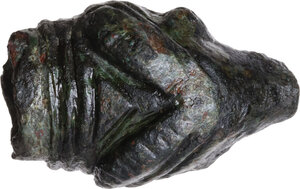
ROMAN BRONZE RAM HEAD Roman period, c. 1st - 4th century AD. Cast bronze ram head from the Roman era, with engraved details of the horns. Dimensions: 45.5 x 29.0 mm. Weight: 91.26. Intact and complete, of good workmanship. Minor wears. Interesting and fascinating item, probably part of a forniture or a chariot.
Results from 351 to 400 of 524