Greek And Roman Art
Results from 401 to 450 of 524
Lot # 1014
-
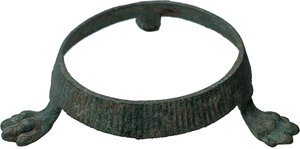
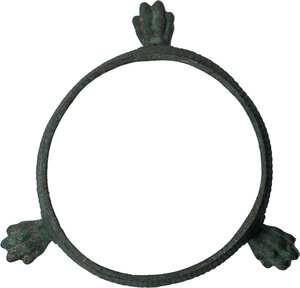
ROMAN BRONZE TRIPOD Roman period, c. 2nd-3rd century AD. Roman bronze tripod resting on three lion paws and composed of a high circular bronze band decorated with vertical strips. The plates surmounting the legs have a rectangular shape and are engraved with tabs. Lenght: 150 mm.; Height: 38 mm. Intact and interesting item.
Lot # 1013
-
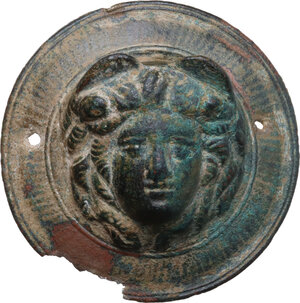
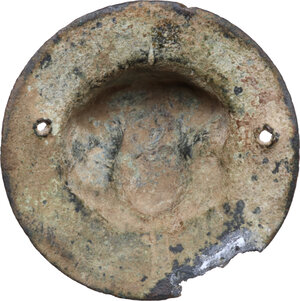
MEDUSA BRONZE PHALERA Roman period, c. 1st - 3rd century AD. Roman bronze phalera depicting, in relief, the head of a medusa with long locks of hair/snakes, surmounted by two wings. The representation is framed by a border made up of engraved lines. Two lateral holes for mounting. Diameter: 72 mm. Rare and fascinating item. Peripheral damage.
Lot # 1012
-
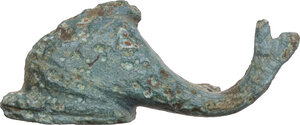
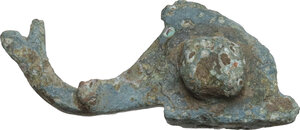
DOLPHIN SHAPED FIBULA Roman period, c. 2nd century AD. Bronze dolphin-shaped fibula. Dimensions: 29.5 x 10 mm. 2.88 g. Missing pin.
Lot # 1011
-
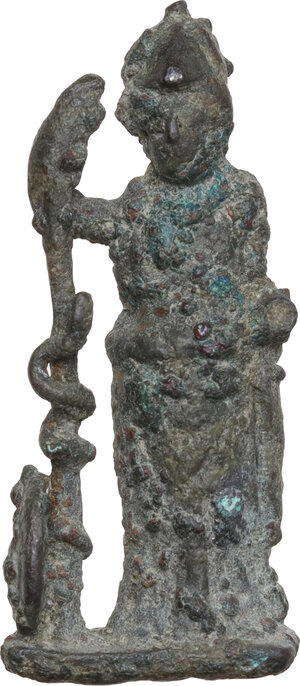
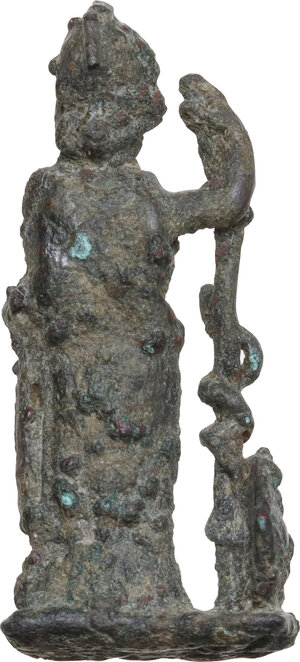
MINERVA BRONZE STATUETTE Roman period, c. 1st - 2nd century AD. Bronze statuette of Minerva standing facing, leaning on spear (?) with a coiled snake and a shield at its end. Height: 35 mm. Intact and complete. Reddish deposits.
Lot # 1010
-
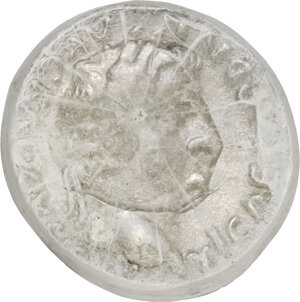
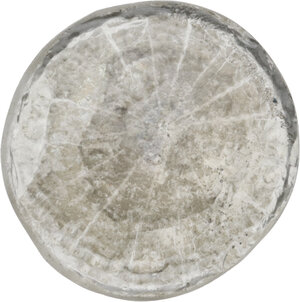
GLASS TOKEN Roman period (?), c. 1st century AD. Curious token obtained by pouring glass onto a refractory material on which the obverse of a denarius of Tiberius had been imprinted. Diameter: 18.5 mm. Weight: 2.28. Sold as is, no return.
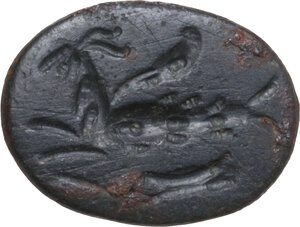
Augustan Bezel with Capricorn
Lot # 1009
-
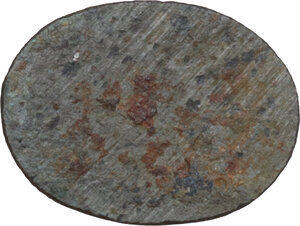
AUGUSTAN CAPRICORN BEZEL Roman Augustan period, after 31 BC - 14 AD. Bronze ring bezel with engraving of a Capricorn on the left, surmounted by a cornucopia and with a rostrum below. Dimensions: 16.5 x 12.5 mm. Rare and choice. Superficial marks. The representation of the zodiac sign of Capricorn becomes common during the second half of the first century BC, when Octavian becomes Augustus and the Roman Republic officially ends. Once the period of the 'Divus Filius' is over, in which Octavian had to affirm his direct descent from Caesar in order to claim the power that would later be imperial, a phase begins in which he will put aside his adoptive father figure, in order to be able to free himself as a 'new' entity. Capricorn was the zodiac sign of Augustus (sign of conception and not of birth, as in use among the Romans), it will be widely used. This bezel represents a celebratory ship's rostrum and is therefore certainly subsequent to the naval battle of Actium in 31 BC, in which Octavian's ships, commanded by Agrippa, defeated those of Marcus Antonius and Cleopatra, marking the end of the dispute.
Lot # 1008
-
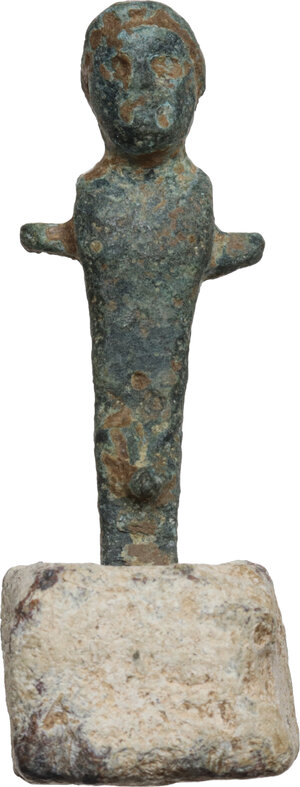
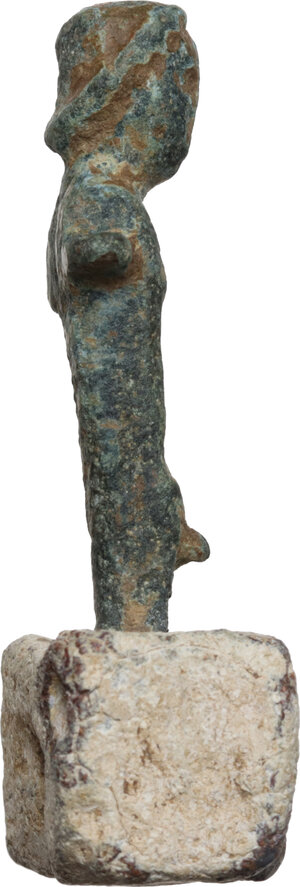
ROMAN BRONZE HERM Roman period, c. 2nd century BC - 1st century AD. Small Roman bronze herm probably depicting Zeus. The details of the head and genital organs are rendered, while the chest, arms and legs are barely sketched. The herm is placed in a cubic lead base. Dimensions: 50.5 x 18.0 mm. Intact and complete. Nice green patina with minor earthy deposits. The presence of the lead base makes the object much more interesting. The lead was poured into a hole carved into the stone, usually a small altar. These statuettes were specially made with a long terminal peduncle, which was intended to keep them erect once incorporated into lead.


Lot # 1007
-
DOUBLE FORK IMPLEMENT Greek world or Roman period, c. 3rd century BC - 3rd century AD. Bronze object composed of a long stem with two fork tines at each end. Dimensions: 200 x 11 mm. Curious and interesting item.
Lot # 1006
-
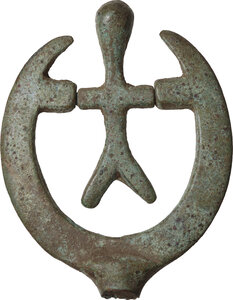
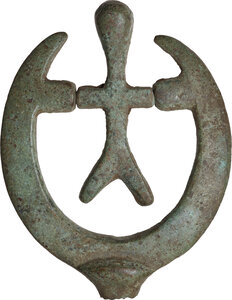
BRONZE TOY (?) Greek world or Roman period, c. 3rd century BC - 3rd century AD. Curious crescent-shaped object with a stylized human figure in the centre, joined by the arms to the support, so that it can rotate on itself. Dimensions: 78 x 59 mm. Interesting study item, part of a bigger object.
Lot # 1005
-
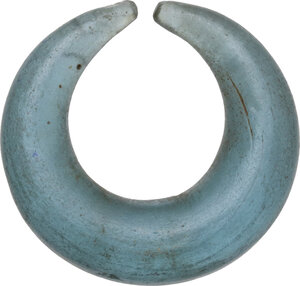
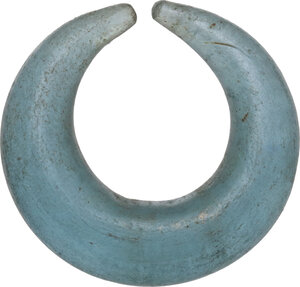
ANCIENT GLASS EARRING South East Asia, Vietnam or Cambodia, c. 3rd - 1st century BC. Light blue glass earring, with thicker body and thin ends. Dimensions: 23 x 21.5 mm. Rare, intact and complete.
Lot # 1004
-
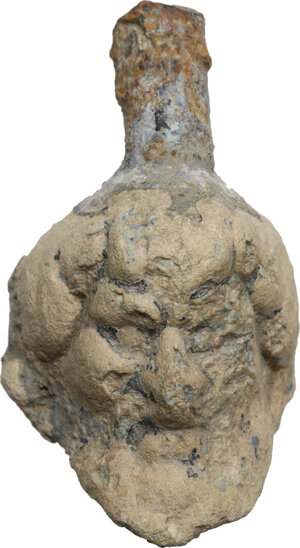
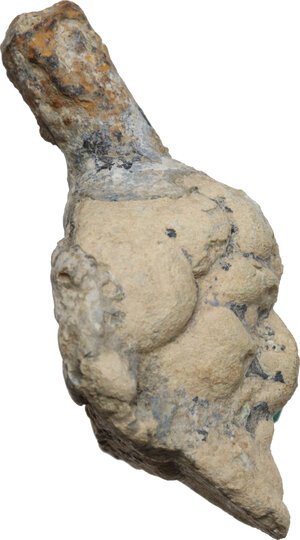
LEAD BEARDED HEAD Greek World, c. 4th - 2nd century BC. Bearded lead male head, part of a larger object, of which it retains the tang through which it was attached. Dimensions: 46.5 x 25 mm.
Lot # 1003
-
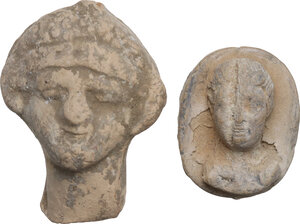
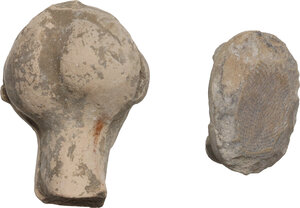
MAGNA GRECIAN TERRACOTTA HEADS Magna Graecia, c. 4th-2nd century BC. Lot of two (2) female terracotta heads, one worked in the round, the other resting on a clipeus. The first has roughly sketched features and retains possible traces of color on the back, the second is much more refined in style. Dimensions: 26.50 x 19.50 and 18.50 x 15.00 mm. Damages and wears.
Lot # 1002
-
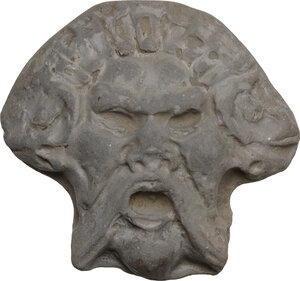
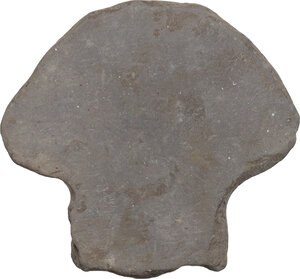
MAGNA GRECIAN TERRACOTTA APPLIQUE Magna Graecia, c. 4th-2nd century BC. Terracotta applique made from matrix, depicting a berded head, probably a theatrical mask, with a wide open mouth and complex hair Dimensions: 31 x 29 mm. Intact and complete.
Lot # 1001
-
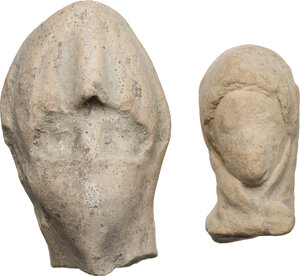
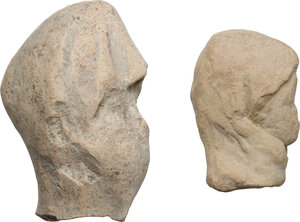
CYPRIOTIC VEILED WOMAN HEADS Greek Cyprus, c. 4th century BC. Lot of two terracotta heads, forming part of goddess statuettes, originally seated on a throne. Sizes: 49x30x34 mm and 36x18x25 mm. Rare and fascinating items. Numerous terracotta heads of veiled women have been found in Cyprus, many from the same mold, a sign that they were produced locally and then probably exported to the mainland. They probably represented a goddess sitting on a throne. Cfr: Metropolitan Museum, The Cesnola Collection, Purchased by subscription, 1874–76. Accession Number: 74.51.1494.
Lot # 1000
-
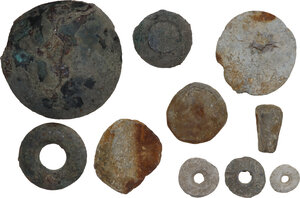
TEN ANCIENT WEIGHTS Central Europe, 1st millennium BC - 1st millennium AD. Lot of ten (10) ancient weights, of different shapes and weights, three in bronze and seven made of lead. Weights: from 446 to 7 g. Interesting study lot.
Lot # 999
-
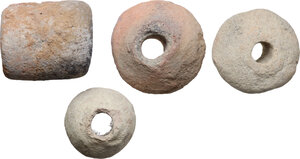
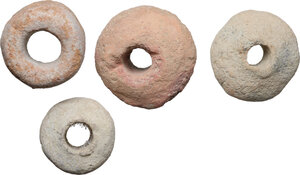
FOUR POTTERY WEIGHTS Greek World, c. 6th - 2nd century BC. Lot of four (4) pottery frame weights; three biconical and one tubular in shape. Dimensions: from 46 to 36 mm. Intact and complete.
Lot # 998
-
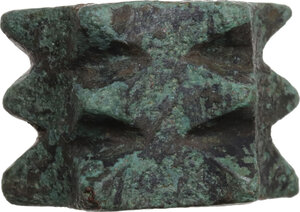
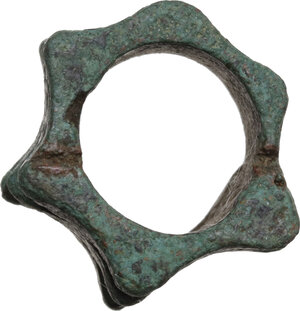
BRONZE 'PASSAREDINI' OR MACE HEAD Italic culture, c. 6th to 4th century BC. Masculine ring forged from leaded bronze. The circular accessory features a relatively smooth interior surface as well as columns of three spikes surrounding the exterior. Diameter: 23 mm. Height: 17 mm. Height: 16 mm. AE. Intact and complete. Generally referred to as 'passaredini' and thus related to the equestrian sphere, this type of bronze object apparently has no certain function. Another hypothesis of use sees these objects as belonging to the military or domestic sphere.
Lot # 1047
-
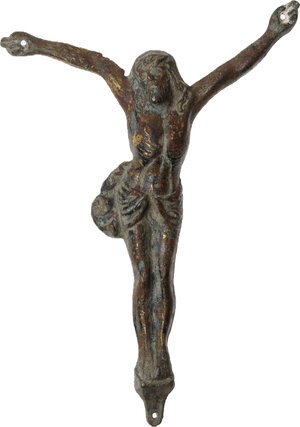
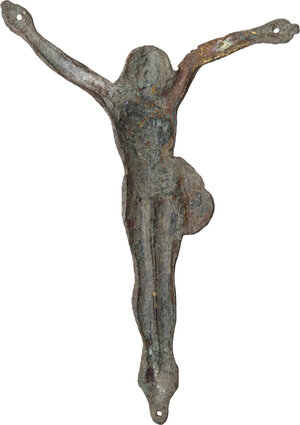
BRONZE CRUCIFIX Italy, c. 17th-18th centuries AD. Bronze crucifix not full fusion, with traces of gilding on the surface. Dimensions: 134 x 94 mm. 71.50 g. One arm is slightly bent.
Lot # 1046
-
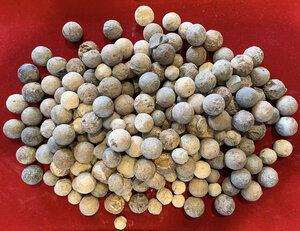
LEAD MUSKET BALLS Europe, c. 1500-1900 AD. Lot consisting of 212 musket bullets and bullet parts of various shapes and sizes.
Lot # 1045
-
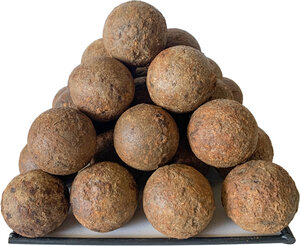
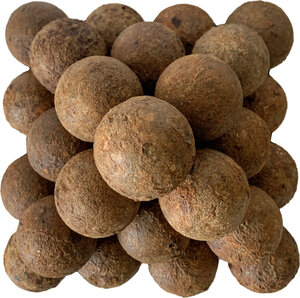
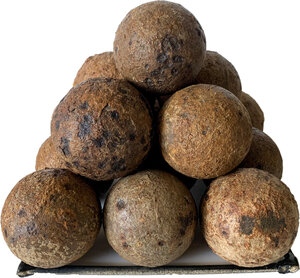
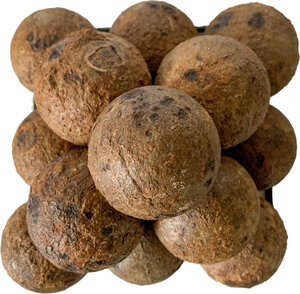
IRON HOWITZER PROJECTILES Reinassence, 16th - 17th century. Lot of thirty (30) iron projectile probably for a falkonet or a serpentine howitzer. ca. 280 g. each one x 43 mm. wide. FE.
Lot # 1044
-
IRON HOWITZER PROJECTILES Reinassence, 16th - 17th century. Lot of fourteen (14) iron projectile probably for a falkonet howitzer. ca. 480 g. each one x 51 mm. wide. FE. One of the falkonet's illustrious victims was Commander Giovanni dalle Bande Nere, wounded in the thigh during a battle against the landsknechts near Governolo and died of gangrene a few days after the amputation of the limb.
Lot # 1043
-
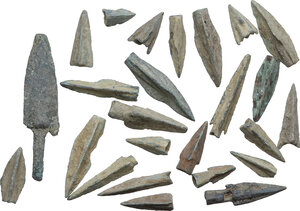
ANCIENT ARROWHEADS Ancient Mediterranean, c. 3rd century BC - 3rd century AD. Lot of twenty five (25) bronze arrow-heads in various shapes and sizes.
Lot # 1042
-
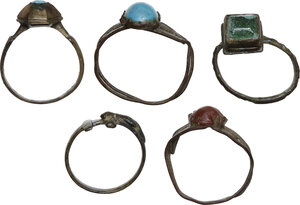
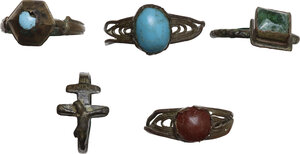
FIVE ANCIENT RINGS Post-medieval period, c. 15th to 19th century AD. Lot of five post-medieval bronze rings with semiprecious stones and glass set.
Lot # 1039
-
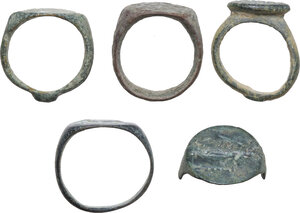
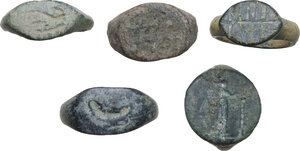
FIVE ANCIENT RINGS Greek World to Early Medieval period, c. 3rd century BC to 10th century AD. Lot of five (5) ancient bronze rings. Various inner sizes.
Lot # 1038
-
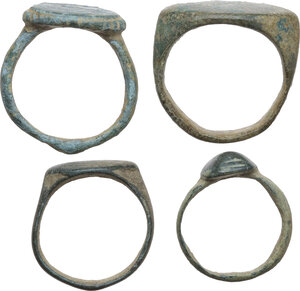
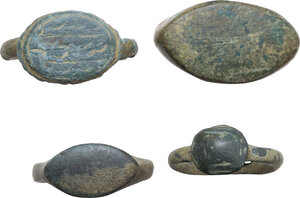
FOUR ANCIENT RINGS Greek World to Early Medieval period, c. 3rd century BC to 10th century AD. Lot of four (4) ancient bronze rings. Various inner sizes.
Lot # 1037
-
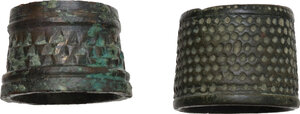
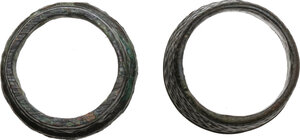
BRONZE THIMBLES From Roman to Post Medieval period, c. 1st to 19th century AD. Lot of two (2) bronze thimbles.
Lot # 1036
-
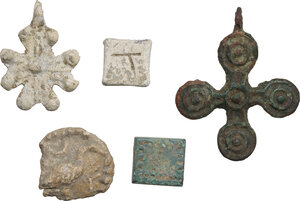
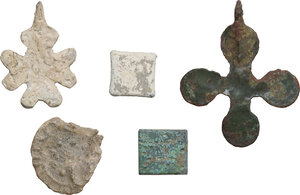
FIVE ANCIENT ITEMS Roman to Byzantine period, c. 1st to 12th century AD. Lot of five ancient items, including two byzantine crosses, one in lead and the other in bronze, two inscribed weights, one in lead and the other in bronze; and a leaden tessera. Dimensions: from 36 to 11.5 mm.
Lot # 1035
-
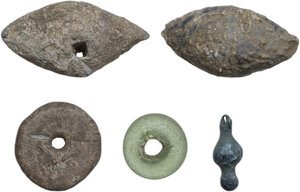
FIVE ANCIENT OBJECTS Greek and Roman world, c. 5th BC - 3rd century AD. Lot of five (5) items, made by two lead slingshots, a lead round weight , a bronze pendant and a glass bead or gaming piece.
Lot # 1034
-
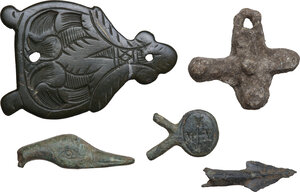
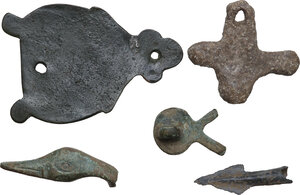
FIVE ANCIENT ITEMS Roman to Medieval period, c. 2nd - 14th century AD. Lot of five items, made by a lead cross pendant, a bronze applique, a bronze duck head, a bronze part of a belt with engraved monogram, a bronze arrowhead. Dimensions: from 51 to 19 mm. Interesting study lot.
Lot # 1033
-
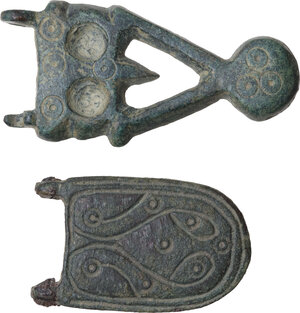
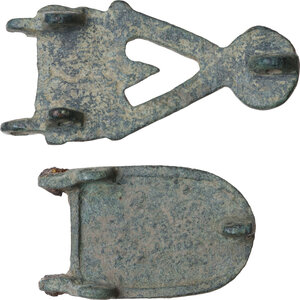
TWO BYZANTINE FIBULAE Late Roman period, c. 7th century AD. Lot of two Byzantine bronze fibulae with engraved decoration. Dimensions: 51x24 and 37x23 mm. Minor damages.
Lot # 1022
-
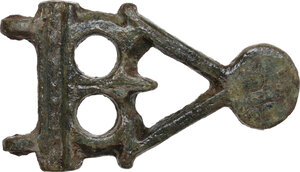
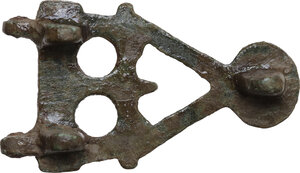
BYZANTINE BRONZE BUCKLE Byzantine, c. 8th century AD. Openwork plate decorated with dot-and-circle indentation, part of a bigger buckle. Dimensions: 42 x 24 mm. Intact. Nice green patina. K. R. Brown. From Attila to Charlemagne. Arts of the Early Medieval Period in The Metropolitan Museum of Art. Yale University Press, 2000, pg. 115.
Lot # 1021
-
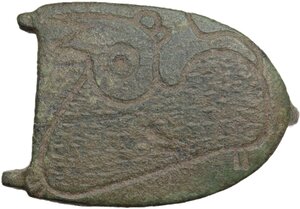
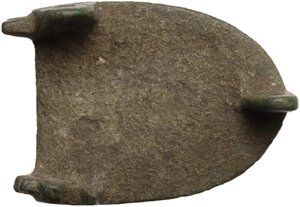
BYZANTINE BRONZE BELT Byzantine, c. 7th century AD. Byzantine bronze belt buckle with the flat side decorated with the engraving of a stylised rabbit (?) facing left. Fur rendered in horizontal dashes. Dimensions: 45 x 23 mm. 9.97 g.
Lot # 1020
-
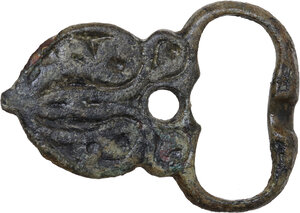
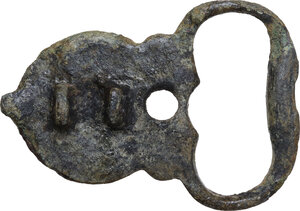
BYZANTINE FLORAL PATTERN BUCKLE Byzantine, c. 6th - 7th century AD. Bronze buckle with floreal pattern. Dimensions: 44 x 31 mm. Missing pin.
Lot # 1019
-
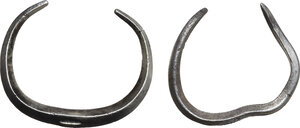
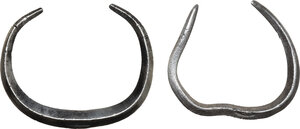
LATE ROMAN SILVER EARRINGS Roman or byzantine period, c. 3rd-7th century AD. Pair of silver earrings of late Roman or Byzantine workmanship of crescent shape with decorative notches engraved on the lower part. Dimensions: 37x31 and 33x29 mm. Total weight: 9.70 g.
Lot # 1017
-
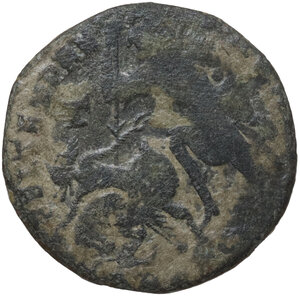
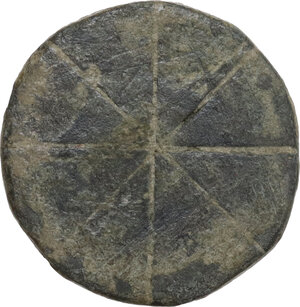
LATE ANTIQUE GAMING PIECE Roman period, 5th century AD. Game tessera obtained by smoothing and engraving the obverse of a FEL TEMP REPARATIO coin. Width: 20 mm. Weight: 4.08 g. Interesting and rare piece.
Lot # 1016
-
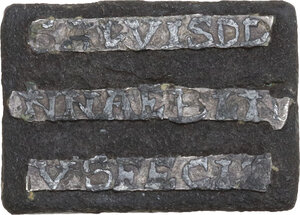
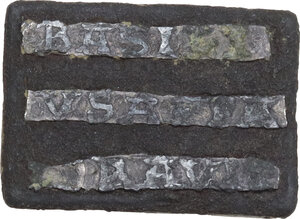
SMALL INSCRIBED TESSERA Roman period, c. 4th-5th century AD. Tessera inscribed in latin letters on six small silver plates placed on a bronze base: SALVIS D D / N N AEBLT / VS FECIT BASILE / VS AFPA / [--] RAVIT Dimensions: 18.5 x 13.5 mm. 3.38 g.
Lot # 1015
-
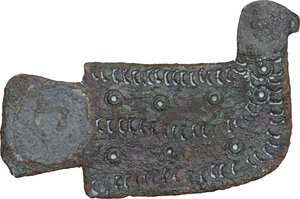
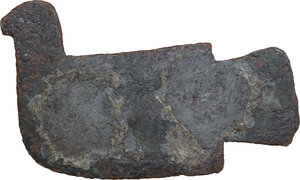
BARBARIC BIRD PLAQUE Roman period, c. 4th-5th century AD. Bronze sheet in the shape of a stylized bird, with details of the feathers engraved with half moons and circles. Dimensions: 39 x 25 mm. 2.99 g. Initially it must have been a fibula which was then reworked, probably in antiquity.
Lot # 1014
-
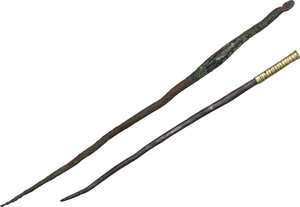
TWO ANCIENT PINS Ancient world, c. 5th century BC - 5th century AD. Lot of two ancient pins; one in bronze with a sort of small spatula and the other made of silver, with a gold sheet bent on one side. Dimensions: 120 and 80 mm. Intact and complete.
Lot # 1013
-
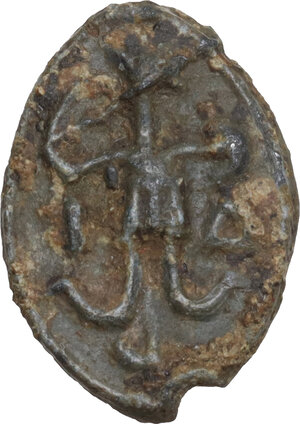
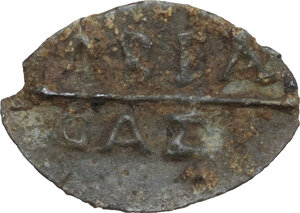
GNOSTIC ROMAN PLAQUE Roman period, c. 3rd - 4th century AD. Lead plaque with the representation of the demon Abraxas on one side and the inscription ABPA / CAS on the other. Dimensions: 18 x 12.5 mm. 1.80 g. The worship of the ancient demon Abrasax (or Abraxas) gained great importance in Roman times through the teachings of the Christian Gnostic Basilids of Alexandria.
Lot # 1012
-
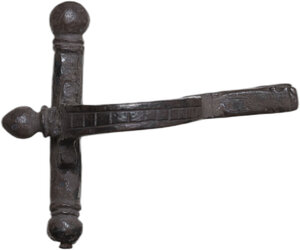
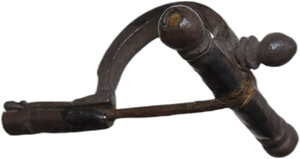
SILVER CROSSBOW FIBULA Roman period, c. 3rd century AD. Roman silver 'crossbow' fibula with engraved grid decoration on the bow. Dimensions: 83 x 48 mm. 24.62 g. Rare. Intact and complete.
Lot # 1011
-
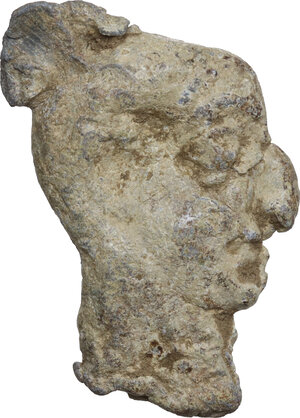
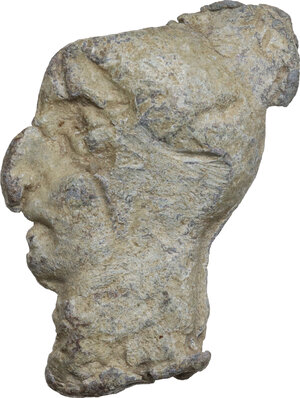
ROMAN LEAD HEAD Roman period, c. 2nd-4th century AD. Lead plaque in the shape of a female head (?) with both faces in relief. The grotesque features suggest a deliberately ugly caricature The characteristics are rendered with a beak nose, big eyes on a narrow face with a long neck. Dimensions: 41 x 25 mm. Hollow and a cracked area (see the pictures above), otherwise very well preserved.
Lot # 1010
-
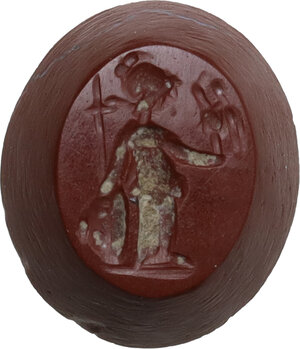
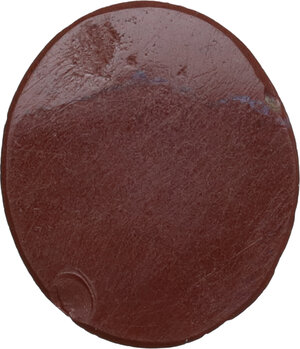
ROMAN MINERVA GEM Roman period, c. 2nd - 3rd century AD. Roman gem in red jasper with a truncated cone shape. The engraving represents a helmeted Minerva standing right, with a spear behind her and leaning on the shield with her right hand; with her left hand she holds the Palladium. Dimensions: 12 x 11 x 4 mm. Minor chips.
Lot # 1009
-
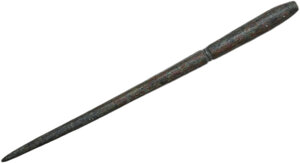
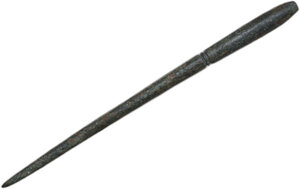
ROMAN NEEDLE Roman period, c. 1st - 3rd century AD. Roman bronze needle, or part of a stylus (a sort of pen), or a sewing item. Lenght: 97.5 mm. 10.50 g.
Lot # 1008
-
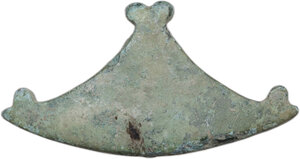
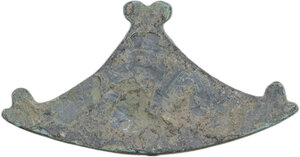
PELTA SHAPED APPLIQUE Roman period, c. 1st-3rd century AD. Bronze pelta shaped roman applique, probably part of a forniture. Dimensions: 68.5 x 30.5 mm. 32.77 g. Intact and complete. Superb green patina.
Lot # 1007
-
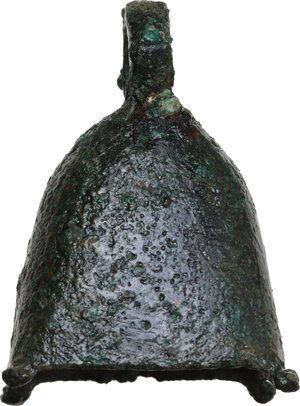
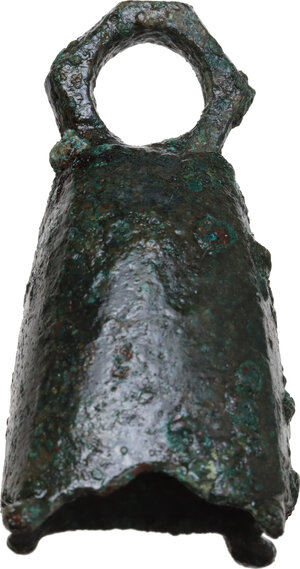
ROMAN BRONZE BELL Roman period, c. 1st - 3rd century AD. Rectangular cross-section bell, with suspension ring. Height: 50 mm. Base: 35 x 25 mm. Well preserved. The iron clapper is missing.
Lot # 1006
-
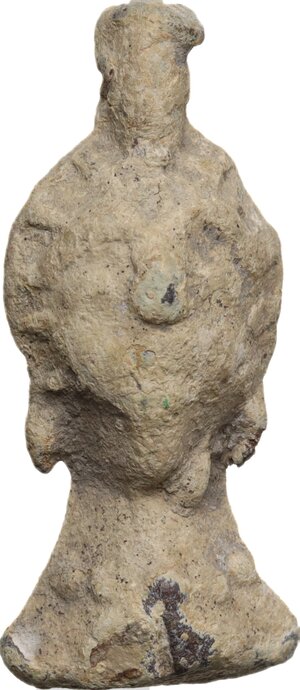
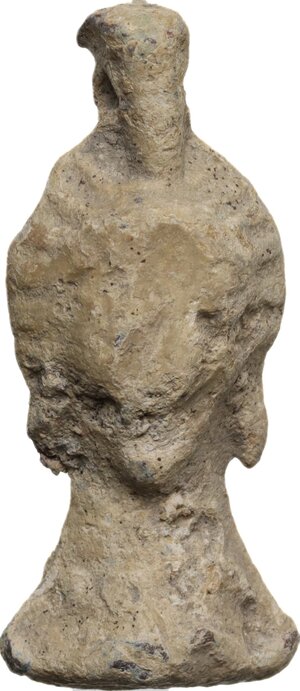
'GROMA' HEAD WEIGHT Roman period, 1st-3rd century AD. Weight in the shape of head with suspension loop. Dimensions: 35 x 15 mm. Weight: 16.39 g. In the building of a Castra, after having flattened the ground and before starting the ditch and wall construction, an agrimensor (land surveyor) drew the locations of the streets and of the wall, beginning from the center of the field, using the groma. It follows the description of this topographical tool and its use. (https://legioneromana.altervista.org/content/how-use-roman-groma?language=en).
Lot # 1005
-
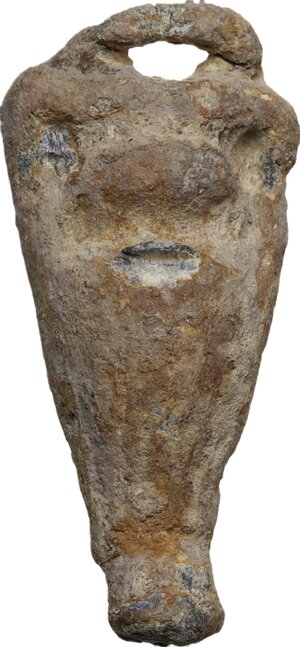
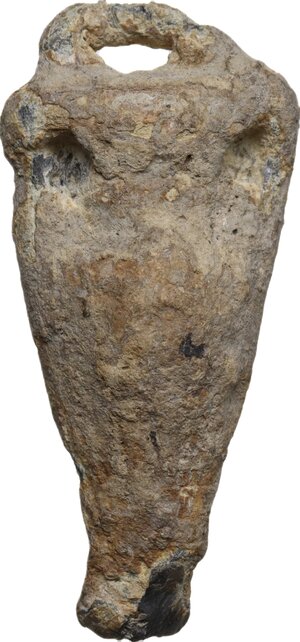
'GROMA' AMPHORA WEIGHT Roman period, 1st-3rd century AD. Weight in the shape of amphora with suspension loop. Dimensions: 46 x 19 mm. Weight: 42.21 g. In the building of a Castra, after having flattened the ground and before starting the ditch and wall construction, an agrimensor (land surveyor) drew the locations of the streets and of the wall, beginning from the center of the field, using the groma. It follows the description of this topographical tool and its use. (https://legioneromana.altervista.org/content/how-use-roman-groma?language=en).
Lot # 1004
-
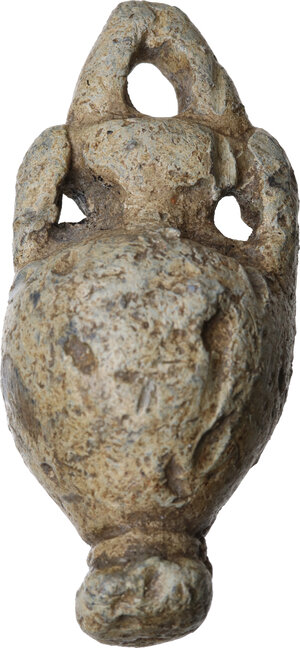
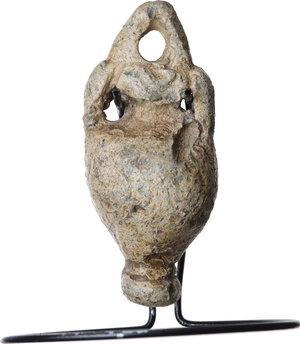
LARGE ROMAN LEAD AMPHORA Roman period, c. 1st-3rd century AD. Large, heavy and unusual Roman solid lead amphora with a large bulbous main body tapering to a short narrow neck with two loop handles on opposing shoulders. On top: hole for suspension. Dimensions: 78 x 34.5 mm. Weight: 310.4 g. Intact and complete.
Lot # 1003
-
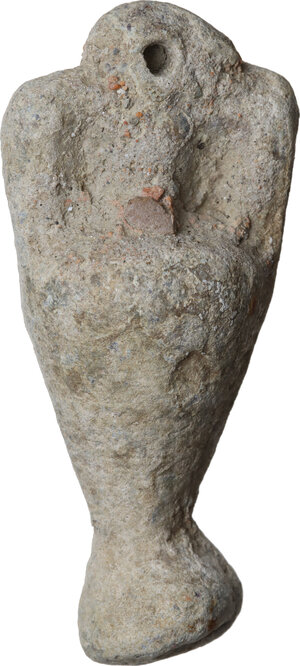
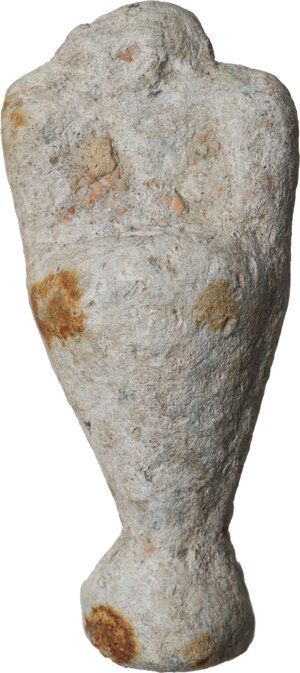
LARGE ROMAN LEAD AMPHORA Roman period, c. 1st-3rd century AD. Large, heavy and unusual Roman solid lead votive amphora with a large bulbous main body tapering to a short narrow neck with two loop handles on opposing shoulders. Dimensions: 87 x 39 mm. Weight: 372 g. Unusual large type.
Lot # 1002
-
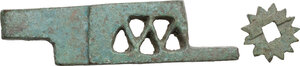
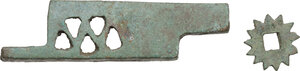
ROMAN PADLOCK AND CASKET DECORATION Roman period, c. 1st-3rd century AD. Lot of two Roman bronze objects, comprising a padlock and a star shaped casket decoration. Dimensions: Padlock; 57 x 15 mm. Decoration; diameter 14.5 mm. Intact and complete. Lovely green patina.
Results from 401 to 450 of 524