Works of Art
Results from 151 to 200 of 624
Lot # 219
-
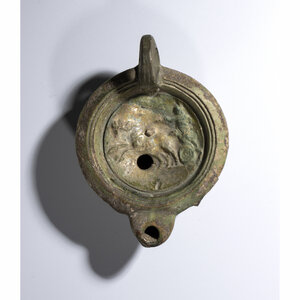
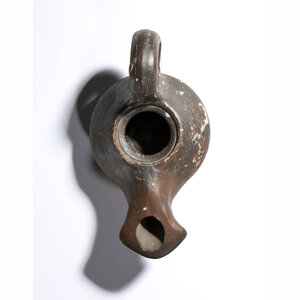
A LOT OF 2 ROMAN OIL LAMPS.
1st-2nd century A.D.
L. 10,7 cm ; 12 cm
Provenance
Swiss private collection of the Numismat Giovanni Maria Staffieri, acquired between the 1960s-1990s
One with a simple nozzle, its central medallion decorated with a depiction of a soldier riding a chariot drawn by two horses. The other, featuring a volute nozzle, is plain and undecorated. On the decorated lamp, traces of green glaze remain.
Lot # 218
-
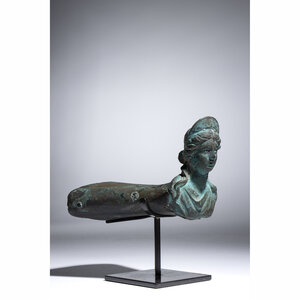
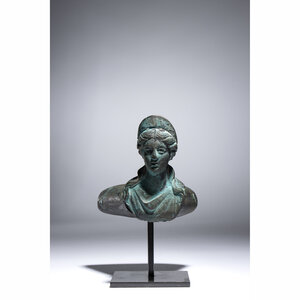
A RARE ROMAN BRONZE FURNITURE ADORNMENT WITH BUST OF GODDESS.
Circa 2nd century A.D.
L. 14 cm x W. 11,5 cm x H. 10,5 cm
Provenance
Formerly, private collection S.A., 1992
Private Collection of the Numismat Giovanni Maria Staffieri, acquired in 2000s, Switzerland
The flared, hollow handle bears traces of holes and screws, indicating that it was once fitted into a larger composite structure—possibly a wooden piece of furniture. The terminal is cast in the form of a divine bust, characterized by draped shoulders, an elongated neck, and a delicately modeled face with softly rounded features. The hairstyle consists of long strands parted at the center and gathered into a low chignon, with a few gently undulating locks falling gracefully over the shoulders. The head is crowned with a diadem. The piece displays an attractive light green patina and is in a fine state of preservation.
Lot # 217
-
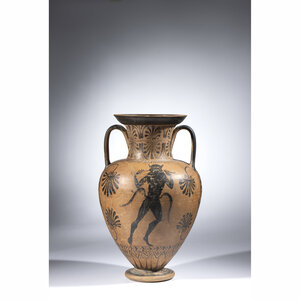
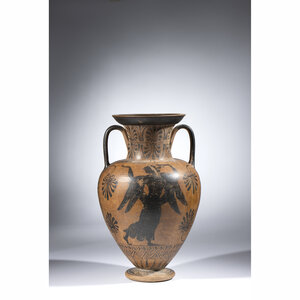
AN ETRUSCAN BLACK FIGURE AMPHORA.
Ca. 480/470 BCE
H. 37,5 cm
Provenance
Swiss private collection of the Numismat Giovanni Maria Staffieri, acquired between the 1960s-1990s
Side A: A Dancing female figure, wearing a long chiton and a folded mantle on the shoulders.
Side B: A satyre playing the double flute.
Multiple palmettes beneath the handles and framing each scene.
Encircling bands around the lower body with ivy leaves and zigzag pattern, with rays from the foot below, the neck with double lotus buds flanked by double palmettes. Restorations.
Lot # 216
-
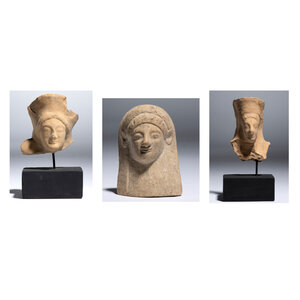
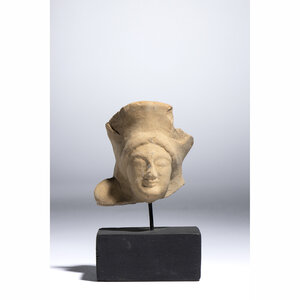
A GROUP OF GREEK TERRACOTTA FEMALE HEAD PROTOMES.
Circa 6th-5th century BCE
H. 5 cm; 3,2 cm ; 3,2 cm
Provenance
Swiss private collection of the Numismat Giovanni Maria Staffieri, acquired between the 1960s-1990s
Each with archaising smile, wearing stephane.
Lot # 215
-
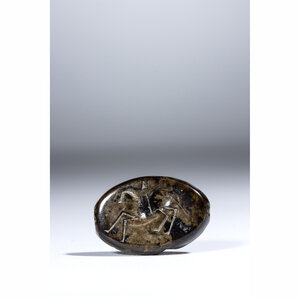
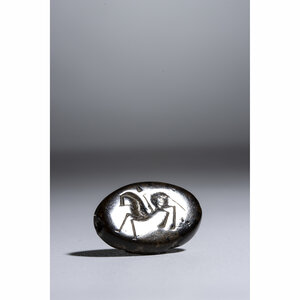
AN URUK STONE STAMP-SEAL.
Proto-Elamite, 4000-3000 BCE
Dim. 21,5 x 14,7 mm
Provenance
Swiss private collection of the Numismat Giovanni Maria Staffieri, acquired between the 1960s-1990s
Oval-shaped, black stone stamp-seal with gabled top; hole drilled through longitudinally for suspension; base engraved with crude design showing a man riding horse.
For a similar typology see British Museum, inv. 135723.
Lot # 214
-
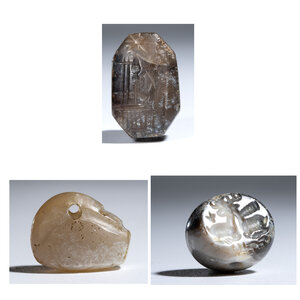
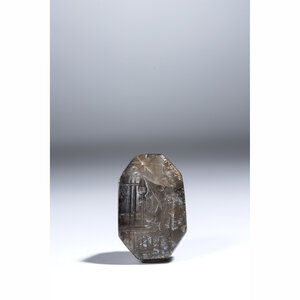
A GROUP OF 3 MESOPOTAMIAN AND SASANIAN AGATE STAMP-SEALS.
Assyro-Babylonian and Sasanian types; 8th century BCE- 4th century A.D.
Dim. 21,4 x 16,9 mm / 22,8 x 21,3 mm / 16,6 x 11,3 mm
Provenance
Swiss private collection of the Numismat Giovanni Maria Staffieri, acquired between the 1960s-1990s
One of a duck-shape form (head partially broken), the base engraved with a cultic scene; one of octogonal shape, the base engraved with a cultic scene; one of rounded shape, the base engraved with two crouched stags and a Pahlavi inscription below. All pierced.
Lot # 213
-
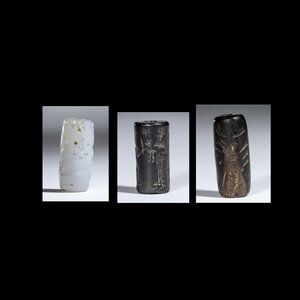
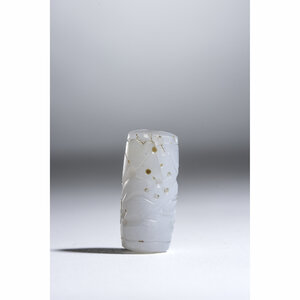
A GROUP OF MESOPOTAMIAN AGATE CYLINDER SEALS.
Assyrian and Neo-Assyrian type, 900-700 BCE
Dim. 23,3 x 10,4 mm ; 18,4 x 9 mm ; 23,5 x 10,2 mm
Provenance
Swiss private collection of the Numismat Giovanni Maria Staffieri, acquired between the 1960s-1990s
Lot # 212
-
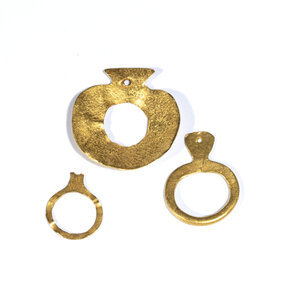
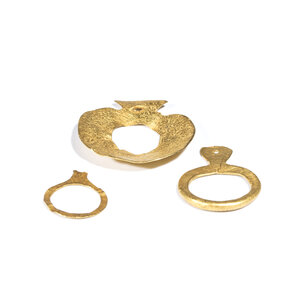
A GROUP OF EUROPEAN CHALCOLITHIC GOLD PENDANTS.
Varna, circa 4550-4450 BCE
Dim. Max. 30,8 x 33,09 mm / min. 20,20 x 16,13 mm
Provenance
Swiss private collection of the Numismat Giovanni Maria Staffieri, acquired between the 1960s-1990s
Both ring-shaped idol pendant with stylized head with a suspension hole (one damage on top). Very good conservation.
Lot # 211
-
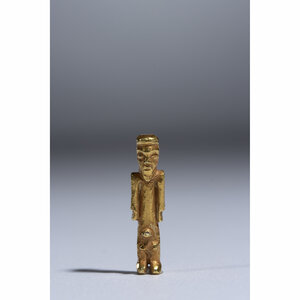
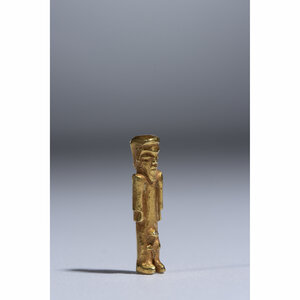
A LATE BRONZE AGE MASSIVE GOLD SMALL MALE FIGURE.
Anatolia or Asia Minor, circa 2nd Millennium BCE
H. 1,9 cm ; 23,13 gr
Provenance
Swiss private collection of the Numismat Giovanni Maria Staffieri, acquired between the 1960s-1990s
The male figure is depicted standing nude, with arms held close to the sides of the body. The head displays archaizing features, including large protruding eyes, a beard, and a headdress. The genitalia are indicated by a slight protuberance. Traces of filing are visible across the entire surface, possibly related to cleaning.
Lot # 210
-
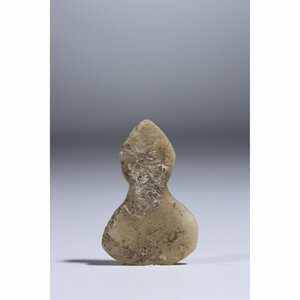
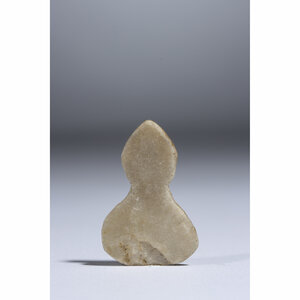
AN ANATOLIAN MARBLE IDOL.
Early 3rd Millennium BCE
Dim. 2,6 x 1,7 cm
Provenance
Swiss private collection of the Numismat Giovanni Maria Staffieri, acquired between the 1960s-1990s
Almost violin shape. With elongated pointed head on a short tapering neck and short rounded body. Traces of concretions and deposit.
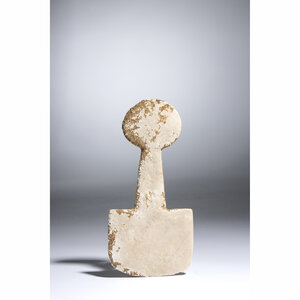
Lot # 209
-
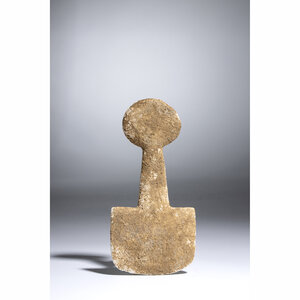
AN ANATOLIAN MARBLE FRAGMENTARY IDOL.
Kusura Type, Circa 2700-2100 BCE
H. 14,8 cm x L. 7,1 cm
Provenance
Swiss private collection of the Numismat Giovanni Maria Staffieri, acquired between the 1960s-1990s
The disk-shaped head on a long tapering neck, with a spade-shaped body (fragmentary). Very good conservation. Traces of concretions and deposit.
Lot # 208
-
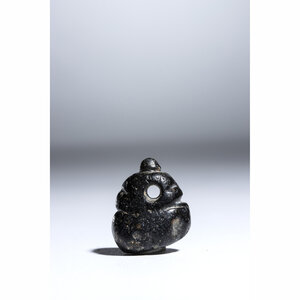
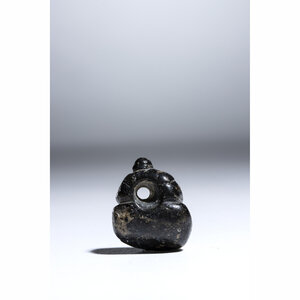
A NEOLITHIC BLACK STONE IDOL PENDANT.
Ca. 4000-3500 BCE
Dim. 21,6 x 18 mm
Provenance
Swiss private collection of the Numismat Giovanni Maria Staffieri, acquired between the 1960s-1990s
With a corpulent body and small rounded head, pierced through the chest for suspension.
Lot # 207
-
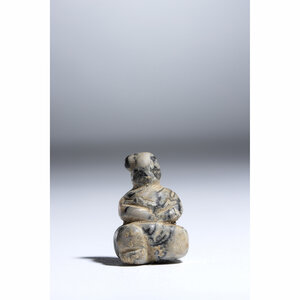
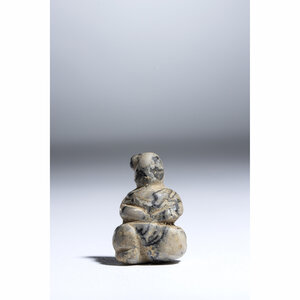
A LATE NEOLITHIC MARBLE SEATED FIGURE.
Ca. 5300-4500 BCE
H. 2,4 cm
Provenance
Swiss private collection of the Numismat Giovanni Maria Staffieri, acquired between the 1960s-1990s
The corpulent seated figure, with her arms crossed below her breasts, the head in three-quarters. The waist intentionally recessed to mark the large and opulent hips, symbolizing maternity and procreation. Deposits and patina.
Lot # 206
-
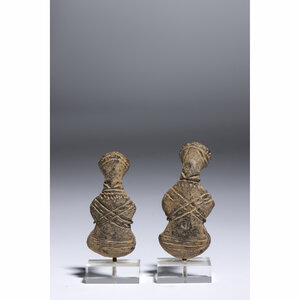
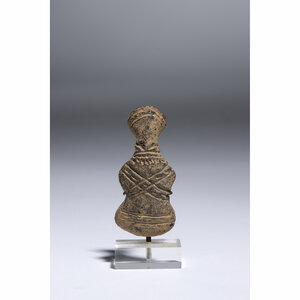
TWO ANATOLIAN TERRACOTTA FIGURES.
Early Bonze Age II, mid 3rd Millennium BCE
H. 4,9 cm ; 5,5 cm
Provenance
Swiss private collection of the Numismat Giovanni Maria Staffieri, acquired between the 1960s-1970s
Each figurine is characterized by an almost violin-shaped silhouette.
On the rounded lower section of the body, which is depicted without legs, sits a slightly backward-tilting, elongated neck and head element. Incised lines and punctuations suggest the presence of a hairstyle or head covering. On the chest, crossed lines, on the hips incised bands.
Lot # 205
-
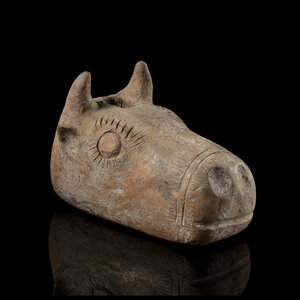
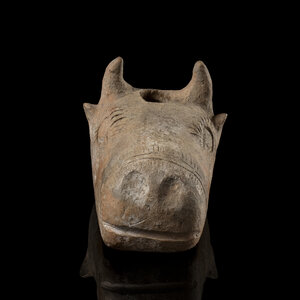
AN ARCHAIC JAPANESE TERRACOTTA HEAD OF A BULL
Dim. 9,5 x 13,5 cm
Provenance
Swiss private collection of Baron O.C.V.L (1937-2022)
Lot # 204
-
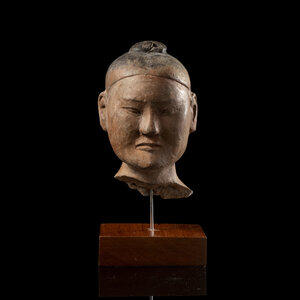
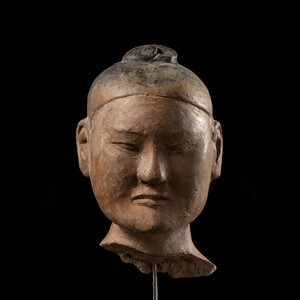
A HAN DYNASTY PAINTED TERRACOTTA WARRIOR HEAD.
206 BCE - 220 A.D.
H. 12 cm circa
Provenance
Swiss private collection of Baron O.C.V.L (1937-2022)
A finely modelled Chinese Han Dynasty terracotta head of a warrior. Much of the original pigment remains, with black used to delineate the hair, which is centrally parted and slicked back, defined by incised lines. Facial features are nicely rendered with much attention towards details.
Lot # 203
-
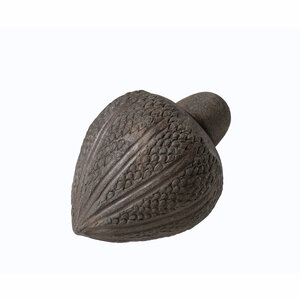
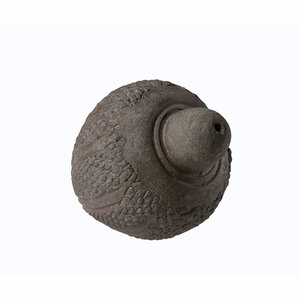
A FATIMID VITRIFIED POTTERY AEOLIPILE.
Circa 10th-11th century
H. 13 cm
Provenance
Swiss private collection of Baron O.C.V.L (1937-2022)
Lot # 202
-
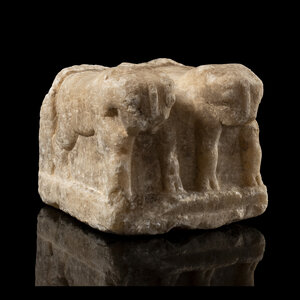
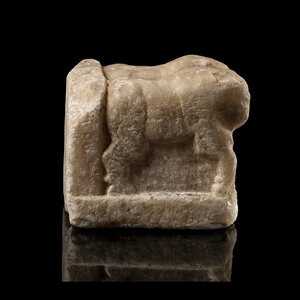
A SOUTH ARABIAN ALABASTER IBEX FRAGMENTARY STELA.
Ca. 1st century A.D.
H. 11 cm x L. 12,5 cm ; W. 12 cm
Provenance
Swiss private collection of Baron O.C.V.L (1937-2022)
Emerging and carved from a single alabaster block, two standing ibex (horns missing), with eyes, nose and legs in relief. The muscles volumes of the powerful beast are well-rendered. at the back remains of a plaque which must have been the front part of a libation table.
Lot # 201
-
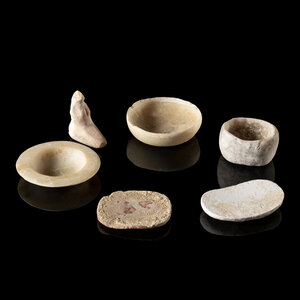
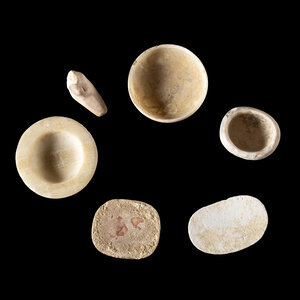
A GROUP OF BACTRIAN ALABASTER AND STONE VESSEL.
2nd-1st Millennium BCE
H. 5 cm / Max. Diam. 8 cm
Provenance
Swiss private collection of Baron O.C.V.L (1937-2022)
Comprising a stone amulet in duck shape.
Lot # 200
-
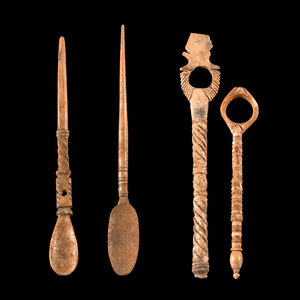
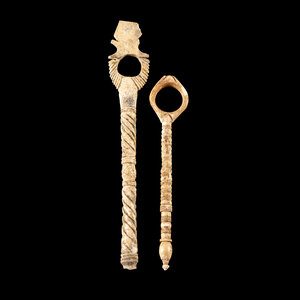
A LOT OF ROMAN BONES COSMETIC AND DAILY INSTRUMENTS.
Circa 3rd-4th century A.D.
L. max 7,2 cm
Provenance
Swiss private collection of Baron O.C.V.L (1937-2022)
Two distaffs and two spoons with carved details.
Lot # 199
-
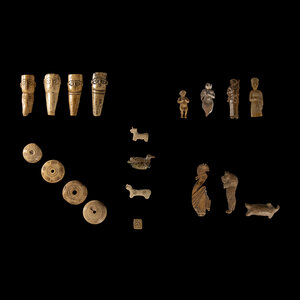
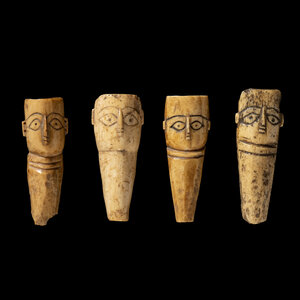
A GROUP OF 19 BONES ELEMENTS.
Coptic to early Medieval period, 6th-8th century A.D.
Min. H. 14 mm / Max. H. 72 mm (chicken)
Provenance
Swiss private collection of Baron O.C.V.L (1937-2022)
With 4 dolls heads (eyes, eyebrows, nose and mouth carved); 4 carved spindle whorls; anthropomorphic and zoomorphic figurines.
Lot # 198
-
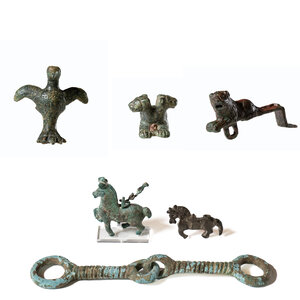
A GROUP OF 6 ROMAN AND EASTERN MEDITERRANEAN BRONZE ANIMAL ELEMENTS.
2nd-4th century A.D.
Provenance
Swiss private collection of Baron O.C.V.L (1937-2022)
With an eagle, a door attachment with a lion, a lion figure, harness elements in the shape of horses and rings.
Lot # 197
-
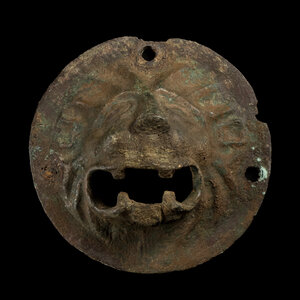
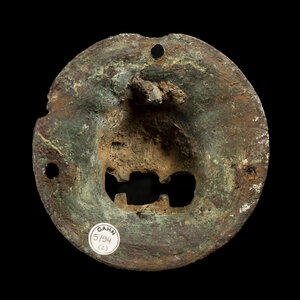
A ROMAN BRONZE HEAD DOOR HANDLE.
2nd-3rd century A.D.
Diam. 12 cm
Provenance
Ex Cahn Auktion (5/94 (2))
Swiss private collection of Baron O.C.V.L (1937-2022)
The handle mount depicts the head of a fierce lion with bare fangs, a wide snout, almond-shaped eyes with delineated pupils, all surrounded by a radiating mane. A ring handle would have been suspended the lion's mouth,
Lot # 196
-
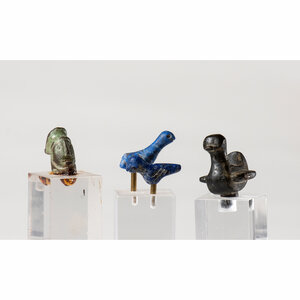
A LOT OF VARIA ELEMENTS IN BRONZE AND LAPIS LAZULI.
1st Millenium A.D. and Modern
Min. H. 5 mm / Max. H. 2,5 cm
Provenance
Swiss private collection of Baron O.C.V.L (1937-2022)
2 Lapis birds (modern). A stylized bronze head (Italic). A bronze bird/duck element.
Lot # 195
-
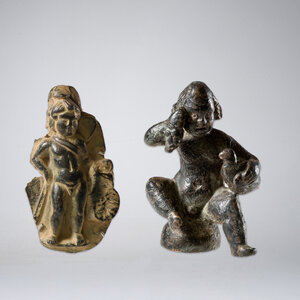
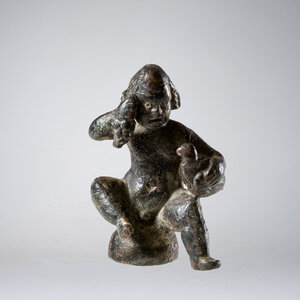
A LOT OF 2 ROMAN BRONZE FIGURES OF EROS.
2nd-3rd century A.D.
H. 4,7 / 3,8 cm
Provenance
Swiss private collection of Baron O.C.V.L (1937-2022)
From left to right: Standing Eros, depicting naked with the belt of his quiver. The other figure displays a seated young naked boy, holding grapes in the right hand, and a bird on the left one, resting on his knee. The eyes once silver gilted.
Lot # 194
-
A ROMAN BRONZE OF ISIS-FORTUNA.
1st-2nd century A.D.
Ca. H. 9 cm
Provenance
Swiss private collection of Baron O.C.V.L (1937-2022)
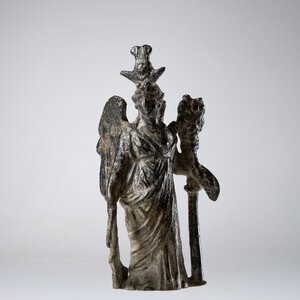
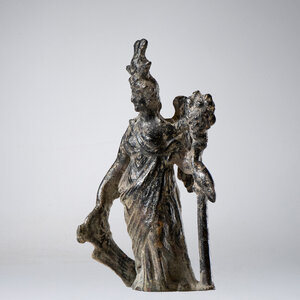
This rare iconography of Isis-Fortuna represents the syncretic goddess, in a Hellenistic robe. She has a combination of cow horns, sun-disk, and ostrich feathers as a crown on her head, a cornucopia in her left arm, and a ship's rudder in her right hand. The cornucopia connects her to the goddess Fortuna, and the Egyptian crown to Isis. The rudder stresses the aspect of Isis as patron of navigation, called Isis Pelagia. However the most important attribute is the cornucopia, which because of its size needed an additional support in the form of an extra pillar below the elbow of the goddess. The originality of this representation, is the presence of large wings that directly refers to the greek-roman goddess Victory.
Lot # 193
-
A BRONZE FIGURES OK HARPOKRATES.
1st-2nd century A.D.
H. 9 cm
Provenance
Swiss private collection of Baron O.C.V.L (1937-2022)
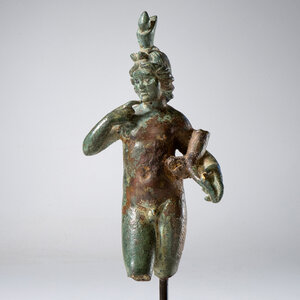
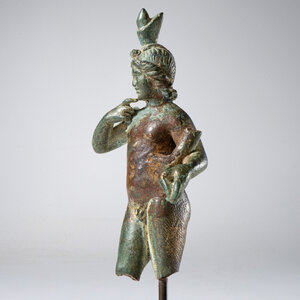
The child god depicted nude, standing in a languid pose, the left arm bent and held out supporting a (fruit-laden missing) cornucopia, the right arm bent acutely with the hand toward his face, the forefinger extended toward his lips in characteristic fashion, his head turned to his right, his tousled hair surmounted by a diminutive pschent-crown fronted by a crescent moon.
Lot # 192
-
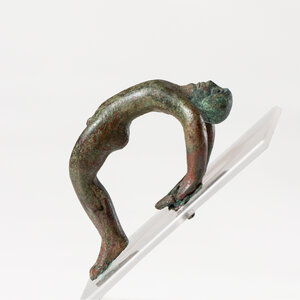
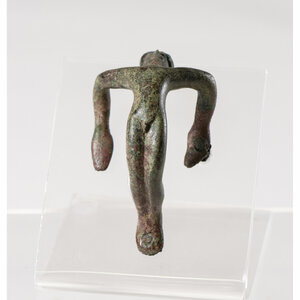
AN ETRUSCAN BRONZE CISTA HANDLE DEPICTING AN ACROBAT.
Ca. 5th-4th century BCE
H. 6 cm
Provenance
Swiss private collection of Baron O.C.V.L (1937-2022)
Cast in bronze, in the form of a nude male youth performing an arched backbend, with his feet joined and head tilted backward. The acrobat is depicted with finely detailed facial features and hair, enhanced by incised lines. His flattened hands and feet serve as attachment points, although one pin is now missing. This handle was originally part of a cista, a cylindrical lidded container used to store women's cosmetics and toiletries, such as hairpins and strigils. Cistae have predominantly been found in the tombs of wealthy Etruscan women.
Lot # 191
-
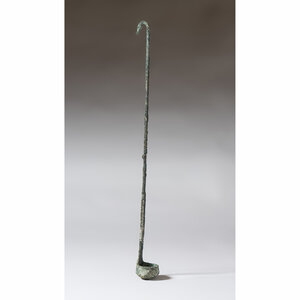
AN ETRUSCAN BRONZE ARTICULATED SIMPULUM.
5th century BCE
H. 47 cm
Provenance
Swiss private collection of Baron O.C.V.L (1937-2022)
Foldable in two, the handle with a duck-head protome.
Lot # 190
-
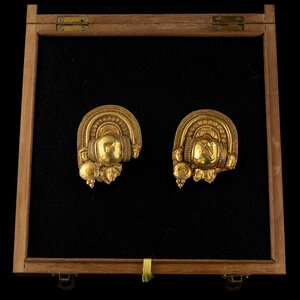
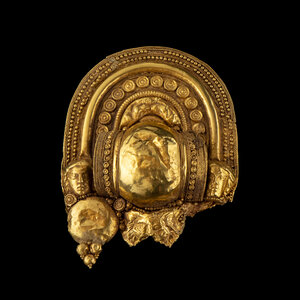
A PAIR OF ETRUSCAN GOLD EARRINGS.
Second half of the 4th century BCE
H. 6,8 cm
Provenance
Formerly Rassla Fondation, Zurich, Dr Giancarlo Ligabue (1931-2015)
Swiss private collection of Baron O.C.V.L (1937-2022)
Gold ear-rings, flattened `leech' with a horseshoe-shaped plaque, decorated with a braided wires alternated with a dotted band in relief and a row of circled wires; above the `leech' in a small crescent-shaped a embossed scene of a man fighting a lion (probably Hercules fighting the Nemean lion) and a ribbed wire; on each side is female head in relief; below are lentoid beads with three triangular clusters of smaller beads, and a head of Gorgona. Although these earrings are fragmentary, the rendered quality of details is exceptional. In their made-on-measure 20th century wood box.
Lot # 189
-
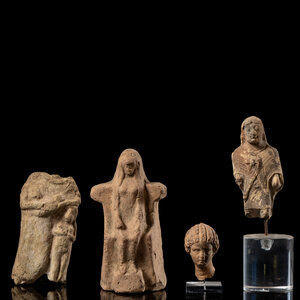
A GROUP OF 4 VOTIVE TERRACOTA FIGURES.
6th-3rd century BCE
H.min 4 cm / Max. 12,5 cm
Provenance
Swiss private collection of Baron O.C.V.L (1937-2022)
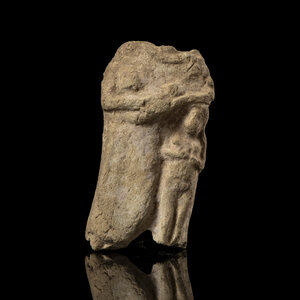
From left to right: a fragmentary statuette of a woman with child; a seated goddess figure, a head of woman, a fragmentary kouros figure.
Lot # 188
-
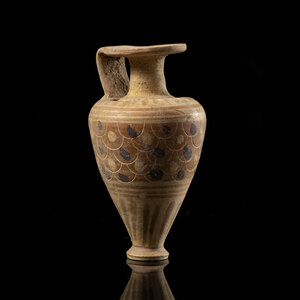
A CORINTHIAN POTTERY AMPHORISKOS.
Circa 625 BCE
H. 9,2 cm
Provenance
Swiss private collection of Baron O.C.V.L (1937-2022)
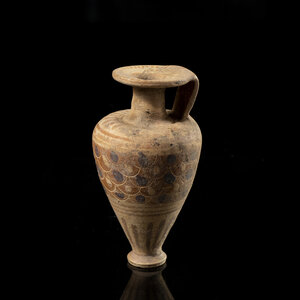
Of piriform shape. On the body, Decoration of scale-pattern adorned with black and beige painted dots. Beautiful conservation.
Lot # 187
-
A BOEOTIAN TERRACOTTA 'PAPADES' IDOL.
7th-6th century BCE.
H. 16 cm.
Provenance
Swiss private collection of Baron O.C.V.L (1937-2022)
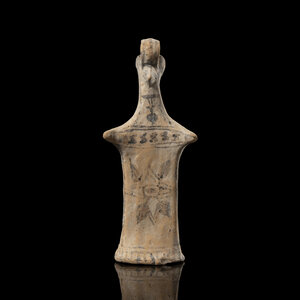
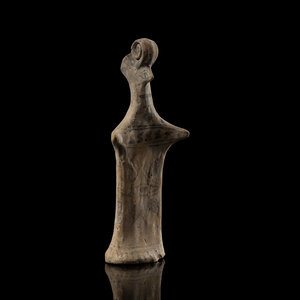
Plank idol with a flat body, merging at the bottom to an oval foot ring and on top to a cylindrical neck. The bird-like face with a beak-shaped nose and black painted eyes. The head surmounted by a cupped polos at the back of the head identifying her as a goddess. On the forehead a large, inwardly rolled volute, suggesting a quiff. The short arms are protruding on the sides, slightly bent forward and tapering. The necklace and the dress, with geometric and 4 pointed rosace. Figurines like the current one are believed to represent goddesses, possibly Demeter or Hera. Their distinctive headdress has led to them being referred to as "Papades."
Lot # 186
-
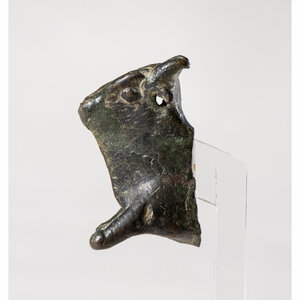
AN ANATOLIAN BRONZE FRAGMENTARY BULL FIGURE.
11th-8th century BCE
H. 5,5 cm
Provenance
Swiss private collection of Baron O.C.V.L (1937-2022)
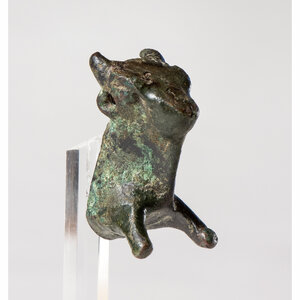
Showing the forepart of the animal.
Lot # 185
-
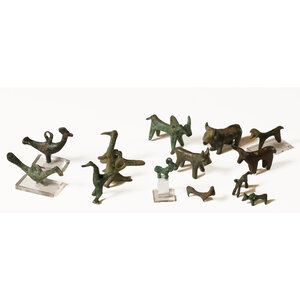
A GROUP OF 14 GREEK AND ANATOLIAN BRONZE ANIMAL FIGURES.
Geometric period, 11th-9th century BCE
H. min 1,2 cm / Max.4,5 cm
Provenance
Swiss private collection of Baron O.C.V.L (1937-2022)
A group of 14 Greek and Anatolian bronze animal figures. 11th-9th century BCE
Lot # 184
-
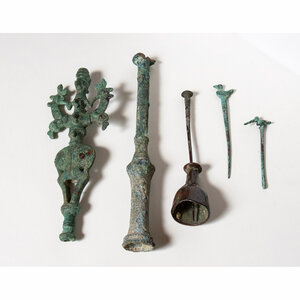
A GROUP OF 5 LURISTAN AND GREEK BRONZE ELEMENTS.
11th-7th century BCE
H. min 7,5 cm / H. max 20,2 cm
Provenance
Swiss private collection of Baron O.C.V.L (1937-2022)
From left to right: a 'Master of Animals' standard final; a tubular stand, a part of a bottle with pin; two Greek Geometric bronze pin with duck finals.
Lot # 183
-
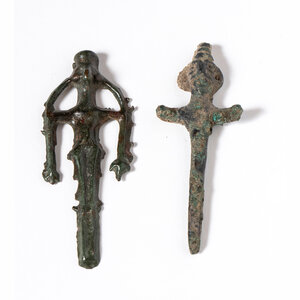
A GROUP OF NEAR EASTERN BRONZE PEGS
Ca. 2nd Millennium BCE
H. 8,2 cm ; H. 8 cm
Provenance
Swiss private collection of Baron O.C.V.L (1937-2022)
Lot # 182
-
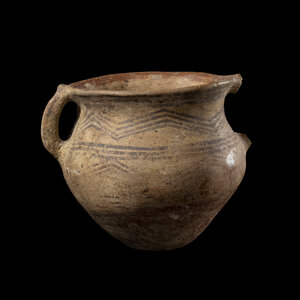
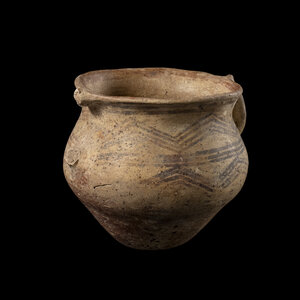
A NEAR EASTERN TERRACOTTA JAR.
Ca. 3rd Millennium BCE
H. 13 cm
Provenance
Swiss private collection of Baron O.C.V.L (1937-2022)
Oblong in shape, with a swollen belly and a flared neck. Black painted decoration structured in registers of zigzag lines separated by three bands. Missing a handle.
Lot # 181
-
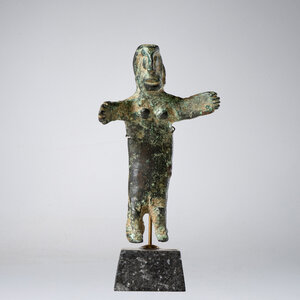
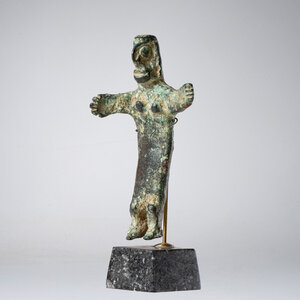
A PIRAVEND BRONZE FIGURE OF A WOMAN.
Early 1st Millennium BCE
H. 9,2 cm
Provenance
Swiss private collection of Baron O.C.V.L (1937-2022), purchased with NEFER, Zurich, 1973
Published in
Catalogue NEFER 6, 1973, n°73
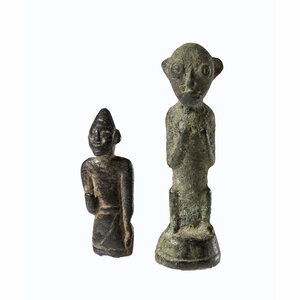
Depicting naked and standing frontal. With a plated body, arms wide-opened, the elongated head is marked by stronf features; proturding eyes and nose. The breasts are also represented with two proturding humps.
Lot # 180
-
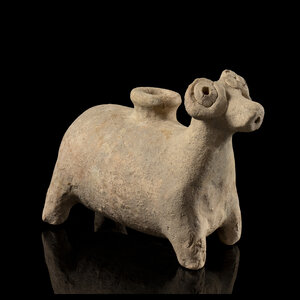
A GROUP OF NEAR WORSHIPPERS FIGURES.
Ca. 2nd Millennium BCE
H. 5,5 cm / H. H. 8 cm
Provenance
Swiss private collection of Baron O.C.V.L (1937-2022)
Lot # 179
-
A NEAR EASTERN POTTERY RHYTON
Ca. 2nd Millennium BCE
Dim. 13,5 x 7 cm
Provenance
Swiss private collection of Baron O.C.V.L (1937-2022)
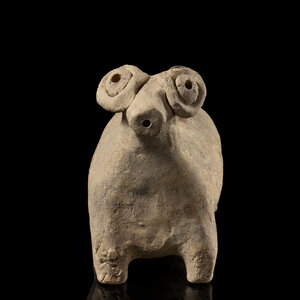
Hand-modeled of a ram shape. With short neck on the back of the animal.
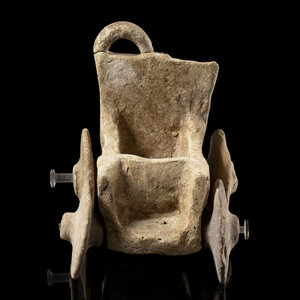
Lot # 178
-
A NEAR EASTERN TERRACOTTA VOTIVE CHARIOT.
Syro-Hittite, ca. 1500-1000 BCE
H. 14 cm
Provenance
Swiss private collection of Baron O.C.V.L (1937-2022)
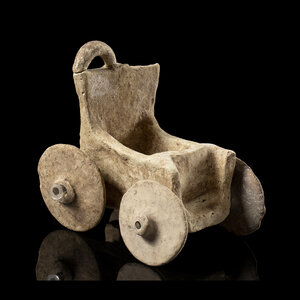
A hand-modeled pottery votive chariot with both high and low sides, this piece is part of a long-standing tradition in the ancient Near East of pottery figures that depict religious and daily life themes. It was likely offered by a worshipper as part of a ritual, and would have originally been accompanied by figures such as oxen, humans, and possibly small offerings like food placed inside. The chariot symbolized the gods' warlike nature.
Lot # 177
-
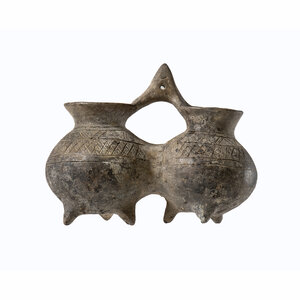
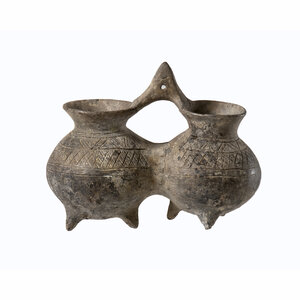
AN URARTU GREY WARE POTTERY
Early Bronze Age, ca. 2800-2500 BCE
H. 13 x L. 16 cm
Provenance
Swiss private collection of Baron O.C.V.L (1937-2022)
Lot # 176
-
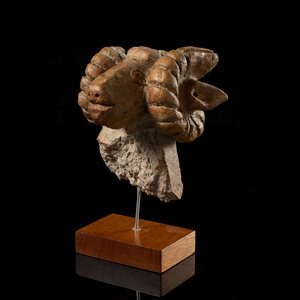
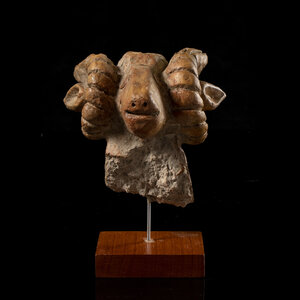
A NEAR EASTERN TERRACOTTA HEAD OF A RAM.
Circa 2nd Millennium BCE
H. 11,5 cm
Provenance
Swiss private collection of Baron O.C.V.L (1937-2022)
Hand modeled with large horns
Lot # 175
-
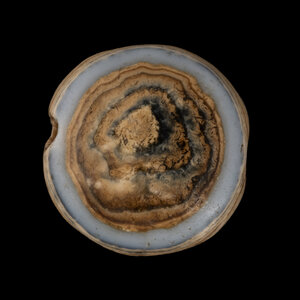
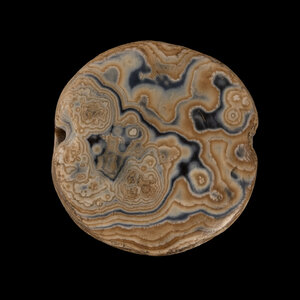
A BACTRIAN AGATE BEAD
1st Millennium BCE
Dim. 16 x 17 x 6 mm
Provenance
Swiss private collection of Baron O.C.V.L (1937-2022)
Of rounded shaped and pierced lengthwise.
Lot # 174
-
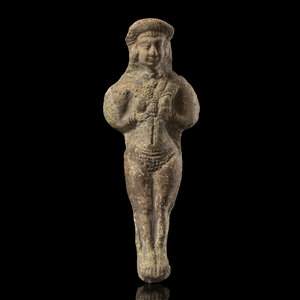
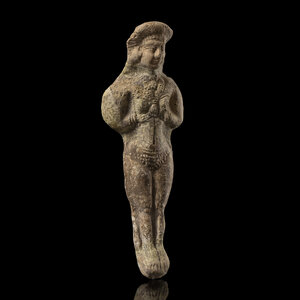
AN ELAMITE TERRACOTTA GODDESS FIGURE.
Ca. 1500-1000 BCE
H. 16,5 cm
Provenance
Swiss private collection of Baron O.C.V.L (1937-2022)
Moulded figure, depicting naked and stading with joined feet. She hold her breasts, between which falls an elaborate pendant. The woman represented may be a goddess, perhaps associated with fertility since her sexual features are raised by pointed details.
Lot # 173
-
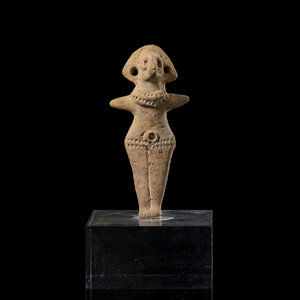
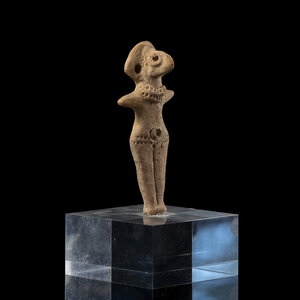
A SYRO HITTITE TERRACOTTA OF A GODDESS.
Ca. 2000-1700 B.C.
H. 7,5 cm
Provenance
Swiss private collection of Baron O.C.V.L (1937-2022)
Hand-modeled statuette representing the goddess Astarte, featuring laterally protruding pointed stump-like arms and a bird-shaped face. The large, circular eyes are prominently applied and deeply pierced. Behind the face, trapezoidal towering hair includes two holes, possibly intended for jewelry. The flat plank-shaped idol displays a prominently extended pelvis, symbolizing fertility. A necklace is represented by a smooth indentation around the neck, while the navel is also marked with a circular application and deep piercing. The idol's hips are decorated with a double-row chain, highlighted with incised details. The legs taper downward, separated by a central indentation.
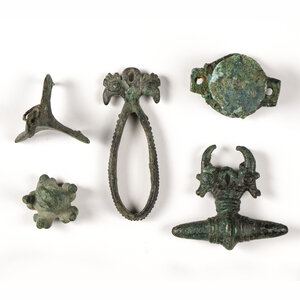
Lot # 171
-
A LOT OF ANATOLIAN AND WESTERN ASIAN BRONZE ELEMENTS.
Circa 2nd Millennium BCE to roman period
Min. H. 30 mm / Max. 65 mm
Provenance
Swiss private collection of Baron O.C.V.L (1937-2022)
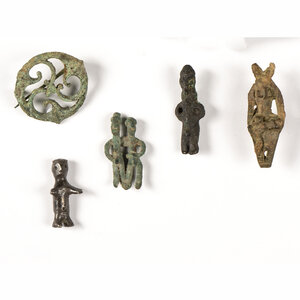
With a germano-roman bronze fibula (2nd/3rd century A.D.); a Bactrian (?) silver anthropomorphic figure (ca. 2nd Mill. BCE); a Amlash bronze embraced figure (ca. 1500-1000 BCE); a Syro-Hittite bronze figure; a copper alloyed figured 'lactans'; 5 bronze harness elements (Luristan to Roman culture, 7th BCE - 2nd century A.D.)
Lot # 170
-
A GROUP OF ANATOLIAN AND LURISTAN BRONZES.
Ca. 1st Millennium BCE
H. min 7 cm / Max. 16 cm
Provenance
Swiss private collection of Baron O.C.V.L (1937-2022)
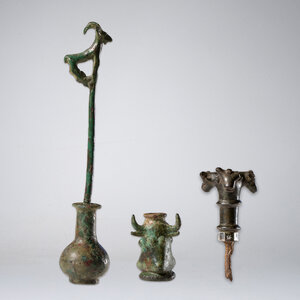
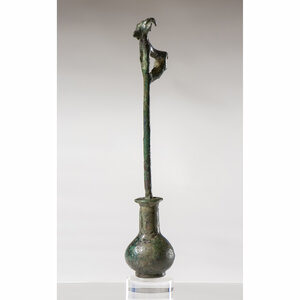
A bronze bottle with stick pin and ibex final, a mace head in the form of triple bulls heads; a mace head with three bull's heads.
Results from 151 to 200 of 624