Info & contacts
My bids
Watched Lots
My Consignment
Terms Of Sale
Shipping costs
Payment methods
Bid increments
Printable results
Live Bidding Saturday 11th April 2026 03:00:00 PM CET
Greek Coins (1-206)
Ancient and Medieval Asia (207-228)
The Roman Republic (229-345)
The Roman Empire (346-400)
Live Bidding Sunday 12th April 2026 03:00:00 PM CET
The Roman Empire (401-588)
Barbaric and Migration Period Coinage (589-593)
The Byzantine Empire (594-632)
Leads of the Ancient World (633-637)
Large Lots (638-690)
Islam (691-707)
Oriente Latino (708-714)
World Coins (715-901)
Antiquities (902-949)

Risultati: 47
Lot # 902
-
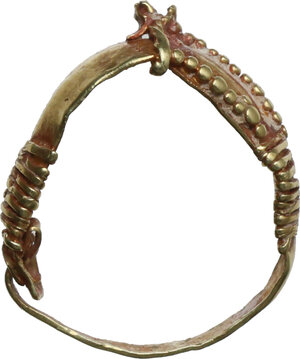
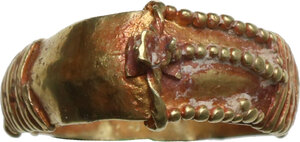
ANCIENT GOLD EARRING. Ancient world, c. 1st millennium BC. Earring composed of a gold band, wider at the base, on which are wound two gold wires and a three-row spherical decoration. Dimensions: 14 x 13 mm. Weight: 0.81 g.
Lot # 903
-
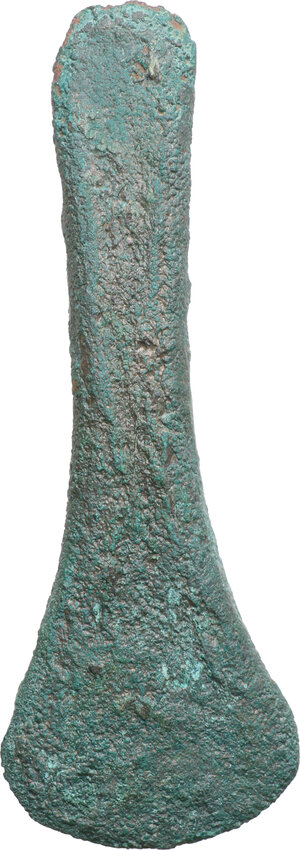
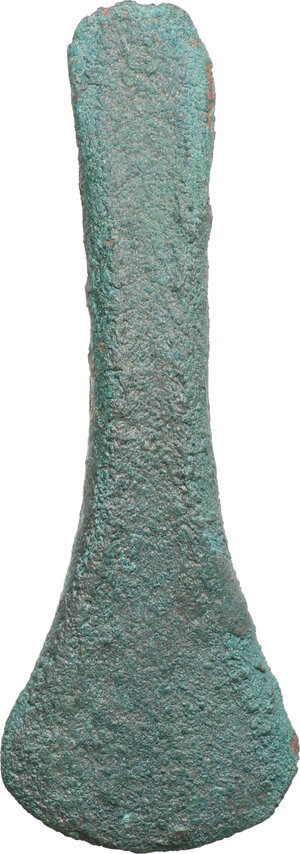
ANCIENT BRONZE AXE HEAD. Hallstatt period 1200 - 1000 BC. A massive copper alloy cast axe head. Dimensions: 81,5 x 28 mm. Weight: 61,77 g. Ex Artemide Kunstauktionen 18, 2021, lot 1026.
Lot # 904
-
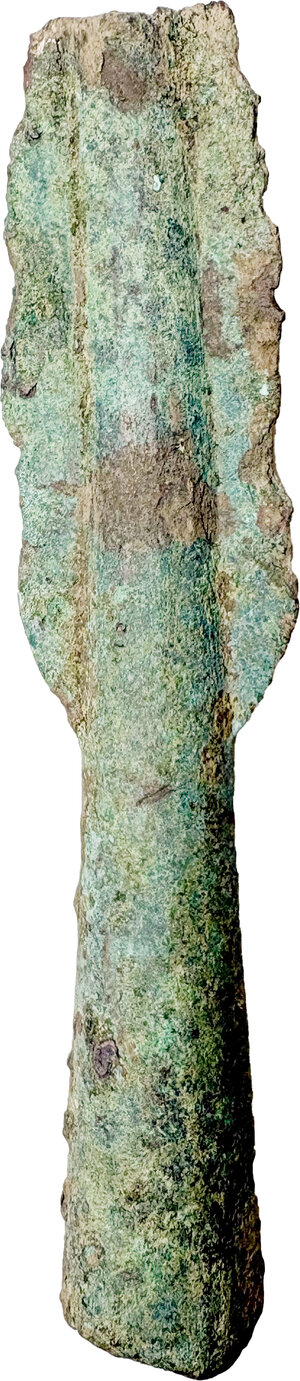
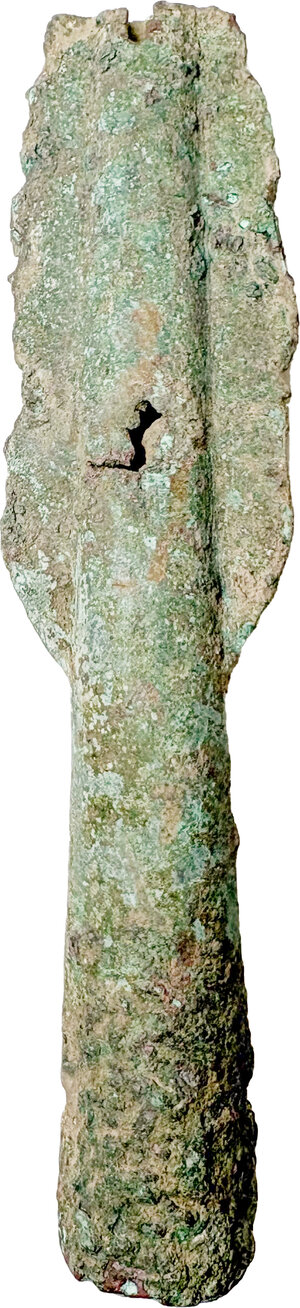
LATE BRONZE AGE SPEAR HEAD. Circa 1200 - 800 BC. Socketed bronze spear head with slender leaf-shaped blade. The shaft tapers through the length of the spear head to the point. The tip is broken off and missing. Lenght: 196 mm. Weight: 302,91 g. Ex Artemide Kunstauktionen 7, 2019, lot 397.
Lot # 905
-
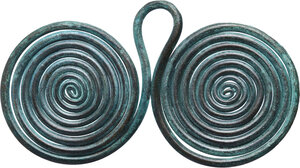
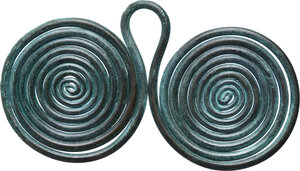
EUROPEAN LATE BRONZE AGE DOUBLE SPIRAL. Bronze Ages to Urn-field period, c. 1200 - 800 BC. AE spiral spectacle fastener or pendant composed of two coils of bronze rod connected by a suspension loop. Dimensions: 72 x 41 x 2,5 mm. Weight: 27,59 g.
Lot # 906
-
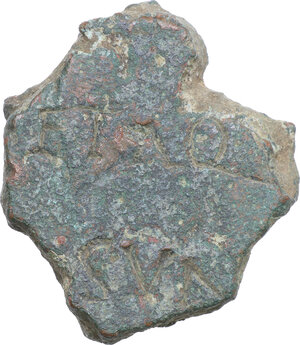
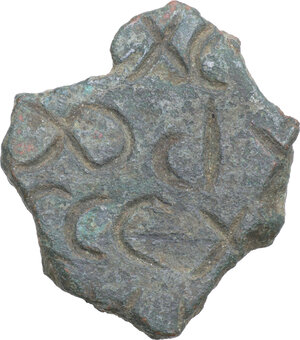
BRONZE TABLET FRAGMENT WITH GREEK INSCRIPTION (?). Greek World or Hellenized area, Hellenistic to early Roman period, ca. 3rd century BC – 2nd century AD. Irregular fragment of a cast bronze tablet with ancient breaks along all sides. The surface is covered with a stable green and bluish patina, with minor earthen encrustations. Both sides are worked. Diameter 38,5mm Weight 39,87.
Lot # 907
-
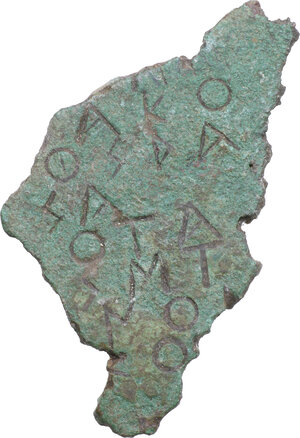
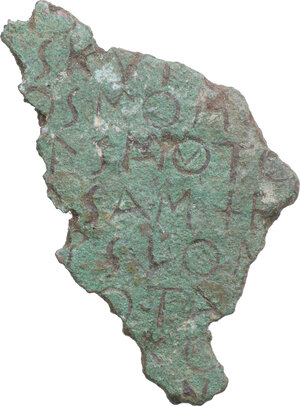
BRONZE TABLET FRAGMENT WITH INSCRIPTION IN MIXED CAPITAL SCRIPT. Italic world, possibly Roman or pre-Roman context, ca. 3rd century BC – 3rd century AD (tentative). Irregular fragment of a bronze tablet bearing an incised inscription on both sides. The surface presents a stable green patina with areas of corrosion; the letters were engraved after casting and remain partially legible. The script consists of angular capital letters. Notably, the inscription appears to include forms resembling the letter K and an A rendered in a triangular, Greek-like form, features that are atypical in standard Imperial Latin epigraphy. The possible presence of the letter K - rare in Classical Latin inscriptions but common in certain Italic alphabets - raises the question of a non-standard orthographic tradition. At the same time, other letterforms (O, T, M, N) are compatible with Latin capital script, and the overall appearance does not correspond to a coherent Greek alphabetic system. The inscription therefore does not appear to be Greek, but may reflect: (a) Latin text with archaic or regional orthographic traits, (b) a provincial or non-standard epigraphic hand, (c) or possibly an Italic linguistic context (e.g. Oscan or related Italic traditions). Further paleographic study and comparison with Italic and early Latin inscriptions would be required for a more precise attribution. Fragmentary, with surface corrosion; inscription partially legible. Diameter 54.5 mm Weight 16.51 g.
Lot # 908
-
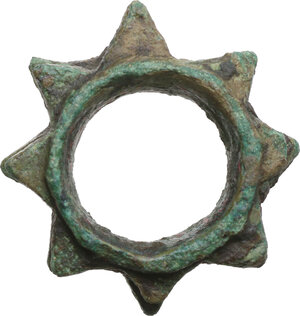
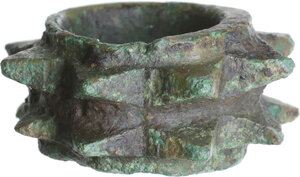
BRONZE 'PASSAREDINI' OR MACE HEAD. Italic culture, c. 6th to 4th century BC. Masculine ring forged from leaded bronze. The circular accessory features a relatively smooth interior surface as well as columns of two spikes surrounding the exterior. Diameter: 34,5 mm. Height: 16 mm. Weight: 31,37 g. Generally referred to as 'passaredini' and thus related to the equestrian sphere, this type of bronze object apparently has no certain function. Another hypothesis of use sees these objects as belonging to the military or domestic sphere.
Lot # 909
-
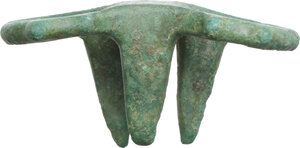
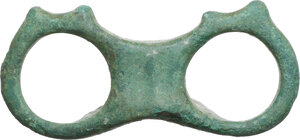
ROMAN BRONZE BOW RING. Roman Republican period, c. 5th century BC - 1st century BC. Tricuspid geminous ring in bronze, formed by two cylindrical annular elements, connected by a median body surmounted by three cusps: a wider one, with a triangular base, and two thinner ones placed side by side, with a pyramidal shape. The rings have faint thickenings on the front. Dimensions: 70 x 31,5 x 35 mm. Weight: 62,62 g. In the past these objects have been interpreted in various ways: as female ornaments, tools for horse taming or bridle clips, as thrusters and bow turnbuckles. Among them, the most reliable hypothesis, based on experiences of experimental practice, is that they are bow turnbuckles, having as their main function the protection of the fingers during the release of the arrow. The tricuspid gemini rings are very widespread especially in the Emilian area, in particular in the Parma, Reggio Emilia and Modena areas, but they are also known in northern Italy in the Lombard and Piedmont areas. Their chronological classification is difficult in the absence of stratigraphic associations, given that they appear both in contexts of the second Iron Age and in the late Republican age, above all due to a tendency towards formal conservatism inherent in the instrument.
Lot # 910
-
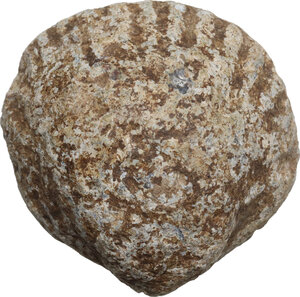
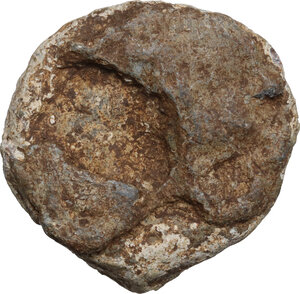
LEAD SCALLOP SHELL. Roman Republic, Italy (?), c. 4th - 2nd century BC. Lead scallop shell, obtained by casting. Natural rendering of details. Diameter 30.5 mm Weight 55.83 g.
Lot # 911
-
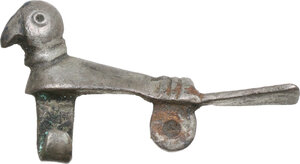
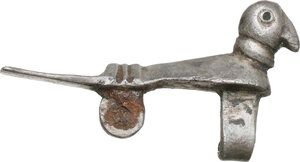
CELTIC SILVER FIBULA WITH BIRD-HEAD TERMINAL. Celtic world, Late Iron Age, ca. 3rd – 1st century BC. Cast silver fibula featuring a stylized bird-head terminal with rounded eye and curved beak. The bow is gently arched and tapers toward the catchplate. A small rounded knop beneath the bow marks the position of the spring mechanism, now missing. The modelling is compact and elegant, with minimal but effective detailing. The avian motif is typical of Celtic decorative vocabulary, where stylized animal forms—particularly birds—held symbolic significance and were widely employed in personal ornaments. Structurally intact, with surface wear and localized oxidation, especially around the spring and catch areas. Pin missing. Fine silver surface preserved. Diameter 34 mm Weight 3.85 g. 3.85 g. 34 mm.
Lot # 912
-
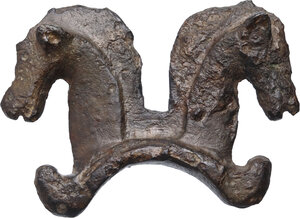
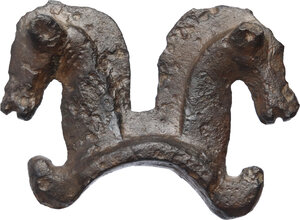
BRONZE HORSE HEADS. Roman period. Fragment of an equal-ended bow brooch decorated with two horse heads facing away from each other. Spring, pin and catchplate missing. Dimensions: 43 x 31 x 8 mm. Weight: 22,84 g. For comparison: https://www.acsearch.info/search.html?id=14225786.
Lot # 913
-
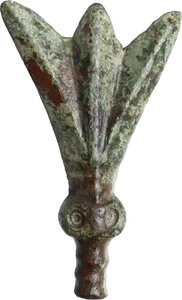
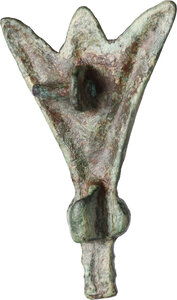
BRONZE CICADA FIBULA. Migration Period, c. 5th - 6th century AD. Plate brooch in the shape of a stylised cicada. Worked in relief, the eyes punched. Catchplate, lug and axis bar preserved; spring and pin missing. Dimensions: 45,5 x 28. Weight: 13,87 g.
Lot # 914
-
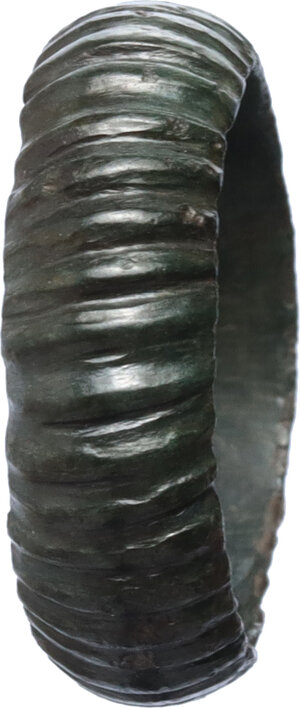
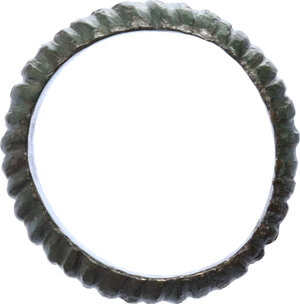
BRONZE RING. Roman period (?). Bronze Ring with grooved decoration. Superb dark green and glossy patina. Inner diameter: 10,5 mm. Weight: 3,33 g.
Lot # 915
-
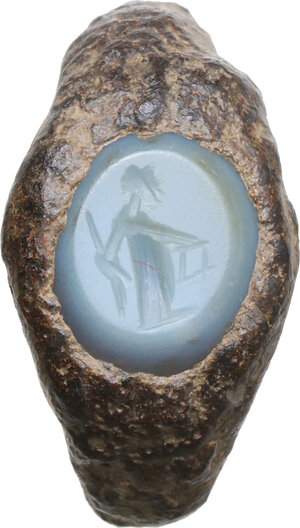
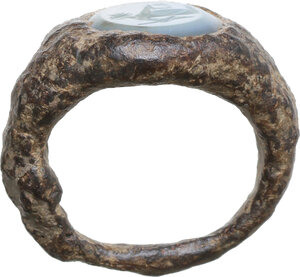
ROMAN BRONZE RING WITH BLUE CHALCEDONY INTAGLIO OF IUSTITIA. Roman Empire, ca. 1st – 2nd century AD. Cast bronze ring with thick circular hoop and oval bezel set with a pale blue chalcedony intaglio. The gem depicts the standing figure of Iustitia holding a balance in one hand and a sceptre in the other. The engraving is executed in a linear wheel-cut technique, with schematic yet characteristic rendering typical of provincial Roman workshops. The bronze mount is heavily encrusted and covered with stable ancient patina. Intaglios of Iustitia were commonly used as personal seals and may have reflected the owner’s association with legal or administrative roles, or symbolized moral authority and civic virtue. Intact; heavy surface encrustation on the mount; intaglio well preserved. Inner Diameter 25 mm. Weight 6.7g. 6.7 g. 25 mm.
Lot # 916
-
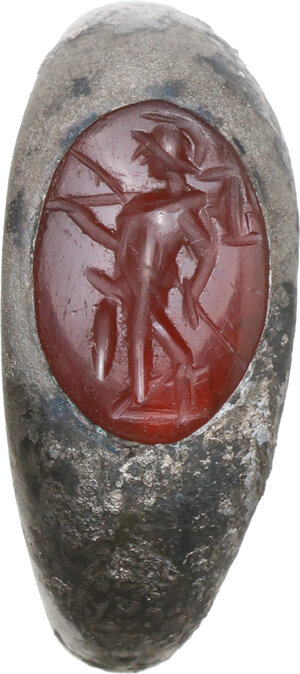
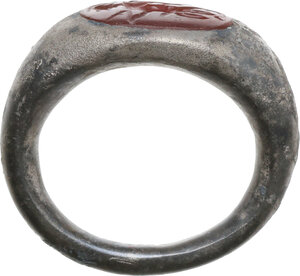
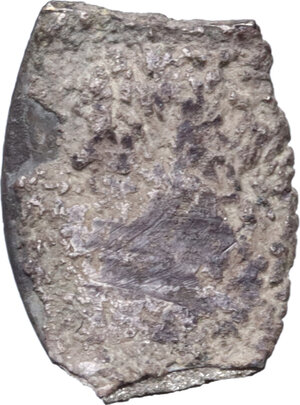
SILVER RING WITH RED CARNELIAN INTAGLIO. Roman Empire, mid-late 2nd century AD. Silver ring with red carnelian intaglio depicting Mars advancing left, carrying trophy over the shoulder and holding diagonal spear. Inner Diameter 22.5 mm Weight 7.27 g.
Lot # 917
-
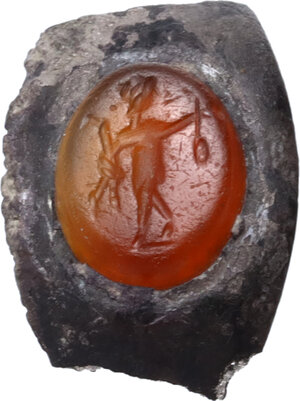
ROMAN CARNELIAN INTAGLIO. Roman Empire, c. 2st - 4th century AD. Carnelian intaglio with the engraving of Bonus Eventus standing left. In original silver ring bezel. Minor crystallizations at the fracture edge on the bezel and oxidation on the back. Dimensions: 11,5 x 12 mm. Weight: 2,39 g.
Lot # 918
-
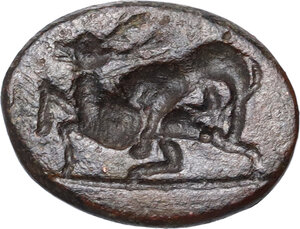
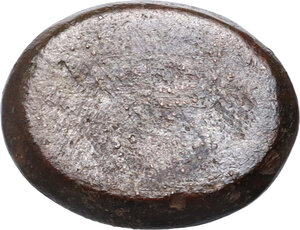
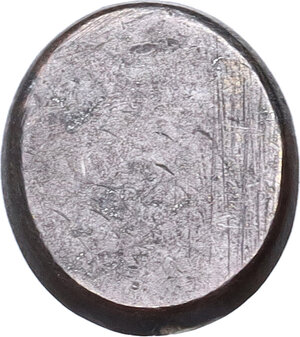
ROMAN BRONZE SEAL. Roman period, 1st - 4th century AD. Engraved bronze seal depicting a lion attacking a stag. The seal was probably mounted or set into a ring. Dimensions: 17 x 13 mm. Weight: 3,77 g.
Lot # 919
-
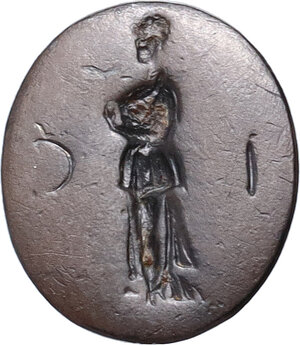
ROMAN BRONZE SEAL WITH ISIS. Roman period, 1st - 4th century AD. Engraved bronze seal depicting draped Isis standing left; in the fields, I - C. The seal was probably mounted or set into a ring. Dimensions: 12 x 10 mm. Weight: 1,66 g. R.
Lot # 920
-
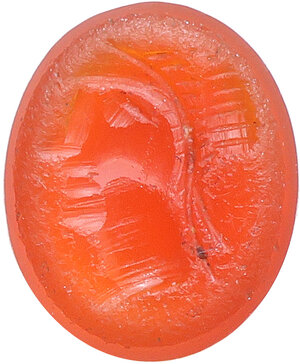
MODERN INTAGLIO IN GLASS IMITATING A ROMAN GEM. Modern period (?) Oval orange glass intaglio engraved with a male head in profile wearing a crested helmet, possibly intended to represent Mars or a classical warrior. The engraving is relatively schematic, and the surface and cutting show no signs of ancient wear. The uniform coloration and texture strongly suggest glass rather than natural carnelian. Good condition Diameter 10 mm Weight 0.35 g. 0.35 g. 10 mm.
Lot # 921
-
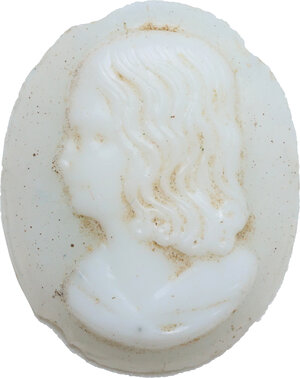
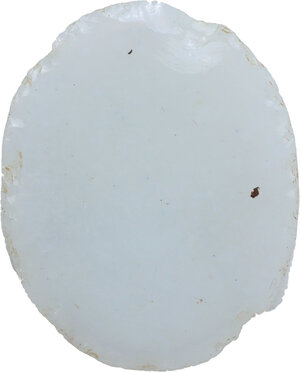
RENAISSANCE TASTE GEM. Modern times (?) Glass paste gem of Renaissance taste, depicting the bust of a young man facing left with long hair. Chipped edge. Dimensions: 21.5 x 17.5 mm.
Lot # 922
-
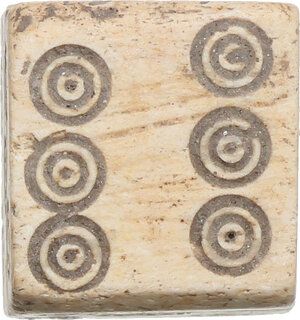
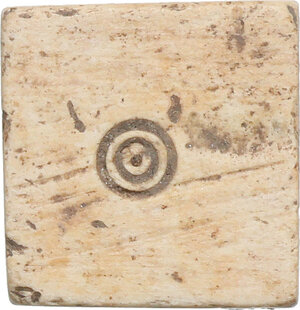
ROMAN BONE DICE. Roman period, ca. 1st – 3rd century AD. Carved bone gaming die of cubic form, with slightly rounded edges and corners. Each face is marked with circular ring-and-dot motifs indicating the numerical values. The bone displays a warm ivory tone with scattered darker inclusions and minor surface staining. Dice of this type were widely used throughout the Roman world for gaming, gambling, and possibly divinatory purposes. Bone examples are among the most common surviving specimens from Roman domestic and military contexts. Intact and well preserved, with minor surface wear and age-related discoloration. Diameter 10 mm Weight 1,62 g.
Lot # 923
-
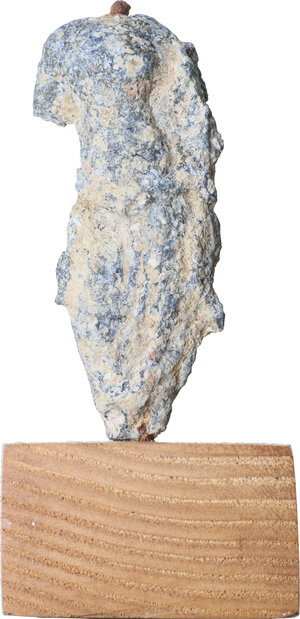
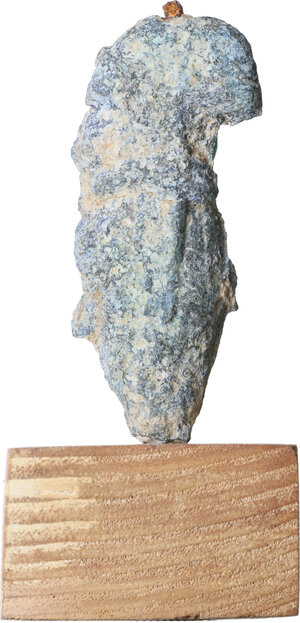
FEMALE FIGURINE. Roman period, 1st century BC - 2nd century AD. Headless lead statuette of a female figure. Mounted on a small wooden base for display. Length 80 mm (without base) or 103 (with base). Weight 128.37. 128.37 g. Ex Artemide 30X, 2019, lot 373.
Lot # 924
-
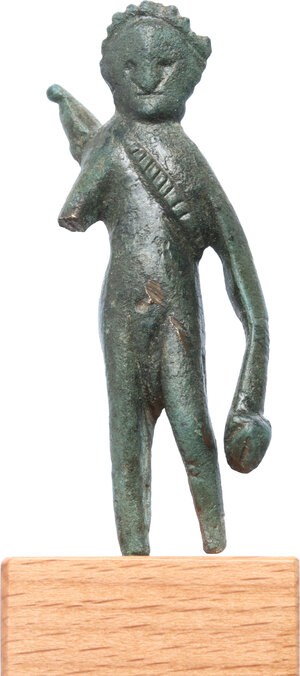
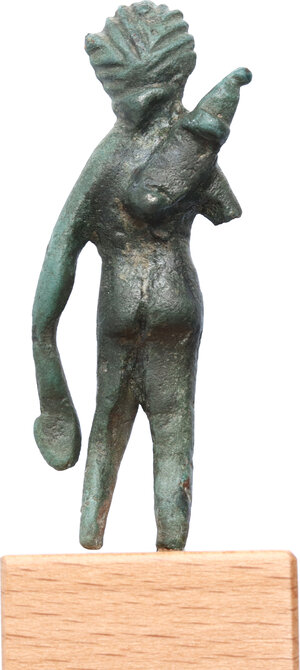
BRONZE STATUETTE OF APOLLO. Roman period, c. 1st - 3rd century AD. Bronze figurine from the Roman era depicting a naked Apollo with a quiver over the right shoulder and something in his left hand. Provincial style. Green patina; right arm missing. Mounted on a wooden base (30 × 28 × 15 mm) for exhibition purposes. Dimensions: 58 x 22 x 12 mm.
Lot # 925
-
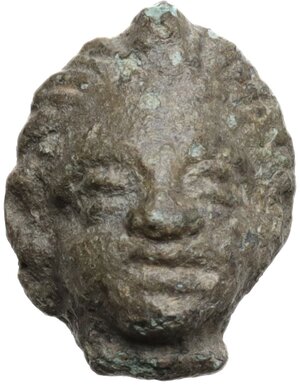
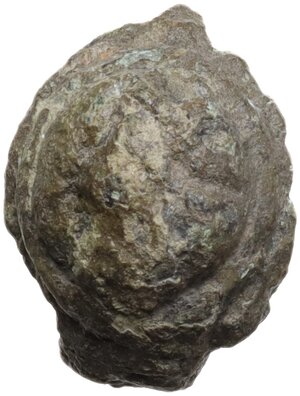
BRONZE FEMALE HEAD. Roman period, 1st - 3rd century AD. Diademed female bronze head. Dimension: 19x15 mm.
Lot # 926
-
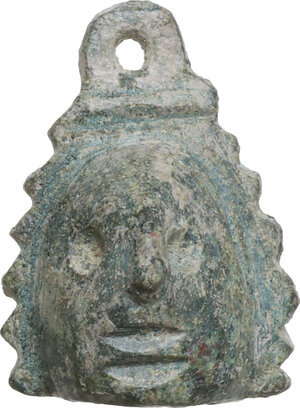
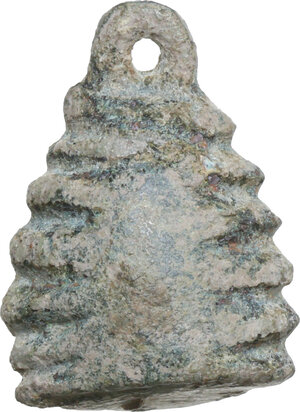
ROMAN BRONZE WEIGHT WITH HUMAN FACE. Roman period, ca. 1st – 3rd century AD. Cast bronze weight of truncated triangular form, featuring a suspension loop at the top. The obverse is decorated with a stylized human face framed by radiating ridges or hair-like projections, while the reverse is plain and undecorated apart from the natural casting texture. The piece was likely used as a small steelyard (statera) weight. Anthropomorphic weights are known in the Roman world and often combine functional and decorative elements. The suspension loop allowed attachment to the weighing apparatus. The rendering of the face is schematic, with simplified eyes, nose, and mouth, typical of utilitarian bronze objects of the Roman period. Intact, with stable green patina and areas of surface encrustation. Diameter 19mm Weight 7,73g. 7.73 g. 19 mm.
Lot # 927
-
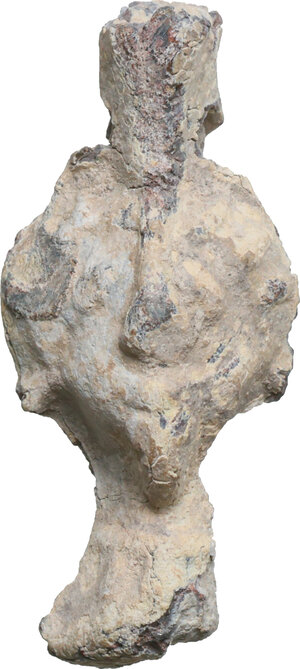
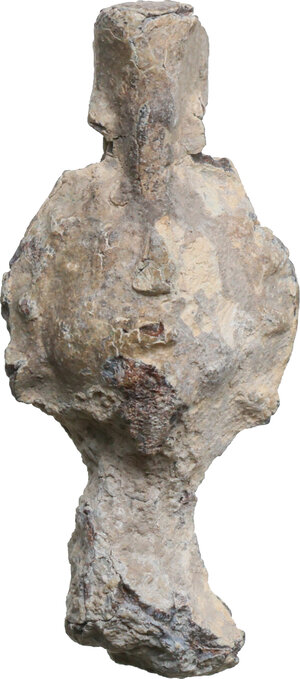
“GROMA” HEAD WEIGHT. Roman period, 1st – 4th century AD. Lead (?) weight in the form of a janiform head, with suspension loop on top; probably part of a groma. Height: 34 mm. Weight: 20.56 g.
Lot # 928
-
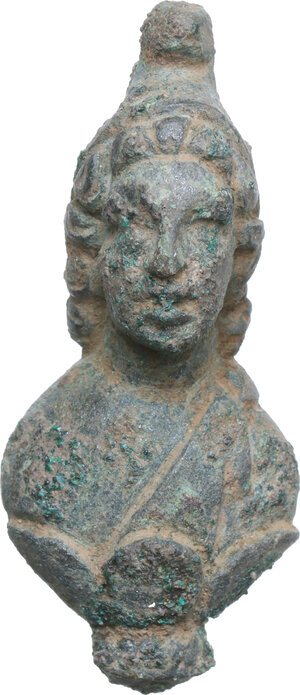
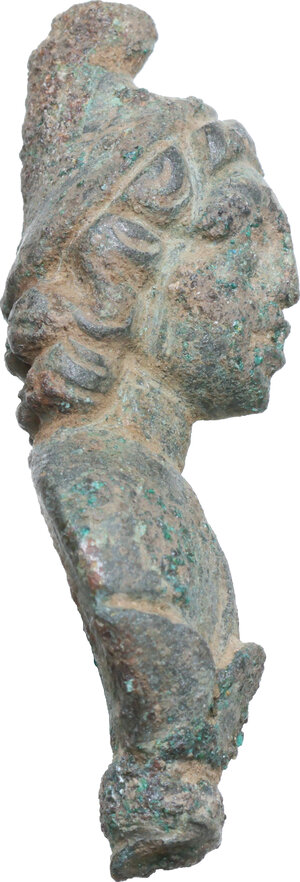
ROMAN BRONZE APPLIQUE WITH BUST OF AN ORIENTAL YOUTH, POSSIBLY MITHRAS. Roman Empire, ca. 2nd – 3rd century AD. Cast bronze applique depicting the bust of a youthful male figure wearing a Phrygian cap. The face is rendered with balanced classical features, framed by wavy hair emerging beneath the cap. The figure wears a draped mantle over one shoulder. The lower part terminates in a truncated base for attachment. The Phrygian cap suggests an Oriental figure and may indicate Mithras, though the absence of additional attributes makes a definitive identification uncertain. Intact, with stable green patina and minor surface wear. 24.54 g. 43 mm.
Lot # 929
-
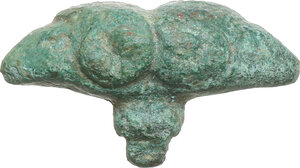
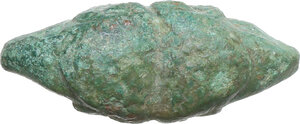
ROMAN BRONZE APPLIQUE TERMINAL IN THE FORM OF A DOUBLE RAM’S HEAD. Roman period, ca. 1st – 3rd century AD. Cast bronze applique or terminal element in the form of two confronted ram’s heads. The horns are rendered in bold, spiral relief, while the facial features are stylized and compact. The modelling is solid and slightly simplified, characteristic of Roman decorative metalwork. The piece may originally have served as a decorative fitting for furniture, a vessel handle terminal, harness equipment, or a ritual object. The ram motif was widely used in Roman art, often associated with strength, protection, and occasionally Dionysiac symbolism. Intact, with stable green patina and minor surface encrustations. Diameter 19.5 mm Weight 4.14 g.
Lot # 930
-
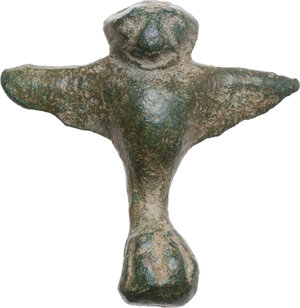
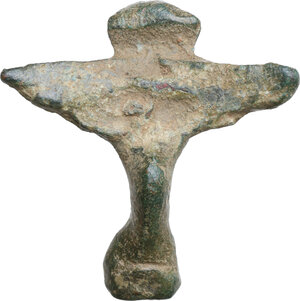
BRONZE APPLIQUÉ OR HANDLE. Migration period, c. 5th – 7th century AD. Bronze appliqué or handle in the form of a stylized eagle with outspread wings. Diameter 45.5 mm Weight 34.71g. 34.71 g. 45.5 mm.
Lot # 931
-
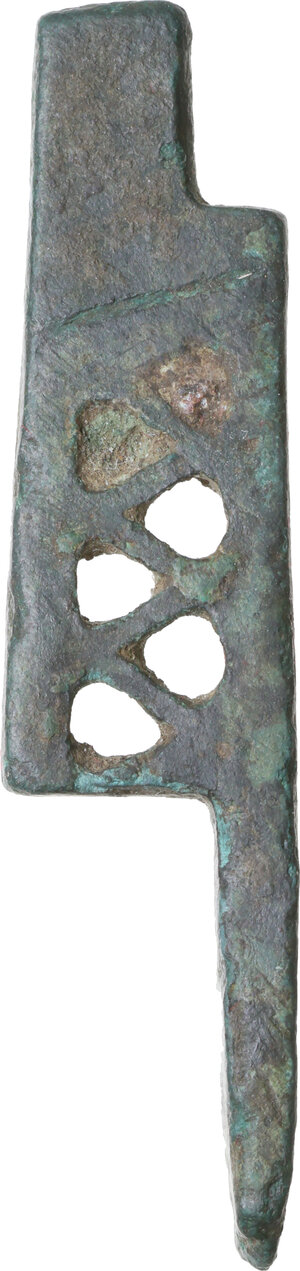
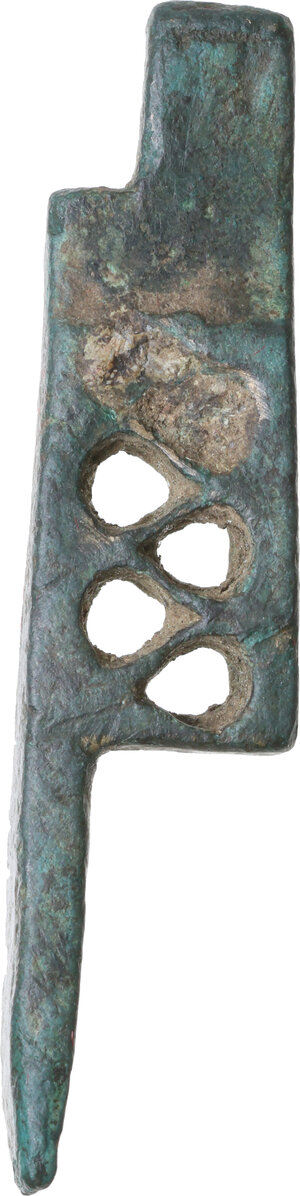
ROMAN BRONZE LOCK ELEMENT. Roman period, ca. 1st – 3rd century AD. Cast bronze component from a locking mechanism, probably part of a sliding bolt or internal lock plate. The rectangular body is pierced with four triangular openings arranged in a lozenge pattern. The lower section terminates in an elongated tongue or pin, functional within the locking system. Stable dark green patina and minor surface corrosion. Diameter 61.5 mm Weight 18.42 g. 18.42 g. 61.5 mm.
Lot # 932
-
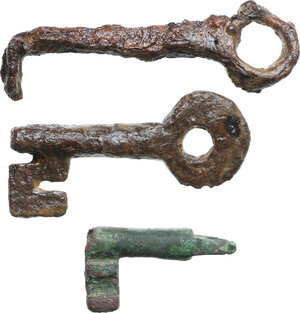
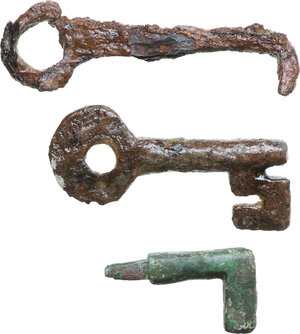
ANCIENT KEYS. Roman to medieval period. Lot of three (3) iron (2) and bronze (1) keys in various shapes and sizes.
Lot # 933
-
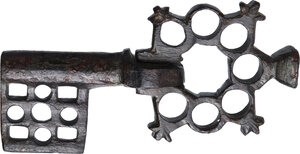
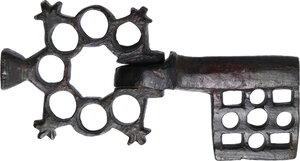
FOLDABLE BRONZE KEY. Byzantine period, c. 5th – 6th century AD. Bronze key with foldable shank and openwork bit, attached to an elaborate rectangular openwork head. Of exceptional craftsmanship. Intact and complete. Length: 42,5 mm. Weight: 8,49 g.
Lot # 934
-
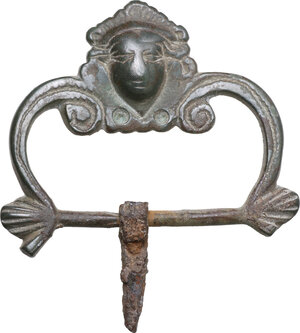
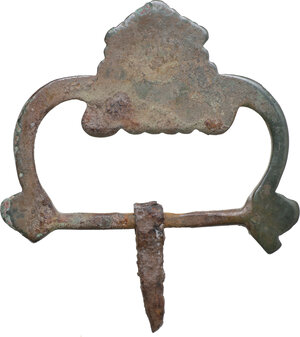
ROMAN BRONZE STRAP FITTING WITH FEMALE HEAD. Roman Empire, ca. 1st – 2nd century AD. Cast bronze strap fitting featuring a central female head framed by scroll-shaped volutes and supported by an arched frame. The lower horizontal bar is fitted with an iron vertical rivet or attachment pin, originally used to secure the fitting to a leather strap. Such fittings were commonly employed as decorative elements on belts or harness equipment. The classical modeling of the female head reflects Roman decorative traditions of the early Imperial period. Bronze frame well preserved; iron attachment pin heavily corroded but intact. Diameter 51 mm Weight 17.14g. 17.14 g. 51 mm.
Lot # 935
-
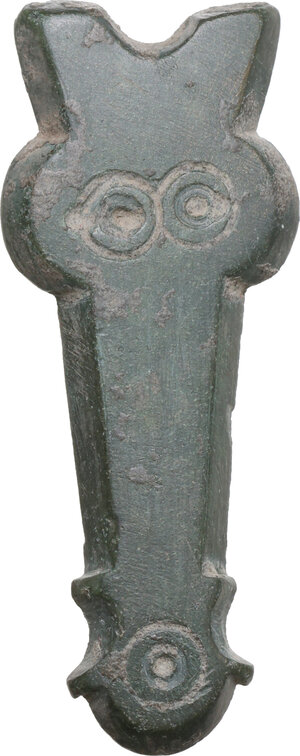
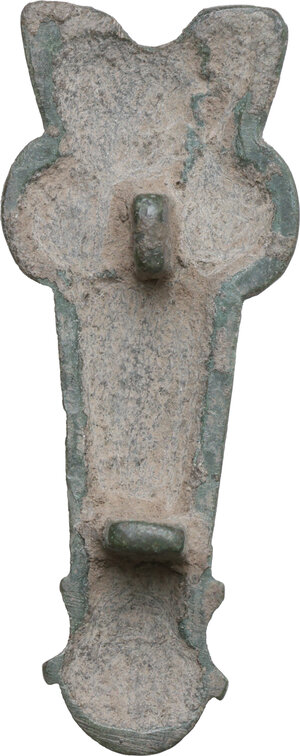
LATE ROMAN / MIGRATION PERIOD BRONZE BELT MOUNT IN THE FORM OF A STYLIZED ANIMAL HEAD. Late Roman to Early Migration period, ca. 4th – 5th century AD. Cast bronze belt mount of elongated form, terminating in a stylized animal head, possibly representing a wolf. The upper section features two lobed projections resembling ears, while the face is defined by two concentric circular motifs forming the eyes. The lower end is decorated with an additional circular element. The reverse is fitted with two integrally cast attachment studs for securing the mount to a leather belt or strap. The highly schematic and geometric rendering of the animal head reflects late Roman provincial or early Germanic decorative traditions. Such mounts were probably used as decorative fittings on military or civilian belts in the Danubian and frontier regions of the Late Roman Empire. Intact, with stable dark green patina and minor surface wear. Diameter 48 mm Weight 11.03 g.
Lot # 936
-
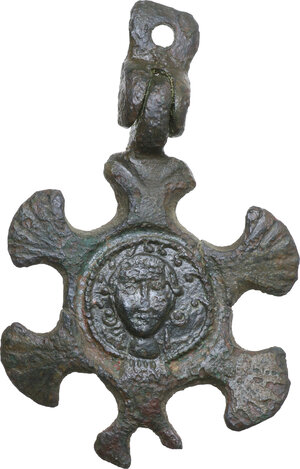
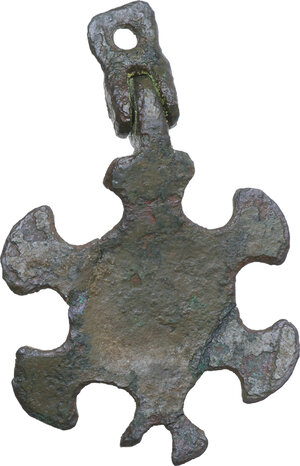
ANCIENT BRONZE PENDANT. Byzantine to Medieval period. Probably a horse harness pendant formed of a central circular panel enclosing a frontal bust; around the circumference are six leaf or petal type projections. Suspension loop and hinge. Diameter: 47 mm. Weight: 8,06 g.
Lot # 937
-
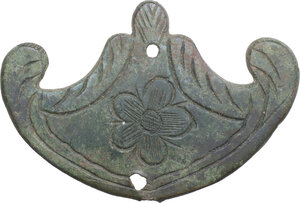
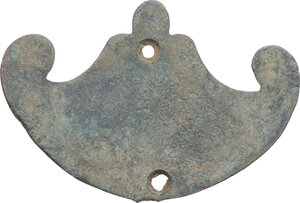
MEDIEVAL BRONZE DECORATIVE MOUNT WITH FLORAL MOTIF. Medieval period, ca. 12th – 14th century AD. Thin cast bronze decorative mount of semi-circular form with outward curving terminals. The front is engraved with a central five-petaled flower framed by symmetrical vegetal scrolls. The decoration is incised with fine linear detailing. Two perforations (one at the top and one at the bottom) were used for attachment to a leather strap, belt, pouch, or wooden object. The floral design and overall composition are characteristic of medieval European decorative metalwork rather than Roman production. Complete, with stable green patina and minor surface wear. Diameter 54 mm Weight 13.56 g.
Lot # 938
-
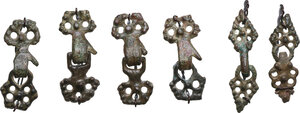
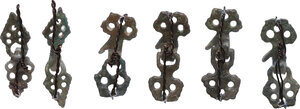
LOT OF SIX BRONZE BOOK CLASPS. Medieval period. The six book clasps feature two clasped hands in their design. Dimensions ca. 25 mm x 9 mm. Total weight ca. 9,30 g.
Lot # 939
-
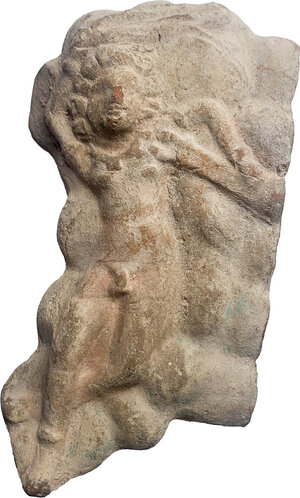
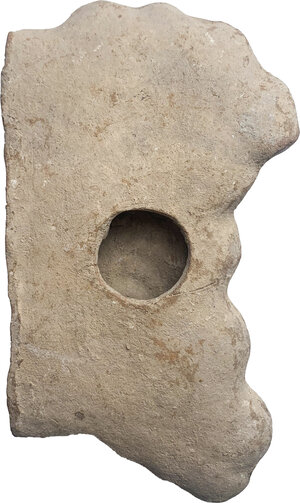
PART OF A POTTERY GROUP. Roman period, c. 1st - 3rd century AD. Left part of a ceramic group, representing Herakles naked except for traces of the lion's skin around the neck, with the club raised, in the act of striking an enemy. Traces of painting. Intact. Dimensions: 162 x 89 mm.
Lot # 940
-
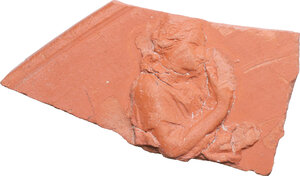
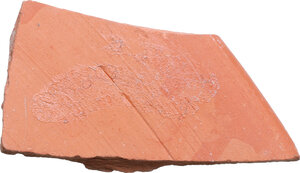
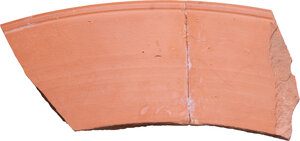
TERRA SIGILLATA FRAGMENT. Late Roman Empire, North Africa, c. 3th - 5th century AD. Pottery fragment. Red slip ware decorated with a depiction of a person to the right, the right hand is raised towards the face, in raised relief. Diameter 68 mm Weight 20.12 g.
Lot # 941
-
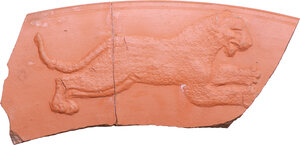
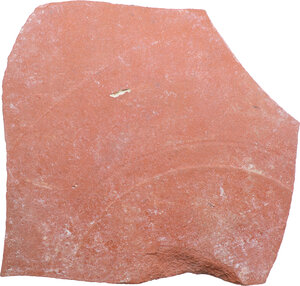
TERRA SIGILLATA FRAGMENT WITH PANTHER. Late Roman Empire, North Africa, c. 4th - 5th century AD. Pottery fragment. Red slip ware decorated with panther (or leopard) leaping right in slightly raised relief. Restored crack. Diameter 133 mm Weight 65,57. 65.57 g. 133 mm.
Lot # 942
-
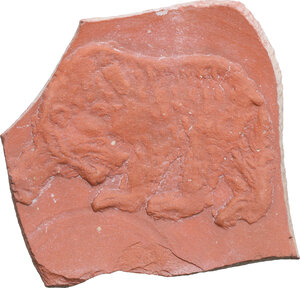
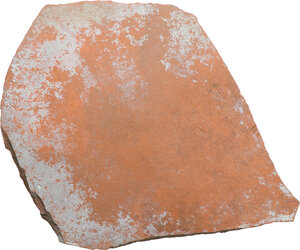
TERRA SIGILLATA FRAGMENT WITH BEAR. Late Roman Empire, North Africa, c. 4th - 5th century AD. Pottery fragment, part of a plate. Red slip ware decorated with bear standing left, looking back in slightly raised relief. Diameter 67.5 mm Weight 22.59 g. 22.59 g. 67.5 mm.
Lot # 944
-
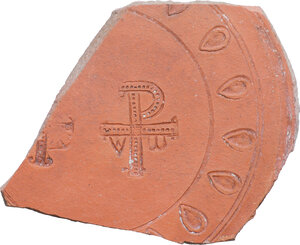
TERRA SIGILLATA FRAGMENT WITH STAUROGRAMM. Late Roman Empire, North Africa, c. 4th - 5th century AD. Pottery fragment, part of a plate. Red slip ware decorated with stamped cross (?) and staurogramm surrounded by teardrop-shaped ornaments. Diameter 96mm Weight 53.63g.
Lot # 945
-
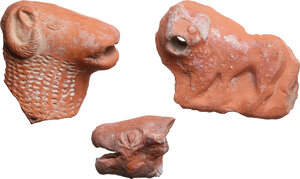
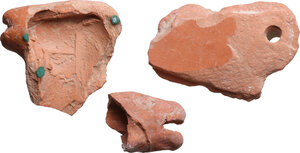
LOT OF ROMAN POTTERY. Late Roman Empire, North Africa, c. 4th - 6th century AD. Lot of three (3) decorated pottery fragments, depicting animals. Height: from 64 to 35 mm.
Lot # 946
-
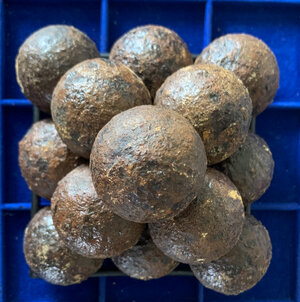
IRON HOWITZER PROJECTILES. Reinassence, 16th - 17th century. Lot of fourteen (14) iron projectile probably for a colubrin or a serpentine howitzer. Dimesions: ca. 203.2 g. each one x 38 mm. wide.
Lot # 947
-
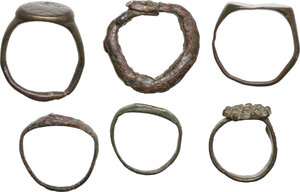
GOUP OF SIX BRONZE RINGS. Late Medieval to Post-Medieval period (?), possibly later. Group of six (6) bronze finger rings of various forms and sizes. The lot includes different typologies, with simple hoops and slightly thickened bezels, reflecting common everyday production. The rings are cast and finished in a functional manner, without elaborate decoration. Fair overall condition.
Lot # 948
-
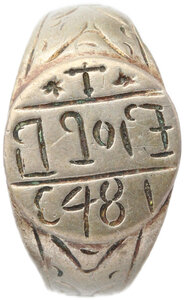
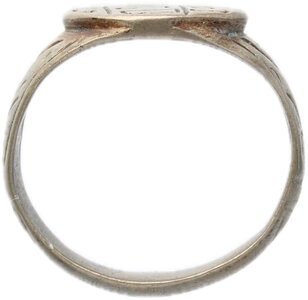
SILVER SEAL RING. Balkans or Levant (?), post Medieval period, 1843 or 1893 AD. Silver seal-ring with an engraved inscription in three lines. Inner diameter: 19 mm; weight: 6,73 g.
Lot # 949
-
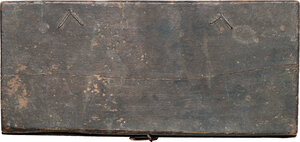
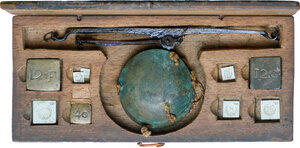
SET OF BALANCE SCALES AND WEIGHTS. 19 th century. Bronze (?) Balance scale in wooden case, including balance arm with handle, two dished pans and cording (not attached to the balance arm), 9 different weights of various sizes.
Caricamento altri risultati...