Banner Astarte 26
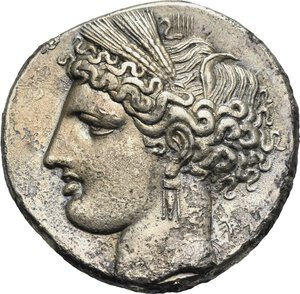
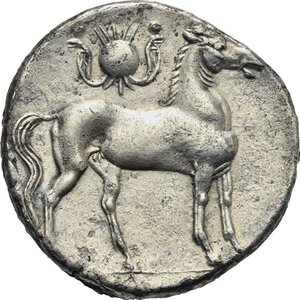
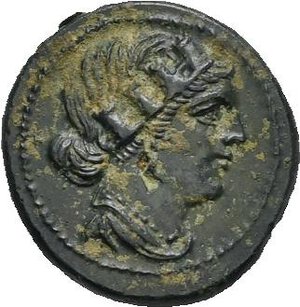
Lot # 252 - Zeugitania. Carthage. First Punic War, 264-241 BC. Hexadrachm or Trishekel (Silver, 34.44 mm, 24.72 g), probably struck circa 255-251 BC. Head of Tanit left, wearing wreath of grain ears, triple-pendant earring and pendant necklace; behind her neck, uncertain Phoenician letter jōd. Rev. Horse standing right; above, solar disc supported by two uraeus serpents; in exergue, Phoenician letter jōd. CNP 42. MAA 38 (drawn). Jenkins & Lewis, Group Xa, pl. 27, 4 = Naples 4850 (different dies). H.R. Baldus, "Unerkannte Reflexe der römischen Nordafrika-Expedition von 256/255 v. Chr. in der karthagischen Münzprägung", in "Chiron" 12, 1982, pl. 1, 7 (the Naples specimen, as above). Slightly toned, with minor signs of flaking and few signs of cleaning. Minted in high relief and well centred for issue. For the type of coin, almost extremely fine; undoubtedly very attractive and one of the finest known examples, if not the finest. Extremely rare, with fewer than ten examples known to date.   From a Swiss Collection, formed before 2005.   This silver issue from Carthage ranks among the rarest and most impressive of all Carthaginian coinages. Struck during the First Punic War (264-241 BC), at a time when Carthaginian minting was largely confined to electrum and bronze owing to the scarcity of silver, it was most probably produced to pay mercenary contingents, particularly Greek soldiers accustomed to silver remuneration. As demonstrated by H. R. Baldus (1982), this issue should be assigned to the period immediately following the African campaign of Marcus Atilius Regulus (256-255 BC), a crucial phase in which Carthage, recovering from initial reverses, reorganized its military and financial resources and ultimately secured victory at the Battle of Tunes, also known as the Battle of the Bagradas.   This extremely rare coin appears to have been struck from a previously unrecorded pair of dies. The hairstyle of Tanit, with tufts forming a shape reminiscent of a swan at the top of the head, is typical of certain dies from the Group IX-Xb series described by Jenkins & Lewis. Of particular interest is a feature never before documented, perhaps overlooked due to the narrow flans of these issues and the often poor state of surface preservation: the presence of Punic control letters on both sides of the coin: behind Tanit’s neck on the obverse and in the exergue on the reverse. Upon closer examination, similar letters can be observed on the obverse of the Naples specimen no. 4850, on the obverse of the Nomos 32, lot 368 specimen, in the reverse exergue of the Leu Numismatik 19, lot 31 example, and - following a new and careful reassessment by the present writer - on both obverse and reverse of the Astarte 23, lot 202 coin, where the obverse with the Punic letter rēš shares its reverse bearing the same letter in the exergue.
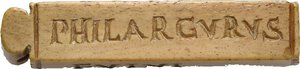
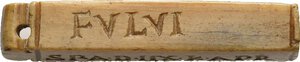
Lot # 292 - Time of the First Triumvirate. Tessera Nummularia dated 25 March 60 BC (Bone, 51 x 11 x 9 mm, 9.78 g). Inscription on all four sides: PHILARGVRVS / FVLVI / SP(ectavit) A(nte) D(iem) IIX K(alendas) APR(iles) / L AFR(anio) Q MET(ello) (Consulibus). Translation: Inspection carried out by Philargurus, slave of Fulvius, on the eighth day before the Kalends of April, in the year of the consulship of Lucius Afranius and Quintus Caecilius Metellus Celer. L. Pedroni, G. Devoto, “Tessere da una collezione privata”, in "Archeologia Classica", Vol. 47, 1995, pp. 164-169, figg. 1a-4a (this specimen). Pierced at the top to be tied to a bag containing coins. Very Rare, with around 150 known examples worldwide - each bearing a different inscription.   From a British private collection, later passing into a Swiss collection in the early 2000s.   This is a "tessera nummularia", carved from bone and featuring a central perforation that allowed it to be tied directly to a bag of coins. Such objects were not intended for circulation but served as guarantees of the verification of coins by professional money-changers or assayers (nummularii) in ancient Rome. They often certified the weight, purity, and authenticity of a batch of currency. Tesserae like this represent a rare glimpse into the control mechanisms of Roman financial practices. Their utilitarian nature and material suggest daily use in commercial settings.   Philargyrus, a speaking name from Greek meaning “lover of silver”, functions here as both a personal and professional designation: Apuleius (Metamorphoses IV, 9) mentions a Theban money-changer named Chryseros, an etymological counterpart illustrating how monetary slaves and attendants were often identified by names evoking metals or wealth. His master, Fulvius, belonged to the homonymous gens Fulvia, one of the foremost Roman families involved in extensive financial operations, which could easily justify the employment of slaves for monetary control. According to Pliny the Elder (N.H. XXI, 6, 8), the first argentarius of Rome was a Fulvius, reportedly condemned during the Hannibalic era for displaying a wreath of roses on his counter - a gesture regarded as an act of ostentatious luxury. Another member of the same family, also a Fulvius, was responsible for constructing the celebrated Basilica Fulvia in the Roman Forum.
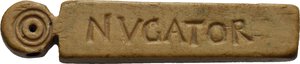
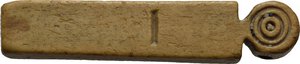
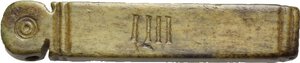
Lot # 295 - Late Republican Period. Circa 2nd - 1st centuries BC. Tessera Lusoria of the Fool. (Bone, 52 x 6 x 3 mm, 5.35 g). Rod-shaped, with a rectangular cross-section and one rounded end decorated with concentric circles, pierced by a tiny hole at the junction with the body of the plaque; at both ends, horizontally, two pairs of incised lines can be seen as decoration. Inscription on two sides: NUGATOR / I. Cf. C. Hülsen, "Miscellanea epigrafica, XXI. Tessere lusorie", in "Mitteilungen des Deutschen Archäologischen Instituts, Römische Abteilung", Vol. 11, 1896, pp. 227-257. L. Pedroni, G. Devoto, "Tessere da una collezione privata", in "Archeologia Classica", Vol. 47, 1995, pp. 178-179, figg. 5a-6a (this specimen). Cf. G. Baratta, "Un set di Tesserae Lusoriae da Corfinium", in "Anuari de filologia. Antiqua et mediaevalia", Vol. 8, 2018, pp. 134‐147. Excellent state of preservation, with no evident fractures or chips. Very Rare specimen.   From a British private collection, later passing into a Swiss collection in the early 2000s.   The Tesserae Lusoriae were small rectangular rods, mostly made of bone and more rarely of ivory, engraved on both sides: on one face appeared a name, an adjective, or a playful epithet, while the other bore a Roman numeral. The known numbering ranges from I to LX, but the evidence suggests an organized game, with pieces numbered from I to XXV, accompanied by special tokens bearing the numbers XXX and LX, and possibly also counters numbered between XXVI and XXIX. The numerical variations and the presence of distinctive pieces indicate a structured game, although its rules and purpose remain unknown and perhaps forever lost. In Spain and Italy, specimens have been found both as isolated pieces and as complete sets placed within rich burials (for instance, at Vaste – 17 tesserae; Perugia – 16; Syracuse – 8; Corfinio – 6), suggesting a circulation among the upper-middle classes. While the deposition of a single piece may have held an apotropaic or commemorative meaning - linked to the fortune of the deceased or an ancestor, thus serving as an amulet - the inclusion of an entire set within a tomb may point to more complex symbolism. In the case of the 16 tesserae discovered in Perugia, their association with glass hemispheres, a mirror, decorative fragments from a cista, and inscribed pebbles has led scholars to suggest that the deceased, likely an extraordinary individual, might have been a magician in life.   In short, one could almost say that these tesserae were either oracular tools used to divine the will of the gods, or the ancient precursors of Magic: The Gathering, created by Richard Garfield.
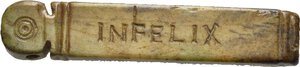
Lot # 298 - Late Republican Period. Circa 2nd - 1st centuries BC. Tessera Lusoria of the Unlucky. (Bone, 53 x 6 x 3,5 mm, 7.18 g). Rod-shaped, with a rectangular cross-section and one rounded end decorated with concentric circles, pierced by a tiny hole at the junction with the body of the plaque; at both ends, horizontally, two pairs of incised lines can be seen as decoration. Inscription on two sides: INFELIX / IIII. Cf. C. Hülsen, "Miscellanea epigrafica, XXI. Tessere lusorie", in "Mitteilungen des Deutschen Archäologischen Instituts, Römische Abteilung", Vol. 11, 1896, pp. 227-257. L. Pedroni, G. Devoto, "Tessere da una collezione privata", in "Archeologia Classica", Vol. 47, 1995, pp. 178-179, figg. 5c-6c (this specimen). Cf. G. Baratta, "Un set di Tesserae Lusoriae da Corfinium", in "Anuari de filologia. Antiqua et mediaevalia", Vol. 8, 2018, pp. 134‐147. Excellent state of preservation, with no evident fractures or chips. Very Rare specimen.   From a British private collection, later passing into a Swiss collection in the early 2000s.   The Tesserae Lusoriae were small rectangular rods, mostly made of bone and more rarely of ivory, engraved on both sides: on one face appeared a name, an adjective, or a playful epithet, while the other bore a Roman numeral. The known numbering ranges from I to LX, but the evidence suggests an organized game, with pieces numbered from I to XXV, accompanied by special tokens bearing the numbers XXX and LX, and possibly also counters numbered between XXVI and XXIX. The numerical variations and the presence of distinctive pieces indicate a structured game, although its rules and purpose remain unknown and perhaps forever lost. In Spain and Italy, specimens have been found both as isolated pieces and as complete sets placed within rich burials (for instance, at Vaste – 17 tesserae; Perugia – 16; Syracuse – 8; Corfinio – 6), suggesting a circulation among the upper-middle classes. While the deposition of a single piece may have held an apotropaic or commemorative meaning - linked to the fortune of the deceased or an ancestor, thus serving as an amulet - the inclusion of an entire set within a tomb may point to more complex symbolism. In the case of the 16 tesserae discovered in Perugia, their association with glass hemispheres, a mirror, decorative fragments from a cista, and inscribed pebbles has led scholars to suggest that the deceased, likely an extraordinary individual, might have been a magician in life.   In short, one could almost say that these tesserae were either oracular tools used to divine the will of the gods, or the ancient precursors of Magic: The Gathering, created by Richard Garfield.