Banner Astarte 26
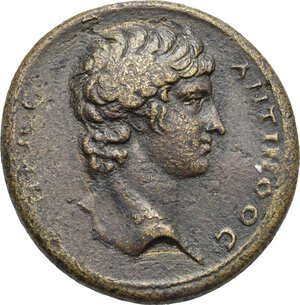
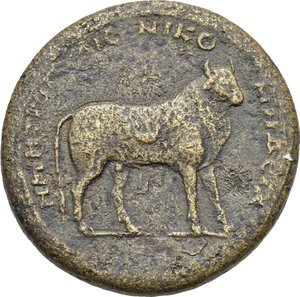
Lot # 317 - Antinous, favourite of Hadrian. Medallion or 8 Assaria (Bronze, 38.54 mm, 37.98 g), Bithynia, Nicomedia, circa 134. HRΩC - ANTINOOC, Bare head right. Rev. H ΜΗΤΡΟΠΟΛΙC NIKO - MEΔEIA, Bull with crescent moon on flank standing right. SNG von Aulock 7102 = RPC 1093.4 (this coin). Blum, p. 45,1 = Waddington, Recueil Général, p. 522,45, and pl. 90,6. R. Pudill, Antinoos, pp. 26-30, M18. Typical brownish patina from an old collection context. Lovely portrait. Very Fine. Extremely Rare, possibly the finest recorded specimen.   From the Hans von Aulock Collection, published in his Sylloge Nummorum Graecorum (Berlin, 1957-1968). Ex Roma Numismatics 19, 26 Mars 2020, lot 662; Classical Numismatic Group, Triton VII, 12 June 2004, lot 723; Classical Numismatic Group, Triton IV, 5 December 2000, lot 358; Münzen und Medaillen (B) 52, 19-20 June 1975, lot 643.   Antinous was a Greek youth from Claudiopolis in Bithynia, renowned for his exceptional beauty. In AD 128 he joined Emperor Hadrian’s personal entourage during a journey through the Greek East of the Roman Empire, visiting the Eleusinian Mysteries, the Oracle of Delphi, and the principal cities and sanctuaries of Asia Minor and Egypt. In October 130, during the festival of Osiris, Antinous drowned under enigmatic circumstances. Hadrian was deeply shaken by his death and had him elevated to divine status, leading to his worship across both the Greek East and the Latin West. Against this background of mystery cults and ideas of death and rebirth, the reverse type depicting a bull marked on its flank with a crescent moon is most likely connected with the taurobolium, a rite involving the sacrifice of a bull. From the mid-second century AD onward, this ritual was practiced in association with the cult of the great Anatolian mother goddess Cybele, her consort Attis, and the Phrygian lunar god Mēn—divinities tied to Eastern concepts of mystery, renewal, and the afterlife.
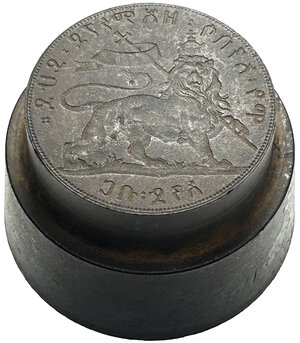
Lot # 356 - Ethiopia (Empire). Menelik II, 1889-1913. Original steel reverse die of the Pattern Gold Birr. (Steel, 51 x 35 mm, upper diam. 39 mm, 458 g). Addis Ababa mint. 1897 - Ethiopian Era 1889 ሞዓ ፡ አንበሳ ፡ ዘእምነገደ ፡ ይሁዳ። (conquering Lion of the Tribe of Judah, in reversed Ge'ez), Crowned Lion of Judah standing right, head facing, holding cross-banner over shoulder; in exergue, አንድ፡ብር (one Birr, in reversed Ge'ez). Cf. KM Pn5 (for type). Gill M21 (for type). Friedberg -. CNG, Triton XIX, 15 January 2016, lot 232 (for the struck coin - 32,500 USD realized). Heritage, NYINC Signature Sale 3105, 9 January 2023, lot 32169 (for the struck coin - 26,000 USD realized). Dark patina, with very few areas of rust. A section of the die - the edge from 12 to 4 o’clock - shows slight corrosion. The struck coin is Extremely Rare: this worn die is Possibly Unique.   From a British private Collection formed before 1960s.   Under Menelik II the Ethiopian currency reform of 1893 introduced the Birr, with the first coins struck at the Paris Mint between 1894 and the early 1900s. In an effort to achieve monetary independence from Europe, a national mint was installed in Addis Ababa between 1903 and 1905, equipped with machinery imported mainly from France. The extremely rare gold pattern issues belong to this experimental phase: they were official trial pieces struck to test the new dies and local metal alloys. Only by closely examining such a die, bordering on artisanal production, can we understand the numerous weight discrepancies and minting defects found in the Pattern issues of Ethiopia. The Addis Ababa Mint, however, never reached full efficiency - production was irregular, the equipment difficult to operate, and supplies of precious metal scarce - so only a handful of specimens were ever produced, and no regular gold coinage followed.