Banner Astarte 26
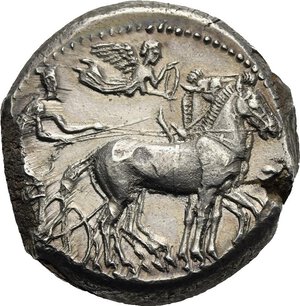
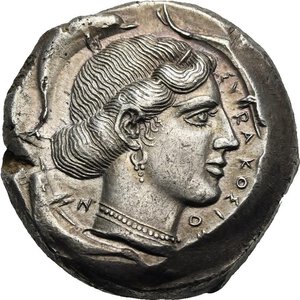
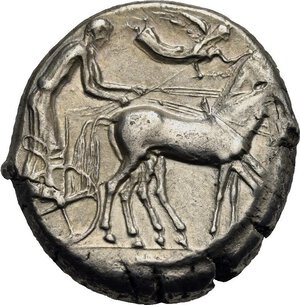
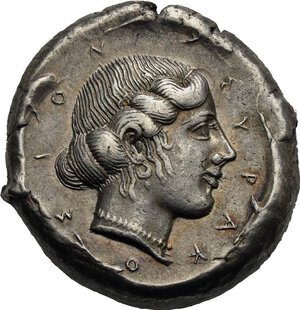
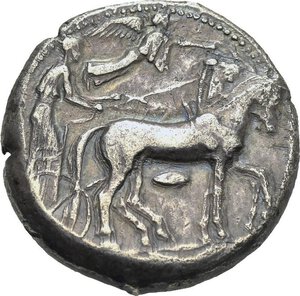
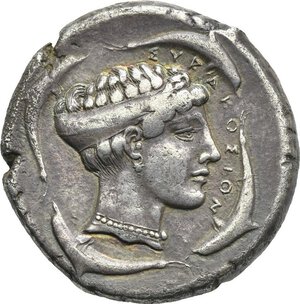
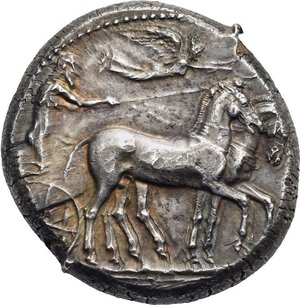
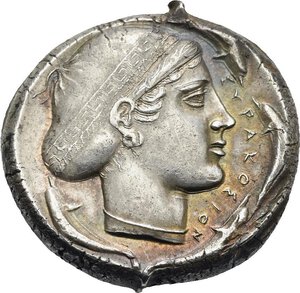
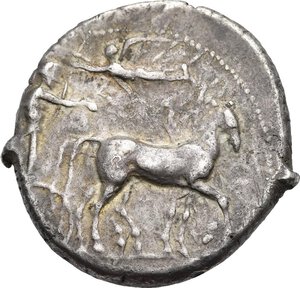
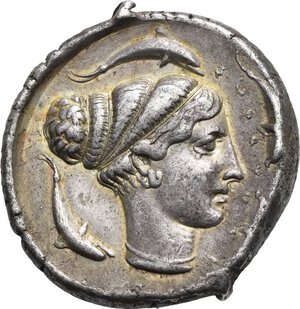
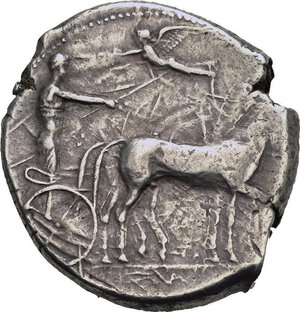
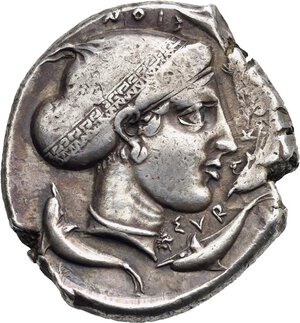
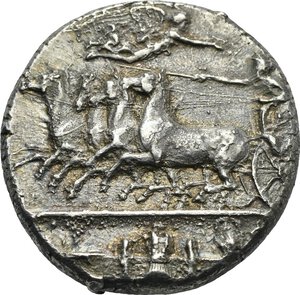
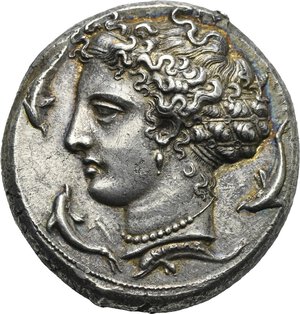
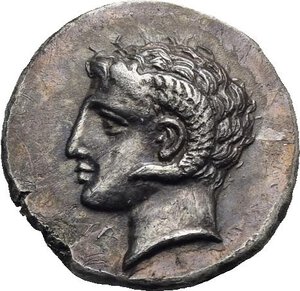
Lot # 131 - Sicily. Syracuse. Dyonisus I, circa 405-400 BC. Dekadrachm (Silver, 35.08 mm, 43.08 g). Signed by the artist Kimon. Charioteer driving fast quadriga left, holding kentron and reins; Nike flying above crowning him; under the heavy exergue line inscribed KIMΩN (only traces visible, as usual), panoply of arms arranged on two steps, the lower inscribed [ΑΘΛΑ] ("prizes"). Rev. ΣΥ[ΡΑΚΟΣΙΩ], Head of Arethusa left wearing single-pendant and pearl necklace, hair bound in front with ampyx and caught up behind by net; around, four dolphins swimming, the one below neck inscribed KIMΩN, border of fine dots. Jongkees 4 (dies A/δ). SNG München 1073 (same dies). Rizzo pl. L,4 (same dies). Regling, Dekadrachmon 4 (same dies). Franke-Hirmer 119 (same reverse die). HGC 2, 1298. Nicely toned with hints of golden iridescence. A spectacular specimen, visually striking and in high relief. Struck (as always on this combination) from a somewhat rusty obverse die. A small hit on the reverse border of dots. One of the great masterpieces of the die engraver's art for the Greek series. Extremely Fine. Very Rare.   Ex Tkalec, 29 February 2000, lot 29.   By the winter of 406-405 BC, Dionysus became tyrant and stregos of Syracuse, the premier city of Sicily. During his reign (405-367 BC), he fought three wars against the Carthaginians, handing them defeat after defeat, and confining the Carthaginians to their older territorial dominions in the western part of Sicily. This accomplished, Syracuse, with its rapidly increasing prestige and wealth, began its own program of territorial and political expansionism, eventually controlling in some form most of southern Italy. Under Dionysios, Syracuse became the most splendid and the best fortified of all Greek cities. Its naval power was vastly increased, likewise, until its fleet was the most powerful in the Mediterranean. Dionysus reintroduced the large and ostentatious silver dekadrachms, a denomination that had not been used in Syracuse since the issue of the Demareteion decades earlier. Dionysus entrusted two of the greatest local numismatic artists, Kimon and Euainetos to design these impressive pieces. Scholars have long attempted to ascribe the dekadrachms to an historical event as they seem in every way to be commemorative medallions. The current thought on the dating of this issue favours the victorious actions of Syracuse in the devastating invasion of Sicily by the Carthaginians from 406 to 405 BC. The most compelling reason to associate the Kimonian dekadrachms with a military victory is the display of armour and weaponry that appears in the exergue along with the inscription AΘΛA, which indicates 'prizes', or at least 'agonistic contests'.
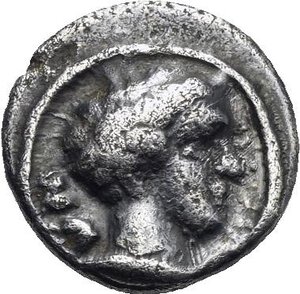
Lot # 145 - Central Italy, possibly Campania. Circa first half of 2nd - 1st centuries BC. Unofficial Pseudo-Coin. (Struck Lead Alloy, 20.5 mm, 3.87 g). Head of Vulcan right, wearing wreathed pileus and with tongs on shoulder. Rev. Furnacator in short tunic, fallus hanging down, advancing right and holding shovel; before, askos. HN Italy -. Stannard 2007 (LOC), series 59, no. 618 - 23.041 (only one specimen). Stannard, "Apollo and the little man with the strigils, and the Italo-Baetican iconography", 2020, pl.5, n. 12. Old cabinet toned. Minor areas of flattening. Otherwise, Good Very Fine. Embarrassingly Rare - possibly the second specimen known - with no example recorded at auction in the last quarter of a century.   From a collection of ancient lead tokens, assembled since the late 1960s.   This rare pseudo-coin belongs to an unofficial Italic series studied by Clive Stannard, first identified in the river deposits of the Liri near Minturnae. These pieces are notable for their striking and unusual iconography. On the obverse of this specimen appears Vulcan, unmistakably associated with hard manual labor. The reverse features a seminude stoker at work, his short tunic lifted to reveal his genitals - a raw, almost defiant image of the physical reality of toil. Related bronze issues from the same series depict similar figures, as well as strigils and other implements of the gymnasium or, more precisely, the bath complex. These pieces reflect themes of work, purification, and public life. Communal baths - often founded by generous benefactors - anchor the social and ritual context in which these tokens circulated. They speak to a world of trade, routine, and collective identity shaped at the margins of formal state control. Ultimately, these popular - or to use a modern term, proletarian - pseudo-coins were the everyday currency of those who kept the baths running: most likely slaves. In their bold imagery and function, they express not just utility, but a kind of pride: currencies made by the working class, for the working class.
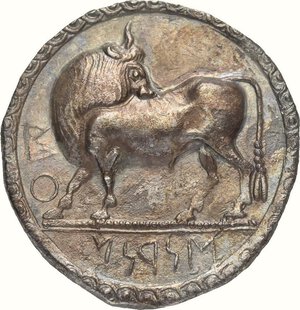
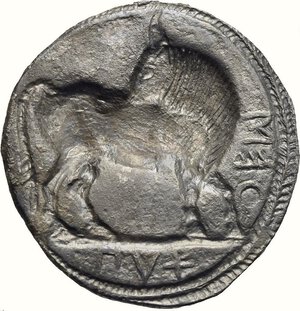
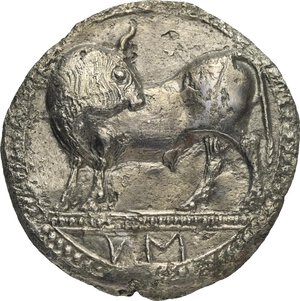
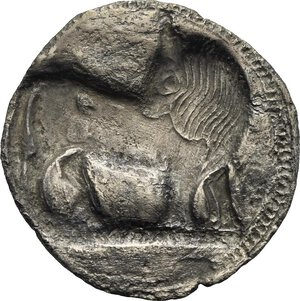
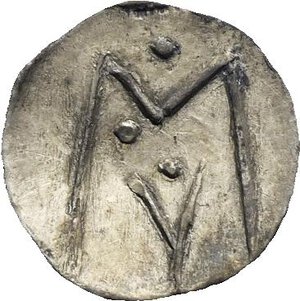
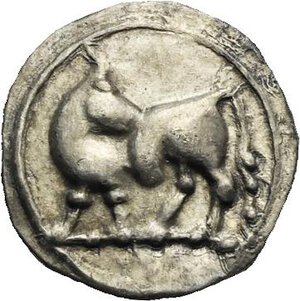
Lot # 168 - Lucania. Siris and Pyxus. Stater. Circa 540-510 BC (Silver, 28.08 mm, 7.64 g). Bull standing left, looking backwards; in exergue and on left field, ΣIΡIN - OΣ (retrograde in archaic characters); cable border with dotted interstices. Rev. The same type right, in incuse; in exergue and on right field, ΠV+ - OES (retrograde in archaic characters); herringbone border. HN Italy - (but cf. 1725 for the reverse). Traité -. Perret -. SNG ANS 816 (this reverse die) = Mangieri, RIN 1981, D25 on pl. IV. Lightly toned. Minor scratches on obverse and scattered cleaning marks. Well struck. Extremely Fine. Exceedingly Rare, with an unpublished obverse die.   From a Swiss collection, formed before 2005.   The retrospicient bull was chosen as a symbol by Sybaris in ancient Greece because it represented fertility and strength, qualities attributed both to the animal and to the river Krathis, which was personified in the shape of the bull. The image of the bull with its head turned backward, recurrent on Sybarite coins, was therefore a reference to the vitality of the waters that made the city rich and prosperous, as well as a symbol of power and protection for the community. Looking backward symbolizes the connection to origins, to the land and the past, while also reflecting a conscious respect for traditions that serve as a source of energy for the future. Later, other colonies of Sybaris, such as Poseidonia (modern Paestum), Laos, Skidros, Siris, and Pyxous, adopted the bull on their coins, symbolizing both a connection to the territory and spiritual value