Info & contacts
PDF Catalogue
My bids
Watched Lots
Terms Of Sale
Shipping costs
Payment methods
Printable results
Live Bidding Thursday 9th April 2026 02:30:00 PM CET
The Connoisseur’s Collection (1-136)
Greek (137-254)
Roman Republic (255-299)
Roman Empire (300-345)
Migration of the German tribes (346-346)
Byzantine (347-354)
Colombia (355-355)
Ethiopia (356-356)
France (357-360)
Italy (361-376)
Papal States (377-379)
Savoy (380-382)
Islam (383-384)
Netherlands (385-385)
Switzerland (386-391)
French Medals (392-397)
Italian Medals (398-411)

Risultati: 136
Pagina 1
Lot # 1
-
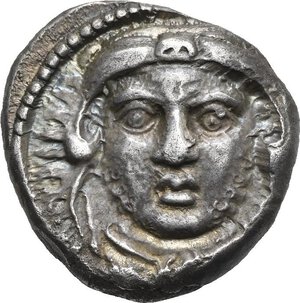
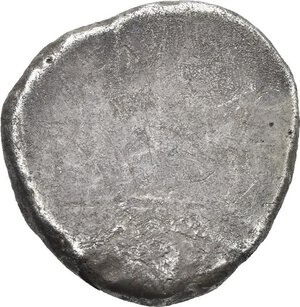
Etruria. Populonia. Circa 300-250 BC. 20 Asses (Silver, 20.47 mm, 7.65 g). Youthful head of Herakles facing, wearing lion's skin headdress; [X – X (mark of value), flanking neck]. Rev. Blank. Vecchi, EC I, Group XIII, 65.82 (O1, this coin illustrated). HN Italy 155 (same dies). Vecchi, SNR 69 (1990), “The coinage of the Rasna II”, 75 (same dies). SNG ANS 89-90 (same dies). BMC Italy 1, 3 (same dies). Dewing 76 (same dies). McClean 132 (same dies). HGC 1, 115 (same dies). Old cabinet tone with hints of iridescent blue. Good Very Fine.
Ex Künker 124,16 March 2007, lot 7798; E. Button 111, September 1965, lot 322.
Lot # 2
-
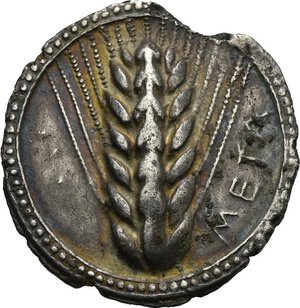
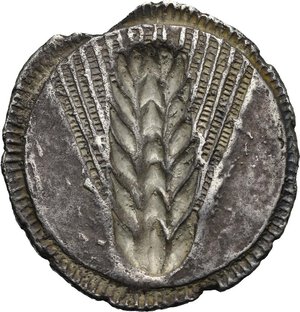
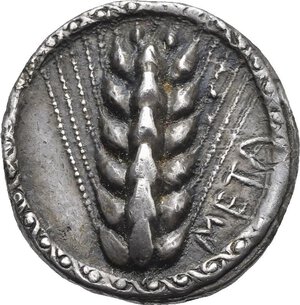
Lucania. Metapontion. Circa 540-510 BC. Stater (Silver, 28.60 mm, 7.68 g). META, Seven-grained ear of barley. Rev. Same type in incuse. HN Italy 1479. Noe, Class VI, 112 (same dies). SNG ANS 209. Gorini 12 var. (eight grains). HGC 1, 1027. Beautiful old cabinet tone, slightly iridescent. Chipped edge. Otherwise, Good Very Fine.
Ex Nomisma 7, 11 April 1996, lot 6.
Lot # 3
-
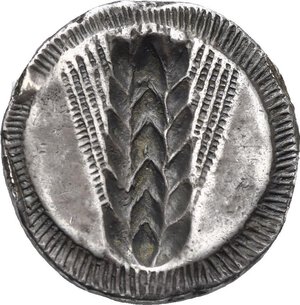
Lucania. Metapontion. Circa 510-470 BC. Stater (Silver, 22.63 mm, 8.10 g). META, Seven-grained ear of barley. Rev. Same type in incuse. HN Italy 1482. Noe, Class IX, 179 (same dies). SNG ANS 225 (same dies). SNG Lloyd 310 (same dies). Gorini 24. HGC 1, 1028. Beautiful old cabinet tone. High reliefs. Well centered. Extremely Fine.
Ex Nomisma 9, 17 May 1997, lot 54.
Lot # 4
-
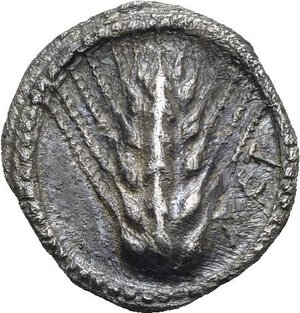
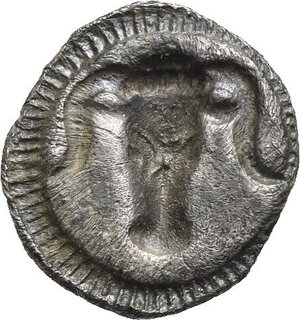
Lucania. Metapontion. Circa 470-440 BC. Triobol (Silver, 13.52 mm, 1.27 g). MET, Six-grained barley grain. Rev. Facing bull head, in incuse. HN Italy 1487. Noe 275 (same dies). SNG ANS 264 (same dies). SNG Copenhagen 1178 (same dies). SNG Lloyd 319 (same dies). McClean 910 (same dies). Gorini 20. HGC 1, 1071. Old cabinet tone. Slightly rough surfaces on obverse. Very Fine.
Ex Asta Internazionale del Titano - Aes Rude 64, 18 February 1996, lot 36.
Lot # 5
-
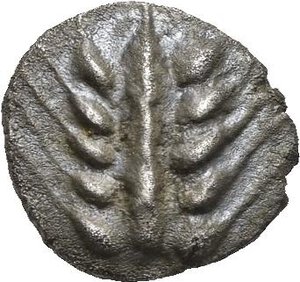
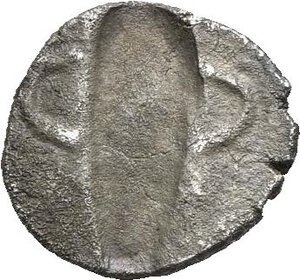
Lucania. Metapontion. Circa 470-440 BC. Diobol (Silver, 10.05 mm, 0.75 g). Five-grained ear of barley. Rev. Barley grain with two annulets at sides (mark of value), in incuse. HN Italy 1488. Noe 299 (same dies). SNG München 947 (same dies). SNG ANS -. SNG Copenhagen -. SNG Lloyd -. Gorini 21. HGC 1, 1075. Well toned. Good Very Fine. Rare.
Ex Asta Internazionale del Titano - Aes Rude 58, 24 September 1994, lot 19.
Lot # 6
-
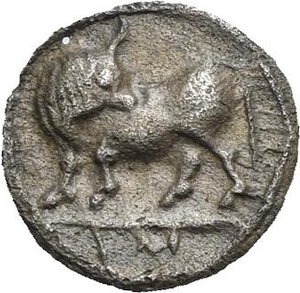
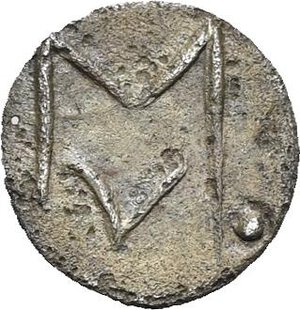
Lucania. Sybaris. Circa 550-510 BC. Obol (Silver, 9.40 mm, 0.34 g). VM (retrograde), Bull standing left, head turned right on exergual dotted line; border of dots. Rev. Large M above V between four pellets (only one visible). HN Italy 1739 (same dies). SNG ANS 854 (same dies). SNG Copenhagen 1396 (same dies). SNG Fitzwilliam 579 (same dies). De Luynes 558 (same dies). McClean 1173 (same dies). HGC 1, 1235 (same dies). Nicely toned. Well centred. An invisible little hole. Good Very Fine. Rare.
Ex Astarte XIV, 24 April 2004, lot 39.
Lot # 7
-
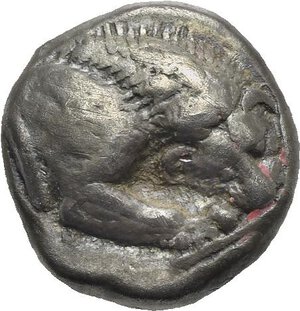
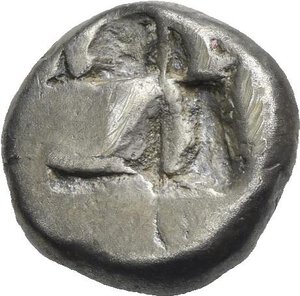
Lucania. Velia. Circa 535-465 BC. Drachm (Silver, 13.05 mm, 3.76 g). Forepart of a lion right, devouring limb of prey held in forepaw. Rev. Quadripartite incuse square. Cf. HN Italy 1259. Cf. Williams Velia, Period I. Cf. Mangieri Velia, Period I, pl. I. Cf. SNG ANS 1202-1206. Cf. SNG Delepierre 399. Cf. Dewing 450-451. Cf. HGC 1, 1327. Old cabinet tone. Some deposits. Very Fine. Rare.
Ex Italo Vecchi 1, 1 February 1996, lot 129.
Velia was founded around 540 BC by settlers from Phocaea, in western Asia Minor, who fled their homeland following the Persian conquest. Its coinage began soon after the founding of the city, and its types (lion-devouring prey front/incuse square) and denomination (Fokaian silver drachm) reflect the Asian origin of Velia's early citizens.
Lot # 8
-
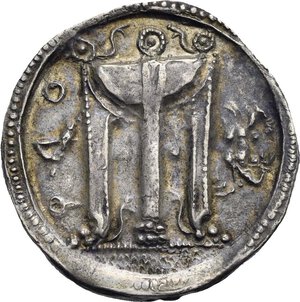
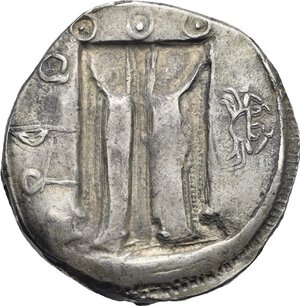
Bruttium. Kroton. Circa 530-500 BC. Stater (Silver, 27.25 mm, 8.21 g). ϘPO (partially retrograde), Tripod with three ring handles and two double volutes below bowl, the legs ending in lion's feet; on either side of the central leg and above the bowl, two snakes facing each other; below beaded exergue line, small waves; in right field, crab; border of dots within two concentric linear circles. Rev. ϘPO (partially retrograde), Same type as the obverse but incuse and without volutes, snakes and waves; ethnic and crab are raised; rayed border. HN Italy 2078 (same dies). P. Attianese, “Kroton, Ex Nummis Historia”, 1992, p. 46, 31 (same dies). G. Gorini, “La monetazione incusa della Magna Grecia”, 1975, p. 23, 15 (same dies). SNG ANS 244 (same dies). SNG Copenhagen 1744 (same dies). Cf. HGC 1, 1444. A beautifully well-struck piece, with a slightly golden iridescent patina. Thin die break at nine o'clock on the obverse. Extremely Fine. Rare.
Ex Italo Vecchi 8, 4 December 1997, lot 16; Numismatica Ars Classica 9, 16 April 1996, lot 100.
Lot # 9
-
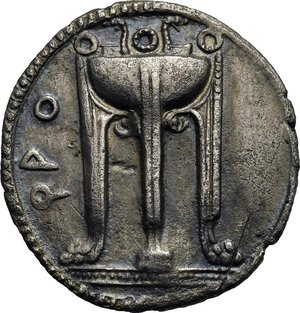
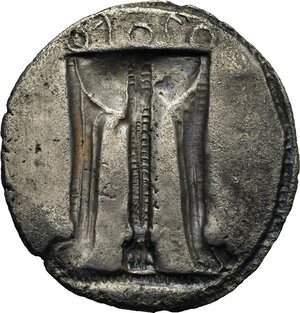
Bruttium. Kroton. Circa 530-500 BC. Stater (Silver, 28.02 mm, 6.56 g). ϘPO, Tripod with three ring handles and two snakes rising from the bowl, the legs ending in lion's feet; below, beaded exergual line between two parallel lines; all within raised cable and dotted border. Rev. Same type as the obverse but incuse and without legend; the three ring handles and two snakes are raised; rayed border.Cf. HN Italy 2075. P. Attianese, “Kroton, Ex Nummis Historia”, 1992, p. 24, 2 (same dies). G. Gorini, “La monetazione incusa della Magna Grecia”, 1975, p. 20, 4 (same dies). SNG ANS 227 (same dies). SNG Copenhagen 1735 (same dies). HGC 1, 1444 (same dies). Nicely toned with hints of blue iridescence. Nearly Extremely Fine. Rare.
Ex Aes Rude (CH) 16, 9 April 1994, lot 26.
Lot # 10
-
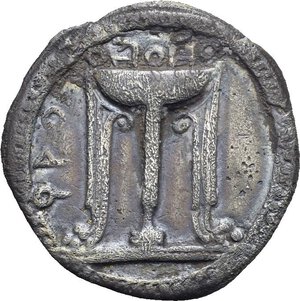
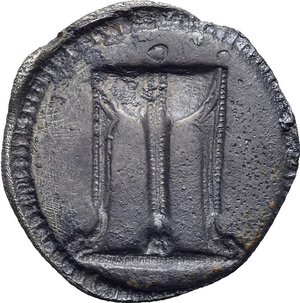
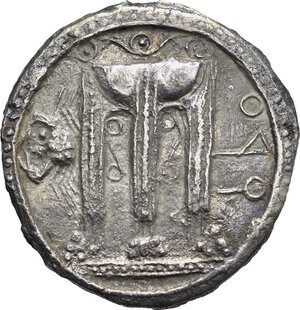
Bruttium. Kroton. Circa 530-500 BC. Drachm or Third Stater (Silver, 19.33 mm, 2.38 g). ϘPO, Tripod with three ring handles and two snakes rising from t7he bowl, the legs ending in lion's feet; below, beaded exergual line between two parallel lines; all within raised cable and dotted border. Rev. Same type as the obverse but incuse and without legend; the three ring handles and two snakes are raised (only partially visible); rayed border. Cf. HN Italy 2076. P. Attianese, “Kroton, Ex Nummis Historia”, 1992, p. 30, 16 (same dies). SNG ANS 299 (same). SNG Copenhagen 1742 (same dies). HGC 1, 1466 (same dies). Charming old cabinet tone with blue iridescent. Some deposits and corrosion, otherwise, Very Fine. Very Rare.
Ex Kunst und Münzen Price list 70, June 1995, lot 40.
Lot # 11
-
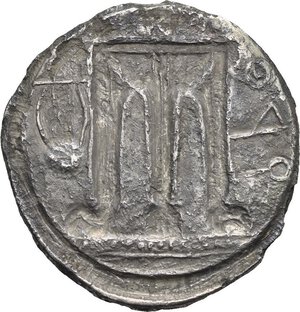
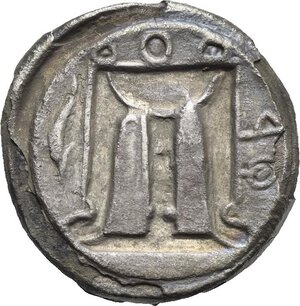
Bruttium. Kroton. Circa 500-480 BC. Stater (Silver, 26.05 mm, 6.43 g). ϘPO (retrograde), Tripod with three ring handles, legs ending in lion's feet and two double volutes below bowl, on exergual line of dots between two parallel lines; in left field, crab; border of dots within two concentric linear circles. Rev. ϘPO (retrograde), Same type as the obverse but incuse and without volutes; ethnic, the three ring handles and the lyre in left field are raised; rayed border. HN Italy 2088 (same dies). P. Attianese, “Kroton, Ex Nummis Historia”, 1992, p. 47, 33 (same dies). G. Gorini, “La monetazione incusa della Magna Grecia”, 1975, p. 23, 16 (same dies). SNG Copenhagen 1746 (same dies). SNG Lloyd 594 (same dies). SNG ANS -. SNG München -. Cf. HGC 1, 1446. Lightly toned. Some bumps and notching to edge, otherwise, Good Very Fine. A rare variety.
Ex Nomisma 4, 5 November 1994, lot 15.
Lot # 12
-
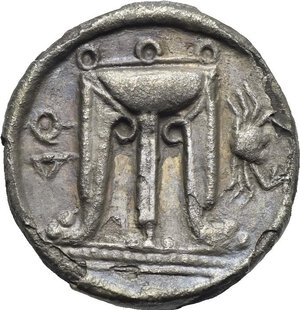
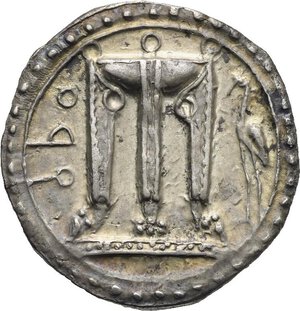
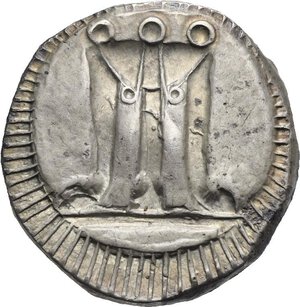
Bruttium. Kroton. Circa 480-430 BC. Stater (Silver, 20.35 mm, 7.45 g). Dumpy incuse. ϘP (retrograde), Tripod with three ring handles, legs ending in lion's feet and two volutes below bowl, on exergual line of dots between two parallel lines; in right field, crab; border of dots within two concentric linear circles? Rev. ϘP (retrograde), Same type as the obverse but incuse and without volutes; ethnic, the three ring handles and the dolphin in left field are raised; incuse border around. Cf. HN Italy 2100. P. Attianese, “Kroton, Ex Nummis Historia”, 1992, p. 48, 37 (same dies). G. Gorini, “La monetazione incusa della Magna Grecia”, 1975, p. 24, 21 (same dies). SNG ANS 282 (same dies). SNG Ashmolean 1470 (same dies). Cf. HGC 1, 1449. Attractively toned. Some parts of the coin with significant delamination, otherwise, Good Very Fine. Rare.
Ex Astarte VI, 10 November 2000, lot 65; Italo Vecchi 2, 12 September 1996, lot 175.
Lot # 13
-
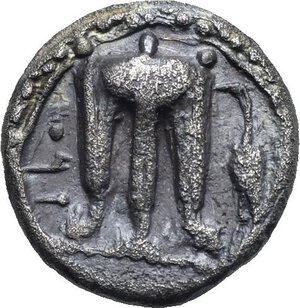
Bruttium. Kroton. Circa 480-430 BC. Stater (Silver, 21.70 mm, 7.96 g). Dumpy incuse. ϘPO, Tripod with three ring handles, legs ending in lion's feet and with two volutes below bowl, on exergual line of dots between two parallel lines; in right field, heron standing left; border of dots within two concentric linear circles. Rev. Same type as the obverse but incuse and without legend and heron; the three ring handles and two volutes below bowl are raised; rayed border. Cf. HN Italy 2102. P. Attianese, “Kroton, Ex Nummis Historia”, 1992, p. 64, 47 var. = G. Gorini, “La monetazione incusa della Magna Grecia”, 1975, p. 24, 22 var. (ethnic). SNG ANS 262 (same dies). SNG Copenhagen 1750 (same dies). Cf. HGC 1, 1449. An impressively well-struck piece with sharp details. The lustrous surfaces display beautiful iridescent toning. Good Extremely Fine. Rare.
Ex Artemide 4, 11 December 1996, lot 19.
Lot # 14
-
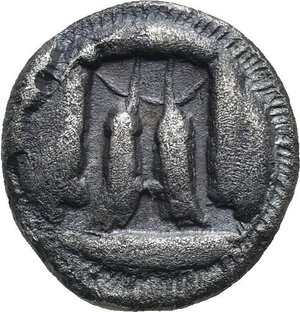
Bruttium. Kroton. Circa 480-430 BC. Drachm or Third Stater (Silver, 14.34 mm, 2.32 g). ϘPO, Tripod with three ring handles, legs ending in lion's feet and with two volutes below bowl, on exergual line of dots between two parallel lines; in right field, heron standing left; border of dots within two concentric linear circles. Rev. Same type as the obverse but incuse and without legend, heron and volutes; rayed border. HN Italy 2103 (same dies). P. Attianese, “Kroton, Ex Nummis Historia”, 1992, p. 72, 63 (same dies). SNG Ashmolean 1495 (same dies). SNG ANS 303 (same reverse die). SNG Lockett (same reverse die). Cf. SNG Copenhagen 1757. Cf. HGC 1, 1468. Pleasant old cabinet tone with iridescent blue. Very Fine. Very Rare.
Ex Asta Internazionale del Titano/Aes Rude 64, 18 February 1996, lot 45.
Lot # 15
-
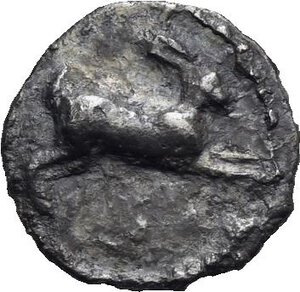
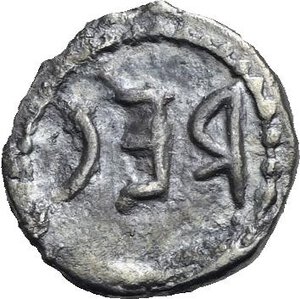
Bruttium. Rhegion. Circa 480-462 BC. Litra (Silver, 10.20 mm, 0.53 g). Struck under the Tyrant Anaxilas. Hare springing right; border of dots. Rev. REC (retrograde), within a border of dots. HN Italy 2475 (same dies). Cf. Caltabiano, Series II–IV, pl. 65-66, 116–117 and 120-136. Cf. SNG ANS 633-634. Cf. SNG Copenhagen 1926. Cf. SNG München 1570-1572. Cf. SNG Lloyd 674-675. Cf. HGC 1, 1649. Old cabinet tone with some deposits. Very Fine. Rare.
Ex Numismatica Ars Classica auction E, 4 April 1995, lot 2140.
Lot # 16
-
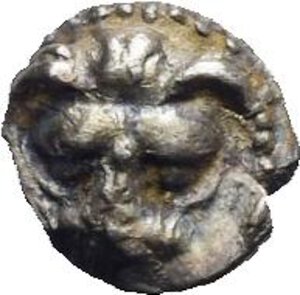
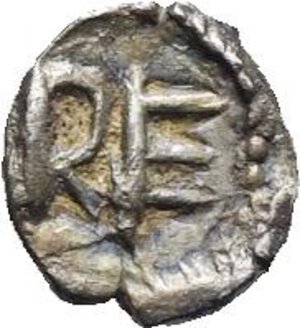
Bruttium. Rhegion. Circa 450-445 BC. Hexas (Silver, 5.63 mm, 0.14 g). Facing lion's head; border of dots. Rev. RE, within a border of dots. HN Italy 2482 (same dies). SNG ANS 656 (same dies). Herzfelder pl. IV, D var. (pellet on reverse). P. Attianese, “Calabria Greca”, 1980, vol. 3, p. 137, 1405 var. (pellets on reverse). Cf. HGC 1, 1665. Small but beautiful piece, with an exquisite iridescent patina. Some deposits. Extremely Fine. Rare.
Ex Sternberg XXXI, 28 October 1996, lot 357.
Lot # 17
-
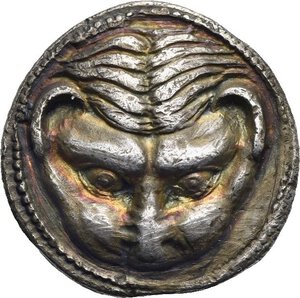
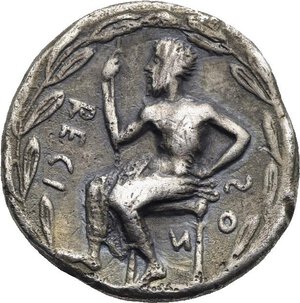
Bruttium. Rhegion. Drachm. Circa 445-435 BC. Drachm (Silver, 17.82 mm, 4.13 g). Facing lion's head; border of dots. Rev. RECI – N – OS, Iokastos seated left, holding staff; all within laurel wreath. Cf. HN Italy 2484. Herzfelder pl. IV, 39 (D25/R33, same dies). P. Attianese, “Calabria Greca”, 1980, vol. 3, p. 131, 1388 (same dies). SNG ANS -. SNG Copenhagen -. SNG Lloyd -. SNG München -. Cf. HGC 1, 1644. Attractively toned with wonderful iridescence. Some light scratches. Good Very Fine. Extremely rare issue, only two drachm’s examples recorded by Herzfelder for this type.
Ex Artemide 3, 4 September 1996, lot 45.
Lot # 18
-
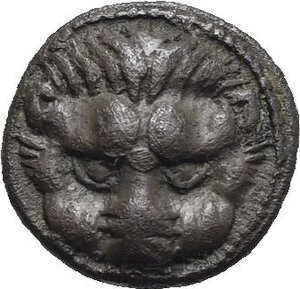
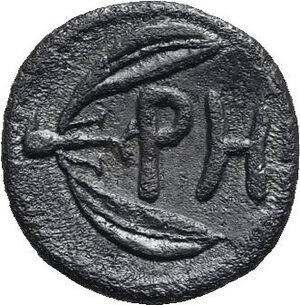
Bruttium. Rhegion. Circa 420-410 BC. Litra (Silver, 9.61 mm, 0.81 g). Facing lion's head; border of dots. Rev. PH, Olive-spray with berries; border of dots. HN Italy 2495 (same dies). Herzfelder pl. VII, H (same dies). P. Attianese, “Calabria Greca”, 1980, vol. 3, p. 150, 1427 (same dies). Cf. SNG ANS 670-674. Cf. München 1588-1589. Cf. HGC 1, 1654. Deep cabinet tone. Extremely Fine. Rare variant.
Ex Nomisma 2, 30 October 1993, lot 63.
Lot # 19
-
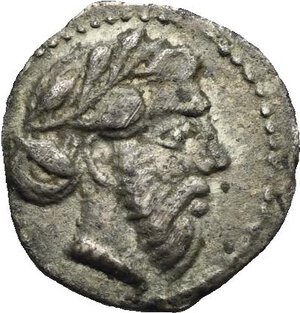
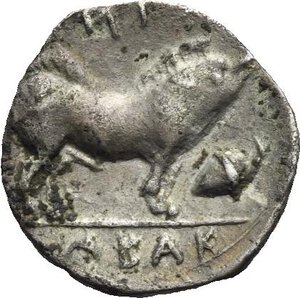
Sicily. Abakainon. Litra. Circa 430-420 BC. Litra (Silver, 12.14 mm, 0.73 g). Laureate and bearded head of Zeus right; border of dots. Rev. ABAK – [A]INI (partially retrograde), Boar standing right on exergue line; to right, a corn; linear circular border. A. Bertino, "Le emissioni monetali di Abaceno" AIIN Suppl. 20 (1975), pl. XII, 14 (same dies). Campana CNAI II, 9, 10 b (same dies). SNG ANS 897 (same dies). SNG Lloyd 777 = Weber 1169 (same dies). HGC 2, 10 (same dies). Lightly toned. Very Fine/Good Very Fine. Rare.
Ex Dieter Gorny 76, 22 April 1996, lot 28; Münzen und Medaillen Price list 570, November/December 1993, lot 34.
Lot # 20
-
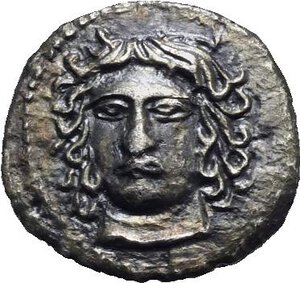
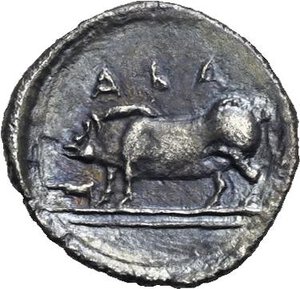
Sicily. Abakainon. Circa 410-400 BC. Litra (Silver, 10.78 mm, 0.68 g). Head of nymph facing slightly left, hair flying above; border of dots. Rev. ABA, Sow with piglet standing left on double exergual line within shallow incuse circle. A. Bertino, "Le emissioni monetali di Abaceno" AIIN Suppl. 20 (1975), pl. XII, 20 (same dies). Campana CNAI II, 16, 22 = SNG Lloyd 779 (same dies). SNG ANS 1293 (additions, same dies). Rizzo pl. LIX, 4 (same dies). De Luynes 841 (same dies). Buceti 27 (same dies). Cf. HGC 2, 21. Old cabinet tone with blue iridescence. Good Very Fine. Rare.
Ex Astarte XIV, 24 April 2004, lot 61.
Lot # 21
-
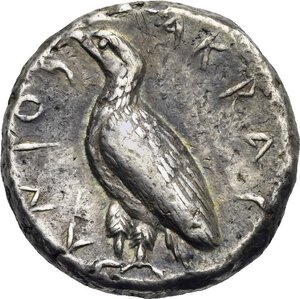
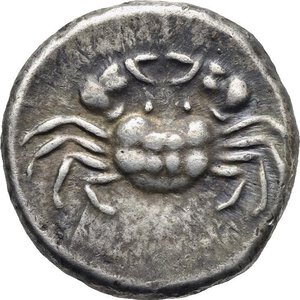
Sicily. Akragas. Circa 510-495 BC. Didrachm (Silver, 21.40 mm, 9.08 g). ΑΚRΑC – ΑΝΤΟS, Eagle standing left with closed wings. Rev. Crab. Westermark, Akragas Period I, Group I, 57 (O27/R30, same dies). SNG ANS 910 (same dies). SNG München 38 (same dies). SNG Copenhagen 21 (same obverse die). Buceti 4 (same reverse die). Cf. Jenkins, Gela Group I. Cf. HGC 2, 87. Attractive old cabinet toning with slight iridescence. Good Very Fine. Very Rare variety.
Ex Dieter Gorny 100, 20 November 1999, lot 67.
Lot # 22
-
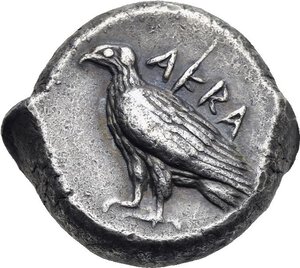
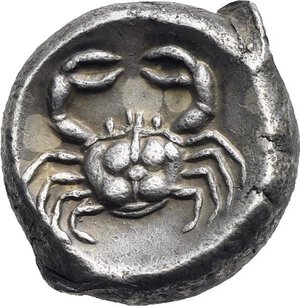
Sicily. Akragas. Circa 495-485 BC. Didrachm (Silver, 19.50 mm, 8.55 g). AKRA, Eagle standing left with closed wings. Rev. Crab; within shallow circular incuse. Westermark, Akragas Period I, Group II, 141 (O57/R87, same dies). Jenkins, Gela Group IIc, pl. 37, 8 (same dies). SNG ANS 926 (same dies). SNG Delepierre 520 (same dies). Dewing 551 (same dies). Cf. Buceti. Cf. HGC 2, 93. Nicely toned. Short and thick flan, with thin die break on the obverse, above letter K. Extremely Fine. Rare.
Ex Asta del Titano M1, 21 June 2015, lot 44.
Lot # 23
-
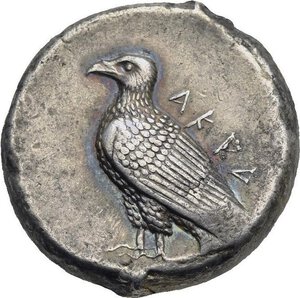
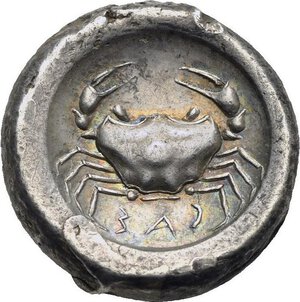
Sicily. Akragas. Circa 488-478 BC. Didrachm (Silver, 19.62 mm, 8.76 g). AKRA, Eagle standing left with closed wings. Rev. Crab; below, CAΣ (retrograde) within shallow incuse circle. Westermark, Akragas Period I, Group III, 216.3 (O76/R141, this coin). Jenkins, Gela Group III, pl. 37, 10 (same dies). SNG ANS 949 (same dies). SNG Copenhagen 34 (same dies). SNG Delepierre 522 (same dies). Buceti 12 = HGC 2, 95 (same dies). Wonderful iridescent toning. Almost uncirculated. Rare.
Ex Numismatica Ars Classica 9, 16 April 1996, lot 130.
Lot # 24
-
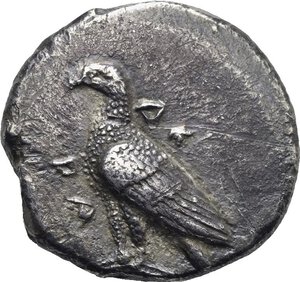
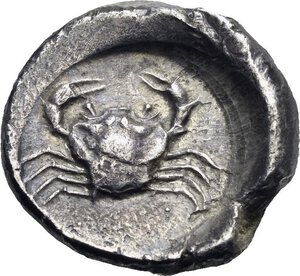
Sicily. Akragas. Circa 480-470 BC. Didrachm (Silver, 22.04 mm, 8.13 g). AK – PA (partially retrograde), Eagle standing left with closed wings. Rev. Crab within shallow incuse circle. Westermark, Akragas Period I, Group IV, 244.9 (O84/R165, this coin). SNG München 52 (same dies). SNG Tübingen 558 (same dies). McClean 2025 (same dies). Cf. SNG ANS 950-953. Cf. Jenkins, Gela Group IV. Cf. Buceti 22. Cf. HGC 2, 97. Old cabinet tone. Two thin scratches on obverse. Near Extremely Fine. Rare.
Ex Dr. Busso Peus Nachfolger 348, 2 May 1996, lot 28.
Lot # 25
-
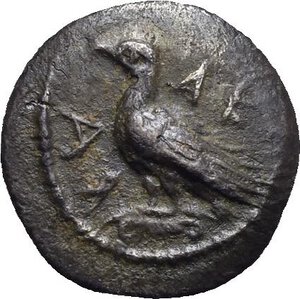
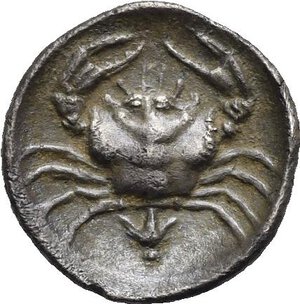
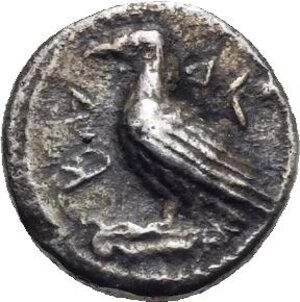
Sicily. Akragas. Circa 450-440 BC. Litra (Silver, 12.20 mm, 0.77 g). AK - RA, Eagle standing left with closed wings on Ionic capital; border of dots. Rev. Crab; below, lotus flower; within shallow incuse circle. Westermark, Akragas Period II, Series A, 450.7 (O2/R2, this coin). SNG ANS 987 (same dies). BMC Sicily 9, 48 (same dies). McClean 2035 (same dies). Buceti 44 c (same dies). HGC 2, 113 (same dies). SNG Lockett 709 (same obverse die). SNG Lloyd 813 (same obverse die). De Luynes 857 (same reverse die). Winterthur 574 (same reverse die). Darkly toned. Good Very Fine.
Ex Leu 79, 31 October 2000, lot 329.
Lot # 26
-
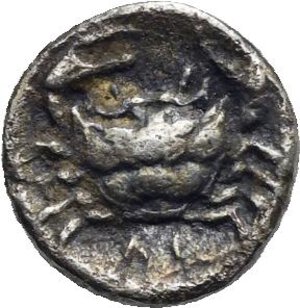
Sicily. Akragas. Circa 450-440 BC. Litra (Silver, 8.30 mm, 0.57 g). AK - RA, Eagle standing left with closed wings on Ionic capital; border of dots. Rev. Crab; below, ΛI (mark of value); within shallow incuse circle. Westermark, Akragas Period II, Series B.1, 467.4 (O12/R12, this coin). SNG ANS 992 (same dies). SNG Copenhagen 48 (same dies). BMC Sicily 9, 50 (same dies). Weber 1190 (same dies). Buceti 44 a (same dies). HGC 2, 121 (same dies). Old cabinet tone with beautiful iridescence. Good Very Fine.
Ex Dr. Busso Peus Nachfolger 345, 1 November 1995, lot 34.
Lot # 27
-
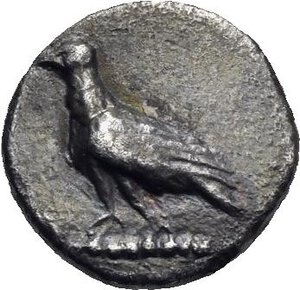
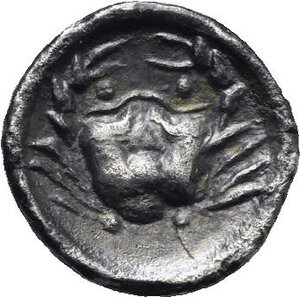
Sicily. Akragas. Circa 450-440 BC. Litra (Silver, 9.60 mm, 0.57 g). Eagle standing left with closed wings on dotted exergue line. Rev. Crab within shallow incuse circle. Westermark, Akragas -. SNG ANS -. SNG Lloyd -. Buceti -. HGC 2, -. Issue without legend. An apparently unpublished type in the standard references and also missing from the Westermark corpus "The Coinage of Akragas". Old cabinet tone with light iridescence. Near Extremely Fine.
Ex Numismatica Ars Classica auction O, 13 May 2004, lot 1256. From the Athos and Dina Moretti Collection.
Lot # 28
-
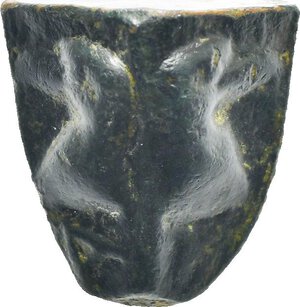
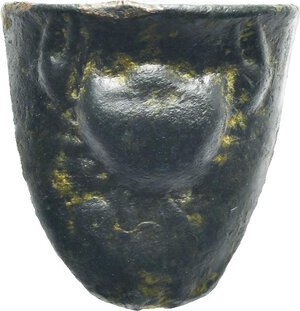
Sicily. Akragas. Circa 440-430 BC. Cast bronze, Tetras triangular Circa 440-430 BC (Bronze, 17.46 x12.71 mm, 11.51 g). Heads and necks of two eagles back to back; below, A – [K]. Rev. Crab; below, P-A. On base, three pellets (mark of value). Westermark, Akragas Period II, 526.7 (this coin). Calciati CNS I, 145, 6 (same dies). SNG ANS 1018 (same dies). SNG Copenhagen 62 (same dies). SNG Lloyd 833 (same dies). Virzì 554 (same dies). Buceti 58 (same dies). HGC 2, 127 (same dies). Dark green patina. Extremely Fine. Rare in this condition.
Ex Dr. Busso Peus Nachfolger 361, 3 November 1999, lot 11.
Lot # 29
-
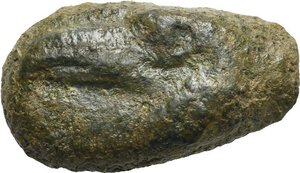
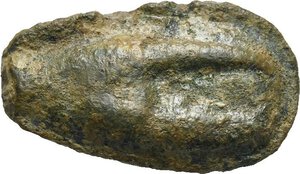
Sicily. Akragas. Circa 440-430 BC. Cast bronze, Onkia (Bronze, 20.06 x11.46 mm, 4.74 g). Head of eagle left. Rev. Claw of crab. Westermark, Akragas Period II, 528 (same dies). Calciati CNS I, 147, 8 (same dies). SNG ANS 1020 (same dies). SNG Lloyd 835-836 (same dies). SNG Morcom 514 (same dies). McClean 2054 (same dies). Buceti 60 (same dies). HGC 2, 130 (same dies). Dark green patina. Some deposits. Good Very Fine. Scarce.
Ex Asta del Titano 6, 29 October 2000, lot 20.
Lot # 30
-
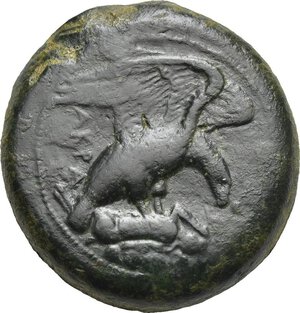
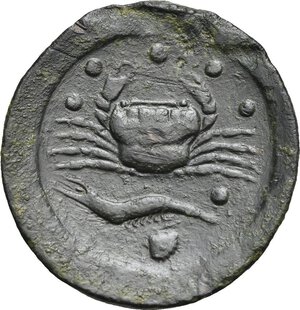
Sicily. Akragas. Circa 415-406 BC. Hemilitron (Bronze, 31.30 mm, 21.67 g). AKPA, Eagle standing right, wings spread and head lowered, clutching dead hare held in its talons; border of dots. Rev. Crab; around, six pellets (mark of value); below, long shrimp left above scallop shell; all within shallow incuse circle. Westermark, Akragas Period III, Series 4, 703.1 (4.O3/4. R3, this coin). SNG Agrigento 110 (same dies). Calciati CNS I, 165, 10 var. (Westermark 702 = thin hare). SNG ANS 1025 var. (Westermark 702 = thin hare). Cf. Buceti 74 = HGC 2, 136. Dark green patina. Very Fine/ Near Extremely Fine. Extremely Rare variety.
Ex Astarte Mail bid Auction 2, 9 December 1998, lot 5.
Lot # 31
-
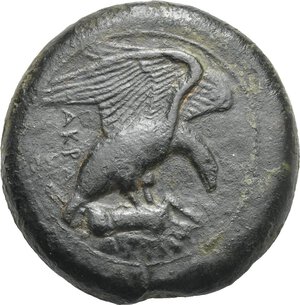
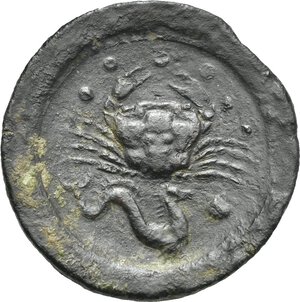
Sicily. Akragas. Circa 415-406 BC. Hemilitron (Bronze, 31.58 mm, 20.53 g). AKPA, Eagle standing right, wings spread and head lowered, clutching dead hare held in its talons; border of dots. Rev. Crab; above, six pellets (mark of value); below, hippocamp right and scallop shell in front; all within shallow incuse circle. Westermark, Akragas Period III, Series 5, 780.4 (4.O3/5.R6, this coin). SNG ANS 1024 (same dies). Buceti 81 (same dies). Calciati CNS I, 169, 18 (same reverse die). Cf. HGC 2, 136. Dark brown patina. Some deposits, otherwise, Near Extremely Fine. Very Rare variety.
Ex Asta Internazionale del Titano/Aes Rude 69, 8 June 1997, lot 31; Lanz 78, 25 November 1996, lot 112.
Lot # 32
-
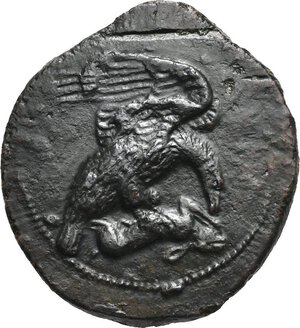
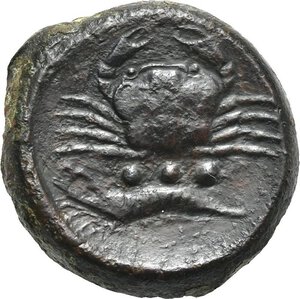
Sicily. Akragas. Circa 415-406 BC. Tetras or Trionkion (Bronze, 23.95 mm, 11.78 g). [AKPA], Eagle standing right, wings spread and head lowered, clutching a dead hare in its talons; dotted border. Rev. Crab with open claws; below, three pellets (mark of value) and shrimp swimming to left; all within shallow incuse circle. Westermark, Akragas Period III, Series D, 850 (O29/R43, same dies). Calciati, CNS I, 182, 54/17 (same dies). SNG ANS 1040 (same dies). SNG Agrigento 128 (same dies). Cf. Buceti 116. Cf. HGC 2, 140. Glossy dark brown patina. Slightly smoothed, otherwise, Extremely Fine. Very Rare variety.
Ex Artemide 7 September 2006, lot 47.
Lot # 33
-
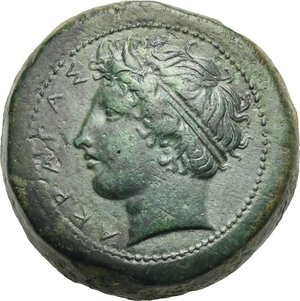
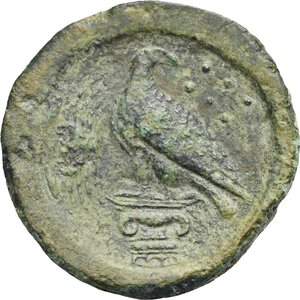
Sicily. Akragas. Circa 400-380 BC. Hemilitron (Bronze, 27.18 mm, 16.96 g). ΑΚΡΑΓΑΣ, Diademed and horned head of young river-god Akragas left; border of dots. Rev. Eagle standing left on Ionic capital, with closed wings and head turned back; in left field, crab; in right field, six pellets (mark of value); all within shallow incuse circle. U. Westermark, “The Fifth century bronze coinage of Akragas” AIIN Suppl. 25 (1979), pl. IV, 8 (same dies). Calciati CNS I, 194, 89 (same dies). SNG ANS 1097-1101 (same dies). SNG Copenhagen 93 (same dies). SNG München 160 (same dies). SNG Morcom 534 (same dies). Buceti 166 (same dies). HGC 2, 139 (same dies). Wonderful portrait with olive-green patina. Weakly struck on reverse. Extremely Fine/Very Fine.
Ex Nomisma 10, 6 December 1997, lot 33.
Lot # 34
-
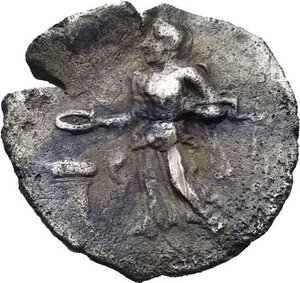
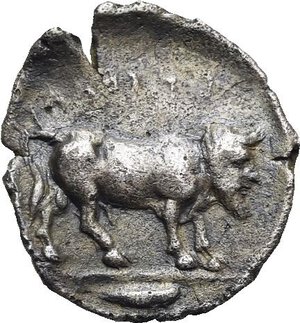
Sicily. Entella. Circa 440-430 BC. (Silver, 13.26 mm, 0.77 g). Female figure of nymph standing left, holding phiale over altar and with filleted temple key in arm. Rev. EИTEΛΛ (retrograde, partially visible), Man-headed bull standing right; in exergue, fish swimming right. R. Ross Holloway, "Le monetazioni di Agyrion, Aluntion, Entella, Hipana, Nakone, Stiela," AIIN Suppl. 20 (1975), p. 148 and pl. XX, 6 (same dies). Campana CNAI II, 180, 1a = Winterthur 628 (same dies). BMC Sicily 60, 1 (same dies). SNG ANS 1339 var. (same obverse die). McClean 2228 (same dies). Buceti 1a (same dies). HGC 2, 235 (same). Toned. Split on edge. Very Fine. Rare.
Ex Triton III, 30 November 1999, lot 165.
Lot # 35
-
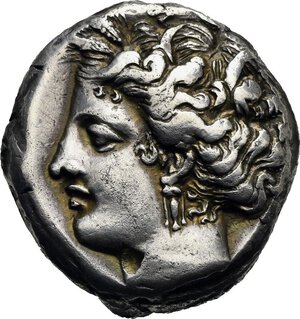
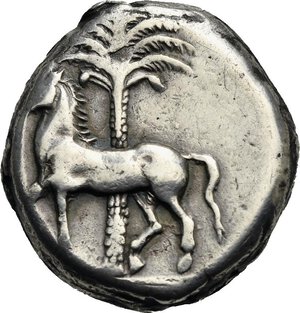
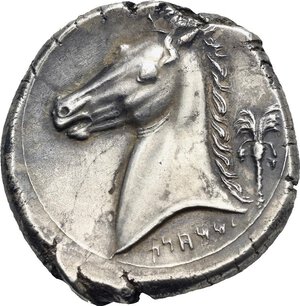
Sicily. Entella? (as “People of the Camp”). Siculo-Punic Coinage, circa 350-320 BC. Tetradrachm (Silver, 24.24 mm, 16.58 g). Wreathed female head (Tanit-Persephone) left, wearing triple pendant earring and necklace; behind, off-flan, “QRTḤDŠT” ("Carthage" in Punic). Rev. Horse stepping left on double exergual line; palm tree in the background; linear circular border. Jenkins, SNR 56 (1977), p. 37, 49.2 (this coin mentioned but with a weight of 16.70 g) and pl. 1, 49 (O13/R43, same dies). Viola CNP 207 a (same dies). SNG Copenhagen 971 (same dies). SNG Lloyd 1627 (same dies). SNG Lockett 1048 (same dies). Jameson 912 (same dies). Buceti 23 (same dies). Cf. HGC 2, 267. Lightly toned on compact flan. Slightly off-centred reverse. Otherwise, Good Very Fine.
Ex Jesus Vico 159, 20 July 2021, lot 368.
From the Guadan Collection n.1728. The location of the main Carthaginian mint in Sicily identified by Punic inscription as "People of the Camp" has long been a matter of conjecture and dispute. Recent researches suggest the "People of the Camp" mint to have been Entella, a fortress-like city located in central-west Sicily. The Siculo-Punic coinage of Entella seems to have been intended mainly to pay mercenary soldiers who were used to being paid in Greek coin, as the silver tetradrachms adhere closely to the Attic weight standard.
Lot # 36
-
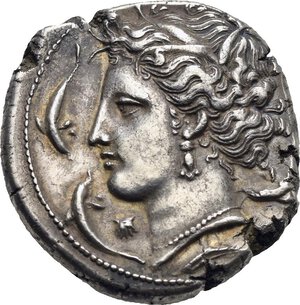
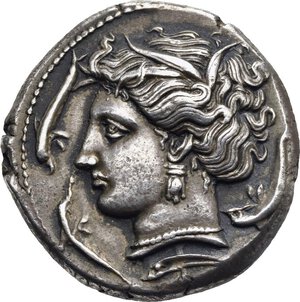
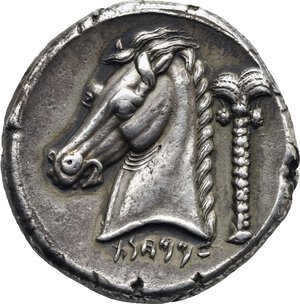
Sicily. Entella? (as “People of the Camp”). Siculo-Punic Coinage, circa 320-300 BC. Tetradrachm (Silver, 26.25 mm, 16.51 g). Wreathed female head (Tanit-Arethusa) left, wearing triple pendant earring and pearl necklace; below the chin, scallop shell; four dolphins swimming around; border of dots. Rev. ''MMHNT'' ("People of the Camp" in Punic), Horse's head left; behind, palm tree; linear circular border. Jenkins, SNR 56 (1977), pl. 11, 163 (O49/R132, same dies). Viola CNP 267 a (same dies). SNG Aberdeen 99 (same dies). SNG Lockett 1051 (same dies). SNG Ashmolean 2159 (same dies). SNG Copenhagen Africa, 85 (same dies). Rizzo pl. LXVI, 4 (same dies). Gulbenkian 371 (same dies). Buceti 46 (same dies). Cf. HGC 2, 284. Toned, slightly iridescent. Beautiful portrait in the style of Euainetos. Extremely fine. Rare variety.
Ex Astarte XVII, 8 May 2005, lot 124.
The beautiful obverse die almost exactly reproduces a decadrachm die of Euainetos used at Syracuse, down to the scallop shell before Arethusa's neck. It is considered one of the finest dies of this extensive series.
Lot # 37
-
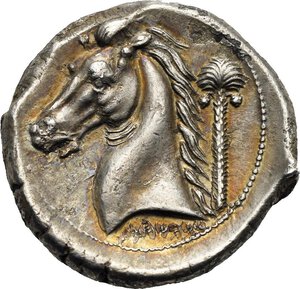
Sicily. Entella? (as “People of the Camp”). Siculo-Punic Coinage, circa 320-300 BC. Tetradrachm (Silver, 26.44 mm, 16.97 g). Wreathed female head (Tanit-Arethusa) left, wearing triple pendant earring and pearl necklace; four dolphins swimming around; border of dots. Rev. ''MMHNT'' ("People of the Camp" in Punic), Horse's head left; behind, palm tree; linear circular border. Jenkins, SNR 56 (1977), pl. 14, 189.5 (O55/R166, this coin illustrated). Viola CNP 267 = Buceti 50 (same dies). SNG Lloyd 1638 (same dies). SNG Fitzwilliam 1482 (same dies). Jameson 2438 (same dies). MFA Boston 496 (same dies). Cf. HGC 2, 284. Beautiful old cabinet tone. Well centered with sharp details and with a wonderful portrait. Extremely fine.
Ex Numismatica Ars Classica 96, 6 October 2016, lot 1038; Heritage sale 3042, 17 September 2015, lot 29026; Leu Numismatik 59, 17 May 1994, lot 79; Hess-Leu 31, 6 December 1966, lot 178; Florange-Ciani sale 1925, lot 414.
Lot # 38
-
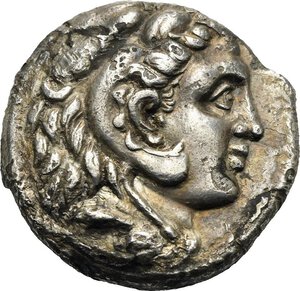
Sicily. Entella? (as “People of the Camp”). Siculo-Punic Coinage, circa 300-289 BC. Tetradrachm (Silver, 26.32 mm, 16.18 g). Head of young Herakles/Melqart right, wearing lion skin headdress; border of dots. Rev. ''MHMHNT'' ("People of the Camp" in Punic), Horse's head left; behind, palm tree; border of dots. Jenkins, SNR 57 (1978), pl. 5, 317 (O101/R261 same dies). Viola CNP 271 (same dies). SNG Copenhagen Africa 89 (same dies). SNG Lloyd 1642 (same dies). De Luynes 1449 (same dies). Buceti 89 (same dies). Cf. HGC 2, 293. Attractively toned, with wonderful iridescence on the reverse. An impressive coin, well centred, struck from fresh dies of the finest style. Near Extremely Fine.
Purchased from Astarte 18 December 2002.
The Punic inscription on this coin names "the People of the Camp" leaves no doubt about its use to pay the numerous foreign (primarily Italic) mercenaries that swelled the armies of Carthage during its conflict with the Greek cities for dominance on Sicily. "People of the Camp" issues are usually attributed to Entella.
Lot # 39
-
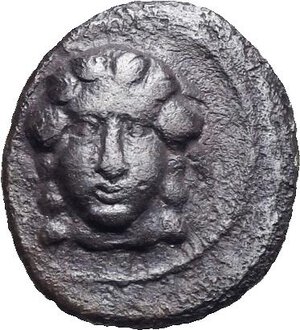
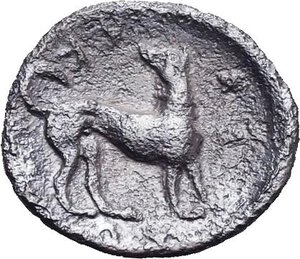
Sicily. Eryx. Circa 450-440 BC. Litra (Silver, 11.74 mm, 0.70 g). Facing head of Aphrodite. Rev. ER - YK - IN - ON (retrograde), Hunting dog standing right, looking back. Campana, CNAI II, 230, 4A (same dies). SNG ANS 1342-1343 (same dies). BMC Sicily 62, 4-5 (same dies). Rizzo, pl. LXIV, 6 (same dies). Jameson 570 (same dies). Buceti 5 (same dies). HGC 2, 297 (same dies). Heavily toned. Very Fine. Very Rare.
Ex Astarte VI, 10 November 2000, lot 104.
Lot # 40
-
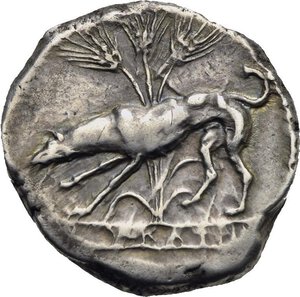
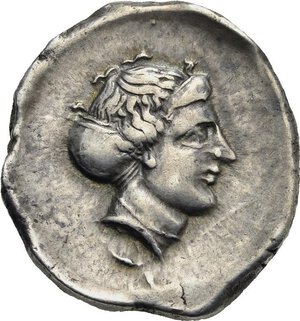
Sicily. Eryx. Circa 412-400 BC. Didrachm (Silver, 22.03 mm, 8.10 g). [IRV]KAZIB (within oblong frame), Hound scenting left; three stalks of barley in the background. Rev. Female head of nymph right, wearing earring and necklace, hair in ampyx and sphendone. Campana, CNAI II, 239, 23 (same dies). SNG Lloyd 1183 (Segesta, same dies). Rizzo pl. LXIV, 9 (same dies). Hurter pl. 17, 195 (same obverse die, but on the right and with the legend ΣEΓΕΣTΑΖΙΒ). Viola, CNP 482 var. (hound right). Jenkins, SNR 50 (1971), pl. 24, 23 (same reverse die). HGC 2, 308 (same reverse die). Toned with beautiful iridescent patina. Near Extremely Fine. Extremely Rare, very few specimens known.
Ex Gorny & Mosch 215, 14 October 2013, lot 682.
From the 5th century BC until the First Punic War the Elymian city of Eryx along with its ally Segesta remained under Carthaginian rule, except for a brief interlude in 398 BC when Eryx was conquered by Dionysios I. When the disputes between Segesta and Selinos intensified around 420 BC, the two Elymian cities minted considerable quantities of didrachms with the same types to pay the mercenaries who regularly formed the armies of the ancient Sicilian cities. On several occasions, the coins of both cities bear the hand of the same engravers. Segesta's production of these didrachms was far greater than that of Eryx. An example of the collaboration between engravers can be seen in Hurter's table 17, no. 195, where the dog is plastically identical in appearance to our coin, except that it faces right and has a different legend.
Lot # 41
-
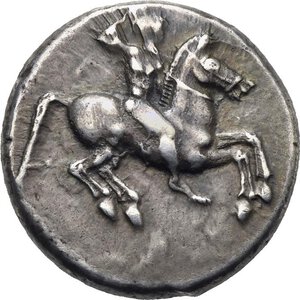
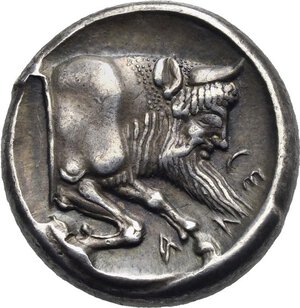
Sicily. Gela. Circa 490-475 BC. Didrachm (Silver, 19.88 mm, 8.71 g). Naked warrior on horseback right, holding spear and reins. Rev. CΕ - Λ - Α, Forepart of a man-headed bull right. Jenkins Gela, Group Ib, 14 (this dies). SNG ANS 4. SNG Lloyd 956. Buceti 8. HGC 2, 362. Lovely old cabinet tone with iridescence. Typical die break on reverse. Near Extremely Fine. Rare.
Ex Italo Vecchi 5, 5 March 1997, lot 99.
Lot # 42
-
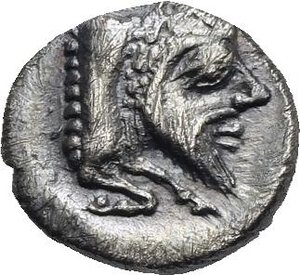
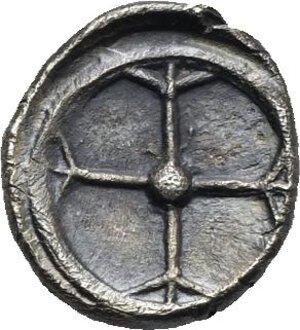
Sicily. Gela. Circa 480-470 BC. Obol (Silver, 9.25 mm, 0.64 g). Forepart of bearded man-headed bull right. Rev. Wheel of four spokes. Jenkins Gela, Group II, 189-198. SNG ANS 40-41. SNG Copenhagen 259. SNG München 277. Buceti 17 (litra). HGC 2, 372. Attractively toned with light iridescence. Good Very Fine.
Lot # 43
-
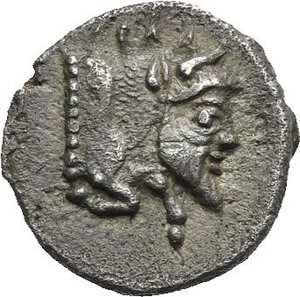
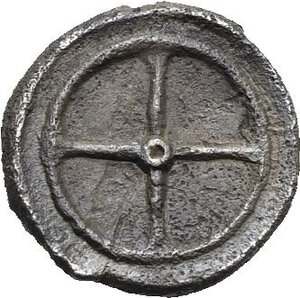
Sicily. Gela. Circa 480-470 BC. Obol (Silver, 9.52 mm, 0.68 g). CΕΛΑ, Forepart of bearded man-headed bull right. Rev. Wheel of four spokes. Jenkins Gela, Group II, 192 (these dies). SNG Copenhagen 259 (these dies). SNG ANS 40-41. SNG München 277. Buceti 17 (litra). HGC 2, 372. Old grey tone and well centred. Slightly porous. Good Very Fine.
Ex Gorny & Mosch 81, 3 March 1997, lot 110.
Lot # 44
-
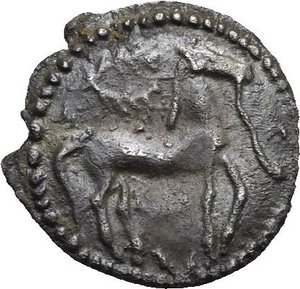
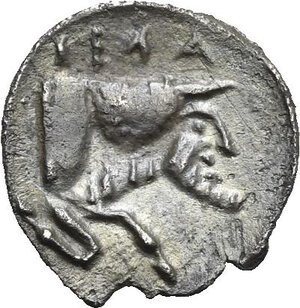
Sicily. Gela. Circa 465-450 BC. Litra (Silver, 11.54 mm, 0.61 g). Horse advancing right, on a loose bridle; above, wreath. Rev. CΕΛΑ, Forepart of a man-headed bull right. Jenkins Gela, Group III, 275 (these dies). SNG Lloyd 976 (these dies). SNG ANS 54-60. SNG Copenhagen 272. SNG München 284. Buceti 30. HGC 2, 373. Attractive iridescent tone. Good Very Fine. Rare variety.
Ex Jean Elsen 51, 13 September 1997, lot 125; Numismatica Ars Classica auction E, 4 April 1995, lot 2159.
Lot # 45
-
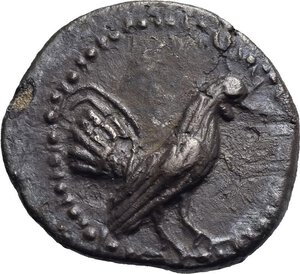
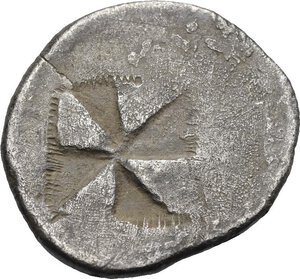
Sicily. Himera. Circa 550-515 BC. Drachm (Silver, 22.60 mm, 5.35 g). Rooster standing right; border of dots. Rev. Incuse square with a mill sail pattern of raised and sunken triangles; within segmented linear border. Kraay Himera, Group II, 42 (O31/R27, same dies). Cf. SNG ANS 137-138. Cf. SNG Lloyd 1003. Cf. Buceti 4. Cf. HGC 2, 420. Attractive old cabinet tone with some light iridescence. Some small metal lack, otherwise, Good Very Fine. Rare variant.
Ex Numismatica Ars Classica auction E, 4 April 1995, lot 2163.
Lot # 46
-
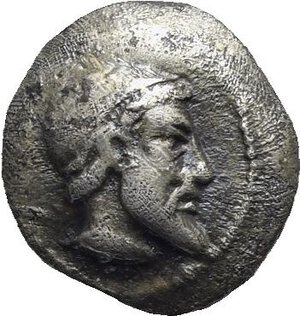
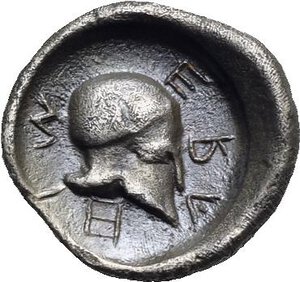
Sicily. Himera. Circa 470-450 BC. Litra (Silver, 10.68 mm, 0.70 g). Bearded and diademed male head right; border of dots. Rev. H-I-M – E-RA (retrograde), Corinthian helmet right; within shallow incuse circle. SNG Lloyd 1028 (same dies). SNG Copenhagen 312 (same dies). SNG München 355 (same dies). Dewing 618 (same dies). Rizzo pl. 21, 13 (same dies). Buceti 27a (same dies). HGC 2, 447. (same dies). Attractively toned with light blue iridescence. Very Fine/Extremely Fine. Rare.
Ex G. Hirsch 195, 5 May 1997, lot 54.
Lot # 47
-
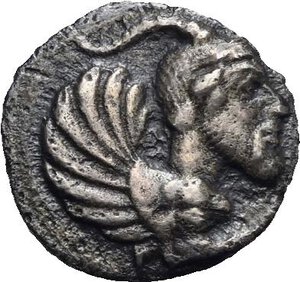
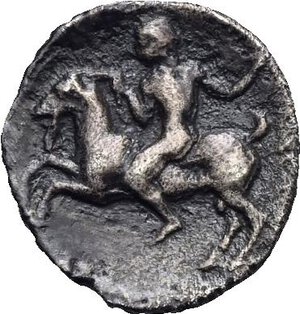
Sicily. Himera. Circa 470-450 BC. Litra (Silver, 11.27 mm, 0.73 g). Forepart of a human-headed monster right, bearded, with goat's horns, curled wings and a lion's paw; border of dots. Rev. [IM–EP-A–ION], Nude youth riding a goat left, holding whip and the goat's horn; within shallow incuse circle. SNG ANS 174 (same dies). SNG Copenhagen 310 (same dies). SNG Lloyd 1026 (same dies). SNG Ashmolean 1768 (same dies). SNG München 354 (same dies). Buceti 32 (same dies). HGC 2, 450 (same dies). Deep cabinet tone. Good Very Fine. Scarce.
Ex F. Sternberg XXXI, 28 October 1996, lot 475.
Lot # 48
-
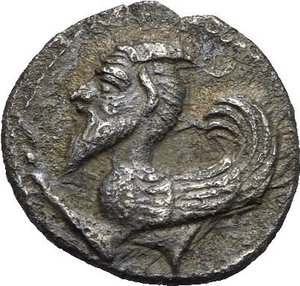
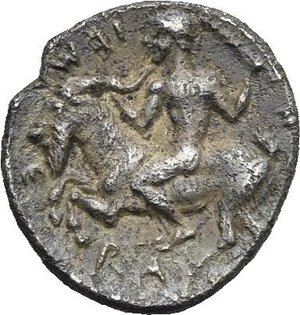
Sicily. Himera. Circa 470-450 BC. Litra (Silver, 11.75 mm, 0.81 g). Forepart of a human-headed monster left, bearded, with goat's horns, curled wings and a lion's paw; border of dots. Rev. IEM - E - PA – [ION], Nude youth riding a goat left, holding whip and the goat's horn; within shallow incuse circle. BMC Sicily 80, 41 (same dies). SNG ANS 172-173 (same dies). SNG Copenhagen 309 (same dies). SNG Ashmolean 1767 (same dies). SNG Lockett 788 (same dies). SNG München 353 (same dies). HGC 2, 451 (same dies). Cf. Buceti 31. Nicely toned with light iridescence. Very Fine. Rare.
Ex Dr. Busso Peus Nachfolger 349, 30 October 1996, lot 39.As for the error in the legend (IEMEPAION), see auctions CNG el. 249/2011, lot 15; el. 327/2014, lot 419; obolos 16/2020, lot 580.
Lot # 49
-
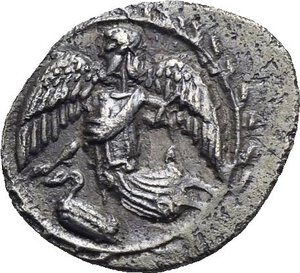
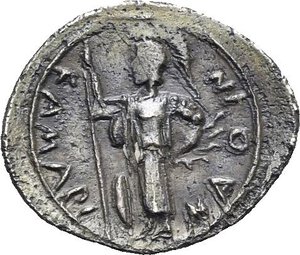
Sicily. Kamarina. Circa 461-435 BC. Litra (Silver, 13.63 mm, 0.73 g). Nike flying left; below, swan standing left; all within wreath. Rev. KAMARI – NAOIN (retrograde), Helmeted Athena standing left, wearing aegis and holding spear; left at her feet, shield; all within linear circular border. Westermark & Jenkins, Period 2, Series 2C, 37 (O14/R18, same dies). SNG ANS 1213 (same dies). BMC Sicily 33, 5 (same dies). McClean 2151 (same dies). Buceti 2C (same dies). HGC 2, 535 var. (legend). Old cabinet tone. Near Extremely Fine. Scarce.
Ex Nomisma 9, 17 May 1997, lot 127.
Lot # 50
-
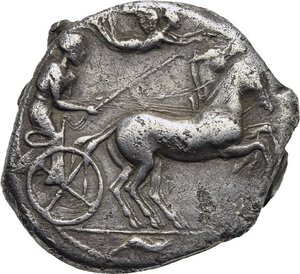
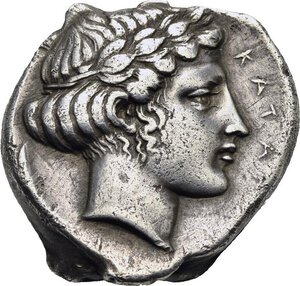
Sicily. Katane. Circa 435-412 BC. Tetradrachm (Silver, 25.96 mm, 16.64 g). Charioteer, wearing long chiton, holding kentron and reins, driving fast quadriga of horses right; above, Nike flying right, crowning horses with wreath held in both hands; in exergue, crayfish. Rev. KATA[NAI – ON], Laureate head of Apollo right; behind neck, fish. AMB 330 (this coin illustrated). Rizzo pl. XI, 17 and XIII, 3 = Boehringer pl. 31, A9 (same dies). Gulbenkian 186 (same dies). McClean 2175 (same dies). Collection C. C. 59 = Buceti 41 (same dies). SNG ANS -. HGC 2 -. A detailed and beautiful portrait, with a pleasant old cabinet toning. Some small scratches. Very Fine/Extremely Fine. Extremely Rare.
Ex Numismatica Ars Classica 13, 8 October 1998, lot 330, formerly exhibited at the Antikenmuseum Basel (from the Athos and Dina Moretti Collection); Jacob Hirsch XIX, 11 November 1907, lot 121 (from the Pennisi collection).
Lot # 51
-
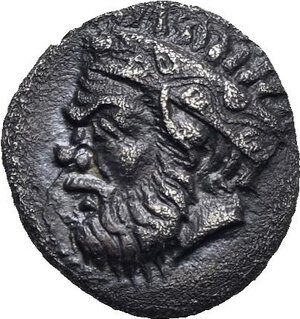
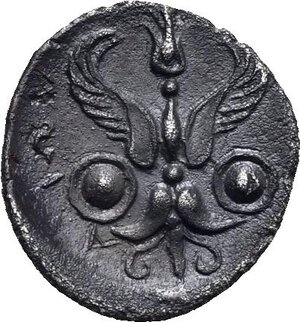
Sicily. Katane. Circa 415-405 BC. Litra (Silver, 12.09 mm, 0.88 g). Bearded head of Silenos left, hair in wide band decorated with ivy wreath; border of dots. Rev. [KATAN] – A – IΩN, Winged thunderbolt; two shields flanking; all within shallow circular incuse. C. Boehringer, "Kataneische Probleme: Silberne Kleinstmünzen," Proceedings of the 9th International Congress of Numismatics (1982), p. 74 and pl. 6, Li 7 (same dies). Rizzo pl. XIV, 20 (same dies). SNG Lloyd 913 (same dies). SNG Lockett 735 (same dies). SNG Copenhagen 183 (same dies). SNG ANS –. Cf. HGC 2, 590. Deep cabinet tone, with centred portrait of Silenos. Roughness, otherwise, Extremely Fine. Very Rare.
Ex Sternberg XXXI, 28 October 1996, lot 541; Münzen und Medaillen Price list 571, January 1994, lot 6.
Lot # 52
-
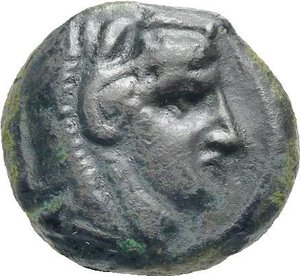
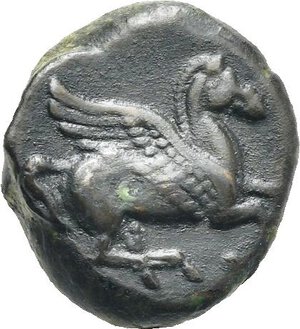
Sicily. Kephaloidion. Circa 339-307 BC. Onkia? (Bronze, 12.95 mm, 2.32 g). Head of young Herakles right, wearing lion's skin headdress; within linear circular border. Rev. Pegasos flying right; below, one dot. Cf. G.K. Jenkins, "Enna, Galaria, Piakos, Imachara, Kephaloidion, Longane," AIIN Suppl. 20 (1975), p. 99, 6 and pl. X, 6. Cf. SNG ANS appendix 1320. Cf. SNG München 526. Calciati CNS I, 371, 3 (same dies). Campana, CNAI II, 329, 6a (this coin illustrated, but in reality it belongs to group b, since there is one dot below the Pegasos). Laffaille 168 = Buceti 6B (this coin illustrated). Cf. HGC 2, 653. Dark brown patina slightly smoothed, otherwise, Near Extremely Fine. Very Rare Variety.
Ex Leu Numismatik Web auction 3, 25 February 2018, lot 87; Hess-Divo 307, 7 June 2007, lot 1058; Münzen und Medaillen 76, 19 September 1991, lot 168. From the P. Arnaud and the M. Laffaille Collections.
Lot # 53
-
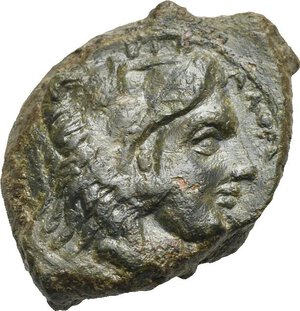
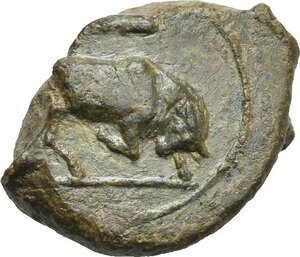
Sicily. Kephaloidion. Circa 307-289 BC. Bronze (Bronze, 20.85 mm, 6.07 g). Κ Ε Φ – ΑΛΟΙΔΙ, Head of young Herakles right, wearing lion's skin headdress; within linear circular border. Rev. Bull butting right, head lowered; above, club; within linear circular border. G.K. Jenkins, "Enna, Galaria, Piakos, Imachara, Kephaloidion, Longane," AIIN Suppl. 20 (1975), p. 99, 4 and pl. IX, 4 (same dies). Calciati CNS I, 371, 1 (same dies). Campana, CNAI II, 328, 4b (same dies). Buceti 4A (same dies). HGC 2, 649 (same dies). Green-brown patina on irregular flan, slightly oblong. Small scratch on beautiful portrait on obverse. Good Very Fine. Rare.
Ex Astarte-Young Collectors Web auction 2, 3 March 2024, lot 22.
Lot # 54
-
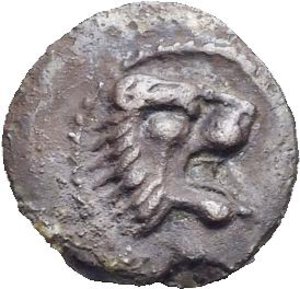
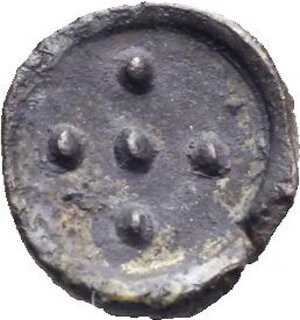
Sicily. Leontinoi. Circa 476-466 BC. Pentonkion (Silver, 7.92 mm, 0.27 g). Head of roaring lion right with protruding tongue; border of dots. Rev. Five pellets (mark of value); within shallow circular incuse. C. Boehringer, Leontinoi, pl. 10, 17 = Winterthur 714 (same dies). E. Cammarata, “Da Dionisio a Timoleonte. Problemi di numismatica della Sicilia antica”, 1984, pl. I/B, 25 (same dies). SNG Lloyd 1051 (same dies). McClean 2334 (same dies). Buceti 12 (same dies). HGC 2, 700 (same dies). SNG ANS -. SNG München -. Old cabinet dark toning. Ancient bump on the edge, otherwise, Extremely Fine. Very Rare.
Ex F. Sternberg XXXI, 28 October 1996, lot 571.
Lot # 55
-
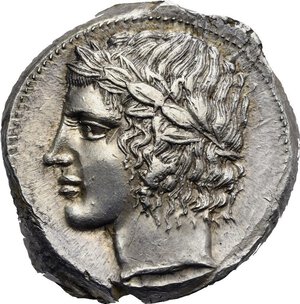
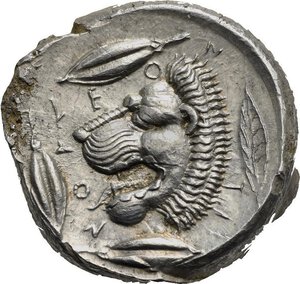
Sicily. Leontinoi. Circa 430-425 BC. Tetradrachm (Silver, 26.76 mm, 17.59 g). Laureate head of Apollo left, wearing curly flowing hair. Rev. LEO - N - TI – NON, Head of roaring lion left and protruding tongue; behind, laurel leaf; around, three barley grains. C. Boehringer, Leontinoi, pl. 12, 55 (same dies). SNG ANS 256-257 (same dies). SNG Lloyd 1063 (same dies). SNG München 559 (same dies). Rizzo pl. XXIV, 4 (same dies). AMB 353 (same dies). Buceti 32 (same dies). HGC 2, 671 (same dies). Usual die break on obverse. Beautiful iridescent tone; a spectacular coin. Virtually as struck. Rare.
Engraved by a master in a refined Classic style, identified by Rizzo as, the "Master of the Leaf " (Maestro della foglia ), because of his use of leaves as a form of signature. He was an exceptionally talented and skilled master-engraver.
Lot # 56
-
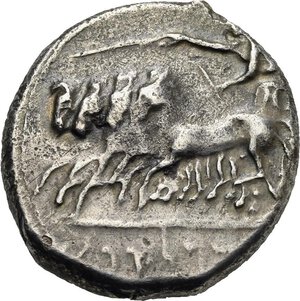
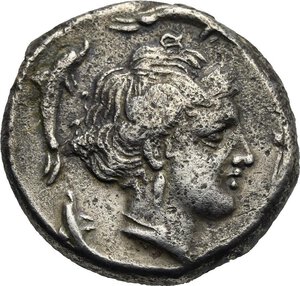
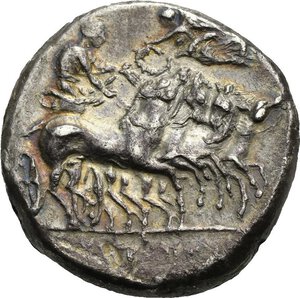
Sicily. Lilybaion (as Cape of Melqart). Siculo-Punic Coinage, circa 330-305 BC. Tetradrachm (Silver, 24.58 mm, 16.60 g). Charioteer driving quadriga galloping left, holding kentron and reins; in exergue, RŠMLQRT ("Raš Melqart" in Punic); border of dots. Rev. Female head (Tanit-Arethusa) right, hair bound in ampyx, wearing single-drop earring; around, five dolphins. Jenkins, SNR 50 (1971), pl. 15, 4 (O3/R3, same dies). Viola CNP 296 (same dies). SNG ANS -. SNG Copenhagen -. SNG Lloyd -. Cf. HGC 2, 730. Lightly toned. Coin with oxidation removed on reverse. Very Fine. Extremely Rare (Jenkins quotes only one piece and with uncertain sale catalogue).
Ex Cayon 422A, 20 November 2024, lot 5556.
After the destruction of Motya by the Syracusan tyrant Dionysios I, the Carthaginians relocated the surviving population to a new, well-defended fortress in the western corner of Sicily. The Greeks called the city Lilybaion, while the Carthaginians called it "Ras Melqart" (Cape of Melqart). The new port town would become a thriving trade hub and the most important military base in Sicily. The strong new walls that were built to defend the city were able to fend off both Pyrrhos of Epiros and the Romans. It was the last bastion of Punic rule in Sicily during Pyrrhos' conquest of the island, beating back his attempts to take the city before his campaign unraveled entirely. The Romans placed the city under a nine-year siege with numerous assaults during the First Punic War, but they were never able to capture the city and only gained control of it after Carthage's surrender at the end of the war. The tetradrachms that are purportedly from Lilybaion were all struck in the later half of the fourth century BC., and exhibit a strong imitative affinity with Syracuse styles from the same period, usually depicting a quadriga with a charioteer on the obverse and a female head with dolphins on the reverse.
Lot # 57
-
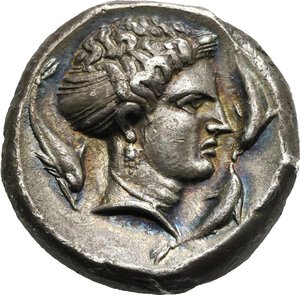
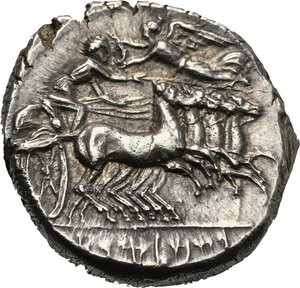
Sicily. Lilybaion (as Cape of Melqart). Siculo-Punic Coinage, circa 330-305 BC. Tetradrachm (Silver, 25.29 mm, 16.75 g). Charioteer driving quadriga galloping right with rearing horses, holding reins in her hand; above, Nike flying left gives wreath to the charioteer; in exergue, RŠMLQRT ("Raš Melqart" in Punic). Rev. Female head (Tanit-Arethusa) right, hair bound in ampyx and sphendone, wearing triple pendant earring and necklace; around, three dolphins. Jenkins, SNR 50 (1971), pl. 15, 6 (O5/R5) = SNG ANS 721 (same dies). SNG Lloyd 1598 var. = HGC 2, 731 var. (hair on reverse). De Luynes 922 var. (hair on reverse). Viola CNP 315 (same reverse die). Light iridescent tone. Extremely fine. Extremely Rare, known in very few specimens.
Ex Numismatica Ars Classica 138, 18 May 2023, lot 113.
From an Exceptional Collection assembled between the early 70s and late 90s.
Lot # 58
-
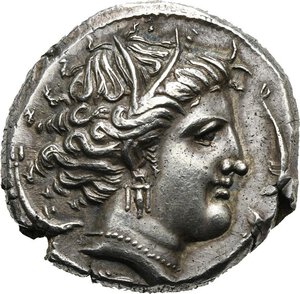
Sicily. Lilybaion (as Cape of Melqart). Siculo-Punic Coinage, circa 330-305 BC. Tetradrachm (Silver, 26.13 mm, 17.26 g). Charioteer driving quadriga galloping right, holding kentron and reins; above, Nike flying left, crowning him; in exergue, RŠMLQRT ("Raš Melqart" in Punic); border of dots. Rev. Wreathed female head (Tanit-Arethusa) right, wearing triple pendant earring and necklace; four dolphins swimming around; border of dots. Jenkins, SNR 50 (1971), pl. 18, 46 (O16/R35, same dies). Viola CNP 310 (same dies). SNG ANS 731 (same dies). SNG Copenhagen 227 (same dies). SNG Lloyd 1600 (same dies). SNG München 1591 (same dies). HGC 2, 741 (same dies). Beautiful struck, with light iridescent tone and well centred on a full flan. Extremely fine.
Ex Numismatica Ars Classica 54, 24 March 2010, lot 66.
Lot # 59
-
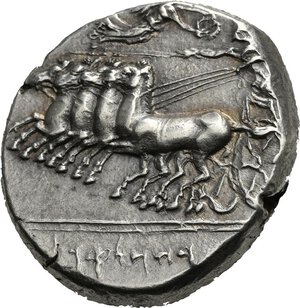
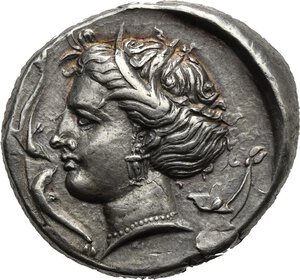
Sicily. Lilybaion (as Cape of Melqart). Siculo-Punic Coinage, circa 330-305 BC. Tetradrachm (Silver, 26.02 mm, 17.14 g). Charioteer driving quadriga galloping left, holding kentron and reins; above, Nike flying right, crowning him; in exergue, RŠMLQRT ("Raš Melqart" in Punic); border of dots. Rev. Wreathed female head (Tanit-Arethusa) left, wearing triple pendant earring and pearl necklace; three dolphins swimming around. Jenkins, SNR 50 (1971), pl. 19, 55 (O19/R42) = SNG Lockett 742 = HGC 2, 744 (same dies). Viola CNP 327 (same dies). Dewing 975 (same dies). SNG ANS -. SNG Lloyd -. SNG München -. Well struck, of particularly fine style, nicely iridescent toning. Slightly double struck on reverse, otherwise, Extremely Fine. Rare.
Ex Sincona 10, 27 May 2013, lot 46.
Lot # 60
-
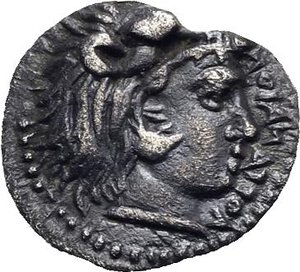
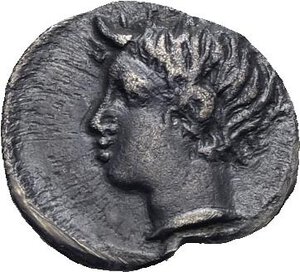
Sicily. Longane. Circa 424-415 BC. Litra. (Silver, 10.40 mm, 0.68 g). ΛOΓΓANAION (retrograde), Head of young Herakles right, wearing lion's skin headdress; border of dots. Rev. Head of young river-god Longanos left, with short hair and small horn; all within a shallow circular incuse. G.K. Jenkins, "Enna, Galaria, Piakos, Imachara, Kephaloidion, Longane," AIIN Suppl. 20 (1975), p. 101, reverse style A and pl. XI, a-d (same dies). SNG ANS 286 = Jameson 637 (same). BMC Sicily 96, 1 (same dies). Campana CNAI I, 156, 1 (same dies). De Luynes 1005 (same dies). Rizzo pl. LIX, 23 (same dies). Buceti 1 = HGC 2, 755 (same dies). Old cabinet tone with iridescence. Good Very Fine. Very Rare.
Ex Numismatica Ars Classica 18, 29 March 2000, lot 100.
Caricamento altri risultati...