Banner Artemide eLive Auktion 43
Risultati: 49
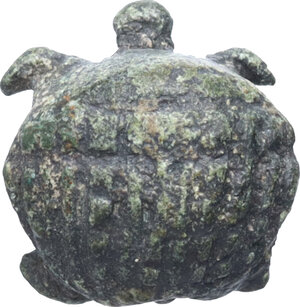
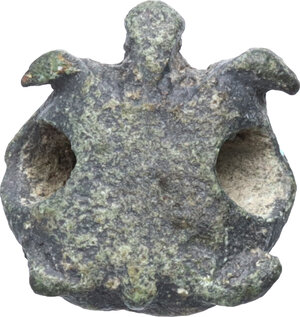
NEAR EASTERN BRONZE TORTOISE WEIGHT Iron Age, circa 1200–600 BC. (?) Small cast bronze weight in the form of a stylized tortoise, with domed shell and linear decoration. The underside features two circular recesses, likely intended for calibration. Zoomorphic weights of this type are characteristic of Near Eastern metrological systems of the Iron Age and were used in commercial transactions across the Levant and Mesopotamia. Diameter: 9.5 mm. Weight: 1.22 g - NEAR EASTERN BRONZE TORTOISE WEIGHT Iron Age, circa 1200–600 BC. (?) Small cast bronze weight in the form of a stylized tortoise, with domed shell and linear decoration. The underside features two circular recesses, likely intended for calibration. Zoomorphic weights of this type are characteristic of Near Eastern metrological systems of the Iron Age and were used in commercial transactions across the Levant and Mesopotamia. Diameter: 9.5 mm. Weight: 1.22 g.
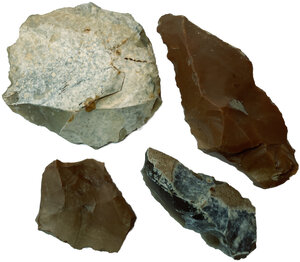
NEOLITHIC FLINT WORKING GROUP Neolithic period. Lot of four (4) flint artefacts including one core and three struck flakes/blades, showing characteristic conchoidal fracture and knapping features. The pieces represent by-products and elements of lithic tool production rather than finished implements. 65.5 × 60 mm (largest) - NEOLITHIC FLINT WORKING GROUP Neolithic period. Lot of four (4) flint artefacts including one core and three struck flakes/blades, showing characteristic conchoidal fracture and knapping features. The pieces represent by-products and elements of lithic tool production rather than finished implements. 65.5 × 60 mm (largest). 55.69 g.
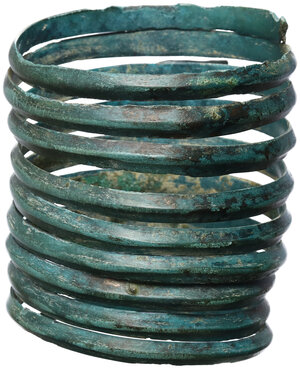
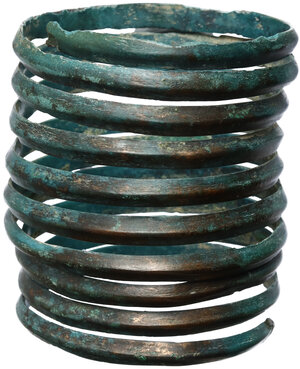
BRONZE SPIRAL BRACELET Late Bronze Age, Urnfield Culture, 10th–8th century BC. Formed from a single bronze rod coiled into a multi-turn spiral, with a gently raised central ridge running along the band. Bracelets of this type are characteristic ornaments of the Urnfield cultural horizon, worn around the wrist or forearm. A well-preserved example with an even spiral form and an attractive green patina. Inner diameter: 51 mm. Length (overall): 69 mm. Weight: 91.90 g - BRONZE SPIRAL BRACELET Late Bronze Age, Urnfield Culture, 10th–8th century BC. Formed from a single bronze rod coiled into a multi-turn spiral, with a gently raised central ridge running along the band. Bracelets of this type are characteristic ornaments of the Urnfield cultural horizon, worn around the wrist or forearm. A well-preserved example with an even spiral form and an attractive green patina. Inner diameter: 51 mm. Length (overall): 69 mm. Weight: 91.90 g. Lovely green patina.
BRONZE DRESS PIN WITH TWISTED SHAFT Late Bronze Age, Urnfield Culture, 9th–7th century BC. Cast bronze dress pin with a large hemispherical knob head and a long shaft, partly twisted to create a pronounced spiral effect. The lower section remains plain and tapers to a point. Pins of this type were used as dress fasteners and are characteristic of the Urnfield cultural horizon of Late Bronze Age Europe. A well-preserved example with clearly defined spiral decoration and an attractive dark patina. Length: 141 mm. Weight: 18.33 g - BRONZE DRESS PIN WITH TWISTED SHAFT Late Bronze Age, Urnfield Culture, 9th–7th century BC. Cast bronze dress pin with a large hemispherical knob head and a long shaft, partly twisted to create a pronounced spiral effect. The lower section remains plain and tapers to a point. Pins of this type were used as dress fasteners and are characteristic of the Urnfield cultural horizon of Late Bronze Age Europe. A well-preserved example with clearly defined spiral decoration and an attractive dark patina. Length: 141 mm. Weight: 18.33 g.
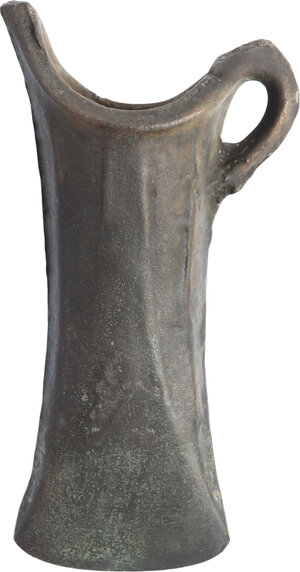
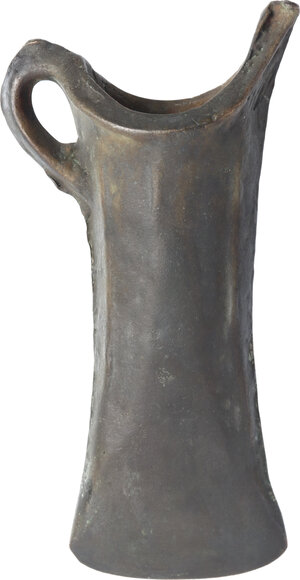
BRONZE SOCKETED AXE HEAD Late Bronze Age, Urnfield Culture, 10th–8th century BC. Cast bronze socketed axe head with a slightly flaring blade and a lateral loop for securing the haft. The body is elongated and gently curved, with a smooth surface and subtle casting seams visible. Axes of this type are characteristic of the Urnfield cultural horizon and were widely used across central Europe during the Late Bronze Age, both as tools and, in some cases, as items of exchange. The surface shows an even dark patina with minor wear. Length: 99 mm. Weight: 169.29 g - BRONZE SOCKETED AXE HEAD Late Bronze Age, Urnfield Culture, 10th–8th century BC. Cast bronze socketed axe head with a slightly flaring blade and a lateral loop for securing the haft. The body is elongated and gently curved, with a smooth surface and subtle casting seams visible. Axes of this type are characteristic of the Urnfield cultural horizon and were widely used across central Europe during the Late Bronze Age, both as tools and, in some cases, as items of exchange. The surface shows an even dark patina with minor wear. Length: 99 mm. Weight: 169.29 g.
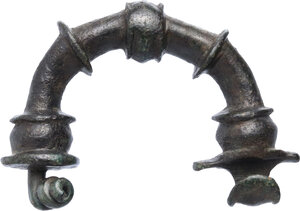
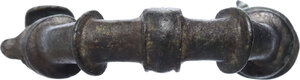
PHRYGIAN BRONZE FIBULA 8th–5th century BC. Cast bronze bow fibula with a strongly arched and profiled bow, decorated with molded collars and ribbed elements. The bilateral spring and catchplate are preserved, while the pin is now missing. The compact proportions and plastic articulation of the bow are characteristic of Phrygian and Anatolian fibula types of the early Iron Age. The surface shows a dark patina with minor encrustations. Dimensions: 37 × 25 mm. Weight: 12.64 g - PHRYGIAN BRONZE FIBULA 8th–5th century BC. Cast bronze bow fibula with a strongly arched and profiled bow, decorated with molded collars and ribbed elements. The bilateral spring and catchplate are preserved, while the pin is now missing. The compact proportions and plastic articulation of the bow are characteristic of Phrygian and Anatolian fibula types of the early Iron Age. The surface shows a dark patina with minor encrustations. Dimensions: 37 × 25 mm. Weight: 12.64 g.
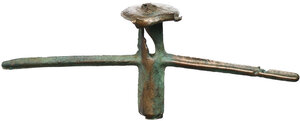
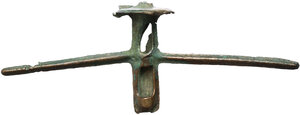
BRONZE DOUBLE-ARMED OBJECT (POSSIBLY INSIGNIA OR SCEPTRE ELEMENT) Middle to Late Bronze Age, 13th–8th century BC. Cast bronze object with a central vertical element surmounted by a broad, flattened head, and two opposing horizontal arms of circular section, slightly tapering towards the ends. The junction area shows partially openwork or perforated sections. The form is unusual and may represent a symbolic or functional element, possibly related to insignia or a sceptre fitting, although a definitive identification remains uncertain. The surface shows a green patina with areas of wear. Length: 138.5 mm. Height: 35 mm. Weight: 35.03 g - BRONZE DOUBLE-ARMED OBJECT (POSSIBLY INSIGNIA OR SCEPTRE ELEMENT) Middle to Late Bronze Age, 13th–8th century BC. Cast bronze object with a central vertical element surmounted by a broad, flattened head, and two opposing horizontal arms of circular section, slightly tapering towards the ends. The junction area shows partially openwork or perforated sections. The form is unusual and may represent a symbolic or functional element, possibly related to insignia or a sceptre fitting, although a definitive identification remains uncertain. The surface shows a green patina with areas of wear. Length: 138.5 mm. Height: 35 mm. Weight: 35.03 g.
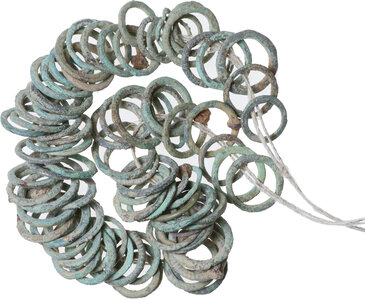
GROUP OF BRONZE RINGS (“RING MONEY” TYPE ASSEMBLAGE) Celtic or Italic world, 1st millennium BC. Group of approximately ninety (90) small cast bronze rings, likely representing an accumulated assemblage rather than a finished ornament. Such rings are widely attested in European contexts of the 1st millennium BC, particularly within Celtic and related cultural spheres, where they are often interpreted as forms of proto-currency, bullion stock, or utilitarian elements intended for exchange or further manufacture. The rings display minor variations in diameter and section, with consistent green patination and surface wear. The present group appears to reflect a collected or deposited lot, possibly stored or transported together, rather than a functional necklace or adornment - GROUP OF BRONZE RINGS (“RING MONEY” TYPE ASSEMBLAGE) Celtic or Italic world, 1st millennium BC. Group of approximately ninety (90) small cast bronze rings, likely representing an accumulated assemblage rather than a finished ornament. Such rings are widely attested in European contexts of the 1st millennium BC, particularly within Celtic and related cultural spheres, where they are often interpreted as forms of proto-currency, bullion stock, or utilitarian elements intended for exchange or further manufacture. The rings display minor variations in diameter and section, with consistent green patination and surface wear. The present group appears to reflect a collected or deposited lot, possibly stored or transported together, rather than a functional necklace or adornment.
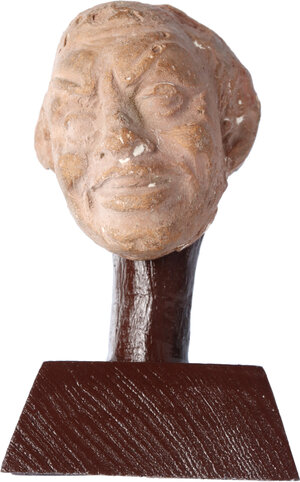
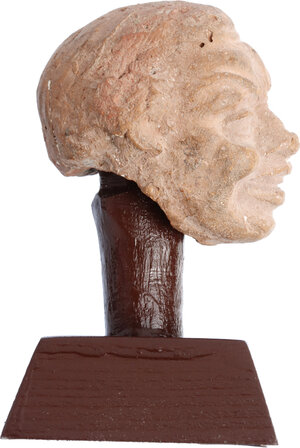
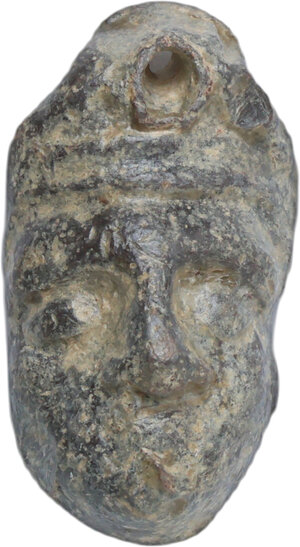
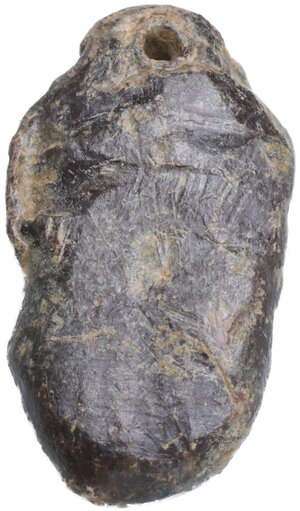
HELLENISTIC TERRACOTTA HEAD Late Hellenistic or Ptolemaic Period, 3rd–1st century BC. Small terracotta head representing a male figure, modeled with expressive features, including pronounced brows and a slightly asymmetrical, animated facial expression. The stylization and lively characterization suggest a popular or theatrical subject, possibly related to mime or genre figures common in Hellenistic coroplastic production. The reverse is plain and unfinished. The surface shows minor wear and encrustations. Mounted on a modern wooden display base, included (41 × 40 × 42 mm). Dimensions: 33 × 41 × 38 mm - HELLENISTIC TERRACOTTA HEAD Late Hellenistic or Ptolemaic Period, 3rd–1st century BC. Small terracotta head representing a male figure, modeled with expressive features, including pronounced brows and a slightly asymmetrical, animated facial expression. The stylization and lively characterization suggest a popular or theatrical subject, possibly related to mime or genre figures common in Hellenistic coroplastic production. The reverse is plain and unfinished. The surface shows minor wear and encrustations. Mounted on a modern wooden display base, included (41 × 40 × 42 mm). Dimensions: 33 × 41 × 38 mm. Ex Coll. Dr. Hans Halter, Switzerland, before 1966 (in the EU since 2006). Ex Gorny & Mosch Auction 318 (2005), 573.
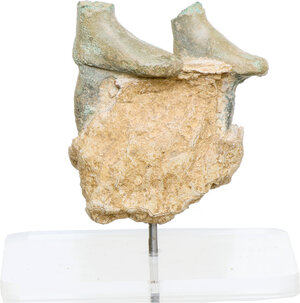
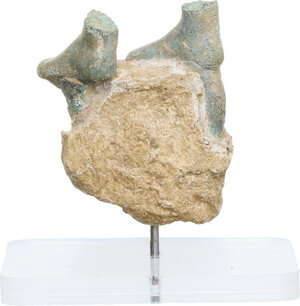
BRONZE FEET FROM A SMALL STATUETTE Ancient, possibly Roman. Fragmentary bronze representing a pair of feet, preserved from a small-scale statuette. The feet are rendered in a naturalistic manner, with gently modeled contours and a slight forward stance, suggesting a standing figure. The piece is broken just above the ankles, with the upper part of the figure now lost. Such fragments are commonly associated with small votive figures, originally dedicated in domestic or sanctuary contexts. The surface shows age-related wear and encrustations. Mounted on an elegant plexiglass display stand, included. 33 × 14 mm - BRONZE FEET FROM A SMALL STATUETTE Ancient, possibly Roman. Fragmentary bronze representing a pair of feet, preserved from a small-scale statuette. The feet are rendered in a naturalistic manner, with gently modeled contours and a slight forward stance, suggesting a standing figure. The piece is broken just above the ankles, with the upper part of the figure now lost. Such fragments are commonly associated with small votive figures, originally dedicated in domestic or sanctuary contexts. The surface shows age-related wear and encrustations. Mounted on an elegant plexiglass display stand, included. 33 × 14 mm. 64.03 g.
LEAD SLINGSHOT BULLETS (GLANDES) Greek, Hellenistic Period. Lot of three (3) lead slingshot bullets (glandes), each of characteristic biconical or almond-shaped form, designed for aerodynamic efficiency in flight. Such projectiles were widely used by ancient light infantry, particularly slingers, in both warfare and hunting. The surfaces show typical wear and patination; no visible inscriptions - LEAD SLINGSHOT BULLETS (GLANDES) Greek, Hellenistic Period. Lot of three (3) lead slingshot bullets (glandes), each of characteristic biconical or almond-shaped form, designed for aerodynamic efficiency in flight. Such projectiles were widely used by ancient light infantry, particularly slingers, in both warfare and hunting. The surfaces show typical wear and patination; no visible inscriptions.
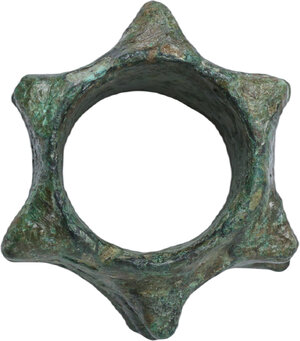
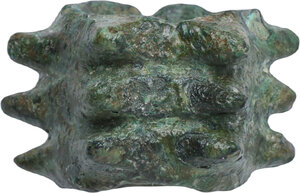
BRONZE SPIKED RING (“PASSARENDINI”) Italic culture, circa 6th–4th century BC. Cast leaded bronze spiked ring, featuring a circular inner opening and an outer perimeter articulated with groups of short conical projections. Such objects are generally interpreted as elements of ring-shaped mace heads or related striking weapons. Fine green patina. Mounted on a modern display stand, included. Weight: 17.51 g. Diameter: 26 mm - BRONZE SPIKED RING (“PASSARENDINI”) Italic culture, circa 6th–4th century BC. Cast leaded bronze spiked ring, featuring a circular inner opening and an outer perimeter articulated with groups of short conical projections. Such objects are generally interpreted as elements of ring-shaped mace heads or related striking weapons. Fine green patina. Mounted on a modern display stand, included. Weight: 17.51 g. Diameter: 26 mm. Generally referred to as 'passaredini' and thus related to the equestrian sphere, this type of bronze object apparently has no certain function. Another hypothesis of use sees these objects as belonging to the military or domestic sphere.
BRONZE HEAD APPLIQUÉ Central Italian, possibly Etruscan, c. 4th–2nd century BC. Small bronze appliqué in the form of a frontal male head with stylised facial features, prominent nose and schematic beard. Suspension hole above the forehead. Likely originally attached to furniture, a vessel, or harness equipment. Green patina with encrustations. Surface wear consistent with age. 29.58 g. 24.5 mm - BRONZE HEAD APPLIQUÉ Central Italian, possibly Etruscan, c. 4th–2nd century BC. Small bronze appliqué in the form of a frontal male head with stylised facial features, prominent nose and schematic beard. Suspension hole above the forehead. Likely originally attached to furniture, a vessel, or harness equipment. Green patina with encrustations. Surface wear consistent with age. 29.58 g. 24.5 mm. 29.58 g. 24.5 mm.
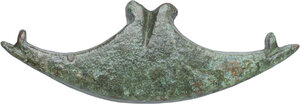
ROMAN BRONZE PELTA-SHAPED MOUNT Roman Empire, circa 1st–3rd century AD. Cast bronze mount in the form of a pelta (crescent-shaped shield), with upturned terminals and a central ridge. The thin construction and form suggest use as a decorative applique, likely attached to leather or wood, possibly as part of a belt or harness fitting. The surface shows a green patina with minor wear. Mounted on a modern display stand, included. Length: 53.5 mm. Weight: 18.13 g - ROMAN BRONZE PELTA-SHAPED MOUNT Roman Empire, circa 1st–3rd century AD. Cast bronze mount in the form of a pelta (crescent-shaped shield), with upturned terminals and a central ridge. The thin construction and form suggest use as a decorative applique, likely attached to leather or wood, possibly as part of a belt or harness fitting. The surface shows a green patina with minor wear. Mounted on a modern display stand, included. Length: 53.5 mm. Weight: 18.13 g. 18.13 g. 53.5 mm.
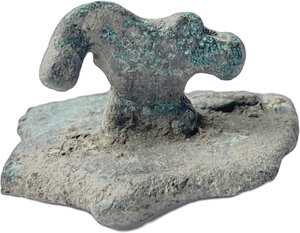
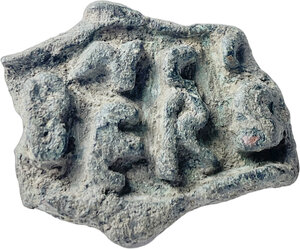
BRONZE MATRICE OR APPLIQUÉ Ancient World, possibly Italic, circa 1st millennium BC. Small cast bronze element of irregular form, featuring a crude relief composition on one face. The object presents a roughly modelled raised surface rather than a true negative cavity, suggesting it is not a functional mould but rather a decorative or symbolic piece, possibly intended as an appliqué or matrix-like element. A small projecting loop or handle-like feature is present on the upper side. Surface with green patina and earthen encrustations. 41 mm, 38.96 g - BRONZE MATRICE OR APPLIQUÉ Ancient World, possibly Italic, circa 1st millennium BC. Small cast bronze element of irregular form, featuring a crude relief composition on one face. The object presents a roughly modelled raised surface rather than a true negative cavity, suggesting it is not a functional mould but rather a decorative or symbolic piece, possibly intended as an appliqué or matrix-like element. A small projecting loop or handle-like feature is present on the upper side. Surface with green patina and earthen encrustations. 41 mm, 38.96 g.
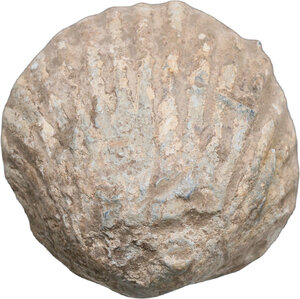
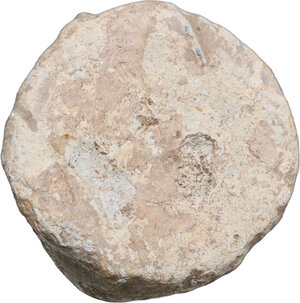
The Roman Republic.. LEAD CAST COCKLE SHELL (AES FORMATUM TYPE) Central Italy, possibly pre-monetary period, circa 6th–4th century BC. Solid cast lead object in the form of cockle shells, with stylized ribbing imitating natural prototypes. Objects of this type are often associated with aes formatum and may have functioned as proto-monetary or exchange pieces, although their exact use remains uncertain. The surface shows encrustations and wear consistent with age - The Roman Republic. LEAD CAST COCKLE SHELL (AES FORMATUM TYPE) Central Italy, possibly pre-monetary period, circa 6th–4th century BC. Solid cast lead object in the form of cockle shells, with stylized ribbing imitating natural prototypes. Objects of this type are often associated with aes formatum and may have functioned as proto-monetary or exchange pieces, although their exact use remains uncertain. The surface shows encrustations and wear consistent with age. PB. 111.05 g. 36 mm.
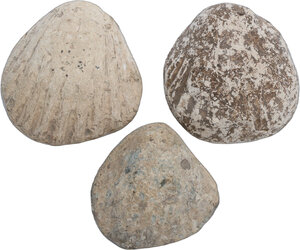
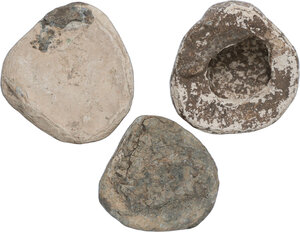
LEAD CAST COCKLE SHELLS (AES FORMATUM TYPE) Central Italy, possibly pre-monetary period, circa 6th–4th century BC. Lot of three (3) solid cast lead objects in the form of cockle shells, with stylized ribbing imitating natural prototypes. Objects of this type are often associated with aes formatum and may have functioned as proto-monetary or exchange pieces, although their exact use remains uncertain. The surfaces show encrustations and wear consistent with age - LEAD CAST COCKLE SHELLS (AES FORMATUM TYPE) Central Italy, possibly pre-monetary period, circa 6th–4th century BC. Lot of three (3) solid cast lead objects in the form of cockle shells, with stylized ribbing imitating natural prototypes. Objects of this type are often associated with aes formatum and may have functioned as proto-monetary or exchange pieces, although their exact use remains uncertain. The surfaces show encrustations and wear consistent with age. 29.58 g.
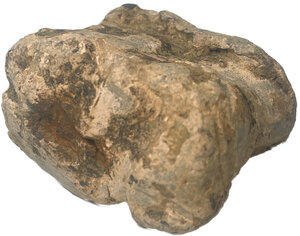
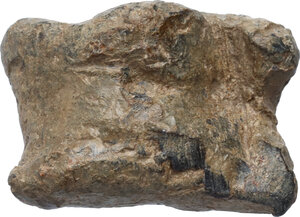
BIG LEAD ASTRAGALUS-SHAPED OBJECT Ancient World, circa 4th century BC – 4th century AD. Solid cast lead object in the form of an astragalus (knucklebone), rendered in a stylized and somewhat irregular manner. Objects of this type imitate natural bones used in antiquity for gaming, divination, or as weights. The substantial weight suggests a functional or symbolic purpose beyond simple play. The surface shows wear and encrustations consistent with age. Length: 46 mm. Weight: 298.17 g - BIG LEAD ASTRAGALUS-SHAPED OBJECT Ancient World, circa 4th century BC – 4th century AD. Solid cast lead object in the form of an astragalus (knucklebone), rendered in a stylized and somewhat irregular manner. Objects of this type imitate natural bones used in antiquity for gaming, divination, or as weights. The substantial weight suggests a functional or symbolic purpose beyond simple play. The surface shows wear and encrustations consistent with age. Length: 46 mm. Weight: 298.17 g.
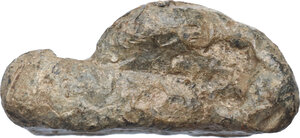
LEAD ASTRAGALUS-SHAPED GAMING PIECE Roman Empire, 1st–3rd century AD. Cast lead object in the form of an astragalus (knucklebone), imitating the natural shape used in antiquity for gaming and divination. Artificial examples in lead are known and were likely produced for repeated use or as substitutes for real bone. The surface shows encrustations and wear consistent with age. Dimensions: 29 × 19 × 18 mm. Weight: 39.68 g - LEAD ASTRAGALUS-SHAPED GAMING PIECE Roman Empire, 1st–3rd century AD. Cast lead object in the form of an astragalus (knucklebone), imitating the natural shape used in antiquity for gaming and divination. Artificial examples in lead are known and were likely produced for repeated use or as substitutes for real bone. The surface shows encrustations and wear consistent with age. Dimensions: 29 × 19 × 18 mm. Weight: 39.68 g.
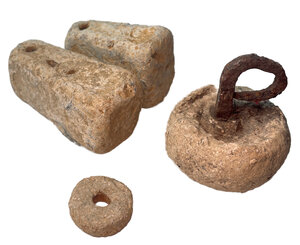
GROUP OF FOUR LEAD WEIGHTS Roman, or possibly later. Lot of four (4) lead weights of varying form, including three large and heavy examples, two of truncated conical shape with perforations, probably intended as loom weights, and one rounded example with an iron suspension loop. Also included is a small perforated disc, possibly a spindle whorl. Surface wear and encrustations throughout - GROUP OF FOUR LEAD WEIGHTS Roman, or possibly later. Lot of four (4) lead weights of varying form, including three large and heavy examples, two of truncated conical shape with perforations, probably intended as loom weights, and one rounded example with an iron suspension loop. Also included is a small perforated disc, possibly a spindle whorl. Surface wear and encrustations throughout. 426.58 g.
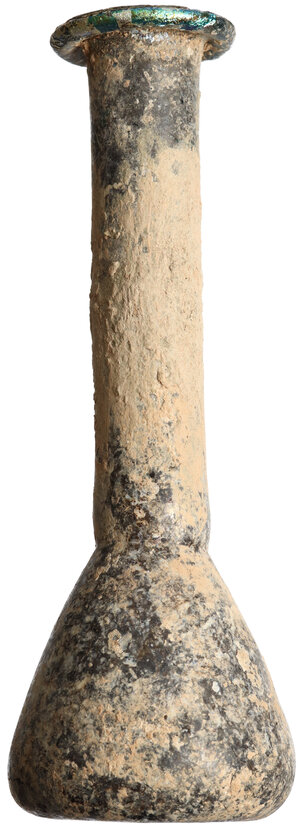
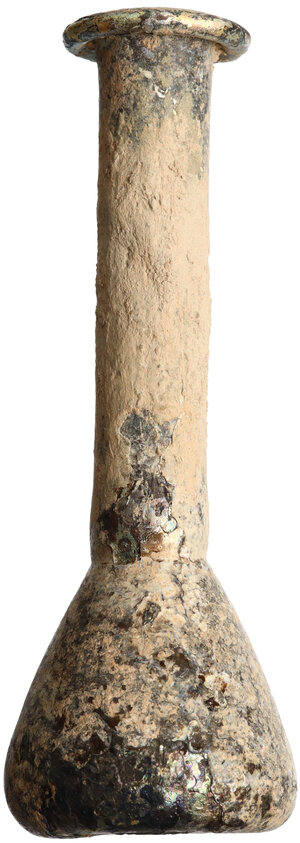
ROMAN GLASS UNGUENTARIUM. Roman period, 1st - 4th century AD. Dark glass unguentarium with a flared folded lip, a long cylindrical neck and a conical body. Diameter rim: 19 mm, diameter base: 19,5 mm, height: 75,5 mm - ROMAN GLASS UNGUENTARIUM. Roman period, 1st - 4th century AD. Dark glass unguentarium with a flared folded lip, a long cylindrical neck and a conical body. Diameter rim: 19 mm, diameter base: 19,5 mm, height: 75,5 mm. Intact and complete. Areas of iridescence. Encrustations and accretions. Sinter is present inside, along with deposits. Ex Gorny&Mosch, auction 268 (2019). FRAGILE! SHIPPING ONLY WITHIN THE EU.
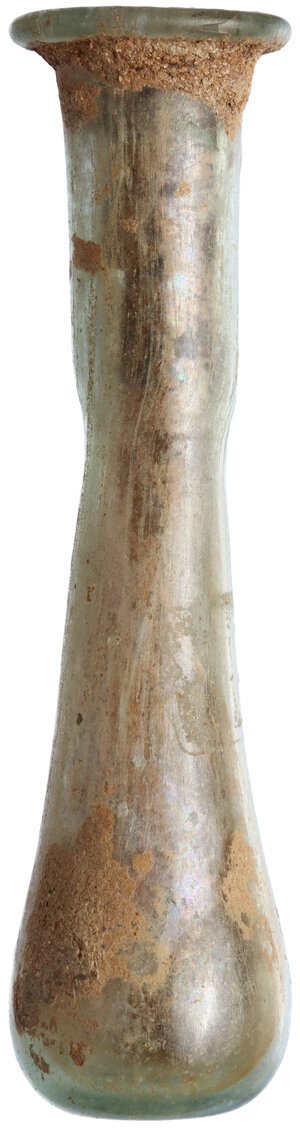
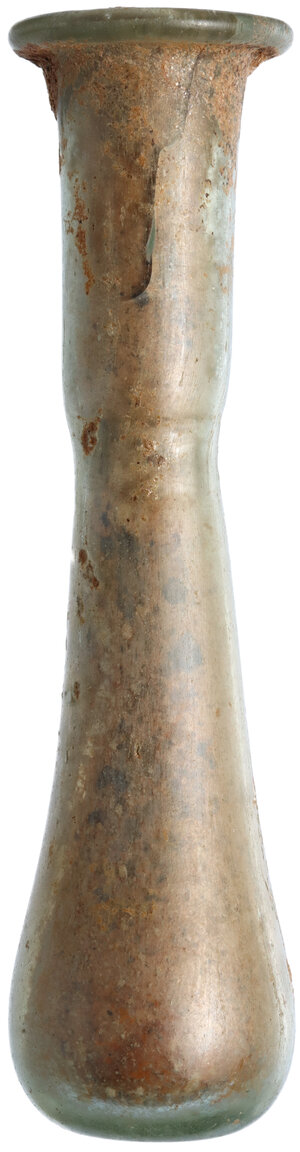
ROMAN GLASS UNGUENTARIUM Roman period, 1st - 4th century AD. Pale translucent tubular glass unguentarium with a long narrow cylindrical form, with a subtle expanson toward the lower end forming gently rounded base, a short neck, wich is only weakly differentiated from the body with a slight constriction and a flat, simple flaring lip. Diameter rim: 29 mm, diameter base: 40 mm, height: 105 mm - ROMAN GLASS UNGUENTARIUM Roman period, 1st - 4th century AD. Pale translucent tubular glass unguentarium with a long narrow cylindrical form, with a subtle expanson toward the lower end forming gently rounded base, a short neck, wich is only weakly differentiated from the body with a slight constriction and a flat, simple flaring lip. Diameter rim: 29 mm, diameter base: 40 mm, height: 105 mm. Intact and complete. Minor crack on neck. Minor encrustations and accretions. Sinter is present inside, along with deposits. Ex Gorny&Mosch, auction 268 (2019). FRAGILE! SHIPPING ONLY WITHIN THE EU.
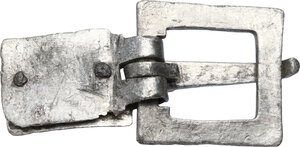
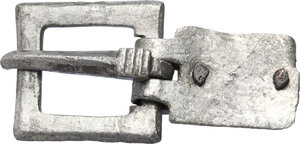
ROMAN SILVER BELT BUCKLE Roman Empire, 2nd–4th century AD. Silver belt buckle comprising a rectangular frame with a movable pin, attached to an oblong rectangular plate secured by two integral rivets for fixing to a leather strap. The robust construction and form are consistent with buckles used on Roman military belts (cingula). The surface shows light wear and minor irregularities consistent with age. Dimensions: 56 × 27 mm. Weight: 17.61 g - ROMAN SILVER BELT BUCKLE Roman Empire, 2nd–4th century AD. Silver belt buckle comprising a rectangular frame with a movable pin, attached to an oblong rectangular plate secured by two integral rivets for fixing to a leather strap. The robust construction and form are consistent with buckles used on Roman military belts (cingula). The surface shows light wear and minor irregularities consistent with age. Dimensions: 56 × 27 mm. Weight: 17.61 g.
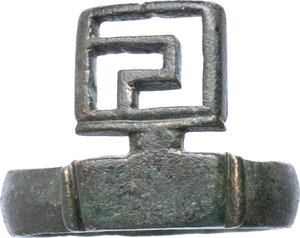
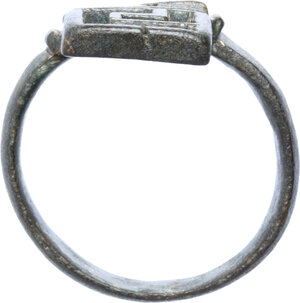
ROMAN BRONZE KEY RING Roman Empire, 1st–4th century AD. Cast bronze finger ring with an integral key, featuring a projecting rectangular bit with openwork design. Such key rings functioned as personal locking devices, commonly used for small caskets or boxes, combining practicality with portability. The surface shows a green patina with minor wear. Dimensions: length of bit 10 mm; inner diameter 16.5 mm. Weight: 3.79 g - ROMAN BRONZE KEY RING Roman Empire, 1st–4th century AD. Cast bronze finger ring with an integral key, featuring a projecting rectangular bit with openwork design. Such key rings functioned as personal locking devices, commonly used for small caskets or boxes, combining practicality with portability. The surface shows a green patina with minor wear. Dimensions: length of bit 10 mm; inner diameter 16.5 mm. Weight: 3.79 g.
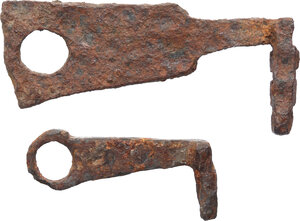
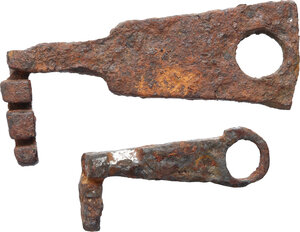
TWO ROMAN IRON KEYS Roman Empire, circa 1st–3rd century AD. Pair of iron keys, each with a looped handle and a short shank terminating in an offset bit. The simple construction is characteristic of Roman keys used for small locks, likely associated with caskets or domestic fittings. The surfaces show heavy oxidation and corrosion. Lengths: 68 mm and 43 mm - TWO ROMAN IRON KEYS Roman Empire, circa 1st–3rd century AD. Pair of iron keys, each with a looped handle and a short shank terminating in an offset bit. The simple construction is characteristic of Roman keys used for small locks, likely associated with caskets or domestic fittings. The surfaces show heavy oxidation and corrosion. Lengths: 68 mm and 43 mm.
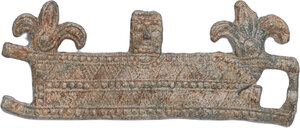
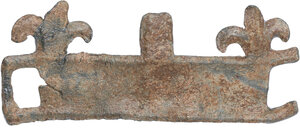
LEAD-ALLOY STRAP FITTING Medieval period, circa 12th–14th century. Cast lead-alloy fitting of elongated form, decorated with two stylized lilies flanking a central human face. The surface is enriched with fine geometric patterns composed of triangles divided by rows of pellets. Based on its manufacture and typology, the piece may be associated with the sphere of pilgrim-related objects. Mounted on an elegant plexiglass and plastic display stand, included. 49.5 × 20 mm - LEAD-ALLOY STRAP FITTING Medieval period, circa 12th–14th century. Cast lead-alloy fitting of elongated form, decorated with two stylized lilies flanking a central human face. The surface is enriched with fine geometric patterns composed of triangles divided by rows of pellets. Based on its manufacture and typology, the piece may be associated with the sphere of pilgrim-related objects. Mounted on an elegant plexiglass and plastic display stand, included. 49.5 × 20 mm. 5.18 g. Pilgrim badges were typically made of lead alloy, they were sold as souvenirs at sites of Christian pilgrimage and bear imagery relating to the saint venerated there. The quality of pilgrim badges varied considerably, with some being naive and crudely made and others displaying great craftsmanship and skill.
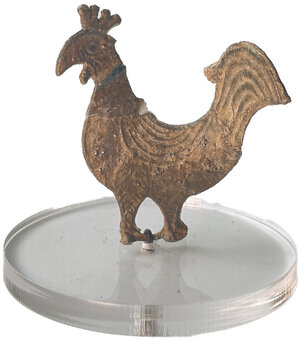
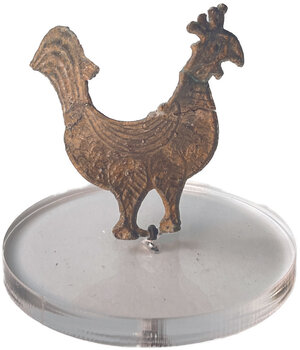
LEAD-ALLOY ROOSTER PLAQUE (PILGRIM-TYPE DECORATION) Medieval period, circa 12th–15th century. Thin hammered lead-alloy plaque depicting a stylized rooster, worked in repoussé with linear detailing defining the plumage and features. The slightly irregular and undulating surface reflects the sheet-metal manufacture. Objects of this type are commonly associated with medieval pilgrim badges or decorative appliqués, worn or attached to garments, bags, or hats. Mounted on an elegant plexiglass display stand, included. Height: 38 mm. Weight: 16.19 g - LEAD-ALLOY ROOSTER PLAQUE (PILGRIM-TYPE DECORATION) Medieval period, circa 12th–15th century. Thin hammered lead-alloy plaque depicting a stylized rooster, worked in repoussé with linear detailing defining the plumage and features. The slightly irregular and undulating surface reflects the sheet-metal manufacture. Objects of this type are commonly associated with medieval pilgrim badges or decorative appliqués, worn or attached to garments, bags, or hats. Mounted on an elegant plexiglass display stand, included. Height: 38 mm. Weight: 16.19 g.
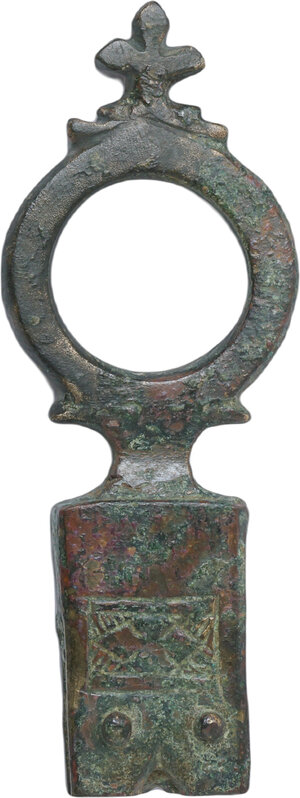
BRONZE STRAP FITTING WITH SUSPENSION RING Medieval period, circa 12th–14th century. Cast bronze strap fitting comprising a rectangular attachment plate with two rivets and a circular suspension ring, surmounted by a stylized cross-shaped finial. The plate is decorated with geometric motifs. Mounted on an elegant plexiglass display stand, included. 62 x 24 x 4 mm - BRONZE STRAP FITTING WITH SUSPENSION RING Medieval period, circa 12th–14th century. Cast bronze strap fitting comprising a rectangular attachment plate with two rivets and a circular suspension ring, surmounted by a stylized cross-shaped finial. The plate is decorated with geometric motifs. Mounted on an elegant plexiglass display stand, included. 62 x 24 x 4 mm. 17.66 g.
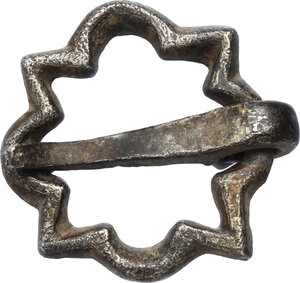
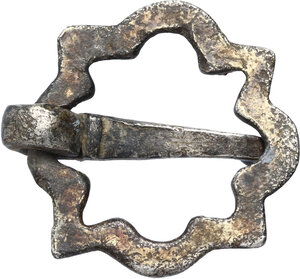
MEDIEVAL SILVER ANNULAR BROOCH (FÜRSPANN TYPE) 12th–14th century. Silver annular brooch of quatrefoil form, with a faceted and angular frame and a hinged pin. The irregular lobed outline and robust construction are characteristic of medieval dress fasteners used to secure garments or cloaks. Traces of gilding are visible on the surface. Diameter: 29 mm. Weight: 8.72 g - MEDIEVAL SILVER ANNULAR BROOCH (FÜRSPANN TYPE) 12th–14th century. Silver annular brooch of quatrefoil form, with a faceted and angular frame and a hinged pin. The irregular lobed outline and robust construction are characteristic of medieval dress fasteners used to secure garments or cloaks. Traces of gilding are visible on the surface. Diameter: 29 mm. Weight: 8.72 g. Intact. Traces of fire-gilding. A Fürspann (also Fürspan or Fürspange), is a brooch from the Middle Ages. It fastened the wedge-shaped neckline of the step-in tunic (the cotte), and is thus a special form or successor of the fibula.
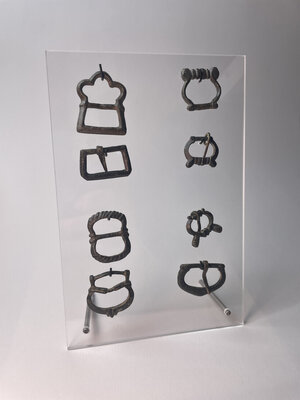
GROUP OF MEDIEVAL BRONZE BELT BUCKLES Circa 8th–14th century. Lot of eight (8) belt buckles of assorted forms, including trilobate and rectangular types. Mounted on a removable plexiglass display panel, included - GROUP OF MEDIEVAL BRONZE BELT BUCKLES Circa 8th–14th century. Lot of eight (8) belt buckles of assorted forms, including trilobate and rectangular types. Mounted on a removable plexiglass display panel, included. 5.53 g.
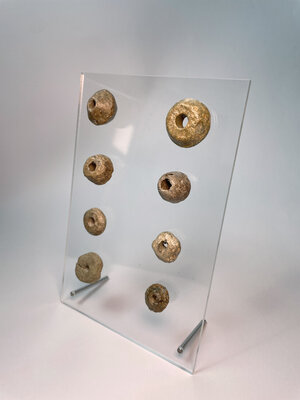
GROUP OF LEAD SPINDLE WHORLS Medieval to post-medieval period. Lot of eight (8) spindle whorls of simple type, in lead. Mounted on a removable plexiglass display panel, included - GROUP OF LEAD SPINDLE WHORLS Medieval to post-medieval period. Lot of eight (8) spindle whorls of simple type, in lead. Mounted on a removable plexiglass display panel, included. 22.24 g.
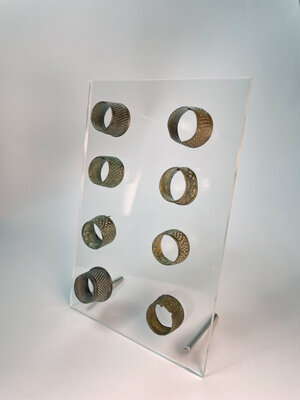
GROUP OF OPEN-TOPPED BRONZE THIMBLES Medieval to post-medieval period. Lot of eight (8) thimbles in thin bronze sheet with punched decoration. Very well preserved. Mounted on a removable plexiglass display panel, included - GROUP OF OPEN-TOPPED BRONZE THIMBLES Medieval to post-medieval period. Lot of eight (8) thimbles in thin bronze sheet with punched decoration. Very well preserved. Mounted on a removable plexiglass display panel, included. AE. 4.16 g.
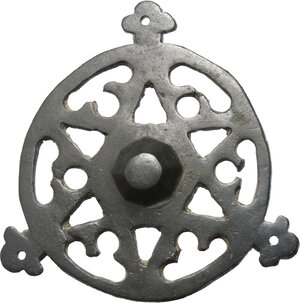
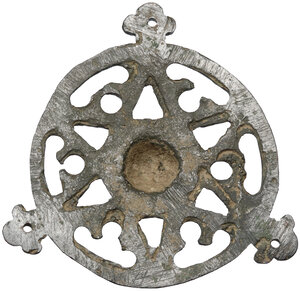
MEDIEVAL BRONZE BOOK FITTING (BOSS / FURNITURE) Late Middle Ages, 15th–16th century. Cast bronze book fitting in the form of a large openwork roundel, decorated with a geometric and foliate design incorporating a hexagram motif. At the center is a prominent domed boss, intended to protect the cover surface when the volume was laid flat. Three attachment lugs with perforations are preserved for fixing the piece to a leather-bound wooden cover. Such fittings formed part of the protective and decorative metal furniture of late medieval books. The surface shows a dark patina with minor wear. Diameter: 83 mm. Weight: 83.78 g - MEDIEVAL BRONZE BOOK FITTING (BOSS / FURNITURE) Late Middle Ages, 15th–16th century. Cast bronze book fitting in the form of a large openwork roundel, decorated with a geometric and foliate design incorporating a hexagram motif. At the center is a prominent domed boss, intended to protect the cover surface when the volume was laid flat. Three attachment lugs with perforations are preserved for fixing the piece to a leather-bound wooden cover. Such fittings formed part of the protective and decorative metal furniture of late medieval books. The surface shows a dark patina with minor wear. Diameter: 83 mm. Weight: 83.78 g. Metalwork embellishments such as fittings, bosses and corners are called book furniture. Since books were often stored lying down until the 16th century, the covering material (usually leather) constantly rubbed against the surface it rested on, leading to permanent damage and diminishing the value of the binding. Fittings therefore served to create slightly raised contact surfaces, thus preventing the delicate binding material from coming into direct contact with the surface below. Book furniture were common around all four corners of the cover and in the center, reinforced by so-called bosses or knobs.
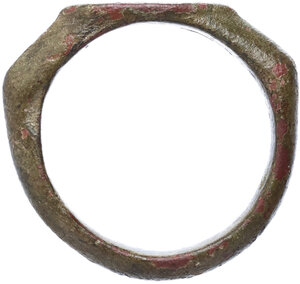
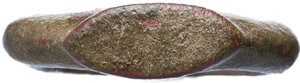
RONZE RING WITH OVAL BEZEL Late Roman to Early Medieval period, circa 4th–7th century AD. Cast bronze finger ring with an oval, slightly raised plain bezel and gently faceted, somewhat angular shoulders. The hoop is of rounded section and shows a robust, utilitarian form. The absence of engraved decoration suggests it may have been worn as a simple personal ornament or possibly intended for later inscription. The surface shows a green patina with traces of reddish encrustation. Ring size: [to be measured] - RONZE RING WITH OVAL BEZEL Late Roman to Early Medieval period, circa 4th–7th century AD. Cast bronze finger ring with an oval, slightly raised plain bezel and gently faceted, somewhat angular shoulders. The hoop is of rounded section and shows a robust, utilitarian form. The absence of engraved decoration suggests it may have been worn as a simple personal ornament or possibly intended for later inscription. The surface shows a green patina with traces of reddish encrustation. Ring size: [to be measured]. 5.86 g. 24 mm. It is possible that this item is at the first stage of production before someone had purchased it and gave instructions for engravings on the bezel.
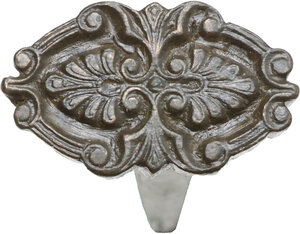
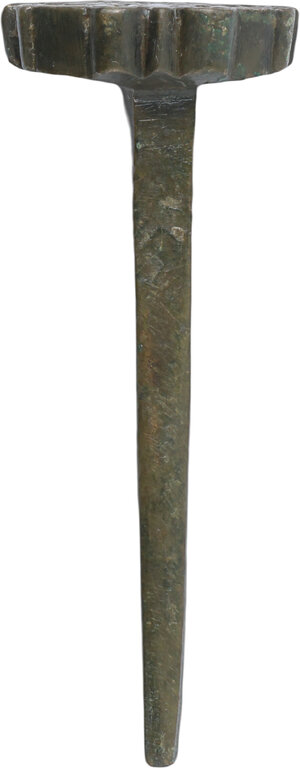
BRONZE DECORATIVE PUNCH (PROBABLY BOOKBINDER’S TOOL) Europe, 18th–19th century. Cast bronze punch with a finely engraved head decorated with symmetrical palmette motifs in relief, likely intended for impressing decorative patterns on leather surfaces, such as book covers. The proportions, workmanship and ornamental design are consistent with tools used in traditional bookbinding or leatherworking. The shaft is solid and slightly tapering, showing a functional form suitable for controlled pressure or light hammering. A later metal ring is present along the shaft. Mounted on an elegant plexiglass display stand, included. 61 × 23.5 mm - BRONZE DECORATIVE PUNCH (PROBABLY BOOKBINDER’S TOOL) Europe, 18th–19th century. Cast bronze punch with a finely engraved head decorated with symmetrical palmette motifs in relief, likely intended for impressing decorative patterns on leather surfaces, such as book covers. The proportions, workmanship and ornamental design are consistent with tools used in traditional bookbinding or leatherworking. The shaft is solid and slightly tapering, showing a functional form suitable for controlled pressure or light hammering. A later metal ring is present along the shaft. Mounted on an elegant plexiglass display stand, included. 61 × 23.5 mm. 22.47 g.
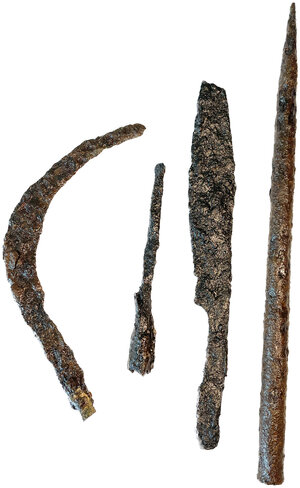
GROUP OF IRON BLADES AND SICKLE Ancient World, uncertain date. Lot composed of four (4) iron implements, including three blades of elongated form and one curved element identifiable as a sickle. The pieces are heavily corroded, with surfaces showing advanced oxidation and encrustations. The blades vary in morphology, from narrow and pointed to broader, flattened profiles, while the sickle preserves its characteristic curved outline. Such implements are commonly encountered in agricultural and domestic contexts throughout antiquity, though the present group cannot be attributed with certainty to a specific culture or period due to the lack of diagnostic features. Dimensions and weights: 203 × 28 mm, 48.55 g 166 × 20 mm, 36.02 g 121 × 13.5 mm, 22.29 g 270 × 15 mm, 221.17 g Group lot, sold as is - GROUP OF IRON BLADES AND SICKLE Ancient World, uncertain date. Lot composed of four (4) iron implements, including three blades of elongated form and one curved element identifiable as a sickle. The pieces are heavily corroded, with surfaces showing advanced oxidation and encrustations. The blades vary in morphology, from narrow and pointed to broader, flattened profiles, while the sickle preserves its characteristic curved outline. Such implements are commonly encountered in agricultural and domestic contexts throughout antiquity, though the present group cannot be attributed with certainty to a specific culture or period due to the lack of diagnostic features. Dimensions and weights: 203 × 28 mm, 48.55 g 166 × 20 mm, 36.02 g 121 × 13.5 mm, 22.29 g 270 × 15 mm, 221.17 g Group lot, sold as is.
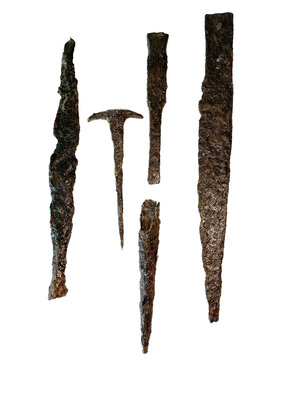
GROUP OF IRON TOOLS AND BLADES Ancient to Medieval period, uncertain attribution. Lot composed of five (5) iron implements of varied form, including elongated blades and a tool with transverse head resembling a small pick or hammer. The pieces are heavily corroded, with surfaces covered by oxidation. The group includes narrow and flattened blades of irregular profile, likely used as utilitarian cutting implements, alongside a central element with a perpendicular head, possibly related to light agricultural or craft activities. Due to the absence of diagnostic features, a precise cultural attribution is not possible. Such tools are broadly comparable to utilitarian iron implements known from ancient through medieval contexts. Dimensions and weights: 240 × 38 mm, 131.34 g 180.5 mm, 77.22 g 128 × 13 mm, 25.37 g 158 × 25.5 mm, 75.72 g 147.5 × 20.5 mm Group lot, sold as is - GROUP OF IRON TOOLS AND BLADES Ancient to Medieval period, uncertain attribution. Lot composed of five (5) iron implements of varied form, including elongated blades and a tool with transverse head resembling a small pick or hammer. The pieces are heavily corroded, with surfaces covered by oxidation. The group includes narrow and flattened blades of irregular profile, likely used as utilitarian cutting implements, alongside a central element with a perpendicular head, possibly related to light agricultural or craft activities. Due to the absence of diagnostic features, a precise cultural attribution is not possible. Such tools are broadly comparable to utilitarian iron implements known from ancient through medieval contexts. Dimensions and weights: 240 × 38 mm, 131.34 g 180.5 mm, 77.22 g 128 × 13 mm, 25.37 g 158 × 25.5 mm, 75.72 g 147.5 × 20.5 mm Group lot, sold as is. 154.56 g.
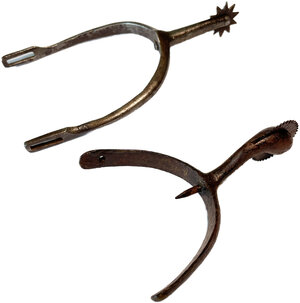
GROUP OF TWO IRON SPURS Post-medieval period, circa 16th–18th century AD. Lot of two (2) iron riding spurs with curved arms terminating in slotted strap fittings. Both examples retain their rowels: one with a multi-pointed star-shaped rowel, the other with a smaller wheel. One spur features a short neck with a lateral projection. Surface shows consistent oxidation and wear. Dimensions and weights: 103 × 74 mm, 55.77 g 148 × 60.33 mm - GROUP OF TWO IRON SPURS Post-medieval period, circa 16th–18th century AD. Lot of two (2) iron riding spurs with curved arms terminating in slotted strap fittings. Both examples retain their rowels: one with a multi-pointed star-shaped rowel, the other with a smaller wheel. One spur features a short neck with a lateral projection. Surface shows consistent oxidation and wear. Dimensions and weights: 103 × 74 mm, 55.77 g 148 × 60.33 mm.
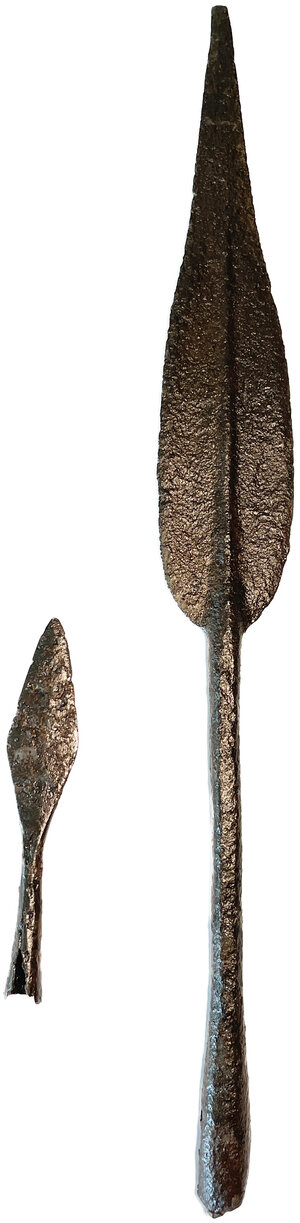
GROUP OF TWO IRON SPEARHEADS Ancient World, possibly Italic or Mediterranean, circa 1st millennium BC. Lot of two (2) iron spearheads of elongated leaf-shaped form, each with a pronounced central midrib and tapering blade. Both retain the socket for hafting. The larger specimen is long and slender with well-developed midrib; the smaller is more compact but of similar typology. Such spearheads are widely attested across the Mediterranean world during the Iron Age and early historical periods. Surface with green patina and areas of encrustation; minor losses. Dimensions and weights: 335 × 38 mm, 92.69 g 104.4 × 20 mm, 15.22 g - GROUP OF TWO IRON SPEARHEADS Ancient World, possibly Italic or Mediterranean, circa 1st millennium BC. Lot of two (2) iron spearheads of elongated leaf-shaped form, each with a pronounced central midrib and tapering blade. Both retain the socket for hafting. The larger specimen is long and slender with well-developed midrib; the smaller is more compact but of similar typology. Such spearheads are widely attested across the Mediterranean world during the Iron Age and early historical periods. Surface with green patina and areas of encrustation; minor losses. Dimensions and weights: 335 × 38 mm, 92.69 g 104.4 × 20 mm, 15.22 g.
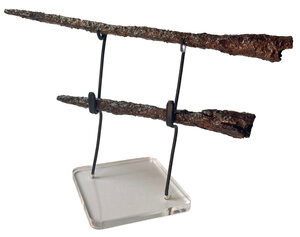
TWO IRON CROSSBOW BOLT HEADS (TANGED TYPE) Medieval period, circa 12th–15th century AD. Pair of iron crossbow bolt heads with elongated tangs, heavily corroded and preserving only their general form. The original tips are largely lost due to oxidation. Such robust tanged forms and elongated proportions are characteristic of medieval crossbow projectiles. Mounted on a modern display stand, included. Maximum length: 144 mm - TWO IRON CROSSBOW BOLT HEADS (TANGED TYPE) Medieval period, circa 12th–15th century AD. Pair of iron crossbow bolt heads with elongated tangs, heavily corroded and preserving only their general form. The original tips are largely lost due to oxidation. Such robust tanged forms and elongated proportions are characteristic of medieval crossbow projectiles. Mounted on a modern display stand, included. Maximum length: 144 mm. 16.98 g.
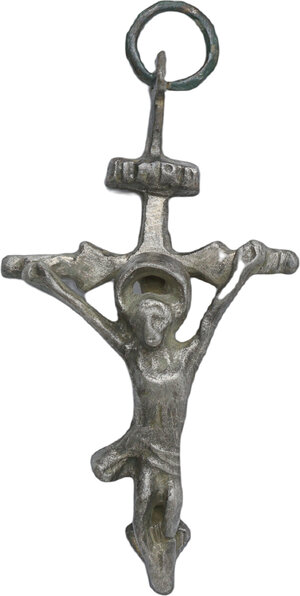
SILVER CRUCIFIX PENDANT Medieval or early post-medieval period, circa 13th–16th century AD. Cast silver (possibly low-grade alloy) crucifix pendant depicting Christ on the cross in a stylized and somewhat crude manner. Suspension loop above. Such pieces are characteristic of popular devotional objects, often worn as personal amulets. Mounted on a modern display stand, included - SILVER CRUCIFIX PENDANT Medieval or early post-medieval period, circa 13th–16th century AD. Cast silver (possibly low-grade alloy) crucifix pendant depicting Christ on the cross in a stylized and somewhat crude manner. Suspension loop above. Such pieces are characteristic of popular devotional objects, often worn as personal amulets. Mounted on a modern display stand, included. 6.03 g. 54 mm.
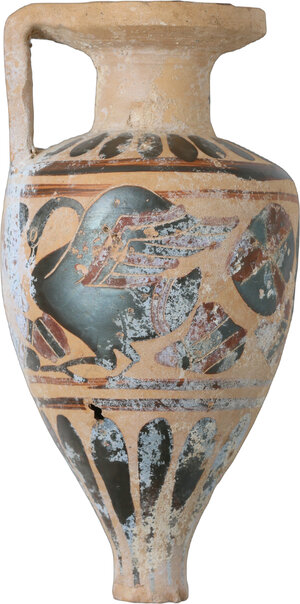
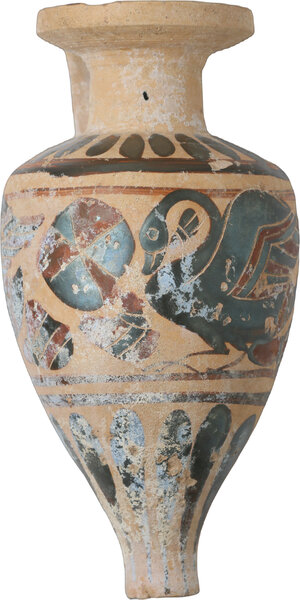
ETRUSCO-CORINTHIAN POINTED ARYBALLOS Etrusco-Corinthian, ca. late 7th–6th century BC. Pointed aryballos with flaring rim, cylindrical neck and elongated fusiform body tapering to a pointed base. The surface is decorated with a frieze of swans in profile, rendered in black with added red and white details, set between horizontal bands. Additional stylised motifs appear on the shoulder and lower body. Black-figure decoration with added red over a light ground. Base broken and pierced in modern times for mounting; now set on a modern plexiglass stand, included. Surface wear, encrustations and areas of flaking consistent with age. Height: 11,65 cm - ETRUSCO-CORINTHIAN POINTED ARYBALLOS Etrusco-Corinthian, ca. late 7th–6th century BC. Pointed aryballos with flaring rim, cylindrical neck and elongated fusiform body tapering to a pointed base. The surface is decorated with a frieze of swans in profile, rendered in black with added red and white details, set between horizontal bands. Additional stylised motifs appear on the shoulder and lower body. Black-figure decoration with added red over a light ground. Base broken and pierced in modern times for mounting; now set on a modern plexiglass stand, included. Surface wear, encrustations and areas of flaking consistent with age. Height: 11,65 cm.
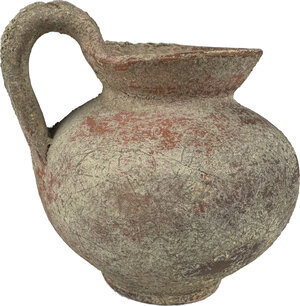
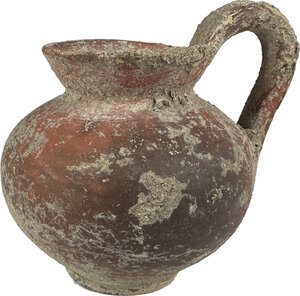
SMALL TERRACOTTA JUG WITH TREFOIL MOUTH Italic / Central Italian, circa 6th–4th century BC. Small terracotta jug with globular body, single strap handle and trefoil-shaped pouring mouth. The surface appears to retain traces of a light slip with faded red-painted decoration, now largely worn. The fabric and execution suggest a utilitarian production within an Italic context. Surface heavily worn with encrustations and abrasion. Height 7.5 cm - SMALL TERRACOTTA JUG WITH TREFOIL MOUTH Italic / Central Italian, circa 6th–4th century BC. Small terracotta jug with globular body, single strap handle and trefoil-shaped pouring mouth. The surface appears to retain traces of a light slip with faded red-painted decoration, now largely worn. The fabric and execution suggest a utilitarian production within an Italic context. Surface heavily worn with encrustations and abrasion. Height 7.5 cm.
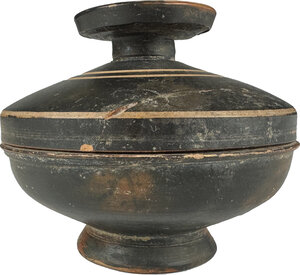
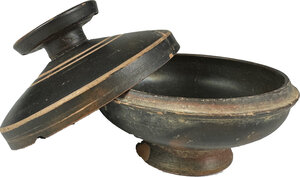
BLACK-GLAZED LEKANE WITH LID Magna Graecia, South Italy, circa 4th–3rd century BC. Black-glazed terracotta lekane with matching lid. The vessel features a broad, rounded body resting on a low ring foot, with a slightly everted rim designed to receive the lid. The lid is domed with a wide, flat knob and decorated with simple reserved bands. The surface is covered in a dark black glaze, now worn in places, revealing the underlying orange clay. Minor chipping and surface abrasion consistent with age. Height 9 cm - BLACK-GLAZED LEKANE WITH LID Magna Graecia, South Italy, circa 4th–3rd century BC. Black-glazed terracotta lekane with matching lid. The vessel features a broad, rounded body resting on a low ring foot, with a slightly everted rim designed to receive the lid. The lid is domed with a wide, flat knob and decorated with simple reserved bands. The surface is covered in a dark black glaze, now worn in places, revealing the underlying orange clay. Minor chipping and surface abrasion consistent with age. Height 9 cm.
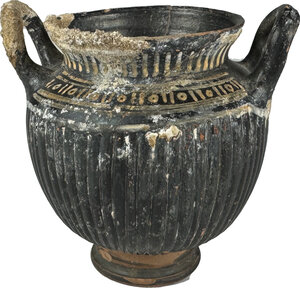
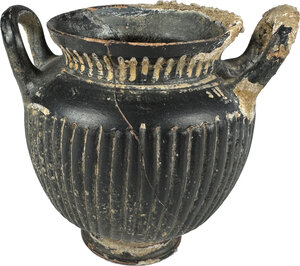
GNATHIA-TYPE BLACK-GLAZED RIBBED VESSEL WITH HANDLES Magna Graecia, circa 4th–3rd century BC. Small black-glazed terracotta vessel with globular ribbed body and two opposed strap handles rising from the shoulder. Short neck with slightly everted rim. The shoulder is decorated with added red-painted geometric motifs, characteristic of the Gnathia decorative tradition. The surface shows extensive wear and encrustations, with partial loss of the added decoration. The underlying clay is visible in several areas. Height 10 cm - GNATHIA-TYPE BLACK-GLAZED RIBBED VESSEL WITH HANDLES Magna Graecia, circa 4th–3rd century BC. Small black-glazed terracotta vessel with globular ribbed body and two opposed strap handles rising from the shoulder. Short neck with slightly everted rim. The shoulder is decorated with added red-painted geometric motifs, characteristic of the Gnathia decorative tradition. The surface shows extensive wear and encrustations, with partial loss of the added decoration. The underlying clay is visible in several areas. Height 10 cm.
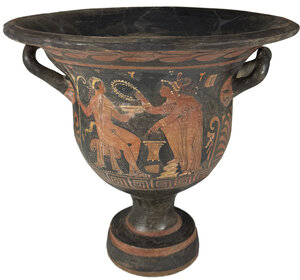
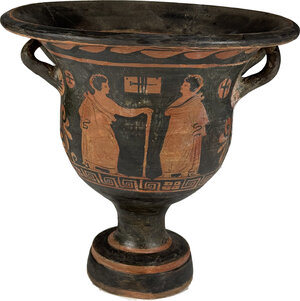
APULIAN RED-FIGURE KRATER Apulia, 4th–3rd century BC. Large red-figure krater with wide flaring rim, deep rounded body and ring foot. The vessel is decorated with figural scenes in red-figure technique: on one side a seated nude youth facing a standing female figure holding a mirror, with additional ornamental elements; on the other side two draped figures in conversation. Beneath the rim runs a decorative band composed of stylised palmettes and olive branches. Added red and white details visible. Broken and repaired in several areas; surface wear, abrasions and minor losses. Height: 31.5 cm. Rim diameter: 33 cm - APULIAN RED-FIGURE KRATER Apulia, 4th–3rd century BC. Large red-figure krater with wide flaring rim, deep rounded body and ring foot. The vessel is decorated with figural scenes in red-figure technique: on one side a seated nude youth facing a standing female figure holding a mirror, with additional ornamental elements; on the other side two draped figures in conversation. Beneath the rim runs a decorative band composed of stylised palmettes and olive branches. Added red and white details visible. Broken and repaired in several areas; surface wear, abrasions and minor losses. Height: 31.5 cm. Rim diameter: 33 cm.NO EXTRA EU SHIPPING
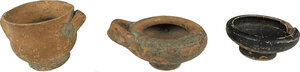
GROUP OF THREE TERRACOTTA VESSELS Ancient World, possibly Roman period. Group of three (3) small terracotta vessels of simple utilitarian type. The pieces feature rounded or shallow bodies with wide openings, slightly everted rims and small applied lugs or handles. Surfaces with wear, encrustations and minor chipping. Maximum height 4 cm - GROUP OF THREE TERRACOTTA VESSELS Ancient World, possibly Roman period. Group of three (3) small terracotta vessels of simple utilitarian type. The pieces feature rounded or shallow bodies with wide openings, slightly everted rims and small applied lugs or handles. Surfaces with wear, encrustations and minor chipping. Maximum height 4 cm.
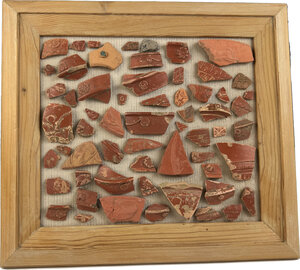
COLLECTION OF TERRA SIGILLATA FRAGMENTS (FRAMED DISPLAY) Roman Imperial period. Collection of numerous terra sigillata fragments, many preserving relief decoration including vegetal motifs, rosettes and figural elements. Mounted in a modern wooden display frame. 30 x 33 cm The assemblage represents a study or decorative collection rather than a single archaeological context. Surface wear and minor chips consistent with age. The frame is available for local collection only. In case of shipment, only the fragments will be sent - COLLECTION OF TERRA SIGILLATA FRAGMENTS (FRAMED DISPLAY) Roman Imperial period. Collection of numerous terra sigillata fragments, many preserving relief decoration including vegetal motifs, rosettes and figural elements. Mounted in a modern wooden display frame. 30 x 33 cm The assemblage represents a study or decorative collection rather than a single archaeological context. Surface wear and minor chips consistent with age. The frame is available for local collection only. In case of shipment, only the fragments will be sent.
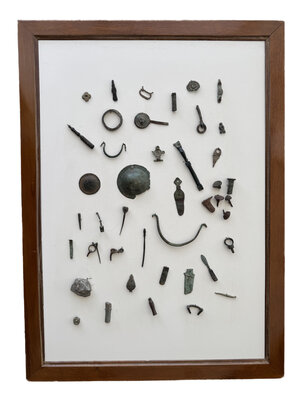
COLLECTION OF BRONZE OBJECTS (FRAMED DISPLAY) Ancient World, likely Roman period. Group of small bronze objects of various types, including fittings, rings, pins, mounts, and fragmentary implements. The assemblage shows a range of utilitarian and decorative elements, many with visible patina and surface wear consistent with age. Mounted in a modern wooden display frame. The group represents a collected assemblage rather than a single coherent set or archaeological context. The frame is available for local collection only. In case of shipment, only the objects will be sent. 57 x 77.5 cm - COLLECTION OF BRONZE OBJECTS (FRAMED DISPLAY) Ancient World, likely Roman period. Group of small bronze objects of various types, including fittings, rings, pins, mounts, and fragmentary implements. The assemblage shows a range of utilitarian and decorative elements, many with visible patina and surface wear consistent with age. Mounted in a modern wooden display frame. The group represents a collected assemblage rather than a single coherent set or archaeological context. The frame is available for local collection only. In case of shipment, only the objects will be sent. 57 x 77.5 cm.