Medals
Results from 7301 to 7350 of 26088
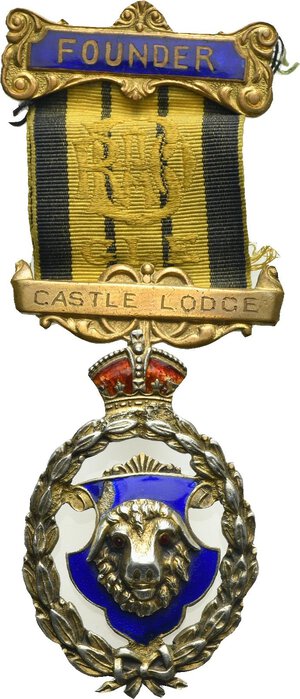
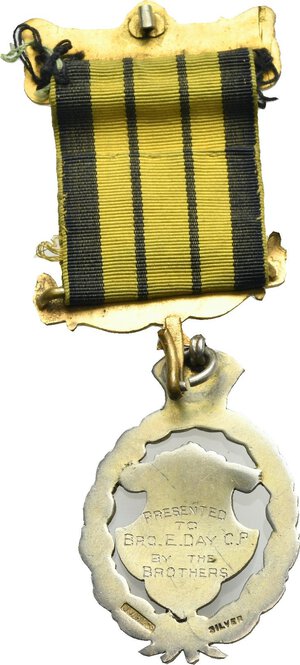
Lot # 327
-
Castle Lodge – Founder’s Jewel, c. 1920s–30s (51.02 x 34.19 mm, 24.68 g).
Material: Silver (marked), with Gilt and Enamel
Presentation: “Presented to Bro. E. Day C.P. by the Brothers” (engraved on reverse)
A handsome and early Founder’s Jewel for Castle Lodge, featuring fine gilded decoration and rich enamel work. The jewel hangs from a gold-and-black striped riband — the colours traditionally associated with senior RAOB offices — topped by an ornate gilt and enamelled bar inscribed:
FOUNDER
Beneath the ribbon sits a second bar naming the lodge:
CASTLE LODGE
The medallion displays an enamelled shield in deep blue and white, framed by a laurel wreath and surmounted by a red enamel crown. At the centre is a bold and expressive buffalo head — a classic emblem of the Order — crisply modelled with excellent detail.
The reverse retains the original hanging loop and displays a neatly engraved dedication:
PRESENTED
TO
BRO. E. DAY C.P.
BY THE
BROTHERS
Along the lower edge is the stamp SILVER, confirming solid silver construction for the suspended jewel.
Condition: Very Fine. Enamel clean and well-preserved; gilding with mild age toning; ribbon worn but original; engraving sharp; silver reverse lightly patinated. A strong, characterful Founder’s jewel with personal presentation.
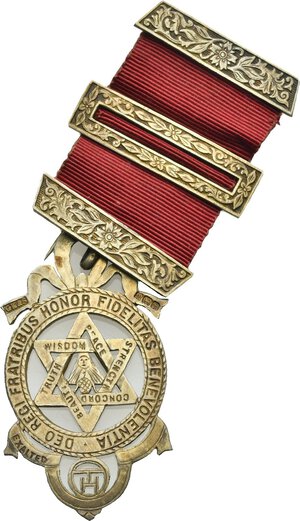
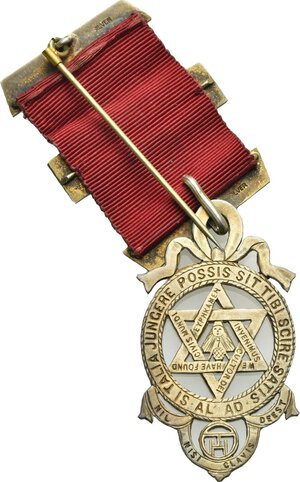
Lot # 326
-
M.M.M. / Mark Degree Jewel – Silver-Gilt & Enamel, c. 1920s–30s (55.64 x 34.05 mm, 33.16 g).
Material: Silver (marked SILVER), with gilt finish and white enamel
Maker: Unattributed (standard Mark style workmanship)
A handsome early 20th-century Mark Masonry jewel, featuring a beautifully modelled interlaced triangles motif with central Mark Master keystone symbol. The surrounding Latin inscription encircles the enamelled field:
HONOR FIDELITAS BENEVOLENTIA DEO REGI FRATRIBUS
on one side,
and
UT TALIA IUNGERE POSSIS SIT TIBI SCIRE SATIS
on the reverse face.
The jewel is suspended from a deep crimson riband fitted with ornate gilt floral bars — classic three-bar construction of the period, each finely chased with foliate detail. The lower segment includes the circular monogram device traditionally associated with the Mark Degree.
The reverse bears two SILVER stamps confirming the medal and suspension components are solid silver with gilt overlay. Original long pin and fittings present.
Condition: Very Fine. Gilt and enamel clean and attractive; riband bright with light age; silver reverse with expected patina; all components original and secure. A strong example of the Mark Master jewel in its more elaborate multi-bar form.
Lot # 325
-
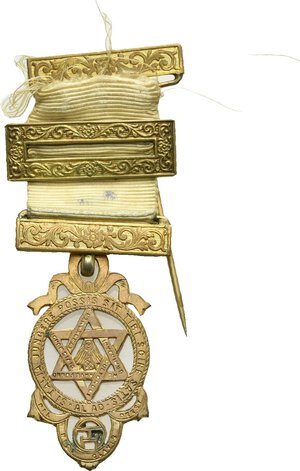
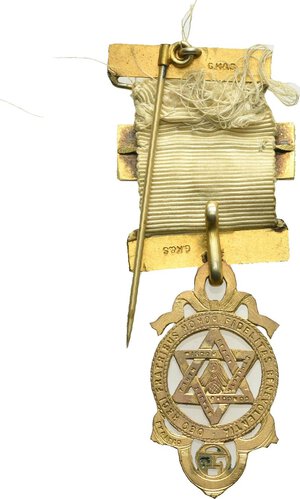
Royal Ark Mariner / Mark Degree Jewel – c. 1920s–30s (Cream Ribbon Variant) (37.00 x 24.37 mm, 16.36 g).
Maker: G. Kenning & Son, London (hallmarked)
Material: Sterling Silver, Gilt, and Enamel
Period: Early 20th Century
A handsome and well-made Royal Ark Mariner or Mark Degree jewel, crafted in sterling silver with bright gilt detailing and elegant enamel work. This example features the cream ribbon variant, less commonly encountered than the crimson ribbon form.
The jewel is suspended from three ornate floral-engraved gilt bars, giving it an impressive vertical presence. The ribbon retains its original cream colour, showing minor period wear but still structurally sound.
The medallion displays the traditional interlaced hexagram enclosing the virtues WISDOM, STRENGTH, BEAUTY, along with the central emblem of the Ark. The Latin motto encircling the device reads:
DEO ARCA FRATRIBUS HONOR FIDELITAS BENEFICENTIA
(“To God, the Ark, the Brethren — Honour, Fidelity, Benevolence”)
The reverse carries full and clear British hallmarks, together with the G. KENNING & SON stamp, confirming silver manufacture and London assay.
Condition: Fine to Very Fine. Gilding even and attractive; enamel clean and undamaged; ribbon aged with some fraying but intact; reverse with clear hallmarks and original fittings. A strong example of a desirable early 20th-century degree jewel.
Lot # 324
-
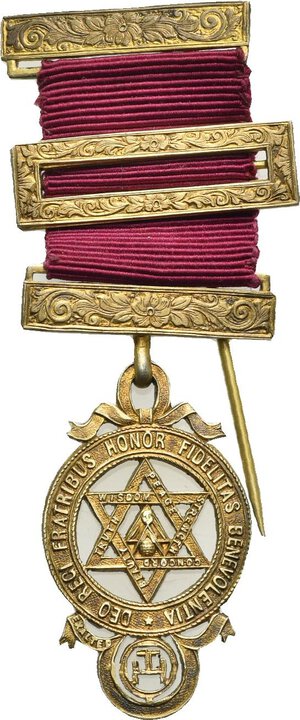
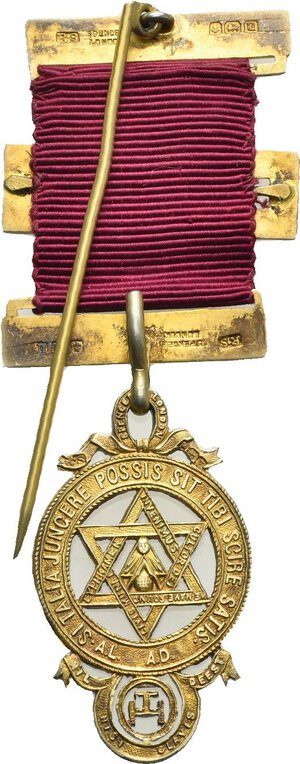
Royal Ark Mariner / Mark Degree Jewel – c. 1920s–30s (40.48 x 24.19 mm, 15.08 g).
Maker: Fattorini & Sons, Birmingham (hallmarked)
Material: Sterling Silver, Gilt, and Enamel
Period: Early 20th Century
A beautifully crafted dual-bar Mark or Royal Ark Mariner jewel, produced in sterling silver with rich gilt finish and detailed enamel elements. This piece displays the high level of ornament typical of inter-war British Masonic regalia.
The jewel is suspended from two ornate floral-engraved gilt bars, joined by a deep crimson ribbon—an unusual and visually appealing configuration associated with presentation or rank rather than standard membership.
Below hangs the medallion, centred by an interlaced hexagram enclosing the words:
WISDOM · STRENGTH · BEAUTY
Surmounting the emblem is a small depiction of the Ark, symbolic of preservation, stability, and the traditions of the Mark Degree. The surrounding Latin motto reads:
DEO · ARCA · FRATRIBUS · HONOR · FIDELITAS · BENEFICENTIA
(“To God, to the Ark, to the Brethren — Honor, Fidelity, Benevolence”)
The reverse features full British sterling hallmarks, together with the maker’s stamp, confirming authenticity and period manufacture.
Condition: Very Fine. Gilding attractive and even; enamel crisp and undamaged; ribbon bright with light handling; reverse clean with clear hallmarks. A well-preserved and impressively ornate jewel.
Lot # 323
-
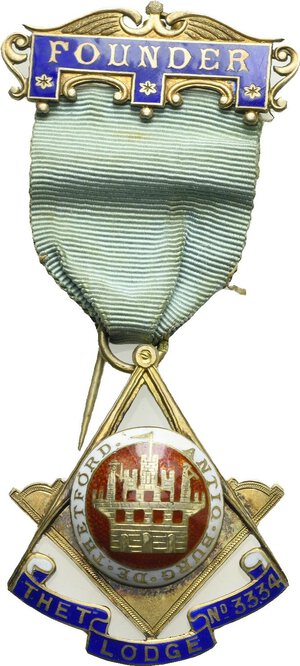
Thetford Lodge No. 3334 – Founder’s Jewel, c. 1920s–1930s (43.78 x 40.09 mm, 24.29 g).
Maker: Toye & Co., London (hallmarked)
Material: Sterling Silver, Gilt & Enamel
Period: Early 20th Century
A handsome and finely crafted Founder’s Jewel for Thetford Lodge No. 3334, produced by the renowned regalia makers Toye & Co., London. This jewel follows the classic early 20th-century founder’s pattern: a broad pale-blue silk ribbon mounted beneath an ornate gilt bar with rich cobalt-blue enamel reading FOUNDER, flanked by decorative scrollwork and stars.
Suspended below is a beautifully formed triangular silver frame, representing one of the most traditional symbols in Craft Masonry. At its centre sits an enamelled roundel depicting the arms of Thetford, with a detailed rendering of the town’s castle or fortified gateway in red, white, and gold. The lower scroll bears the lodge designation:
THET LODGE No. 3334
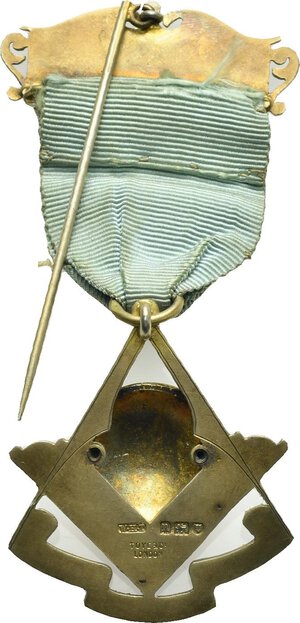
The reverse retains the original long pin and hinge fittings and is clearly struck with full London silver hallmarks alongside the maker’s mark of Toye & Co., confirming both authenticity and quality.
Condition: Very Fine. Enamel clean and bright; gilt elements show only light age toning; ribbon lightly faded but stable; reverse with attractive patina and crisp hallmarks.
Lot # 322
-
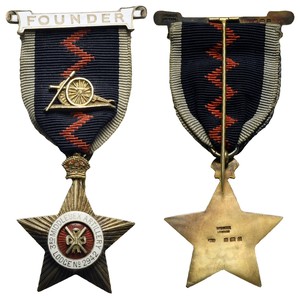
33rd Middlesex Artillery Lodge No. 2942 – Founder’s Jewel, c. 1920s–1930s (41.71 mm, 27.48 g).
Maker: Spencer, London (hallmarked)
Material: Sterling Silver, Gilt & Enamel
Period: Early 20th Century
A superb and highly distinctive Founder’s Jewel for the 33rd Middlesex Artillery Lodge No. 2942, crafted in sterling silver with gilt details and enamelled insignia. Regimental-themed lodge jewels are among the most sought-after in Masonic regalia, and this example is an excellent representation of the tradition linking Freemasonry with British Territorial and Volunteer units.
The jewel is suspended from a deep navy-blue silk ribbon with grey edging and a bold red zig-zag central motif—mirroring artillery colours. A gilt miniature field gun is mounted upon the ribbon, emphasising the lodge’s military identity. Above sits a white-enamelled bar inscribed:
FOUNDER
The pendant takes the form of a finely executed five-pointed star with radiating rays, surmounted by a Tudor-style crown. At the centre, a circular white-enamel band encloses a red ground bearing the crossed-guns insignia of the Royal Artillery and the inscription:
33rd Middlesex Artillery Lodge No. 2942
The reverse retains the original pin fitting and carries full London hallmarks together with the maker’s name SPENCER LONDON, confirming quality manufacture.
Condition: Very Fine. Gilt elements bright with light age toning; enamel fully intact; ribbon well-preserved with only slight wear to edges; reverse shows even patina and strong, legible hallmarks.
Lot # 321
-
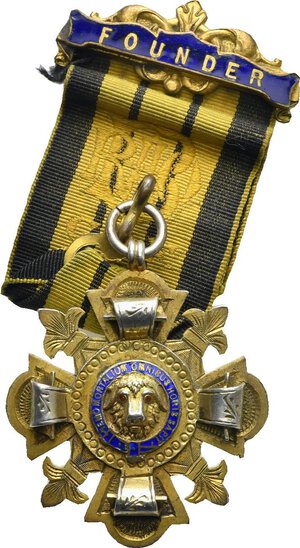
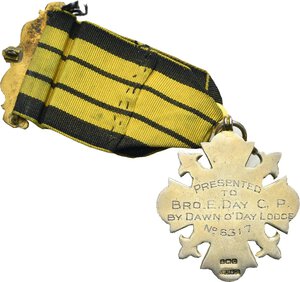
Dawn o’ Day Lodge No. 6317 – Founder’s Jewel, c. 1920s–1930s (44.33 x 39.14 mm, 22.91g).
Maker: (Hallmarked silver, British manufacture)
A finely executed and visually striking Founder’s Jewel for Dawn o’ Day Lodge No. 6317, crafted in silver with gilt highlights and rich blue enamel, suspended from its original black-and-gold striped ribbon.
The jewel is surmounted by an ornate gilt scroll bar bearing the title FOUNDER in deep blue enamel. Below hangs a Maltese cross-style jewel with radiating arms, centred by a crowned lion’s head within a blue enamel circlet inscribed Mortalium Omnibus Horis Sapit. The contrasting gilt and silver elements are crisply defined, with excellent symbolic balance and strong visual depth.
The reverse is engraved:
“Presented to Bro. E. Day C.P. by Dawn o’ Day Lodge No. 6317”,
and retains its original suspension, fittings, and silver hallmarks, confirming period manufacture.
Condition: Very Fine. Enamel well preserved with good colour; metalwork sharp; ribbon original with expected age wear and minor fraying; overall an attractive and honest example with pleasing patina.
Lot # 320
-
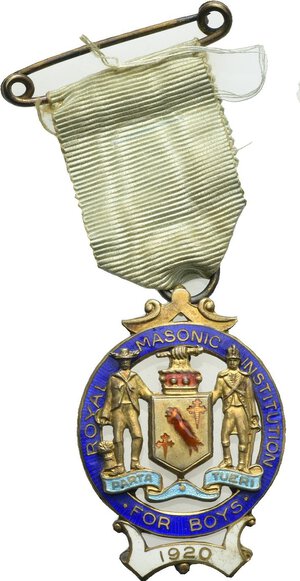
Royal Masonic Institution for Boys – Festival Jewel, 1920 (31.22 mm, 42.93 g).
Maker: (London silversmith; hallmarks present)
Hallmarked Sterling Silver (London, 1919–20)
A handsome and early Royal Masonic Institution for Boys (RMIB) Festival Jewel dated 1920, executed in gilt and multi-coloured enamel and displaying the distinctive heraldic elements associated with early 20th-century RMIB issues.
The oval medallion features a soft gilt background supporting the full achievement of arms: a shield charged with symbolic devices, flanked by two classical figures in period dress, and surmounted by a crest of wheat. Beneath the shield appears the motto PARTA TUERI, beautifully rendered on a ribbon scroll. The surrounding blue enamel band reads:
ROYAL MASONIC INSTITUTION FOR BOYS
The date 1920 is shown prominently at the lower panel of the medallion. The jewel is suspended from its original pale ribbon, displaying age-consistent wear but retaining its period form.
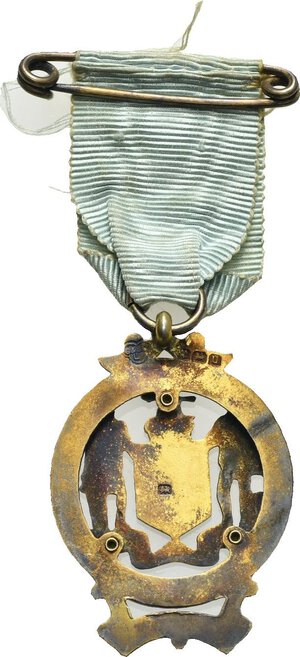
Reverse
The reverse shows the openwork structure characteristic of early RMIB pieces. Along the upper edge are clear British silver hallmarks confirming manufacture in sterling silver, assayed in London, with the date-letter corresponding to 1919–20.
The fastening bar is fitted with the original early-style safety pin.
Condition: Fine to Very Fine. Enamel largely intact with strong colour; gilt surfaces show graceful patination; ribbon worn and frayed at edges; reverse retaining good detail; suspension fitting secure.
A desirable and well-preserved example of a post–World War I RMIB Festival Jewel, prized for its silver construction, historical date, and characteristic heraldic design. Highly collectible among enthusiasts of Masonic regalia and early institutional festival jewels.
Lot # 319
-
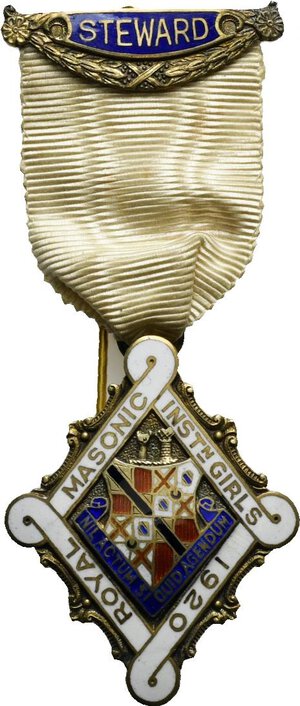
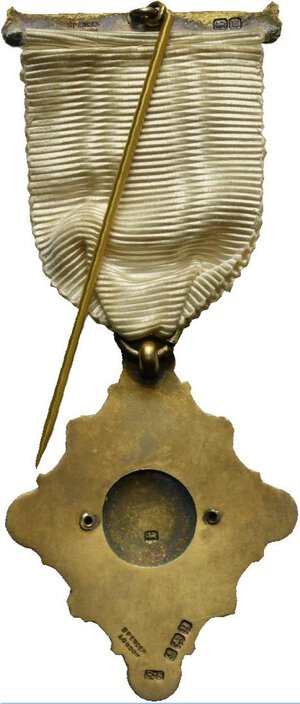
Royal Masonic Institution for Girls – Steward Jewel, 1920 (Silver, 47.15 x 39.32 mm, 18.62 g).
Maker: Spencer & Co., London (stamped SPENCER to suspension bar).
Hallmarked Sterling Silver (with coloured enamel), suspended from its original cream ribbed ribbon.
In a dark green leather fitted box, gilt-tooled to lid, by Spencer & Co., London (box slightly worn/used).
Provenance: Ex Phillips 294, sale 96; CDV 65.
A handsome interwar Royal Masonic Institution for Girls (RMIG) Steward Jewel dated 1920, executed in hallmarked silver with crisp white and blue enamel, suspended from its original cream moiré ribbon. The design is a classic RMIG form, notable for its balanced proportions and strong enamel contrast.
The upper bar is an ornate laurel-and-crossed emblem mount with a blue enamel panel inscribed STEWARD. Suspended beneath is the enamelled lozenge-form badge with white enamel scrollwork reading ROYAL MASONIC INSTN GIRLS 1920, framing a central heraldic shield in coloured enamels. Below the shield runs a blue enamel motto scroll (Latin inscription beginning “NIL ACTUM SI …”, as struck).
Reverse: The reverse retains the original long pin fitting, with the SPENCER maker’s stamp to the suspension bar and hallmarks present to the mount and/or badge (as visible in the photo). The reverse construction plate is intact.
Condition: Very good. Ribbon with light age wear and minor creasing; enamel bright with small high-point wear; silver with light toning and handling marks; fittings secure; hallmarks and maker’s stamp visible. Box slightly used, with expected age wear.
Lot # 318
-
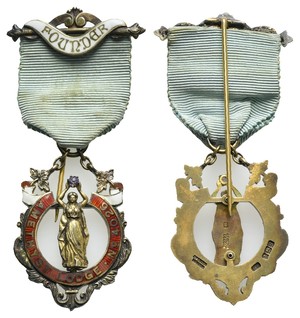
Amethyst Lodge No. 1026 – Founder’s Jewel, c. 1920s (44.13 x 34.58 mm, 24.63 g).
Maker: (Hallmarked, London – maker’s mark present)
Material: Sterling Silver with Gilt and Enamel; Set with Amethyst-Coloured Gem
A striking and beautifully detailed Founder’s Jewel for Amethyst Lodge No. 1026, crafted in sterling silver with gilt highlights and rich hand-applied enamel. This jewel exemplifies the ornate and highly symbolic workmanship of early 20th-century lodge regalia.
The pale blue silk ribbon is suspended from an elegant bar bearing the word FOUNDER in white enamel. Below, the medallion features a finely modelled classical female figure in gilt, arms raised to present an amethyst-coloured stone — the emblematic jewel of the lodge. The surrounding wreath incorporates twin enamel scrolls and the lodge name:
AMETHYST LODGE No. 1026
The reverse shows the original fittings, along with full London sterling hallmarks and a clear maker’s stamp, confirming authenticity and period manufacture.
Condition: Very Fine. Gilt figure crisp and expressive; enamel largely intact with only minor age touches; stone original; ribbon lightly toned but stable; silver reverse with attractive patina. A distinctive and unusual Founder’s jewel with strong visual appeal.
A scarce lodge-specific jewel with an uncommon symbolic centrepiece.
Lot # 317
-
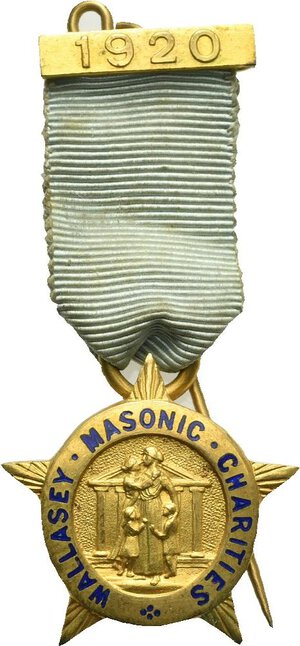
Walsey Masonic Charities – Steward’s Jewel, 1920 (29.19 mm, 9.01 g).
A scarce and attractive Steward’s Jewel awarded for service to the Walsey Masonic Charities, dated 1920. The jewel is suspended from its original pale blue ribbed silk ribbon, fitted with a gilt top bar engraved:
1920
The obverse displays a star-shaped gilt medal with blue enamelled circular band inscribed:
WALSEY · MASONIC · CHARITIES
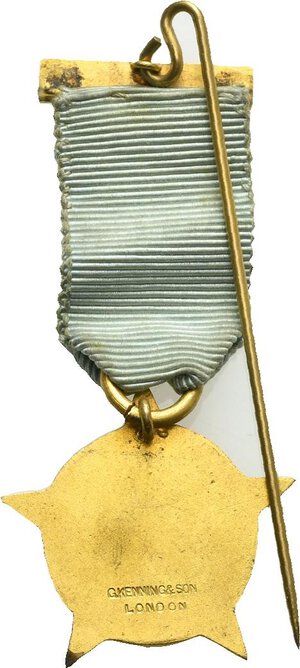
enclosing a finely modelled allegorical scene depicting benevolence and charity beneath classical architectural elements. The reverse is plain, retaining the original long pin and suspension, and clearly stamped by the maker:
G. KENNING & SON – LONDON
The piece is a characteristic example of early 20th-century English Masonic charitable regalia, combining restrained enamel work with strong symbolic imagery.
Condition: Very Fine. Original ribbon present with light fading and gentle wear; enamel intact and well preserved; metal surfaces with even age-related patina; pin and fittings complete and functional.
A desirable dated steward’s jewel from a recognised Masonic charitable institution, well suited to collectors of British Masonic and benevolent awards.
Lot # 316
-
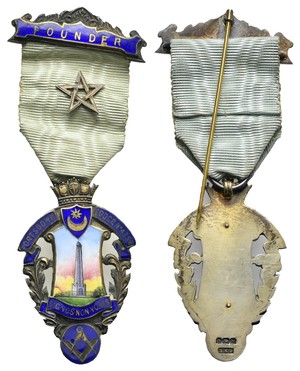
Freemasonry – Founder’s Jewel, Portsmouth Lodge No. 4255 (52.57 x 31.42 mm, 33.42 g).
Maker: J. R. Gaunt & Son Ltd., London
Hallmarked Sterling Silver (London, 1920s–1930s)
Lodge Founded: c. late 1920s
A striking and beautifully crafted Founder’s Jewel for Portsmouth Lodge No. 4255, executed in sterling silver with vivid polychrome enamel and suspended from its original pale sea-green ribbon. Founder jewels are among the most prestigious Masonic awards, presented only to the original establishing members at the consecration of a new lodge.
The upper suspension bar is gilt and enamelled in deep blue with the word FOUNDER, decorated with ornate scrollwork. The ribbon displays a five-pointed interlaced star device. Beneath it hangs the jewel’s richly detailed pictorial medallion.
Obverse
The central enamel scene presents a finely painted representation of a coastal monument—likely a stylised rendering of a prominent Portsmouth landmark—set against a radiant sunset sky. The pictorial element is framed by scrollwork and surmounted by a crown-like emblem containing a radiant sun.
Blue enamel banners flank the scene:
PORTSMOUTH LODGE No. 4255
and below:
SIC VOS NON VOBIS
(“Thus you work, but not for yourselves”)
At the base of the jewel is a traditional square-and-compasses device in rich blue enamel.
Reverse
The reverse carries:
Full London sterling silver hallmarks
Maker’s mark of J.R. GAUNT & SON LTD, one of the foremost manufacturers of Masonic and military regalia
The silver backplate has the expected multi-part riveted construction typical of Gaunt’s high-quality lodge jewels of this era.
Condition: Fine to Very Fine. Ribbon with mild age-wear but intact; enamel vibrant and pictorial scene exceptionally well preserved; silver with gentle patina; hallmarks strong and clear; suspension fittings original and fully secure.
A highly desirable and decorative founder’s jewel, notable for its vivid hand-painted enamel scene and motto scrolls. Such early founder pieces are scarce, particularly from provincial English lodges.
Lot # 315
-
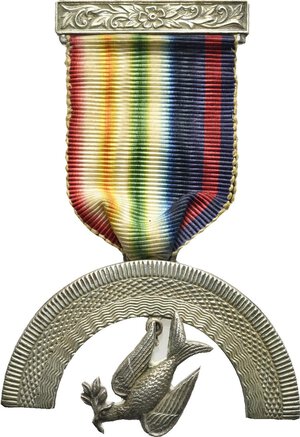
Peace Commemorative Medal (Dove of Peace), c. 1919–1920 (56.66 mm, 18.06 g).
Maker: British manufacture
A well-preserved post–First World War Peace commemorative medal, suspended from its original rainbow-striped silk ribbon, symbolising the Allied victory and the restoration of peace following the Great War.
The obverse features a finely cast dove in flight carrying an olive branch, suspended beneath a textured semi-circular arch, emblematic of peace and reconciliation. The symbolism is both elegant and direct, characteristic of British commemorative issues produced in the immediate post-war period. The medal is suspended from a decorative silver-toned bar, retaining its original pin fitting.
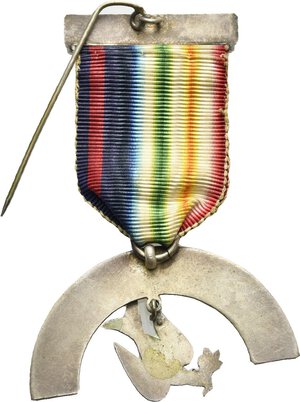
The reverse is plain, as issued, showing the original suspension and fittings. The construction and ribbon style are consistent with privately issued British peace medals of 1919–1920, often worn alongside official campaign awards.
Condition: Very Fine. Medal with even toning and light surface wear; dove intact with good definition; ribbon original, bright in colour with minor age creasing; suspension and pin sound.
Estimate
Lot # 314
-
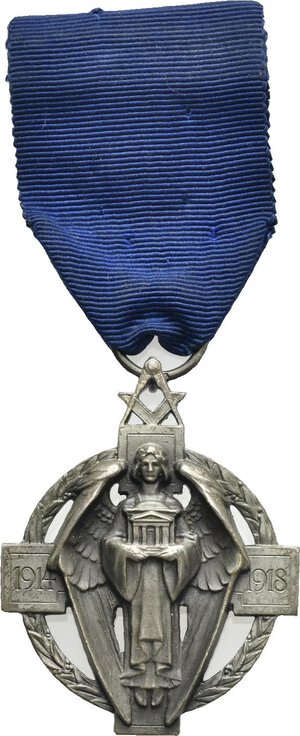
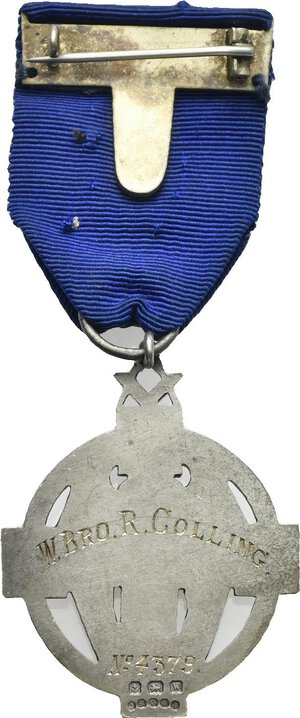
Masonic Commemorative Jewel, 1914–1918 (45.97 x 37.72 mm, 32.65 g).
Masonic Commemorative Jewel, England, dated 1914–1918.
Silver jewel suspended from a dark blue ribbed silk ribbon. The obverse depicts a standing allegorical female figure with outstretched wings, holding a classical temple, within a laurel wreath and flanked by the dates “1914” and “1918”, surmounted by a square and compasses. Plain pierced reverse engraved “W. Bro. R. Colling” with issue number No. 14379, retaining original horizontal pin fitting. Hallmarks present to the lower reverse.
A fine First World War commemorative Masonic jewel, well modelled and of good quality, commemorating service during the Great War.
Condition: Very good, light surface wear and patina consistent with age; ribbon with minor wear.
Period: Circa 1919–1920.
Lot # 313
-
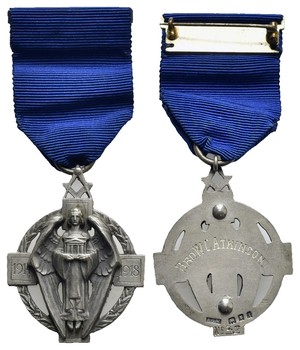
Masonic War Service Commemorative Jewel, 1914–1918 (46.36 x 37.70 mm, 28.94 g).
Maker: A.G.W. (hallmarked)
Hallmarked Sterling Silver (British, c. 1919–1920)
A striking and well-crafted Masonic commemorative jewel issued to honour service or support during the First World War, dated 1914–1918. Executed in solid silver with sculptural detail and suspended from a deep blue ribbon, this piece represents one of the most symbolically rich wartime jewels produced for the Masonic fraternity.
The obverse features a powerful allegorical figure—an angelic guardian or winged personification of Peace—standing before a temple façade, framed by laurel wreath elements symbolising victory and remembrance. Extending to either side are rectangular panels bearing the dates 1914 and 1918, marking the duration of the Great War.
Above the central figure is a stylised square and compasses, integrating the jewel firmly into Masonic tradition.
Reverse
The reverse is engraved:
BRO. W. C. ATKINSON
with additional British silver hallmarks along the lower edge confirming manufacture in sterling silver. The maker’s mark A.G.W. is clearly struck. The original suspension fitting remains intact.
A period paper label survives on the reverse, likely an old collector or lodge inventory notation.
Condition: Very Fine. Silver surfaces show even age patina; sculptural detail strong and well-preserved; original ribbon in excellent colour and condition; reverse lightly marked consistent with age; suspension bar sound.
An evocative and collectible post–World War I Masonic commemorative jewel, notable for its silver construction, symbolic imagery, and engraved attribution. Highly desirable to collectors of Masonic regalia and Great War commemorative medals.
Lot # 312
-
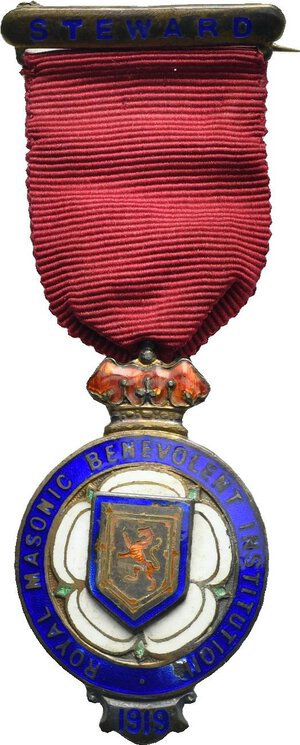
Royal Masonic Benevolent Institution – Steward Jewel, 1919 (28.05 mm, 16.96 g).
Maker: C. Kenning & Son, London
Hallmarked Sterling Silver (London, 1918–19)
A fine post–World War I Royal Masonic Benevolent Institution (RMBI) Steward Jewel, dated 1919, crafted in sterling silver with rich enamel and suspended from its original deep crimson ribbon. This early interwar jewel is an excellent example of Kenning’s high-quality regalia workmanship.
The suspension bar is gilt and enamelled in dark blue with the inscription STEWARD, from which hangs a ribbed crimson ribbon of strong colour. Below this is a red-enamelled coronet, marking the jewel as an official RMBI fundraising honour.
The circular medallion features a white enamel Tudor rose at its centre, overlaid with a blue-bordered shield bearing a rampant red lion on a gold field. Surrounding this emblem is a blue enamel band reading:
ROYAL MASONIC BENEVOLENT INSTITUTION
The year 1919 appears at the bottom of the medallion.
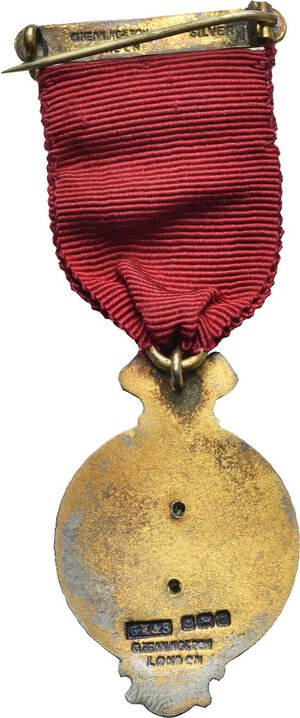
Reverse
The reverse is stamped:
C. KENNING & SON
LONDON
and carries full British silver hallmarks:
Sterling silver (lion passant)
London assay (leopard’s head)
Date-letter for 1918–19
Maker’s mark: CKS (C. Kenning & Son)
Two small screws secure the enamel medallion to its frame, as typical of RMBI construction of this period.
Condition: Fine. Ribbon with some age wear but retains strong colour; enamel with minor losses at edges but overall intact and attractive; gilt areas toned; reverse showing natural patina; hallmarks clear; suspension fitting intact.
A historically appealing post-WWI RMBI Steward Jewel, valued for its early date, silver construction, and classic Tudor rose design. A strong example for collectors of Masonic benevolent regalia.
Lot # 311
-
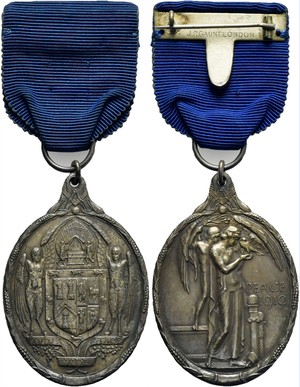
Peace 1919 – Silver Commemorative Medal (J. R. Gaunt, London) (Silver, 41.44 mm, 42.22 g).
Maker: J. R. Gaunt, London (stamped to suspension bar).
In a dark green leather fitted box, gilt-tooled to lid, George Kenning & Son, Liverpool (box slightly worn/used). A substantial silver Peace 1919 medal, suspended from its original deep blue ribbed ribbon on a brooch bar stamped J.R. GAUNT, LONDON. The medal is of impressive weight and sculptural quality, with strong relief and a rich aged tone. One side bears an armorial shield within an architectural/cartouche setting, flanked by two standing figures (supporters) and surmounted by an emblematic canopy. A ribbon motto scroll below begins “AND …” and continues “… TAC …” (as struck; full motto indistinct in the photograph), with an additional small scroll at the base. The reverse is a classic allegorical “Peace” composition, showing a standing figure receiving/holding a dove and olive branch, with the inscription:
PEACE 1919
and symbolic elements in the field, executed in the characteristic style of early 20th-century medallic art.
Reverse / fittings
Brooch fitting intact and functional; suspension bar clearly stamped J.R. GAUNT, LONDON.
Condition: Very good. Strong detail with attractive natural patina; ribbon crisp with light wear; minor surface marks consistent with age; fittings secure. Case with visible use and age wear.
Lot # 310
-
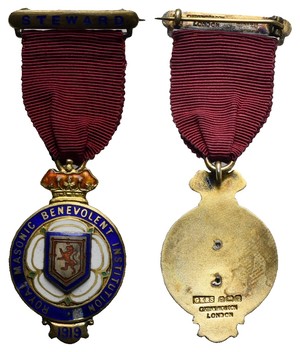
Royal Masonic Benevolent Institution (R.M.B.I.) Steward’s Jewel, Sterling Silver and Enamel, 1919, by G. Kenning & Son (43.54 x 28.25 mm, 18.02 g).
A fine early Steward’s jewel for the 1919 Festival of the Royal Masonic Benevolent Institution, the gilt and blue enamel bar reading STEWARD above a crimson ribbed ribbon. Suspended below, a crowned sterling silver and enamel medallion bearing the Institution’s name and date, enclosing a heraldic shield with red lion on white field surrounded by decorative white and blue enamel.
Reverse struck with full London silver hallmarks and the maker’s stamp G. KENNING & SON, LONDON, retaining its original fittings.
Condition: Very fine; enamel clean with only light age wear, silver with attractive natural patina, ribbon intact with gentle handling marks. A handsome and desirable early RMBI jewel.
Lot # 309
-
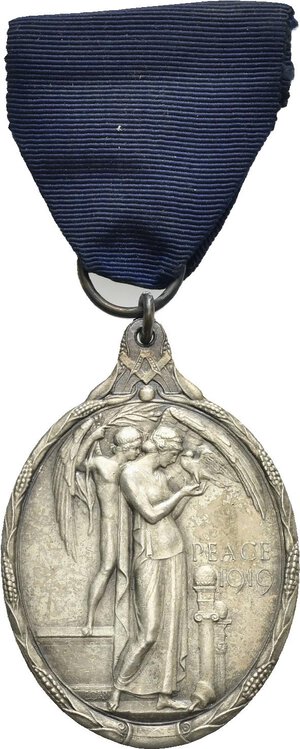
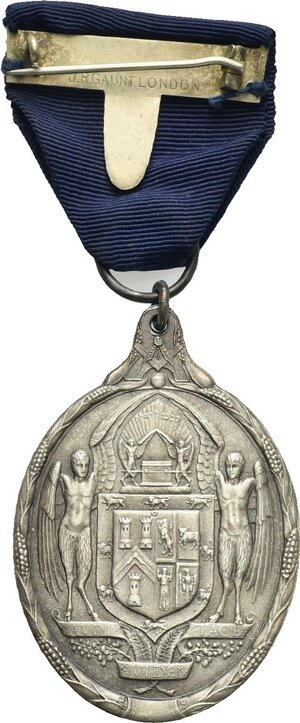
Commemorative Peace Medal, 1919 (41.36 x 58.05 mm, 43.21 g).
Commemorative Peace medal, dated 1919, silvered metal, suspended from its original dark blue ribbed silk ribbon.
The obverse depicting two allegorical winged figures embracing, symbolising reconciliation and peace, with the inscription “PEACE 1919” beside a flaming altar. The reverse showing a heraldic shield flanked by two standing angels beneath a canopy, with the Latin motto “Audi, Tace, Vide” on scrolls below. The medal is framed by a laurel and decorative border.
Suspension with original ring and ribbon bar, the reverse of the bar stamped “J.R. Gaunt, London”, with original pin fitting intact.
A finely modelled and evocative post–First World War commemorative medal, reflecting the symbolic language of peace and vigilance prevalent immediately after the Armistice.
Condition: Very good, with light surface wear and natural patina; ribbon with minor age-related wear.
Date: 1919.
Lot # 308
-
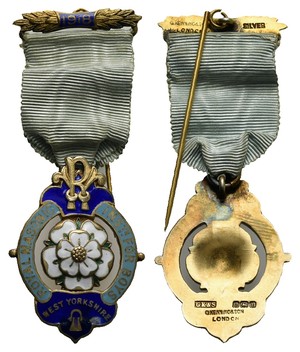
Royal Masonic Institution for Boys – West Yorkshire Festival Jewel, 1918 (42.94 x 31.95 mm, 17.58 g).
Maker: G. Kenning & Son, London
Material: Hallmarked Sterling Silver (London, 1918)
A fine 1918 Festival Jewel for the Royal Masonic Institution for Boys, issued for the West Yorkshire Province. This example is crafted in sterling silver with vivid blue and white enamel and retains its original pale-blue watered silk ribbon and gilt suspension fittings.
The top bar features a laurel-wreathed panel with the date 1918 in blue enamel, symbolising contribution and merit during this wartime fundraising year. Suspended below is the monogram R M I B, neatly cast and gilded.
The central medallion displays a large, beautifully modelled White Rose of York, finely executed in white enamel with green accents, set within an oval border. The surrounding blue enamel legend reads:
ROYAL MASONIC INST. FOR BOYS (upper)
WEST YORKSHIRE (lower)
The reverse bears full and clear London 1918 silver hallmarks, along with the maker’s mark G.K.&S for George Kenning & Son, one of the foremost manufacturers of Masonic jewels of the period.
Condition: Very Fine. Enamel crisp and clean; the white rose sharply defined; ribbon original and only lightly softened; silver with an attractive golden patina from age; hallmarks distinct. A handsome and early WWI-era RMIB jewel, increasingly sought after.
An excellent example from the final year of the Great War.
Lot # 307
-
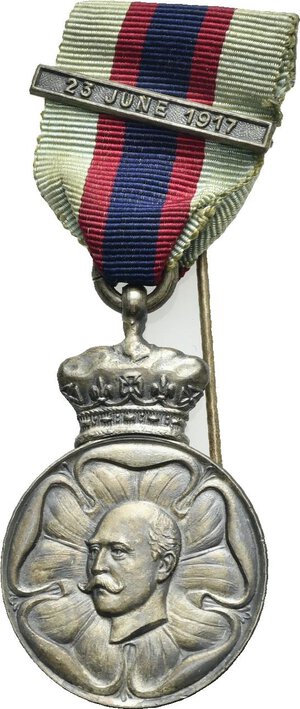
HRH Duke of Connaught – Masonic Medal, 1917 (47.25 x 30.22 mm, 29.03 g).
Date Bar: 25 June 1917
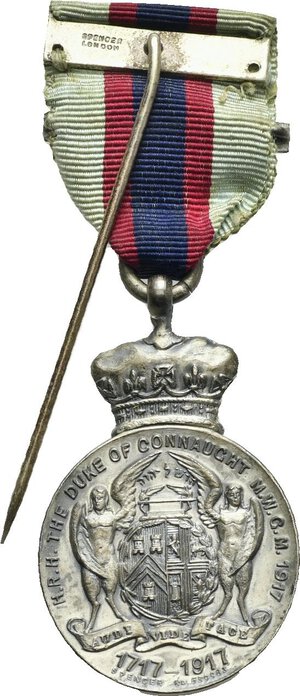
Maker: Spencer, London (marked on reverse bar)
Material: Silver (unhallmarked, but typical Spencer strike during WWI era)
Condition: Very Fine
DESCRIPTION
A historically significant commemorative Masonic medal issued during WWI in honour of H.R.H. the Duke of Connaught, Grand Master at the time.
Suspension & Ribbon
Original silk ribbon with central navy and flanking red stripes.
Suspended from a metal top bar engraved:
“25 JUNE 1917”
Long period-style pin mount to the rear.
Obverse
Struck in relief with a fine portrait of Prince Arthur, Duke of Connaught, facing left.
The portrait is framed by a radiating petal-like border, giving the medal a crisp, sculptural appearance.
Reverse
Displays the full Coat of Arms supported by two robed figures.
Around the edge inscribed:
“H.R.H. THE DUKE OF CONNAUGHT M.W.G.M. 1917”
Lower panel shows the dual date:
“1717 – 1917”
marking the bicentenary of English Freemasonry.
Maker’s mark: SPENCER LONDON impressed at the bottom.
NOTES
This medal commemorates the 200th Anniversary (1717–1917) of the establishment of the first Grand Lodge in London, making it one of the most recognisable and desirable early 20th-century Masonic commemoratives. Spencer of London produced a range of very high-quality lodge jewels and medals throughout the 1910s–1930s.
Lot # 306
-
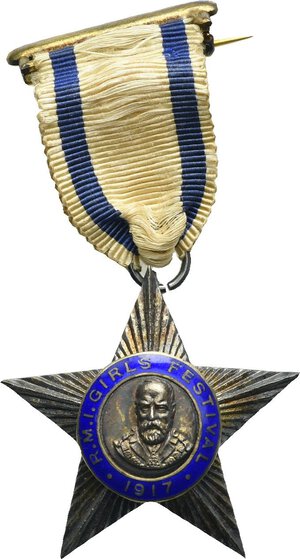
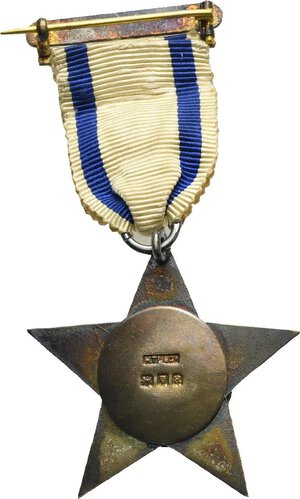
Royal Masonic Institution for Girls – Festival Jewel, 1917 (42.95 mm, 22.15 g).
Maker: (Hallmarked Birmingham)
Hallmarked Sterling Silver (Birmingham, 1916–17)
A scarce and appealing Royal Masonic Institution for Girls (RMIG) Festival Jewel dated 1917, produced during the final years of the First World War. Crafted in sterling silver with enamel highlights and suspended from its original cream-and-blue ribbon, this early festival star displays a bold and distinctive wartime design.
The jewel takes the form of a radiating five-pointed star, centred by a circular medallion bearing a portrait of King George V, finely struck in relief. Surrounding the portrait is a deep blue enamel ring inscribed:
R.M.I. GIRLS FESTIVAL – 1917
The contrast between the darkened silver rays and the enamelled medallion creates a striking visual depth characteristic of RMIG’s early 20th-century festival issues.
Reverse
The reverse shows a circular plaque struck with full British silver hallmarks, confirming:
Sterling silver (lion passant)
Birmingham assay (anchor mark)
Date-letter for 1916–17
Maker’s mark (clearly impressed)
The original pin-back suspension fitting remains present, exhibiting natural oxidation consistent with age.
Condition: Fine. Ribbon with pronounced creasing and wear at folds; enamel ring intact with good colour; portrait medallion with light toning; silver star showing attractive age patina; reverse hallmarks sharp; suspension secure.
A desirable and historical First World War-era RMIG Festival Jewel, valued both for its early date and its portrait medallion of George V. Highly collectible among enthusiasts of Masonic regalia and wartime institutional jewels.
Lot # 305
-
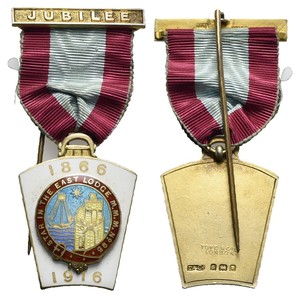
Mark Master Masons – Jubilee Jewel, Star in the East Lodge No. 508 (1866–1916)
Maker: Toye & Co. Ltd., London (31.23 mm, 28.69 g).
Hallmarked Sterling Silver (London, 1915–16)
Occasion: 50th Anniversary (Jubilee) of the Lodge
A beautifully detailed Jubilee Jewel commemorating the 50th anniversary of the Star in the East Lodge of Mark Master Masons No. 508, first established in 1866. This early World War I era jewel is crafted in sterling silver with gilt and enamel highlights, and suspended from its original crimson-and-white ribbon.
The suspension bar is gilt and boldly inscribed in high-relief:
JUBILEE
Below this hangs the original ribbon in alternating crimson and white vertical bands, remaining in strong and presentable condition.
Obverse
The main badge is shaped as a Mark keystone — the defining emblem of Mark Masonry — and is enamelled with the dates:
1866 at the top
1916 at the bottom
At the centre lies a vivid, pictorial blue enamel medallion encircled by the inscription:
STAR IN THE EAST LODGE M.M.M. No. 508
The inner enamel roundel depicts a castle or fortified tower at seaside, waves beneath, with a radiant star above — symbolising guidance, steadfastness, and the “Star in the East” theme of the lodge name. The colours are crisp and luminous, indicative of Toye & Co.’s high-quality enamel work.
Reverse
The reverse is cleanly stamped:
TOYE & CO LTD LONDON
Full London sterling silver hallmarks:
Lion passant (sterling)
Leopard’s head (London assay)
Date-letter for 1915–16
Maker’s mark: T & Co
The original long pin-back fastening is present and in sound working order.
Condition: Very Fine. Ribbon bright with minimal wear; enamel exceptionally well preserved with no significant losses; gilt and silver surfaces attractively toned; hallmarks sharp; suspension fittings fully intact.
A highly collectable Mark Masonry Jubilee Jewel, especially desirable for its pictorial enamel centre and early date. Toye’s production quality and the lodge’s historic name make this an appealing example for both Mark Masons and enamel/regalia specialists.
Lot # 304
-
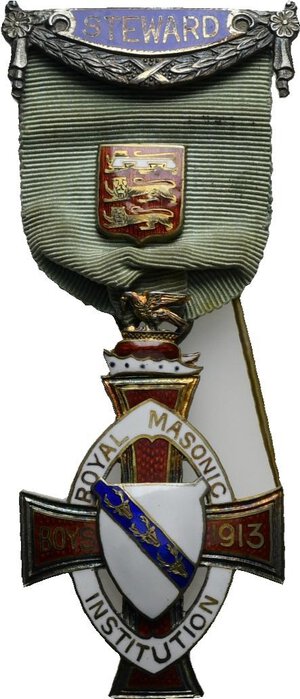
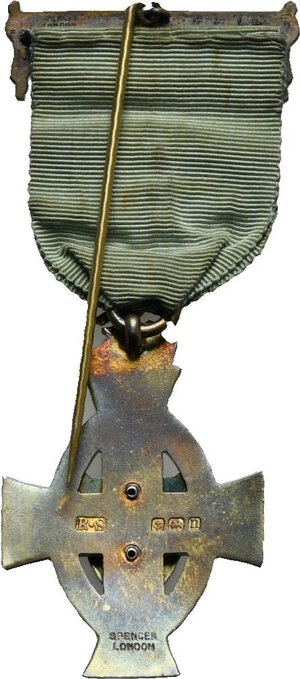
Royal Masonic Institution for Boys – Steward Jewel, 1913 (50.45 x 33.64 mm, 23.18 g).
Maker: Spencer, London
Hallmarked Sterling Silver (with coloured enamel), suspended from its original pale green ribbed ribbon.
In a burgundy leather fitted case by H. S. Lindsay Ltd.
A fine Edwardian Royal Masonic Institution for Boys (RMIB) Steward Jewel dated 1913, executed in sterling silver with coloured enamel and suspended from its original pale green ribbon. The design is of the classic cross-and-badge type, combining bold enamel fields with crisp die-struck detail typical of Spencer’s early 20th-century workmanship.
The upper bar is a decorative silver mount with laurel and floral terminals, centred by a blue enamel panel inscribed STEWARD. The ribbon is fitted with a small enamel shield device (showing a heraldic animal and quarterings).
Suspended below is the main RMIB jewel: a cross-form badge with red enamel arms and a central white enamel oval inscribed ROYAL MASONIC INSTITUTION, with side panels BOYS and the date 1913. Above sits a coronet with an eagle, and at centre is a shield with a diagonal blue band charged with gold emblems.
Reverse: The reverse shows the original brooch fitting and openwork construction, with clear maker’s stamp SPENCER LONDON and hallmarks to the silver.
Condition: Very good. Ribbon with age wear/creasing; enamel bright with small losses and surface wear at high points; silver with attractive toning and some handling marks; reverse with clear maker’s stamp and hallmarks; suspension secure.
Lot # 303
-
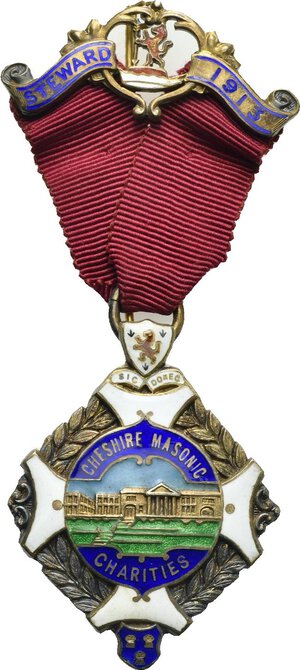
Cheshire Masonic Charities – Steward Jewel, 1913 (37.40 mm, 27.40 g).
Maker: Fattorini & Sons, London & Birmingham
Hallmarked Sterling Silver (London, 1912–13)
A finely executed Cheshire Masonic Charities Steward Jewel, dated 1913, crafted in sterling silver with richly coloured enamel and suspended from its original deep crimson ribbon. This pre–WWI example is notable for its elegant early design and its detailed architectural enamel scene.
The suspension bar is enamelled in blue with:
STEWARD — 1913
It features ornate scrollwork and a central gilt emblem depicting a knight with shield—an allegorical figure of charity or guardianship.
The jewel hangs from a ribbed crimson ribbon folded in the traditional triangular Masonic style.
Obverse
The main medallion is formed as a cross with laurel wreaths between the arms, symbolising honour and benevolence. At its centre is a superb pictorial enamel of the Royal Masonic School, Cheshire, showing its sweeping classical façade, green lawns, and blue sky background.
The blue enamel band at the bottom reads:
CHESHIRE MASONIC CHARITIES
Above the central scene is a scroll with the motto:
SIC DONEC
(“Thus until…” – part of the fuller motto Sic Donec used in regional Masonic philanthropy)
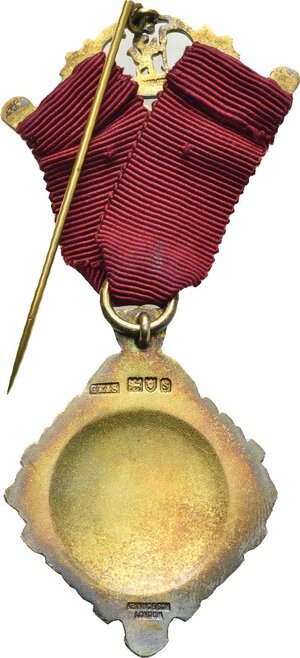
Reverse
The reverse carries full London silver hallmarks:
Sterling silver (lion passant)
London assay (leopard’s head)
Date-letter for 1912–13
Maker’s mark of Fattorini & Sons
The rim shows natural age patina, and the original long pin-back catch remains intact.
Condition: Fine to Very Fine. Ribbon with mild wear but stable; enamel scene bright and appealing with only minor age spotting; silver surfaces toned attractively; hallmarks clear; suspension fittings secure and original.
A desirable pre–World War I Cheshire Masonic Charities jewel, valued for its early date, pictorial enamel work, and sterling silver construction. An excellent addition to a regional or charity-focused Masonic collection.
Lot # 302
-
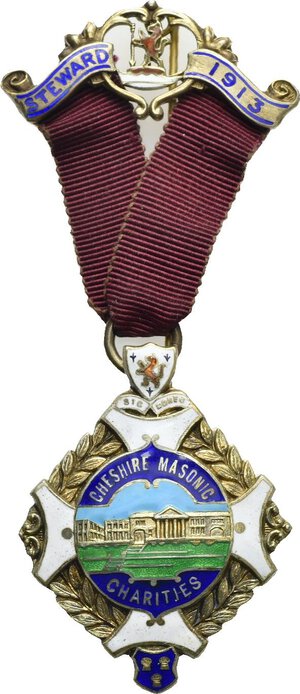
Cheshire Masonic Charities Steward’s Badge,1913 (37.60 x 46.70 mm, 27.24 g).
Cheshire Masonic Charities Steward’s badge, dated 1913, gilt and enamel, suspended from its original deep claret ribbed silk ribbon.
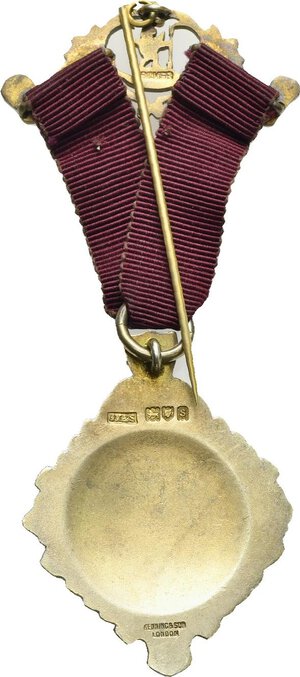
The obverse with enamelled cross bearing a central circular panel inscribed “Cheshire Masonic Charities”, depicting a classical building within a landscaped setting, surrounded by laurel wreath decoration. Above, the suspension bar enamelled “Steward 1913”, with heraldic crest surmount. The reverse plain, with maker’s mark “Kenning & Son, London”, retaining its original pin fitting.
A well-made and attractive provincial Masonic charity steward’s badge, representative of early 20th-century English Masonic regalia.
Condition: Very good, with minor enamel losses and light surface wear consistent with age; ribbon with slight wear.
Date: 1913.
Lot # 301
-
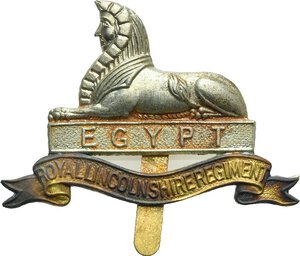
Royal Lincolnshire Regiment – Cap Badge (Egypt Sphinx) (43.05 x 64.30 mm, 14.18 g).
Type: Other Ranks’ Cap Badge
Period: Likely WWI–WWII era (c. 1910s–1940s)
Material: White metal with brass slider
A classic and desirable Royal Lincolnshire Regiment cap badge featuring the iconic Egypt Sphinx, a battle honour awarded for the Regiment’s distinguished service in the Egyptian Campaign of 1801. This style of badge remained in use for decades, including during the First and Second World Wars.
The design consists of a finely cast sphinx couchant atop a plinth bearing the word EGYPT, rendered in raised lettering. Beneath this lies a sweeping scroll inscribed:
ROYAL LINCOLNSHIRE REGIMENT
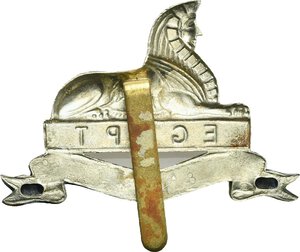
The badge is struck in white metal, with the scroll and lower highlights showing a contrasting gilt-brass tone. The reverse retains its original brass slider, a key indicator of authenticity and period manufacture.
Reverse
The back shows the expected plain white metal finish with the integral brass slider affixed firmly in place. Wear, oxidation, and patina are consistent with genuine service-era pieces.
Condition: Very Fine. Detail on sphinx and scroll remains strong; surface wear and patina appropriate to age; slider original and intact; no repairs.
A fine example of the Royal Lincolnshire Regiment’s historic sphinx cap badge, highly collectable among enthusiasts of British military insignia and regimental history.
Lot # 300
-
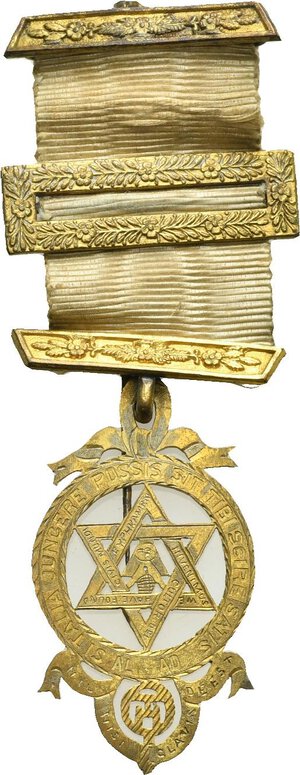
Royal Arch / Allied Masonic Degrees–Type Jewel (Uninscribed) (42.09 x 24.19 mm, 9.57 g).
Maker: Unmarked
Material: Gilt metal with white enamel
Date: c. 1910–1930 (stylistic estimate)
A large, ornate gilt fraternal jewel, consisting of a triple-section floral suspension and cream-coloured ribbon, leading to an intricate open-work medallion. The central motif is a hexagram (double triangle) containing Latin mottos, typical of late-Victorian and early-20th-century esoteric fraternal societies, including Royal Arch–related bodies, the Allied Masonic Degrees, and associated side-orders.
Suspension & Ribbon
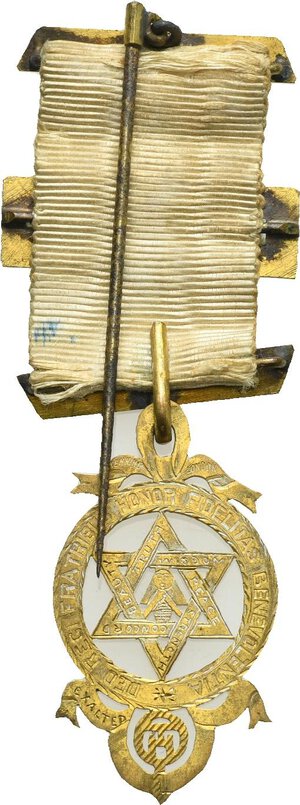
Three gilt bars, each with raised floral decoration, connected by cream silk ribbon in the original long ceremonial format. A long Victorian-style pin remains intact on the reverse.
Obverse
The medallion features:
A double triangle / hexagram formed by scroll-work arms
Latin mottos in the triangular arms (partially worn but consistent with Masonic moral maxims)
A surrounding gilt ring with additional Latin inscriptions in relief
A lower cartouche with further symbolic initials
The aesthetic is consistent with early 20th-century British-produced esoteric regalia.
Reverse
Plain gilt reverse without hallmarking, typical for non-silver issue jewels of this type. The construction shows hand-cut and soldered elements, suggesting small-batch manufacture.
Condition: Good overall. Ribbon lightly aged; gilding with moderate oxidisation; enamel intact; pin original and functional. No structural damage.
Notes
While the exact issuing order cannot be definitively attributed due to lack of inscription and hallmarking, the jewel clearly belongs to the symbolic/esoteric branch of British fraternal regalia, and pieces of this size and complexity are collectible.
Lot # 299
-
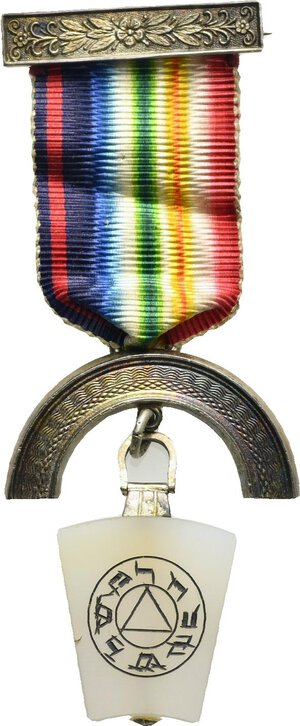
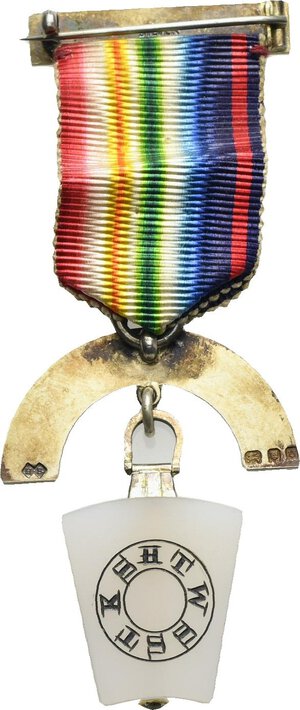
Royal Arch / Allied Masonic Degrees – Steward’s or Officer’s Jewel (36.90 mm, 17.86 g).
An unusual and attractive Masonic jewel, suspended from its original multicolour ribbed silk ribbon, the colours arranged in vertical bands of red, blue, green, yellow and white. The ribbon is mounted with a decorative gilt top bar featuring foliate engraving, fitted with original pin fastening to the reverse.
The jewel consists of a crescent-shaped metal suspension supporting a translucent shield-shaped pendant, finely engraved on each side. One face displays a sacred triangle within a circular inscription in Hebrew characters, while the reverse shows a corresponding circular emblem with further symbolic lettering, reflecting esoteric and ritual significance associated with higher Masonic or allied orders.
The reverse of the crescent retains maker’s hallmarks and the original suspension fittings, all intact.
Condition: Very Fine. Original ribbon present with light fading and minor wear; pendant well preserved with clear engraved symbols; metal components showing light age-related patina; pin and suspension complete and functional.
A distinctive and visually striking Masonic jewel, appealing for its symbolism, colour and quality of manufacture, well suited to collectors of British and allied Masonic regalia.
Lot # 298
-
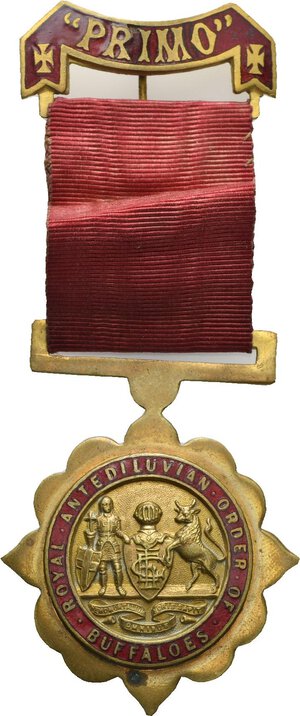
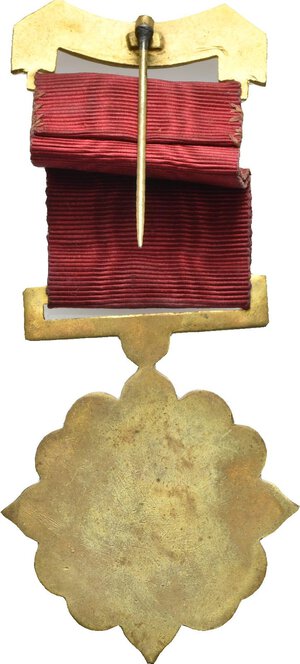
Royal Antediluvian Order of Buffaloes – “Primo” Jewel (45.24 mm, 23.51 g).
Buffaloes, Royal Antediluvian Order of, Primo Degree Jewel, England, early 20th century.
Gilt metal jewel suspended from a broad red ribbed silk ribbon, the upper suspension bar enamelled and inscribed “PRIMO” between two small crosses. The obverse with a circular enamelled central medallion inscribed “ROYAL ANTEDILUVIAN ORDER OF BUFFALOES”, enclosing a detailed allegorical scene with standing figures flanking a central shield, all within a scalloped gilt border. Plain gilt reverse. Original horizontal pin fitting to the reverse of the suspension bar.
An attractive and well-preserved example of an early Buffaloes Primo jewel, retaining strong colour to the enamel and ribbon, with expected light surface wear consistent with age.
Condition: Very good, minor wear and patina commensurate with age.
Period: Circa 1900–1925.
Lot # 297
-
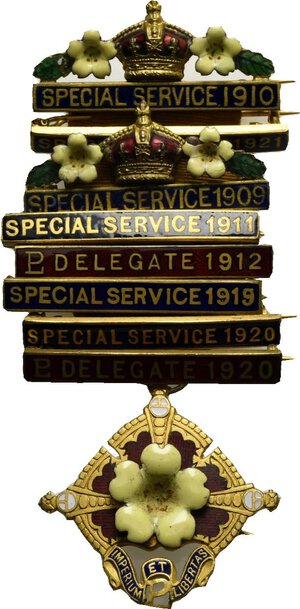
Primrose League – Multi-Clasp “Special Service / Delegate” Badge Group, 1909–1921 (102.46 x 40.20 mm). Maker: not visible from the provided photo (often found stamped to reverse on comparable Primrose League badges). Gilt metal with coloured enamels, mounted with its original ribbon backing; in a burgundy leather fitted case by J. Bragg, Birmingham & London (as supplied).
A striking and unusually extensive Primrose League badge group, built up with multiple year clasps for Special Service and Delegate duties spanning the Edwardian period through the immediate post–WWI years. The piece is dominated by a tall stack of enamel bars, including SPECIAL SERVICE 1909, SPECIAL SERVICE 1910 (crowned top bar with primrose sprays), SPECIAL SERVICE 1911, P DELEGATE 1912, SPECIAL SERVICE 1919, SPECIAL SERVICE 1920, P DELEGATE 1920, and an additional bar present behind/within the stack (partially obscured in the image, likely a later year).
Suspended below is the Primrose League badge device: a gilt quatrefoil/lozenge form with rich maroon enamel panels and a prominent primrose flower at centre. At the base is the League motto scroll:
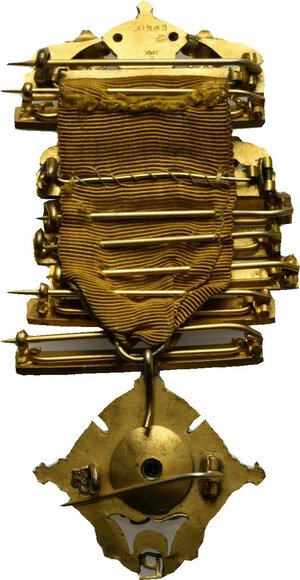
IMPERIUM ET LIBERTAY (“Empire and Liberty”). Reverse: The reverse shows the original composite construction with multiple brooch fittings (one for each clasp section) and the stitched ribbon backing, consistent with an assembled, worn service group.
Condition: Good. Enamel generally strong across the bars; the central primrose flower shows age spotting/soiling; gilt with surface wear; reverse fittings intact. Case with expected age wear.
Lot # 296
-
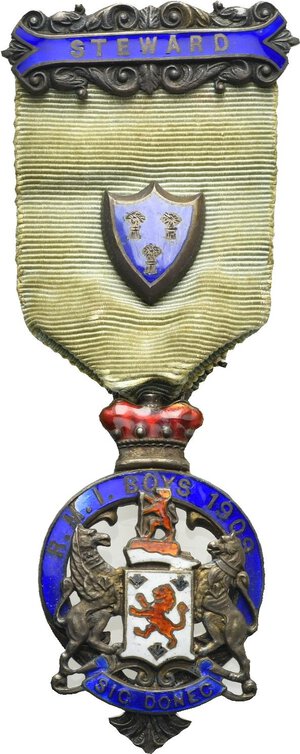
Royal Masonic Institution for Boys – Steward Jewel, 1909 (43.12 x 28.45 mm, 17.24 g).
Maker: Spencer, London
Hallmarked Sterling Silver (London, 1908–09)
A distinguished early Royal Masonic Institution for Boys (RMIB) Steward Jewel dated 1909, executed in silver with coloured enamel and suspended from its original pale ribbon. This Edwardian-period jewel is notable for its bold heraldic composition and the highly refined early 20th-century workmanship characteristic of Spencer’s London atelier.
The upper bar is an ornate scrollwork mount bearing a blue enamel panel inscribed STEWARD. Suspended beneath is the original ribbed ribbon in pale greenish-cream, adorned at centre by a small enamel shield displaying three wheat sheaves, a classic symbol of beneficence and abundance.
The main medallion is surmounted by a red enamel coronet, beneath which an oval blue enamel band reads:
R.M.I. BOYS 1909
Within the band is the full achievement of arms: a central shield displaying a rampant red lion, supported by two rearing horses, and crowned by a smaller lion crest above. At the base, a blue enamel scroll bears the Latin motto:
SIC DONEC
(“Thus until…” / “So long as…”)
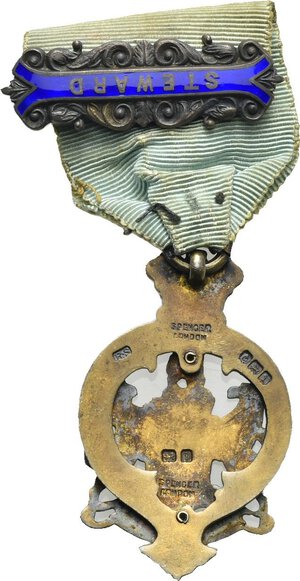
Reverse
The reverse shows the original construction plate with age patina.
Clear hallmarks on both the mounting frame and medallion confirm:
Sterling silver (lion passant)
London assay (leopard’s head)
Date-letter for 1908–09
Maker’s mark: SPENCER LONDON
The suspension fittings remain original and fully functional.
Condition: Fine. Ribbon with fraying and losses at edges; enamel bright with isolated wear at high points; silver with attractive toning; reverse retaining strong hallmarks; suspension secure.
An impressive and highly collectible Edwardian RMIB Steward Jewel, valued for its early date, elaborate heraldry, and high-quality silver construction. Examples from the first decade of the 1900s are increasingly sought after by collectors of Masonic regalia.
Lot # 295
-
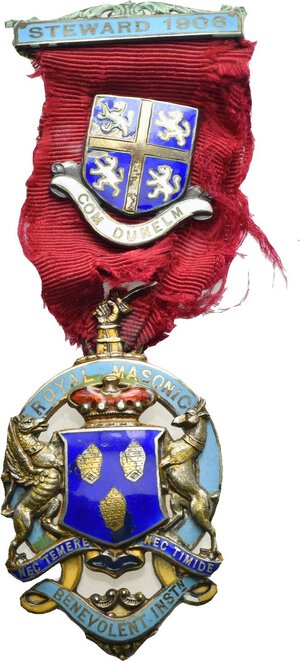
Royal Masonic Benevolent Institution – Steward Jewel, 1906 (County Durham) (55.55 x 34.20 mm, 21.77 g).
Maker: Spencer & Co., London
Hallmarked Sterling Silver (London, 1905–06)
A historically important Edwardian-era Royal Masonic Benevolent Institution (RMBI) Steward Jewel, dated 1906, representing the Province of County Durham (Comitatus Dunelmensis — Com. Dunelm). Crafted in sterling silver with rich enamel and suspended from the original crimson ribbon, this early RMBI example displays the elaborate heraldry and craftsmanship typical of Spencer & Co.
The upper suspension bar is enamelled STEWARD 1906, flanked by stylised scrollwork. Below hangs the provincial badge of County Durham, a blue-enamelled cross charged with four silver lions, set above a scroll inscribed:
COM. DUNELM
The ribbon—though heavily worn and frayed—remains original, adding genuine antique character.
The large pendant medallion is shaped in ornate scroll form and crowned at the top. Its outer band is enamelled ROYAL MASONIC BENEVOLENT INST., while the lower scroll bears the Latin motto:
NEC TEMERE • NEC TIMIDE
(“Neither rashly nor timidly”)
At centre is the striking coat of arms: a gilt shield bearing three golden lilies (fleurs-de-lis) against a deep blue enamel field, supported by two heraldic animals.
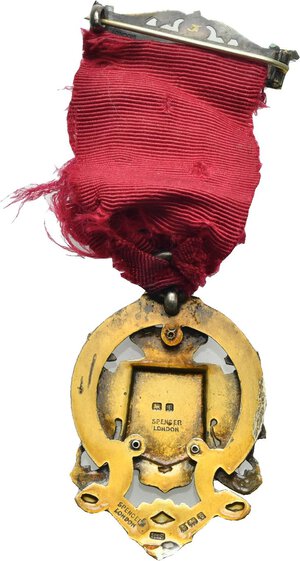
Reverse
The reverse bears:
SPENCER LONDON maker’s stamp
Full London hallmarks:
Sterling silver (lion passant)
London assay (leopard’s head)
Date-letter for 1905–06
Maker’s mark S&Co.
Two screw fixings secure the enamelled heraldic shield to the frame, as expected for early RMBI construction.
Condition: Fair to Fine (historically appealing). Ribbon heavily tattered and fragile; enamel largely intact with some age-related losses; gilt portions toned and worn; silver surfaces patinated; hallmarks clear; suspension mount original. Despite ribbon condition, the jewel retains strong display value and considerable historical interest.
A scarce and highly desirable pre-WWI RMBI Provincial Steward Jewel, representing the Province of Durham and dating from just after the turn of the century. Early dated RMBI jewels, especially with provincial arms, are increasingly difficult to obtain.
Lot # 294
-
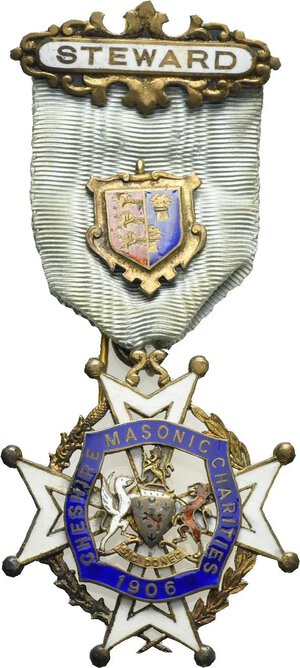
Cheshire Masonic Charities Steward’s Badge, 1906 (41.33 x 19.67 g).
Cheshire Masonic Charities Steward’s badge, dated 1906, gilt and enamel, suspended from its original pale blue ribbed silk ribbon.
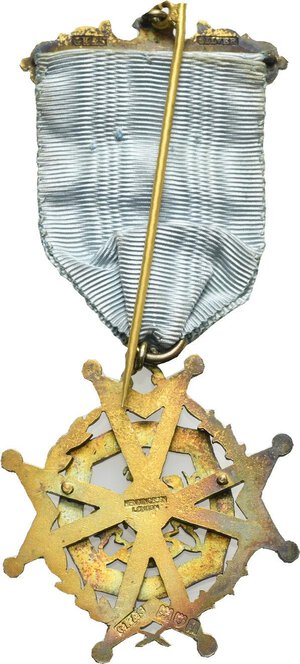
The obverse with an enamelled multi-pointed star badge inscribed “Cheshire Masonic Charities”, dated 1906, centred with a heraldic shield bearing supporters and armorial devices, all within a blue enamelled circular band. The star backed with white enamel arms and laurel wreath details. Above, the ribbon mounted with a gilt and enamel suspension bar inscribed “Steward”, surmounted by ornate scrollwork, and a small enamelled shield device affixed to the ribbon. The reverse with openwork star backing plate, retaining its original long pin fitting, and stamped “Kenning & Son, London”, with maker’s marks to the lower arm.
A fine and well-detailed early 20th-century Cheshire Masonic Charities steward’s badge, retaining good enamel colour and original ribbon.
Condition: Very good, with light surface wear and age-related patina; enamels largely intact with minor losses; ribbon showing expected wear.
Date: 1906.
Lot # 293
-
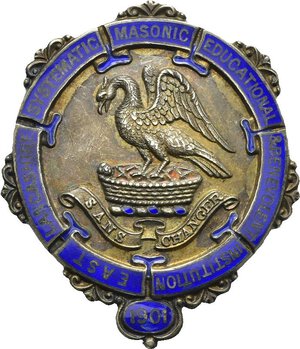
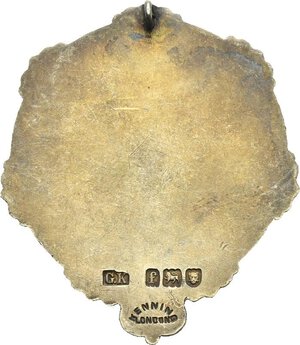
Systematic Masonic Educational & Benevolent Institution, East Lancashire, Award Jewel, Sterling Silver & Enamel, 1901, by G. Kenning, London (50.37 mm, 21.56 g).
A scarce early Masonic charity jewel for the East Lancashire branch of the Systematic Masonic Educational & Benevolent Institution, the ornate sterling silver medal with blue enamel border inscribed SYSTEMATIC MASONIC EDUCATIONAL & BENEVOLENT INSTITUTION – EAST LANCASHIRE, dated 1901.
The centre depicts the pelican feeding her young, the traditional emblem of Masonic charity, above a scroll bearing the motto SANS CHANGER. The reverse struck with full London silver hallmarks for 1901 and the maker’s mark G.K. for George Kenning, London, with additional KENNING LONDON stamp below.
Condition: Very fine; attractive toning to silver, enamel completely intact, light age wear only. A rare and desirable pre-RMBI charitable jewel.
Lot # 292
-
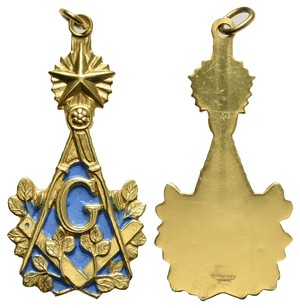
A Gold-Gilt and Enamel Masonic Jewel, Early 20th Century (38.89 x 78.73 mm, 36.05 g).
A finely crafted Masonic jewel, the obverse featuring the traditional Square and Compasses centred with the letter G, symbolising Geometry and the Great Architect. The background highlighted with blue enamel and surrounded by detailed foliate decoration. Above, a radiant star and rosette motif form the suspension, complete with original loop.
The reverse plain and uninscribed, retaining a smooth polished surface. Gold-gilt throughout with attractive warm tone.
Condition: Very fine; minor enamel wear, light handling marks; suspension intact.
A well-executed example of Masonic ceremonial jewellery, likely produced for lodge officers during the early 20th century.
Lot # 291
-
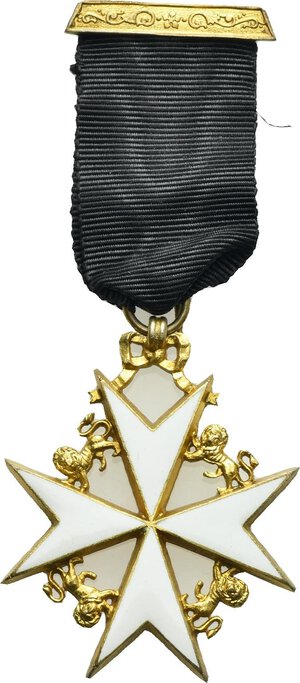
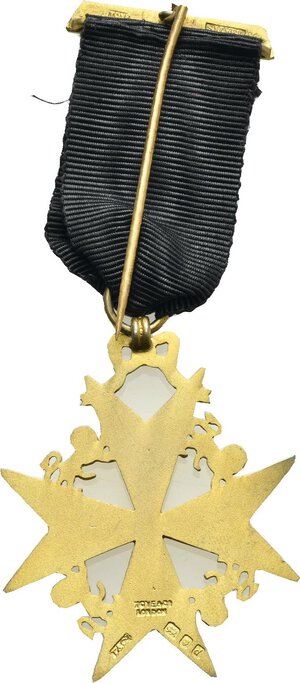
Order of St John – Officer’s Breast Jewel (Early 20th Century) (42.30 mm, 22.17 g).
Maker: Toye & Co., London
Hallmarked Sterling Silver (London, date-letter early 1900s)
A refined and elegant Order of St John Officer’s Jewel, crafted in sterling silver with gilt finish and white enamel, suspended from its original black ribbed ribbon. This piece represents the classic insignia style used in the early decades of the 20th century and is distinguished by its crisp enamelwork and detailed gilt ornamentation.
The insignia takes the form of an eight-pointed Maltese Cross, the arms rendered in smooth white enamel bordered in gilt. Between the arms appear finely modelled gilt lions and unicorns—traditional heraldic supporters associated with the Order’s British Royal Charter. The suspension is through a gilt bow element, attaching the cross to a broad black ribbon, surmounted by an engraved gilt top bar of foliate design.
Reverse
The reverse shows the clean geometry of the cross construction, with the gilt finish intact.
Clearly struck British hallmarks confirm:
Sterling silver (lion passant)
London assay (leopard’s head)
Maker: TOYE & Co., LONDON
Date-letter corresponding to early 20th century manufacture
The long pin-back fitting on the top bar remains fully intact and functional.
Condition: Very Fine. Enamel clean and undamaged; gilt metal with soft patina; ribbon in good condition with only light handling creases; reverse hallmarks sharp; suspension and pin fittings secure.
An attractive and high-quality example of an Order of St John Officer’s Jewel, admired for its elegant enamelled cross, detailed supporters, and early 20th-century hallmarking. A desirable piece for collectors of chivalric, fraternal, and Masonic-associated insignia.
Lot # 290
-
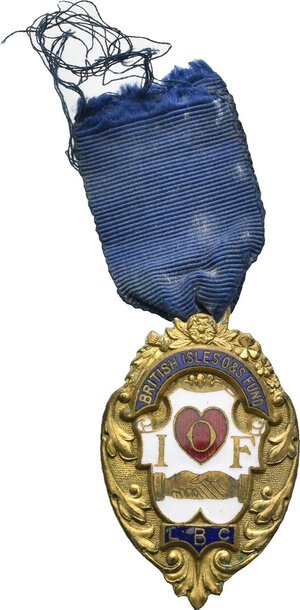
Independent Order of Foresters (I.O.F.) British Isles & Sons Fund Medal, Early 20th Century (43.99 mm, 14.67 g).
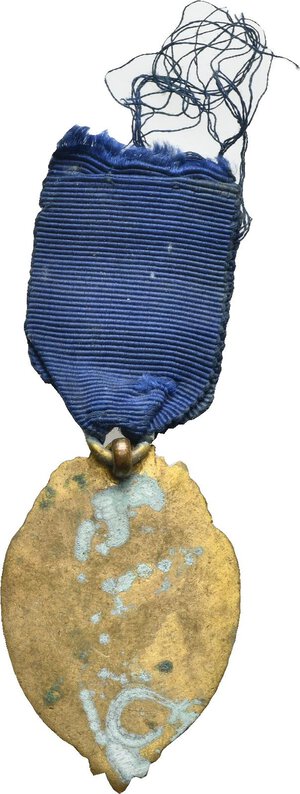
A gilt and enamel medal of the Independent Order of Foresters, suspended from a blue ribbed ribbon, the obverse with ornate gilt-framed shield enamelled in white, red and blue. The centre displays the red heart and handshake symbols of the Order, flanked by the initials I • O • F, with the motto initials L • B • C (Liberty, Benevolence, Concord) on the lower scroll. The upper scroll reads BRITISH ISLES & SONS FUND in blue enamel. Reverse plain, retaining original suspension loop; ribbon worn from age.
Condition: Good to very good; enamel intact with minor surface wear, gilding with age patina, ribbon visibly frayed but original.
Lot # 289
-
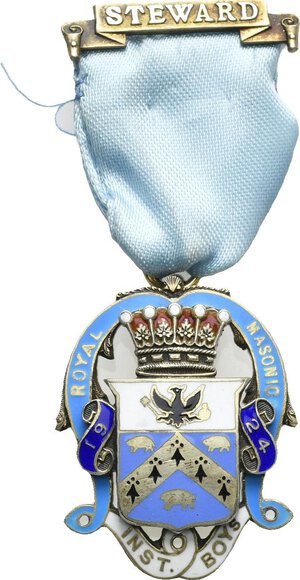
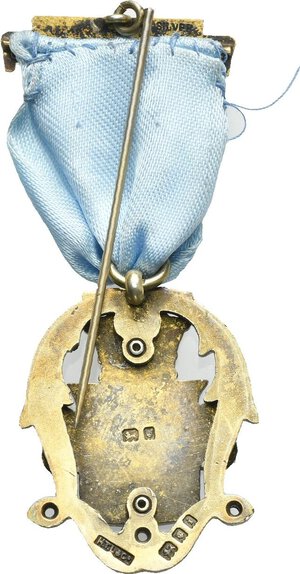
Royal Antediluvian Order of Buffaloes – Steward Jewel (32.41 x 39.49 mm, 23.53 g).
Buffaloes, Royal Antediluvian Order of, Steward Jewel, England, early 20th century.
Gilt and enamelled metal jewel suspended from a pale blue silk ribbon with an upper suspension bar inscribed “STEWARD”. The obverse decorated with a heraldic shield beneath a crown, flanked by blue enamel scrolls inscribed “ROYAL” and “MASONIC”, the lower portion inscribed “INST. BOS”. The shield displays traditional Buffaloes symbolism including pigs and chevrons, executed in white and blue enamel. Plain gilt reverse with original horizontal pin fitting. Maker’s marks to the reverse.
A well-detailed and attractive Steward’s jewel, retaining good colour to the enamel and ribbon, with light wear consistent with age and use.
Condition: Very good, light surface wear and patina commensurate with age.
Period: Circa 1900–1925.
Lot # 288
-
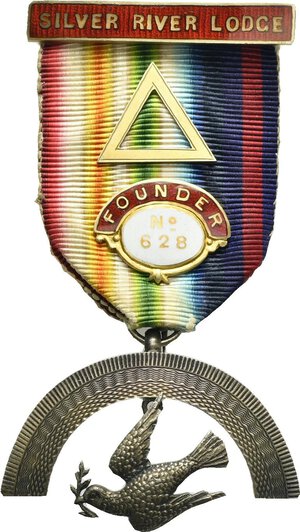
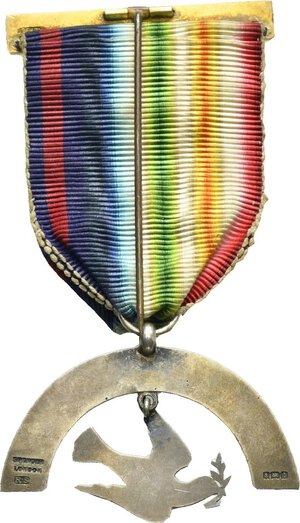
Silver River Lodge Founder’s Jewel, No. 628 (48.07 x 26.18 mm, 24.83 g).
Silver River Lodge Founder’s jewel, silver, suspended from its original multi-coloured ribbed silk ribbon, fitted with a red enamelled suspension bar inscribed “SILVER RIVER LODGE”, and retaining its original pin fastening.
The obverse with a silver circular openwork medallion, featuring a dove in flight carrying an olive branch, suspended beneath a triangular Founder’s emblem, with an oval enamelled plaque inscribed “FOUNDER” enclosing “No. 628”, the ribbon displaying the characteristic graduated colour bands associated with founder or commemorative lodge jewels.
The reverse plain silver, with maker’s mark “SPINK & SON LTD, LONDON”, additional hallmarks visible, and original long pin fastening intact.
A well-executed early 20th century Masonic Founder’s jewel, notable for its symbolic dove motif and original ribbon, preserved in attractive, honest condition.
Condition: Very good, with light wear and patina consistent with age; enamel intact; ribbon clean with minor age-related toning.
Date: Early 20th century.
Lot # 287
-
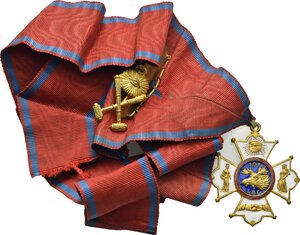
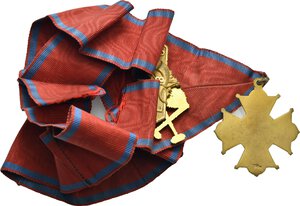
Yorkshire Order of Foresters (Y.O.F.) – Loyal British Court (L.B.C.) Ceremonial Jewel / Sash Badge, (60 x 60 mm) c. 1900–1925
Gilt metal with coloured enamel, suspended from a wide maroon moiré ribbon with blue edge stripes.
A striking fraternal / friendly-society jewel, suspended from its original broad ribbon. The upper clasp is a gilt bar bearing the initials L • B • C, centred by an emblematic animal-head device. Below hangs a gilt All-Seeing Eye within radiating rays, set above crossed mallets, leading down to the main cross-form badge.
The principal badge is a white enamel cross with gilt ball terminals, featuring side panels with standing allegorical figures and a clasped-hands motif to the lower arm (symbolic of fellowship). At centre is a deep blue enamel roundel with a relief stag/elk head, lettered Y.O.F above and L.B.C. below.
Reverse: Plain gilt reverse (as photographed), with ribbon wear consistent with age and use.
Condition: Good. Enamel generally sound; gilt with expected rubbing; ribbon shows clear wear/creasing and loose threads, but remains presentable.
Lot # 286
-
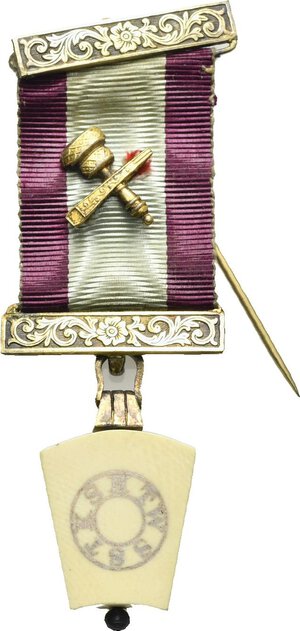
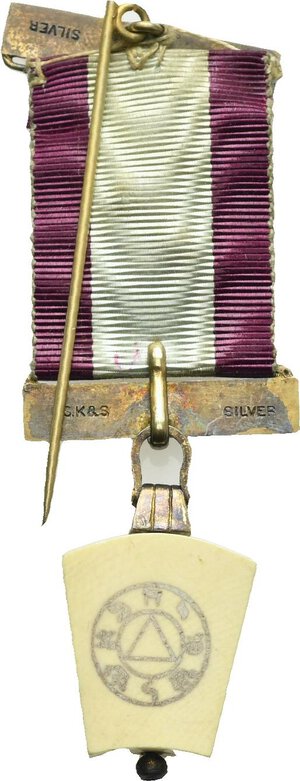
Royal Arch Masonic Companion’s Jewel, c. 1900–1920 (35.86 x 20.94 mm, 11.81g).
Maker: George Kenning & Son (G.K.&S.), London
Material: Silver-mounted ribbed silk ribbon; suspended with an ivory-coloured pendant engraved with Royal Arch symbols
A fine early 20th-century Royal Arch Masonic Companion’s jewel, suspended from a vertically ribbed silk ribbon in the traditional purple and white colours of the Order. The ribbon is fitted with ornate silver bars above and below, finely engraved with foliate decoration, and retains its original long pin fastening to the reverse.
The jewel is completed by an ivory-coloured pendant of tapering form, engraved on both sides with circular and triangular Royal Arch symbols, including the Triple Tau within a triangle and Hebrew characters arranged around a central circle. The pendant is secured by its original suspension fitting and terminal mount.
The reverse of the ribbon mount is clearly stamped G.K.&S. / SILVER, confirming manufacture by George Kenning & Son of London, one of the principal makers of British Masonic regalia during the late 19th and early 20th centuries.
Condition: Very Fine. Ribbon with light age wear and minor fading consistent with period use; silver mounts with attractive toning; pendant intact with clear engraved detail. A well-preserved and complete Royal Arch jewel with strong visual and symbolic presence.
Lot # 285
-
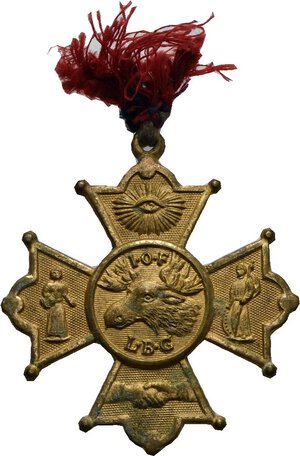
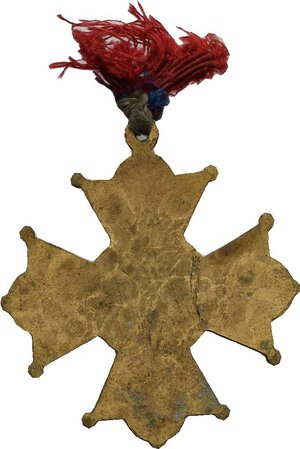
Independent Order of Foresters IOF/LBC Gilt Metal Badge, c. 1900 (47.79 mm, 11.47 g).
Maltese-style cross badge of the Independent Order of Foresters, the obverse with central medallion bearing a right-facing elk’s head and the legend I.O.F. above, L.B.C. below (for Liberty, Benevolence, Concord). The cross arms with symbolic figures, all-seeing eye above and handshake device below, retaining its original red threaded tassel suspension. Reverse plain.
Condition: Fine; scattered wear and small surface marks, some rubbing to the gilding, reverse with light age patina; tassel slightly frayed from use.
Lot # 284
-
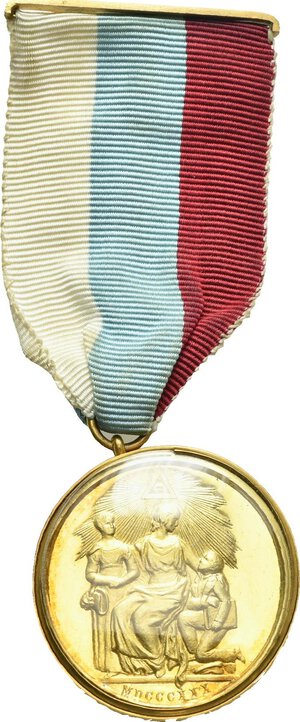
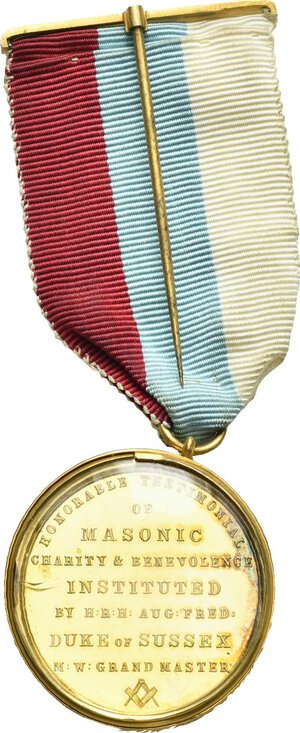
A Masonic Charity and Benevolence Medal with Original Ribbon, 19th Century - 20th Century (37.75 mm, 31.50 g).
A finely preserved Masonic testimonial medal struck in gilt bronze, suspended from its original tricolour ribbon in white, pale blue and crimson. The obverse depicts an allegorical scene of Charity seated, flanked by two attendants in classical drapery, all beneath a radiant All-Seeing Eye within a triangle. The date MDCCCXXX (1830) appears below.
The reverse is inscribed:
“HONORABLE TESTIMONIAL
OF
MASONIC
CHARITY & BENEVOLENCE
INSTITUTED
BY H.R.H. AUGt FRED.
DUKE OF SUSSEX
M.W. GRAND MASTER”
with the Masonic Square and Compasses emblem at the base. Fitted with a straight-bar suspension and long pin to the reverse.
Condition: Extremely fine; minor toning to gilt, ribbon lightly handled but well preserved, details crisp and clear. A distinguished 19th-century Masonic award, issued under Prince Augustus Frederick, Duke of Sussex, one of the most influential Grand Masters of the United Grand Lodge of England. Rare in this state and with its original ribbon.
Lot # 283
-
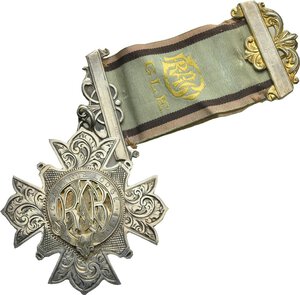
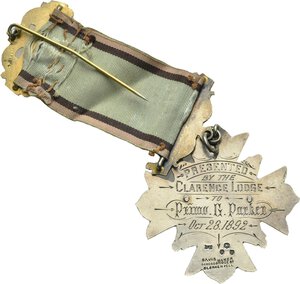
Clarence Lodge – Presentation Jewel (57.50 mm, 27.25 g).
Presented 28 December 1892**
Maker: Davis, Birmingham
Material: Sterling Silver; original riband
A finely executed late Victorian Masonic presentation jewel, issued by Clarence Lodge and formally presented on 28 December 1892 to Bro. Henry M. Parker. The jewel is of star form, richly engraved throughout with crisp foliate scrollwork and centred with the intertwined lodge initials C.L. within a circular cartouche.
The jewel is suspended from its original pale green riband with brown and buff edge stripes, bearing the gilt embroidered letters C.L.E. and mounted with period silver bars and fittings. The reverse is fully engraved with the original presentation inscription:
“Presented by the Clarence Lodge
to
Henry M. Parker
Dec. 28. 1892”
Below, the maker’s mark DAVIS MAKER / BIRMINGHAM is clearly stamped, confirming manufacture in the final decade of the 19th century.
Condition: Very Fine. Silver bright with light, even patina; engraving sharp and legible throughout; riband original and intact with expected age wear and small period repairs; fittings complete and functional. A well-preserved and attractive Victorian lodge presentation jewel.
Lot # 282
-
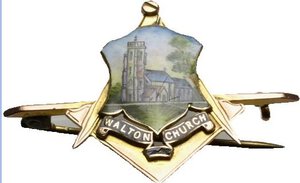
Walton Church – Pictorial Brooch / Badge (Gold, 44.30 x 31.23 mm, 5.60 g).
In a burgundy leather fitted box, gilt-tooled to lid. 1890-1915.
A charming gold and enamel Walton Church brooch, of diamond form with star-point terminals, centred by a shield-shaped cartouche finely decorated with a painted view of a church and grounds. Beneath the scene, a black enamel ribbon scroll reads:
WALTON CHURCH
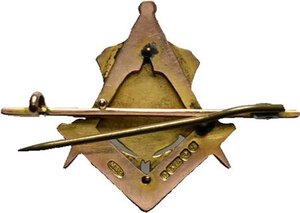
The piece is designed as a horizontal bar-brooch, with the decorative badge mounted centrally and the pin extending across the full width, giving a smart, wearable presentation.
Reverse: The reverse retains its original bar-brooch fitting with hinged pin and catch. A set of small stamp marks / hallmarks is visible to the lower right area (as shown in the photo).
Condition: Very good. Enamel/painted centre well preserved with light age wear; gold with minor surface marks; fittings secure. Box with expected handling wear.
Lot # 281
-
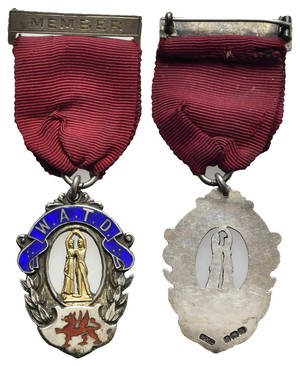
Workers’ Amalgamated Temperance & Dispensary Society (W.A.T.D.), Silver Member’s Jewel, c. 1890–1910 (29.34 mm, 13.57 g).
A scarce sterling silver and enamel membership jewel of the W.A.T.D. (Workers’ Amalgamated Temperance & Dispensary Society), featuring two allegorical robed figures of Temperance in gilt relief on a white enamel ground, framed by laurel branches and surmounted by a blue enamel scroll bearing the initials W.A.T.D.. The lower portion displays a red Welsh dragon, indicating issue for a Welsh branch of the society.
Suspended from the original maroon ribbon and a silver bar inscribed MEMBER. The reverse stamped with full British silver hallmarks and maker’s mark.
Condition: Very Fine; light wear; enamel complete; ribbon worn but original.
A rare survival from a now-defunct temperance friendly society.
Lot # 280
-
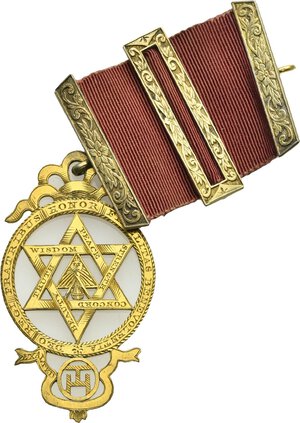
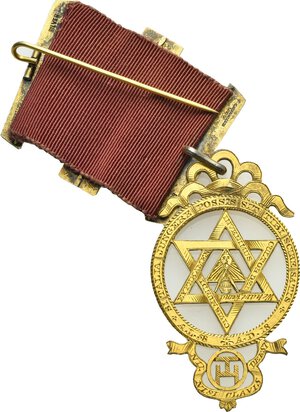
Royal Arch Masonry – Companion’s Jewel, England, c. 1890–1910 (37.15 x 65.83 mm, 27.27 g).
A finely executed Royal Arch Masonic Companion’s jewel, of circular form, suspended from its original deep crimson ribbed silk ribbon, mounted with an ornate pierced and engraved gilt suspension bar and long pin fitting. The quality of manufacture and ribbon construction is characteristic of late Victorian to early Edwardian English Masonic regalia.
The obverse displays a well-modelled hexagram enclosing the principal Royal Arch symbols, including the Triple Tau, together with surrounding inscriptions referring to the core virtues of the Order. The design retains good definition, with the original translucent enamel centre and gilt surfaces showing pleasing age toning. The upper mount is of decorative scroll form, consistent with higher-quality pre–First World War production.
The reverse is plain gilt metal, retaining the original suspension fittings and construction, as issued. Overall, a correct and attractive example of an English Holy Royal Arch Companion’s jewel from the turn of the 20th century.
Condition: Very Fine. Light wear consistent with age; enamel intact; ribbon original and sound; suspension and pin secure.
Lot # 279
-
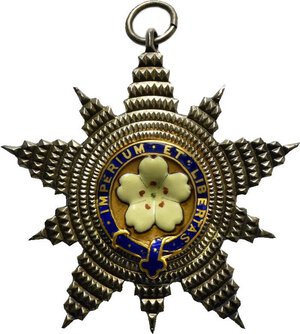
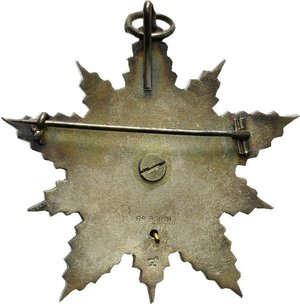
Primrose League – “Honourable Order of the Grand Star” (Second Grade) Decoration, Rd. 98330 (c. 1888 design registration) (59.60 mm, 28.83 g). Maker: W. O. Lewis (Badges) Ltd., Birmingham (fitted case by W. O. Lewis, Birmingham). 
Silvered/white metal star with gilt and blue enamel strap; yellow enamel primrose centre.
A bold and impressive Victorian-period Primrose League Grand Star decoration, formed as a large, faceted eight-point star. The centre carries a gilt garter strap inlaid with deep blue enamel, lettered with the Primrose League motto:
IMPERIUM ET LIBERTAS
(“Empire and Liberty”). 
Within the strap is the characteristic primrose emblem in pale yellow enamel.
The reverse retains its original brooch pin fitting and shows the Registered Design number Rd 98330 (struck to the field). This registration number dates the design to 1888 (earliest possible production date). 
Condition: Good. Enamel generally intact; primrose centre with visible age spotting; star surface with expected wear and patina; fittings complete. Housed in a black leather fitted case by W. O. Lewis, Birmingham.
Lot # 278
-
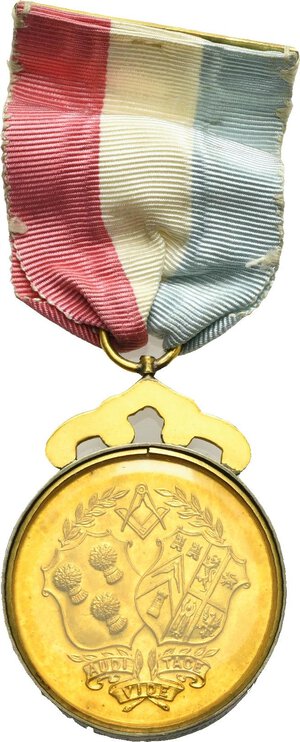
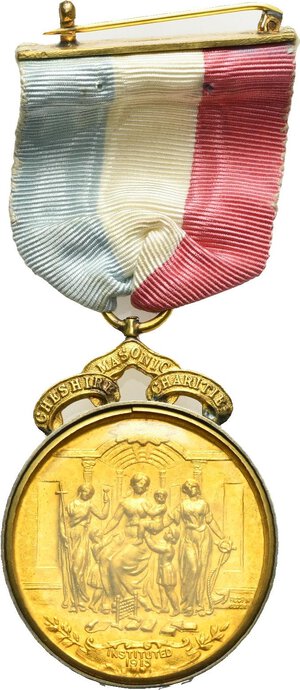
Cheshire Masonic Charity – Medal, Instituted 1813 (Late 19th–Early 20th Century) (39.25 mm, 43.75 g).
Maker: Unmarked (typical provincial die-struck medal)
Material: Gilt bronze; original tricolour ribbon
Period: c. 1880s–1920s
A handsome and historically significant Cheshire Masonic Charity Medal, suspended from its original red–white–blue moiré ribbon and featuring attractive gilt surfaces. This type of medal was presented in recognition of contributions to Cheshire’s Masonic charitable institutions, whose origins date back to the early 19th century.
Obverse
The obverse displays a detailed arrangement of symbolic devices:
Square and compasses within a laurel wreath
The heraldic shield of the County of Cheshire, incorporating three wheatsheaves
A second shield with Masonic and civic charges
A scroll beneath bearing the Latin motto:
AUXILIO TACE VIDET
The engraving and relief work are crisp, characteristic of the high-quality die-striking typical of provincial regalia makers of the era.
Reverse
The reverse features an allegorical classical scene representing Charity: a central robed figure seated with children, flanked by attendant figures holding symbolic objects. At the base appears the inscription:
INSTITUTED 1813
Above the medal, the suspension mount forms an arched gilt header reading:
CHESHIRE MASONIC CHARITY
The heavy gauge and deeply modelled relief emphasize the prestige associated with these medals.
Ribbon
The original tricolour ribbon remains attached, showing honest age but retaining good structural integrity.
Condition: Fine to Very Fine. Ribbon with wear but sound; gilt surfaces with gentle age toning; relief detail sharp; minor contact marks consistent with age; suspension original and functional.
A visually impressive and historically meaningful Cheshire Masonic Charity medal, valued for its classical allegory, county heraldry, and original ribbon. A desirable addition for collectors of provincial Masonic awards and charitable medals.
Results from 7301 to 7350 of 26088